



“The vision of Isaiah the son of Amoz concerning Judah and Jerusalem, which he saw during the reigns of Uzziah, Jotham, Ahaz and Hezekiah, kings of Judah.”
Isaiah 1:1 NASB1995
After a wonderful journey through the Epistle of Ephesians, I have decided to turn my attention to the book of Isaiah in the Old Testament. This will be the third book of prophecy in my amateur Bible studies, the other two being Daniel and Jonah. Daniel was extremely challenging with its strange visions; I expect Isaiah to be even more challenging, due to its intricate prophecies and the length of the book. My approach will rely on conservative, literal interpretation and commentary as much as possible.
So, the obvious first question would be who was Isaiah? I like this commentary from Enduring Word that gives us some good background on this major prophet:
a. The vision of Isaiah: This book contains the prophecies of Isaiah, the son of Amoz, who ministered from about 740 to 680 B.C. For about 20 years, he spoke to both the northern kingdom of Israel and the southern kingdom of Judah. After Israel’s fall to the Assyrians in 722 B.C., Isaiah continued to prophesy to Judah.
i. This period of Israel’s history is told in 2 Kings 15-21 and 2 Chronicles 26-33. Isaiah was a contemporary of the prophets Hosea and Micah. By the time of Isaiah, the prophets Elijah, Elisha, Obadiah, Joel, Jonah, and Amos had already completed their ministry.
ii. By this time, Israel had been in the Promised Land for almost 700 years. For their first 400 years in Canaan, judges ruled Israel. These were spiritual, military, and political leaders whom God raised up as the occasion demanded. Then, for about 120 years, three kings reigned over all Israel: Saul, David, and Solomon. But in 917 B.C. Israel had a civil war and remained divided into two nations, Israel (to the north) and Judah (to the south) up until the time of Isaiah.
iii. Up until the time of Isaiah, the kingdom of Israel – the northern ten tribes – had some 18 kings, all of them bad and rebellious against the LORD. The kingdom of Judah – the two southern tribes – had some 11 kings before Isaiah’s ministry, some good and some bad.
iv. In the time of Isaiah, Israel was a little nation often caught in the middle of the wars between three superpowers: Egypt, Assyria, and Babylon.
v. As Isaiah’s ministry began, there was a national crisis in the northern kingdom of Israel. The superpower of Assyria was about to overwhelm the kingdom of Israel. During the span of Isaiah’s ministry as a prophet, the southern kingdom of Judah was faced with repeated threats from the larger surrounding nations.
vi. Many modern scholars think that there was more than one author to the book of Isaiah. They use terms like “Deutero-Isaiah” and “Trito-Isaiah” or the “Isaianic School.” Sometimes more than one author is supposed for the book of Isaiah because of changes of style and tone, and sometimes as a denial of Isaiah as predictive prophecy.
vii. However, the New Testament indicates that there was only one author of Isaiah. In John 12:37-41, John quotes from both the “first” part of Isaiah and the “second” part of Isaiah – the parts supposedly written by two or more different Isaiahs – and John specifically tells us it was the same Isaiah. The New Testament quotes Isaiah by name more than all the other prophetic authors combined.
viii. The book of Isaiah is filled with many wonderful prophecies of the Messiah, telling us about the person and work of Jesus Christ some seven hundred years before Jesus was born in Bethlehem. For this reason, sometimes Isaiah is called “The Fifth Gospel.”
b. Isaiah, son of Amoz: The name Isaiah means Salvation is of the LORD. There are at least seven men by the name of Isaiah in the Bible, but only one is Isaiah, the son of Amoz.
i. Some have thought that Amoz and the prophet Amos were the same person, but this seems unlikely. Some ancient Jewish traditions say that Amoz was a brother of king Amaziah, but there is no biblical way to prove this.
ii. We know more about Isaiah than we do about many other of the prophets. Isaiah was married and was the father of at least two sons (Isaiah 7:3 and 8:3). He lived in Jerusalem (Isaiah 7:3, 22:1, 37:2, 38:5, and 39:3).
iii. There is “a strong Judeo-Christian tradition that holds that Isaiah also outlived Hezekiah and was sawn asunder by his successor Manasseh with a wooden saw after the prophet had hidden himself in a hollow tree from the angry king.” (Bultema) Many think Hebrews 11:37 (they were sawn in two) is a reference to the martyrdom of Isaiah.
iv. Most of all, Isaiah was a great man of God. Isaiah “has the courage of a Daniel, the sensitivity of a Jeremiah, the pathos of a Hosea, and the raging anger of an Amos; and moreover he leaves all of them far behind in the unique art of holy mockery. His courage is of such a nature that he never, not even for a moment, shows himself to be weak or timid.” (Bultema)
c. In the days of: The prophecy of this chapter probably took place in the time of Ahaz, king of Judah (2 Kings 16 and 2 Chronicles 28). Ahaz was an evil king, and in his reign Judah was invaded many times by surrounding nations.
A few key takeaways:
Isaiah was a contemporary of Hosea and Micah and was a great man of God.
Isaiah ministered from about 740 to 680 B.C.
Elijah, Elisha, Obadiah, Jonah, Joel and Amos had completed their ministries prior to the life of Isaiah.
Isaiah was married and had at least two sons and lived in Jerusalem.
He ministers to both the northern kingdom (Israel) and the southern kingdom (Judah); his ministry started after the civil war that split the 12 tribes into 10 northern tribes and 2 southern tribes. He continued to prophesy to Judah after Israel was taken by the kingdom of Assyria.
Modern scholars think there was more than one author of Isaiah. This conjecture is likely used to downplay the prophecies that point to Jesus, just like how the prophecies of Daniel were dismissed by trying to force the writing into a later timeline.
The New Testament affirms that there was one author of Isaiah and both parts of Isaiah are quoted in the Gospels and other books in the NT.
Isaiah is filled with wonderful prophecies of the Messiah and it is sometimes called the “Fifth Gospel”.
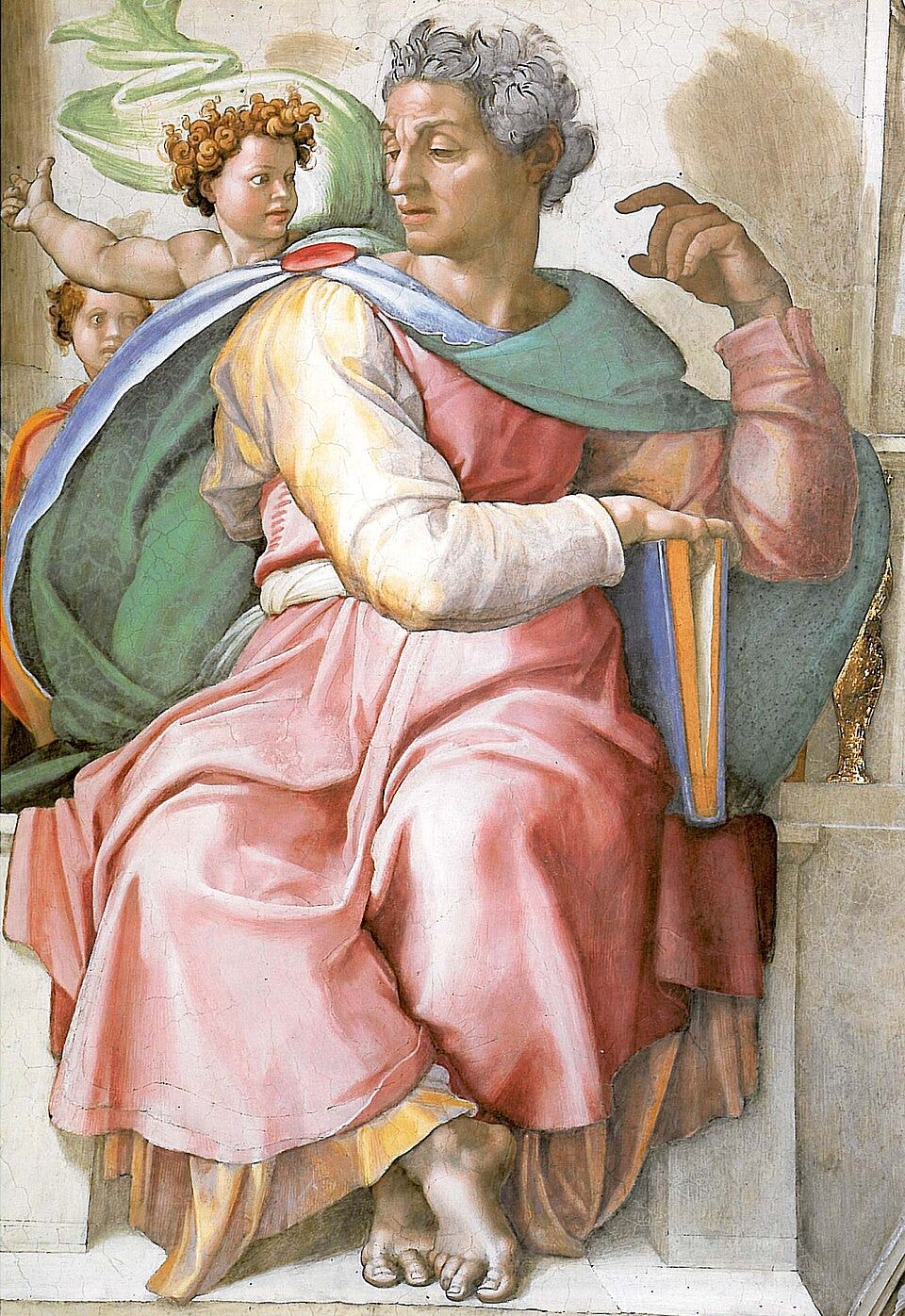
This is the painting of Isaiah that was done by Michelangelo on the Sistine Chapel ceiling between 1508 and 1512:
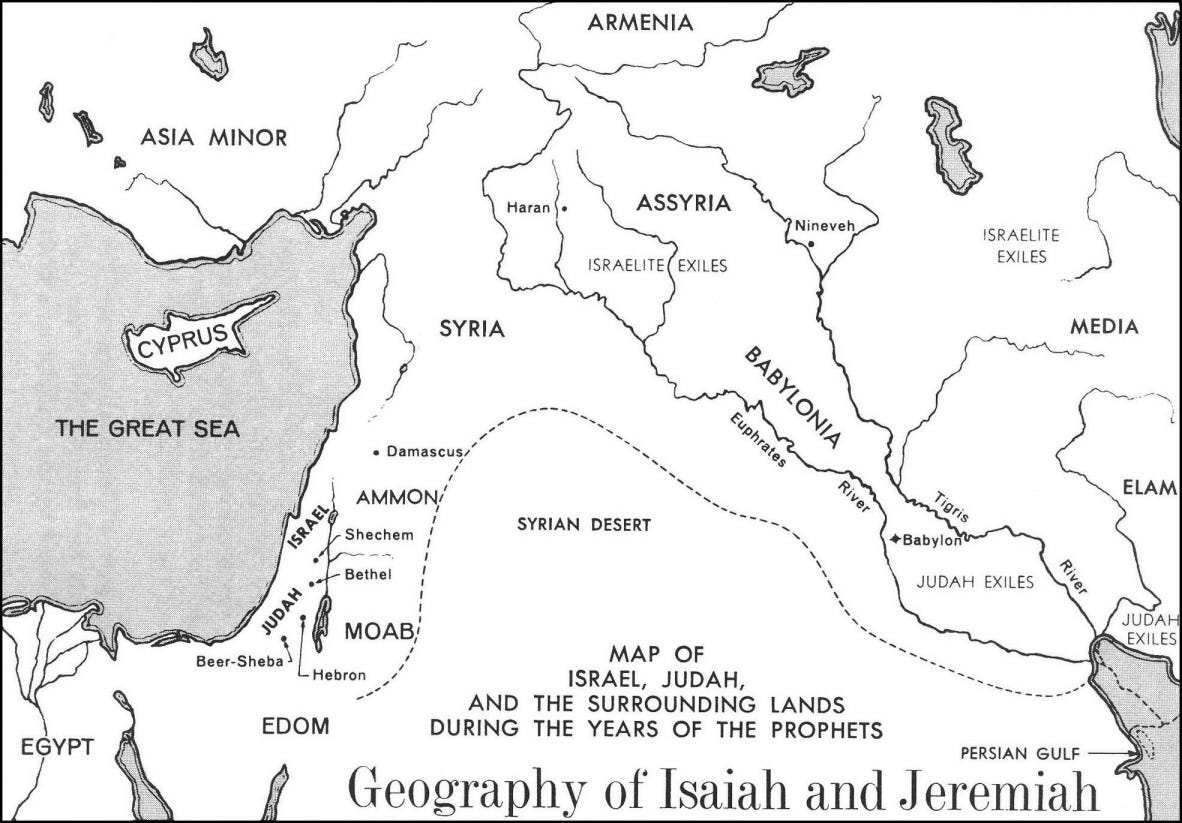
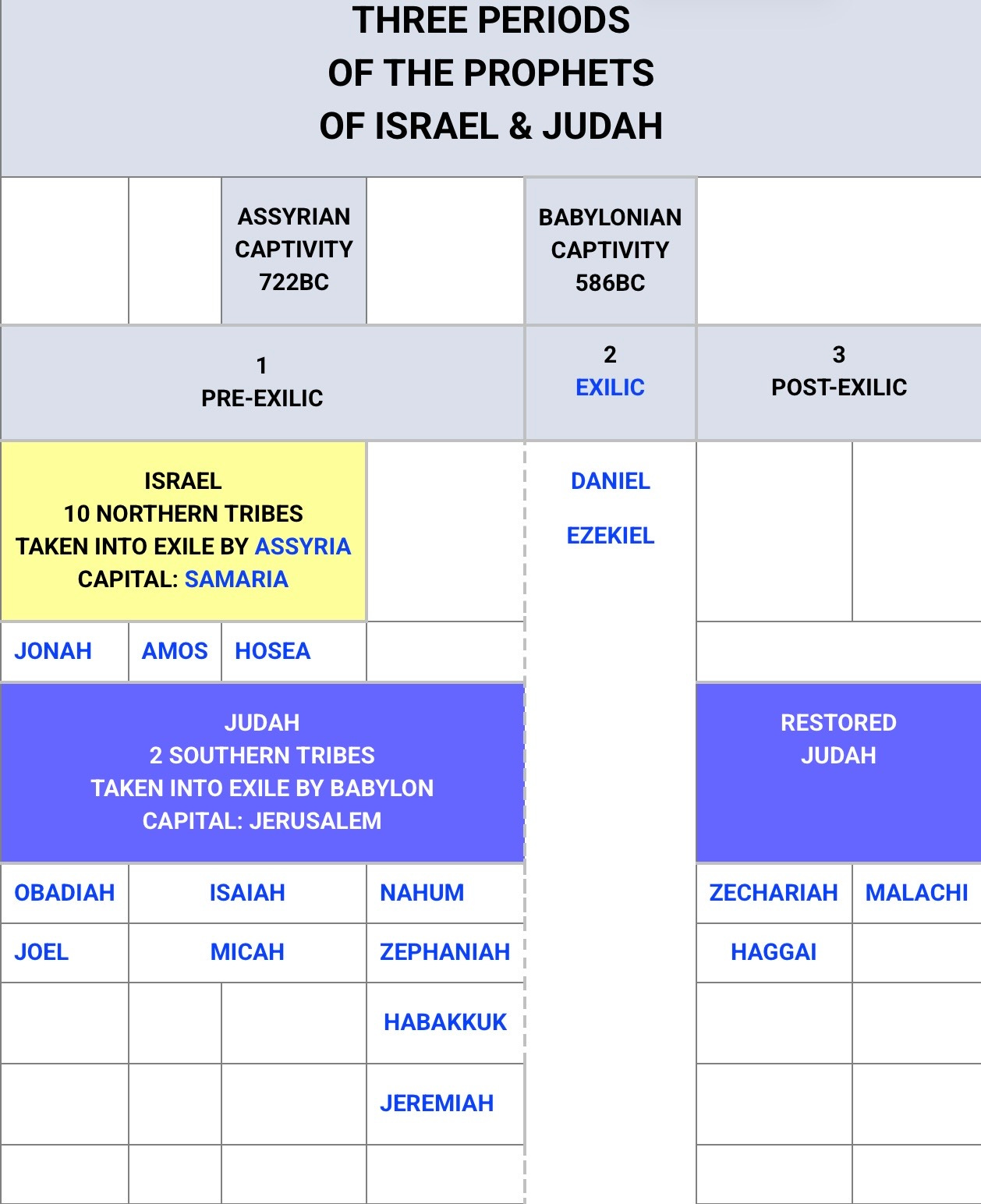
The map above was found in Precept Austin showing the lands of the Middle East during the years of Isaiah, followed by Jeremiah and then the subsequent years when Israelite exiles were in Assyria and Judah exiles were in Babylon.
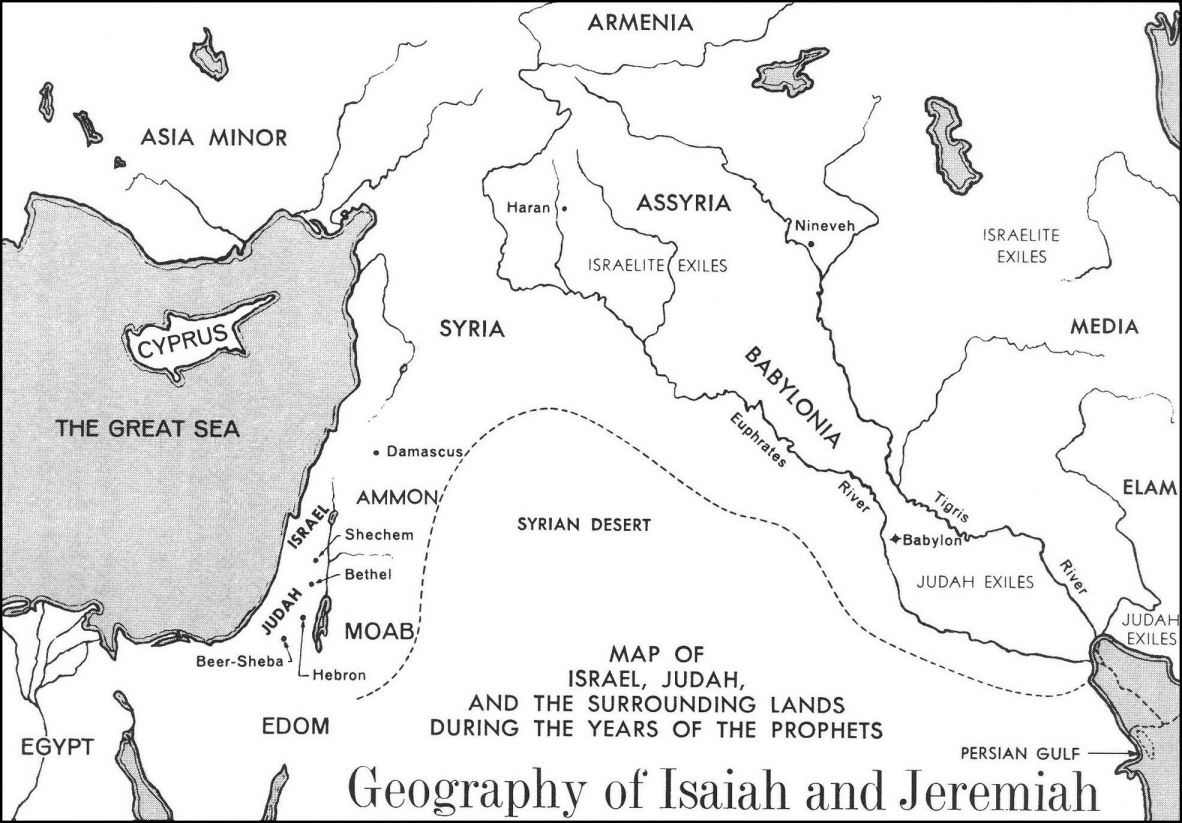
This table, also found in Precept Austin, is a handy graphic on the timelines for these prophets:
Ray Stedman has a lovely introduction to Isaiah, as quoted in Precept Austin:
Any time we approach a new book, we always want to look for a key. I am afraid, however, that this is sometimes a rather weak approach. Sometimes these Bible books seem like locked houses, barred and shuttered, so that you can’t get anything out of them unless you find the key. And some people feel that the only duly-licensed real estate agents are the Bible teachers, who alone have the keys to the Scripture’s “real estate.”
But scriptural books are not like that. They are more like national parks. They are open to everyone to roam in, and are a delight to explore all by yourself. But each park has a characteristic peculiar to itself that distinguishes it from the others; and you appreciate a park better if you know what that characteristic is. I have learned to appreciate some of the distinct characteristics of the great national parks in the West. For instance, if you want to see nature’s various moods, go to Yellowstone Park. There she pulls all the tricks out of her bag and throws everything together. If you want to see mountain grandeur and cool lakes, Glacier Park in Montana is the place to go. If you want to be awed and humbled and stirred, then go to the Grand Canyon. If you are looking for a quiet valley in which to rest and reflect, Yosemite fills the bill -- that is, any time other than midsummer, when some twenty thousand people are in the valley with you.
Sometimes I think of these books of the Bible like this. The book of Revelation is to me very much like Yellowstone National Park. It is full of spouting geysers and all kinds of weird symbolism and a variety of formations. The Gospel of John is more like Yosemite; quiet and deep and reverent. But there is no question that the book of Isaiah is the Grand Canyon of scripture. Geologists tell us that the Grand Canyon is a miniature history of the earth -- a condensed history, a pocket volume of the past -- just so, the book of Isaiah has long been recognized as a miniature Bible…
Visitors to the Grand Canyon are always astonished by one thing when they go there. They stand at the rim and look out over the vast. jumbled, silent canyon -- down to the Colorado River, which seems but a silver thread more than a mile below them -- and sooner or later some tourist cries in amazement, “I don’t understand how a tiny thing like that river could have carved a canyon like this!” They are amazed by that concept.
Now if you read the book of Isaiah thoughtfully and carefully, you sense immediately the grandeur and the power of God. You hear the powerful, rolling cadences of this book’s language. You sense the insignificance of man when compared with the might and the wisdom and majesty of God. And if you ask yourself, “How could Isaiah, just a human being like myself, write a book like this?” to answer seems impossible…
Now if any key is needed to this book, this is it. Isaiah was a man who was searching for something. Peter says he was searching after the salvation that was to come from God. And the interesting thing is that the name “Isaiah” means “The salvation of Jehovah.”
I love the comparison of books of the Bible to the wonders found in our beautiful National Parks. We as believers are invited to enter these books and behold their wonders, just like the beautiful creation that God bestowed on this Earth. The comparison of Isaiah to the Grand Canyon is so apt:
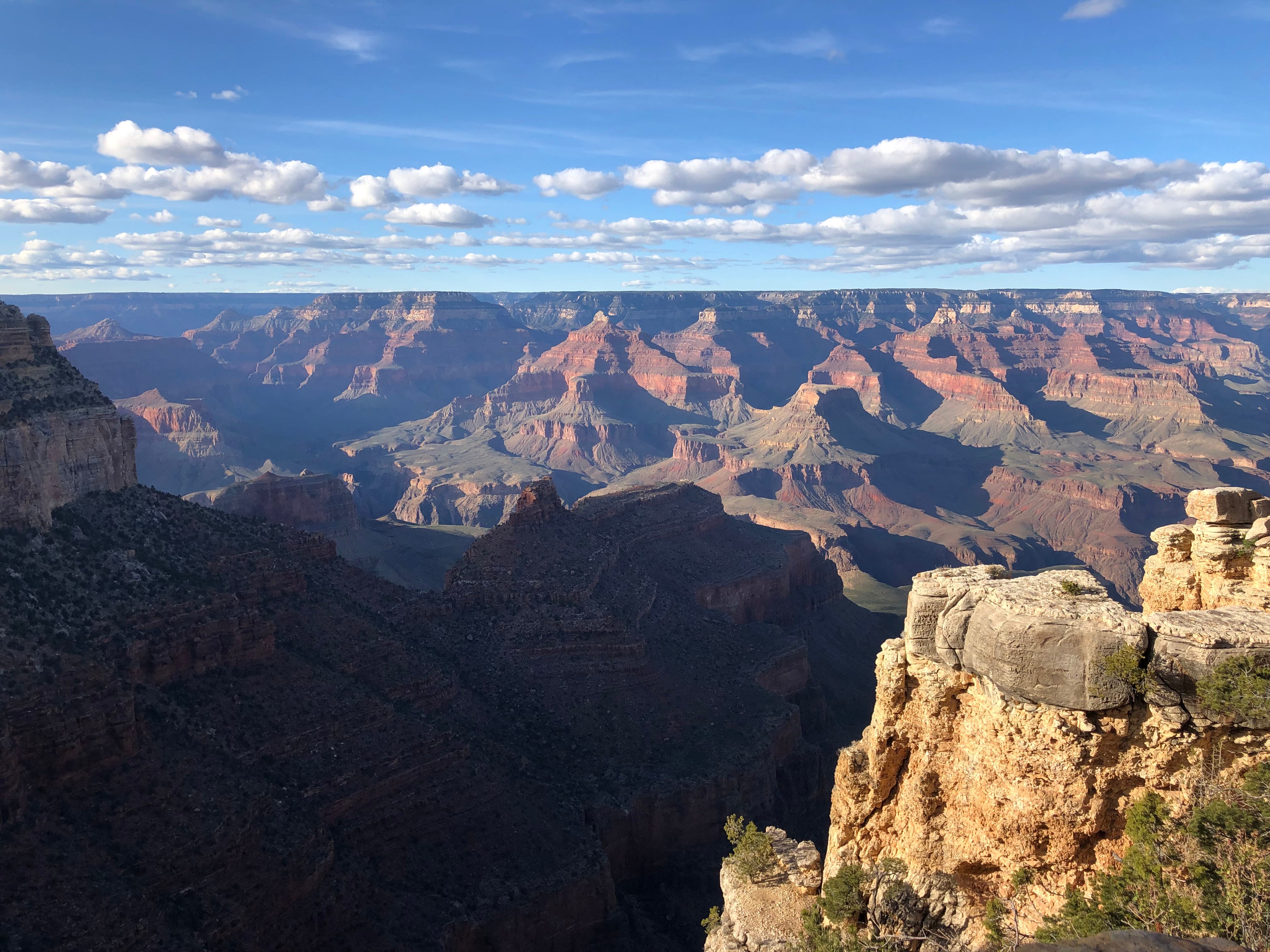
Let’s go exploring the shadows, the depths and the layers of the book of Isaiah together! My next devotional examines Isaiah 1:2-4 - The Lord’s indictment of Judah and Jerusalem.
Heaven on Wheels Daily Prayer:
Dear Lord - Please guide my studies and approach to Isaiah to honor You above all things, as You are the inspiration for men like Isaiah. Amen.
Citations and Credits:
Scripture quotations taken from the (NASB®) New American Standard Bible®, Copyright © 1960, 1971, 1977, 1995 by The Lockman Foundation. Used by permission. All rights reserved. www.Lockman.org.
Precept Austin was accessed on 07/13/2026 to review commentary for Isaiah 1:1. The full sermon by Ray Stedman can be found at this link.
Commentary from Enduring Word is used with written permission and without any alteration. ©1996-present The Enduring Word Bible Commentary by David Guzik – enduringword.com. Within the Enduring Word commentary:
Bultema, Harry Commentary on Isaiah (Grand Rapids, Michigan: Kregel Publications, 1981)