


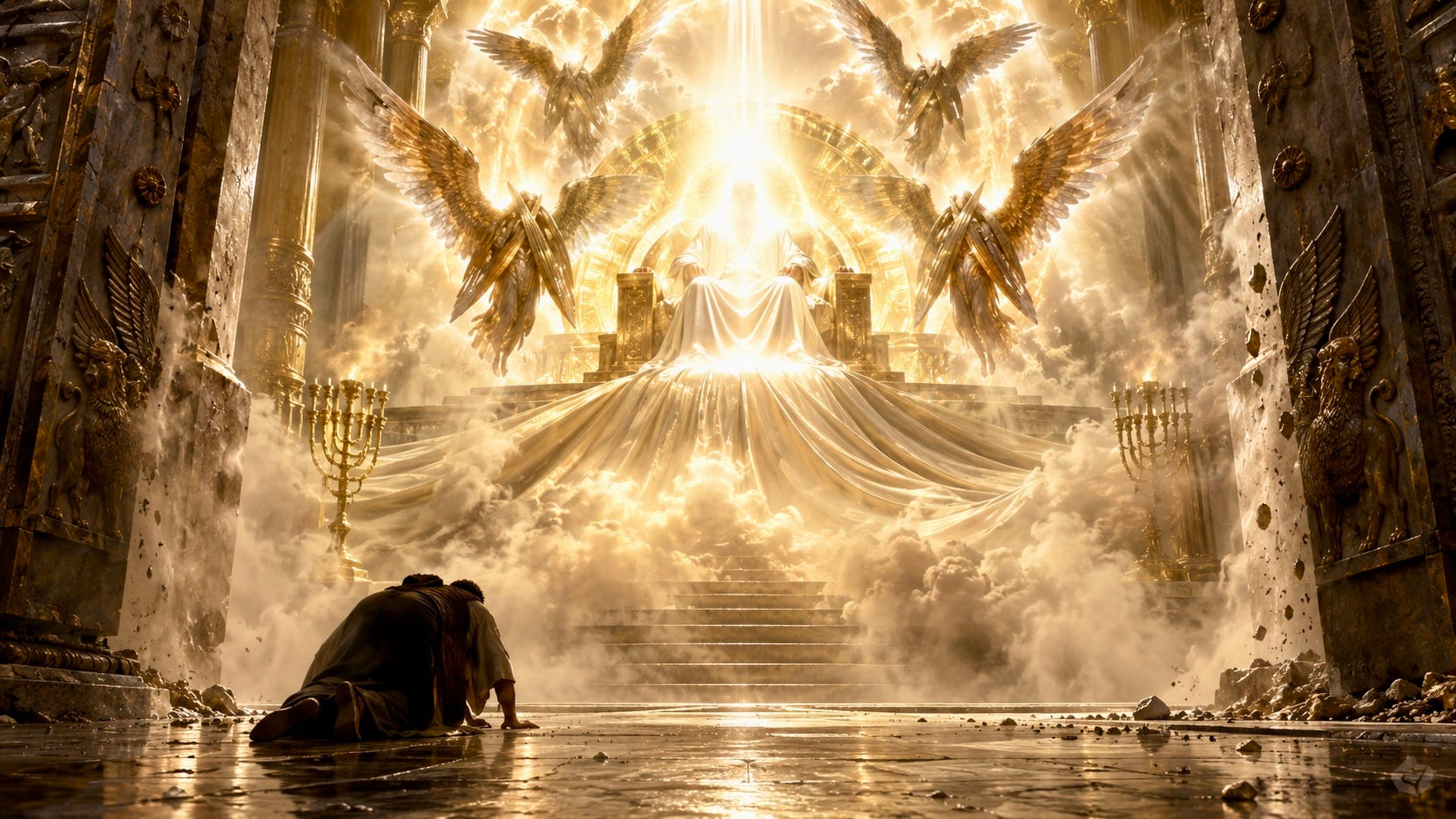
“In the year of King Uzziah’s death I saw the Lord sitting on a throne, lofty and exalted, with the train of His robe filling the temple. Seraphim stood above Him, each having six wings: with two he covered his face, and with two he covered his feet, and with two he flew. And one called out to another and said,
“Holy, Holy, Holy, is the Lord of hosts,
The whole earth is full of His glory.”
And the foundations of the thresholds trembled at the voice of him who called out, while the temple was filling with smoke.”
Isaiah 6:1-4 NASB1995
At the end of my last devotional, I said that I would do verses 1 & 2 in this devotional, but then I felt like verses 3 & 4 also belonged in the devotional once I started researching it.
Isaiah 6 starts with an amazing vision. Isaiah, in the year of King Uzziah’s death, sees the Lord sitting on a throne with the train of His robe filling the temple. The Lord is surrounded by seraphim, singing “Holy, Holy, Holy is the Lord of hosts”. I think the AI image at the top is rather good and includes Isaiah in terror on the floor of the heavenly temple.
Biblical scholars are divided about this vision. Some believe that this was the inaugural vision for the prophecies of Isaiah (which means the first five chapters are out of sequence), while others feel that the first five chapters were an earlier vision and this is a new commission. Whatever the case, this fixes this event on a timeline in history. Here’s a timeline from Precept Austin showing the events (this timeline supports the opinion that this is the first vision for Isaiah):
790 - Uzziah (790-739BC) becomes king of Judah, reigns 52 years
759 - Jotham becomes king of Judah assuming reign when Uzziah becomes leprous
742 - Micah begins his prophetic ministry (cp ministry to Hezekiah Jer 26:18, 19, Mic 3:12)
739 - Isaiah begins prophetic ministry in year King Uzziah died (Isa 6:1f)
731 - Ahaz becomes king of Judah (2Ki 15:38, 16:1, 2Chr 28:1)
726 - Hezekiah becomes 12th king of Judah (2Ki 16:20, 18:1,2) and one of 3 best (2Ki 18:5)
722 - Shalmaneser (2Ki 17:3, 18:9) dies while besieging Samaria, Sargon seizes crown
722 - Sargon of Assyria (Sargon) (Is 20:1) conquers Samaria (2Ki 17:6, 18:9, 10, 11, 12)
701 - Sennacherib (son of Sargon) of Assyria lays siege to Jerusalem
695 - Manasseh becomes king of Judah (2Ki 21:1, 2, 3, 4, 5, 6, 7, 8, 9, 10, 11, 12)
627 - Jeremiah begins prophetic ministry
586 - Nebuchadnezzar of Babylon conquers Judah
(Source: The Ryrie Study Bible: New American Standard Translation: 1995. Moody Publishers) Note that most of these dates are approximations and not indisputable facts. They are listed to help give the reader have a general idea of the relationship of historical events in Isaiah’s time.
The best commentary that I found on these first four verses is in Enduring Word so let’s take a look at that:
a. In the year that King Uzziah died: King Uzziah of Judah had a long and distinguished reign, described in 2 Chronicles 26 and in 2 Kings 15:1-7 (Uzziah is called Azariah in 2 Kings 15).
i. Uzziah began his reign when he was only 16 years old, and he reigned 52 years. Overall, he was a good king, and 2 Kings 15:3 says, he did what was right in the sight of the LORD, according to all that his father Amaziah had done. 2 Chronicles 26:5says, He sought God in the days of Zechariah, who had understanding in the visions of God; and as long as he sought the LORD, God made him prosper.
ii. Uzziah also led Israel in military victories over the Philistines and other neighboring nations, and he was a strong king. Uzziah was an energetic builder, planner, and general. 2 Chronicles 26:8 says of Uzziah, His fame spread as far as the entrance of Egypt, for he became exceedingly strong.
iii. But Uzziah’s life ended tragically. 2 Chronicles 26:16 says, but when he was strong his heart was lifted up, to his destruction, for he transgressed against the LORD his God by entering the temple of the LORD to burn incense on the altar of incense. In response, God struck Uzziah with leprosy, and he was an isolated leper until his death.
iv. So, to say in the year King Uzziah died is to say a lot. It is to say, “In the year a great and wise king died.” But it is also to say, “In the year a great and wise king who had a tragic end died.” Isaiah had great reason to be discouraged and disillusioned at the death of King Uzziah, because a great king had passed away, and because his life ended tragically. Where was the LORD in all this?
b. I saw the LORD sitting on a throne: Where was the LORD in all this? The LORD was sitting on a throne! God was still enthroned in heaven and was still in charge of all creation.
i. There is a throne in heaven, and the LORD God sits upon it as the sovereign ruler of the universe! This is the central fact of heaven; that there is an occupied throne in heaven. God does not sit on a chair in heaven. Anyone might sit on a chair. But sovereign kings sit on thrones. Judges sit on thrones. Those with proper authority and sovereignty sit on thrones.
ii. Isaiah was not alone in seeing God’s throne. Almost everyone in the Bible who had a vision of heaven, was taken to heaven, or wrote about heaven spoke of God’s throne.
·The prophet Michaiah saw God’s throne (1 Kings 22:19).
·Job saw God’s throne (Job 26:9).
·The Sons of Korah saw God’s throne (Psalm 45:6, 47:8).
·Ethan the Ezrahite saw God’s throne (Psalm 89:14).
·Jeremiah saw God’s throne (Lamentations 5:19)
Ezekiel saw God’s throne (Ezekiel 1:26, 10:1).
Daniel saw God’s throne (Daniel 7:9).
The Apostle John saw God’s throne (Revelation 4:1-11). In fact, the book of Revelation may as well be called “the book of God’s throne,” because God’s throne is specifically mentioned more than 35 times in that book.
iii. The core belief of atheism or materialism is that there is no throne; there is no seat of authority or power all the universe must answer to. The core belief of humanism is that there is a throne – but man sits upon it. But the Bible makes it clear that there is a throne in heaven, and no fallen man sits on the throne, but the Lord GOD is enthroned in heaven.
iv. Isaiah may have been depressed or discouraged because a great leader of Judah was no longer on the throne. God in heaven now shows Isaiah, “Don’t worry about it, Isaiah. Uzziah may not be on his throne, but I am on My throne.”
c. High and lifted up: The throne was exalted and majestic. The throne set its Occupant in a superior position.
d. The train of His robe filled the temple: Kings of that time would wear robes with long trains because they were difficult to maneuver and work in. Wearing a long train meant, “I am important enough that I don’t have to work. I am a person of honor and dignity. Others must serve me and wait upon me.” Essentially, the same is said when a bride wears a dress with a long train today.
i. God is so honored, so important, so dignified, that the train of His robe filled the temple. That’s a long train.
e. Above it stood seraphim: Surrounding the throne of God are angels known here as seraphim. In many other passages, these angels are known as cherubim (Psalm 80:1; Isaiah 37:16; Ezekiel 10:3) or as the living creatures of Revelation 4:6-11. This is the only chapter in the Bible where these creatures are named seraphim.
i. Some deny that cherubim and seraphim refer to the same beings. But the name seraphim means, “burning ones.” Ezekiel 1:13 describes cherubim (see also Ezekiel 10:15) this way: their appearance was like burning coals of fire, like the appearance of torches going back and forth among the living creatures. The fire was bright, and out of the fire went lightning. That certainly seems to describe burning ones.
f. Each one had six wings: In Revelation 4:8, the Apostle John also mentions their six wings. They need the six wings, so each can cover his face (to show they are too lowly to look upon the LORD), so each can cover his feet (to hide this “humble” area of the body, so nothing even possibly deficient is seen in the LORD’s presence), and so each can fly.
i. The LORD said to Moses, “You cannot see My face; for no man shall see Me, and live” (Exodus 33:20). Apparently, the same is true even for angels, so the seraphim cover their faces.
ii. “The two wings with which the angels fly mean nothing else than their ready and cheerful performance of the commandments of God…. The two wings with which they cover their face show plainly enough that even angels cannot endure God’s brightness, and that they are dazzled by it in the same manner as when we attempt to gaze upon the radiance of the sun.” (Calvin)
iii. “For the seraph remembers that even though sinless he is yet a creature, and therefore he conceals himself in token of his nothingness and unworthiness in the presence of the thrice Holy One.” (Spurgeon)
g. Each one had six wings: with two he covered his face, with two he covered his feet, and with two he flew: The seraphim used four of their wings to express their humility and used two of their wings to express their willingness and ability to serve God. This is the proper balance.
i. “Thus they have four wings for adoration and two for active energy; four to conceal themselves, and two with which to occupy themselves in service; and we may learn from them that we shall serve God best when we are most deeply reverend and humbled in his presence. Veneration must be in larger proportion than vigor, adoration must exceed activity. As Mary at Jesus’ feet was preferred to Martha and her much serving, so must sacred reverence take the first place, and energetic service follow in due course.” (Spurgeon)
…
a. One cried to another and said: The seraphim are not even directly addressing the LORD God here. They are proclaiming His glorious nature and character to one another, in the presence of the LORD.
b. Holy, holy, holy is the LORD of hosts: Why do they repeat “holy” three times? Wasn’t it enough to simply say that the LORD was “holy” once? It wasn’t enough. They say it three times because there are Three Persons in the One God.
i. Calvin didn’t think that this was the best verse to prove the Trinity, but he still saw the truth of the Trinity here. “The ancients quoted this passage when they wished to prove that there are three persons in one essence of the Godhead…. I have no doubt that the angels here describe One God in Three Persons.”
c. Holy, holy, holy is the LORD of hosts: Why do they repeat “holy” three times? Wasn’t it enough to simply say that the LORD was “holy” once? It wasn’t enough. In the Hebrew language, intensity is communicated by repetition. To say the LORD is holy says something. To say the LORD is holy, holy, says far more. To say, holy, holy, holy is the LORD is to declare His holiness in the highest possible degree.
i. What does it mean that God is holy, and holy in the highest possible sense? Holiness, at its root, has the idea of apartness. It describes someone, or something, which is set apart from other people or things. An object can be holy if it is set apart for sacred service. A person is holy if they are set apart for God’s will and purpose.
ii. What is the LORD set apart from? He is set apart from creation, in that the Lord GOD is not a creature, and He exists outside of all creation. If all creation were to dissolve, the Lord GOD would remain. He is set apart from humanity, in that His “nature” or “essence” is Divine, not human. God is not a super-man or the ultimate man. God is not merely smarter than any man, stronger than any man, older than any man, or better than any man. You can’t measure God on man’s chart at all. He is Divine, and we are human.
iii. Yet, because we are made in the image of God (Genesis 1:26-27), humanity is compatible with Divinity. They are different, but they do not automatically oppose each other. This is how Jesus, the Second Person of the Trinity, could add humanity to His deity when He became a man. Unfallen humanity is not deity, but it is compatible with it.
iv. God’s holiness is a part of everything He is and does. God’s power is a holy power. God’s love is a holy love. God’s wisdom is a holy wisdom. Holiness is not an aspect of God’s personality; it is one characteristic of His entire Being.
d. The whole earth is full of His glory: The seraphim surrounding the throne of God could see this probably more clearly than Isaiah could. We are often blind to the obvious glory of God all around us.
e. The posts of the door were shaken by the voice of him who cried out: The seraphim are majestic beings, and their voice carries weight. When they speak, the doorposts of God’s throne room shake! The idea may be that Isaiah was watching from the doorway, and when the seraphim cried out, he could feel the doorposts shake.
i. Yet these high, majestic beings – perhaps the highest beings in all of God’s creation – have one occupation. Their existence is given over to the praise and worship and honor of the LORD God who is enthroned in heaven. What could we possibly do that is a higher calling than that?
ii. They sang so powerfully the doorposts were shaken! Shouldn’t we sing with the same passion, the same heart, the same intensity? Do those angels have more to thank and praise God for than we do?
f. The house was filled with smoke: This smoke reminds us of the pillar of cloud that represented the presence of God (Exodus 13:21-22), the smoke on Mount Sinai (Exodus 19:18), and the cloud of God’s Shekinah glory that filled the temple (1 Kings 8:10-12). A cloud of glory often marks the presence of the LORD.
There’s a lot to unpack in this commentary, so let’s find a few takeaways:
Isaiah was probably discouraged at the death of Uzziah, who was a king who tried to do the right things and yet suffered a terrible illness and death.
Isaiah sees the Lord God sitting on His throne as a response to the circumstances of Judah and Jerusalem and the death of Uzziah. He is always there, on the throne as the sovereign ruler of the universe.
There are many visions of God in His throne in the Bible. I found it fascinating that God’s throne is truly the centerpiece of Revelation!
Atheism rejects the idea of God’s throne (and God’s existence). I rejected the idea, too, when I was wandering in the wilderness, but have returned to be in the same abject and lowly position as Isaiah! We can’t even begin to fathom what God is like, other than we know some of His characteristics from His Son Jesus (grace, mercy, love, authority, holiness).
No one can see God’s face, including His highest servants the seraphim (the explanation of the seraphim in this commentary is quite good). Think about it - they spend eternity singing God’s praises. Most of us balk at more than four worship songs on a given Sunday.
Holy, Holy, Holy may be a pointer at the Trinity, One God in Three!
Holiness means that God is set apart and is not a creature, but is the creator and is outside the universe. If everything disappeared at this instant God would remain.
We lowly humans are made in His image, however, which means humanity is compatible with His Divinity. Jesus proved compatibility through His humanity. This is a wonderful, wonderful thing to know!
The intellectual challenge of Christianity should make every believer tremble! We are not moronic followers of some invisible sky God, but are the beloved children of a being so all-powerful that He could make the universe disappear, yet He can count the hairs on our heads and is our salvation.
All I can say about my faith is best summed up by C. S. Lewis:

Amen, C. S! The more I dig into scriptures the more I realize that we are not meant to be comfortable or happy, but to be in awe and full of joy, like the seraphim.
My next devotional examines Isaiah 6:5-7 - Isaiah’s unclean lips.
Heaven on Wheels Daily Prayer:
Dear Lord - I thank you for the excellent commentary from Enduring Word for this passage today. The mysteries abound in Your glory! Amen.
Scripture quotations taken from the (NASB®) New American Standard Bible®, Copyright © 1960, 1971, 1977, 1995 by The Lockman Foundation. Used by permission. All rights reserved. www.Lockman.org.
Precept Austin was accessed on 09/09/2026 to review commentary for Isaiah 6:1-4.
Commentary from Enduring Word is used with written permission and without any alteration. ©1996-present The Enduring Word Bible Commentary by David Guzik – enduringword.com. At the link referenced, the bibliography used by David Guzik can be accessed.