


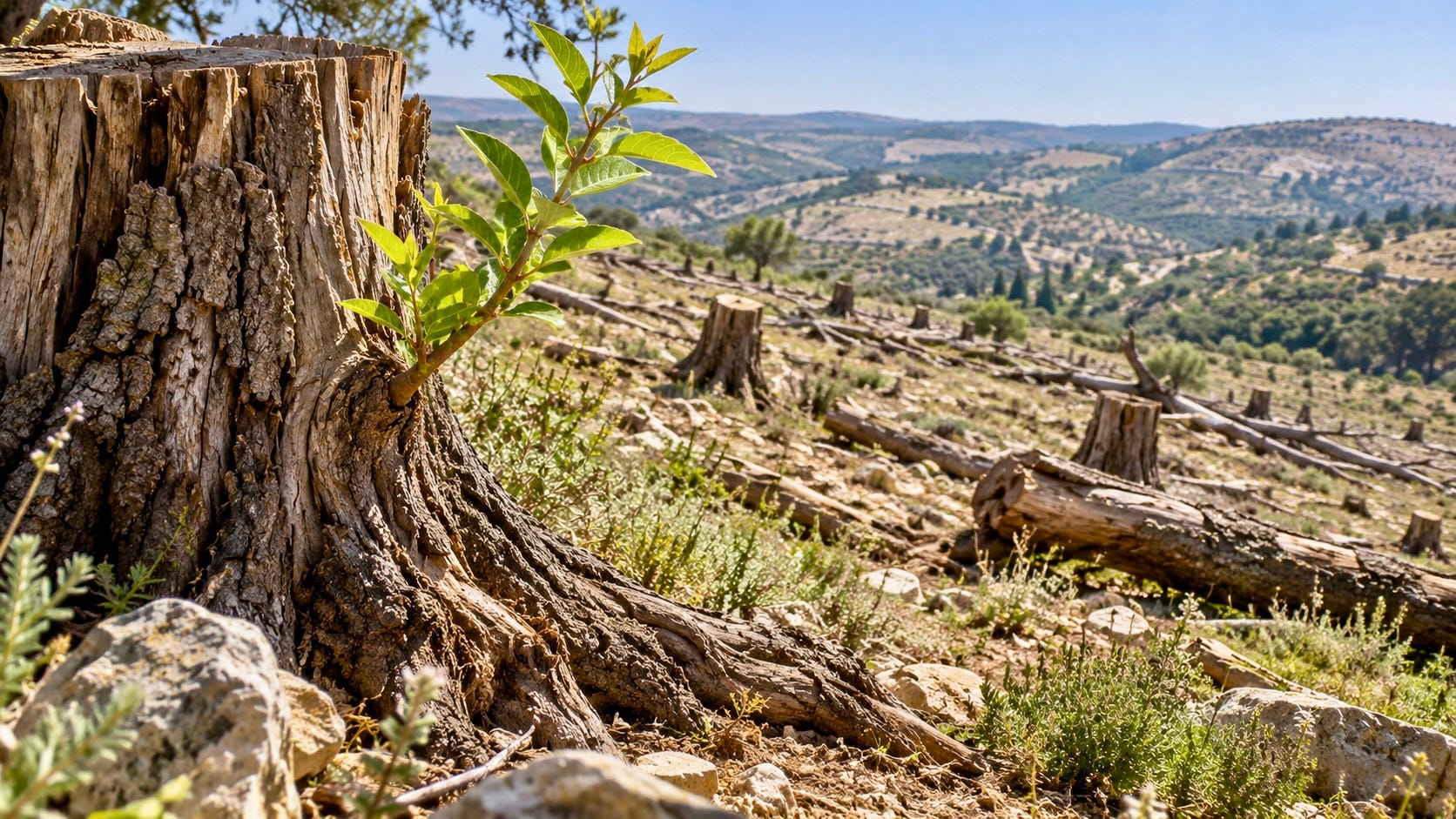
“Then a shoot will spring from the stem of Jesse,
And a branch from his roots will bear fruit.
The Spirit of the Lord will rest on Him,
The spirit of wisdom and understanding,
The spirit of counsel and strength,
The spirit of knowledge and the fear of the Lord.”
Isaiah 11:1-2 NASB1995
Isaiah 11 is a beautiful, powerful chapter of prophecy. In fact, Precept Austin has these remarks at the beginning of their commentary for Isaiah 11:
Beloved child of the Living God, let me encourage you to prayerfully read this chapter before you read any notes. And as you pray, be sure to confess your sins so that your fellowship with the Father might be full and unhindered and that He might give ear to your prayer that the eyes of your heart would be enlightened, so that you might know what is the hope of His calling, what are the riches of the glory of His inheritance in the saints and what is the surpassing greatness of His power toward us who believe. And then read through Isaiah 11 without interruption, trusting that the Spirit will indeed open the eyes of your heart to His incredible promises in this great prophecy, indeed one of the greatest in the entire Word of God. As you read, meditate on your glorious King and His soon coming Kingdom and let those truths marinate in your mind and stimulate in your heart a heightened desire for the Return of the King of kings. You might read through Isaiah 11 one more time, slowly as if it were a love letter from God written personally to you, for it is!
Some people are probably dragging around today, the day after the midterm elections, lamenting the results while others are probably openly (or possibly secretly) celebrating what occurred at the ballot box (I would say be careful what you wish for). Being a conservative, I was a bit mopey and depressed, but there is nothing that can pull you out of bewailing the temporary follies of fallen humanity than reading scripture like this passage in Isaiah. I’m afraid our nation and our people are becoming like the ones described in Romans 1, but that’s a story for another day.
A shoot will spring from the stem of Jesse and a branch from his roots will bear fruit. The AI image for today is just lovely, IMHO, as we have just read about how the thickets of the forest (the proud) are felled with a mighty axe at the end of Isaiah 10. Enduring Word has this to say about the shoot from the stem of Jesse (King David’s father):
a. There shall come forth a Rod from the stem of Jesse: Isaiah 10:33-34 left with the idea of the LORD chopping down the proud as if they were mighty trees. Now, the picture is of the LORD looking over these stumps, and causing a Branch to grow out of one of them, the root of the family of Jesse, King David’s father.
i. Indeed, Jesus did come from the stump of Jesse. The royal authority of the house of David was dormant for 600 years when Jesus came as King and Messiah. When Jesus came forth, it was like a new green Branch coming from an apparently dead stump.
ii. The LORD wanted Judah to know that even though the Assyrians and others would come and bring judgment, God would still use them and bring forth life from them. Even if they looked like a long-dead stump, God could bring forth life. Glorious restoration under the Messiah was promised.
iii. “We see a bare, withered tree stump, robbed of its trunk and top, and it looks as though the stump will never bear any fruit any more. But, a small shoot sprouts from the root of this dry stump which is the Davidic dynasty. Because of its unsightliness and misery, it is not named after David but after his father. When Christ was born, there was nothing royal about that dynasty. But a new shoot sprang from this old stem.” (Bultema)
b. A Rod from the stem of Jesse: In using this title, the LORD emphasized the humble nature of the Messiah. Jesse was the much less famous father of King David. It is far humbler to say, “from Jesse” than to say, “from King David.”
I like that thought that the stem of Jesse emphasizes the humble nature of the Messiah. Let’s learn a little bit more about Jesse from this article in Gotquestions.org:
Jesse in the Bible is father of David and thus an important part of the lineage of Christ, the Son of David(Matthew 22:42). We don’t know much about Jesse as a person; most of the Bible’s references to Jesse come in the context of his relation to his famous son David.
In order to understand the rich history surrounding the name of Jesse, one might begin by tracing his lineage back to Abraham. God chose Abraham and promised that through his seed all the nations of the world would be blessed (Genesis 22:16–18). Jumping forward several generations, we are introduced to Boaz, a wealthy and God-fearing resident of Bethlehem. Boaz demonstrates God’s redemptive character by wedding himself to Ruth the Moabitess, who forsook her ungodly heritage (see Numbers 25:1–5) and clung to the God of Israel (Ruth 1:16).
The book of Ruth is an incredible story of God’s salvific nature. By faith Ruth is welcomed into the fellowship of God’s covenant people, Israel. After her marriage to Boaz, Ruth gives birth to Obed (Ruth 4:13), and the Bethlehemite women rejoice in the blessing of God over her family (verses 14–15). Boaz and Ruth’s son Obed later begets Jesse, who becomes the father of David (verse 22), God’s choice for king for Israel (1 Samuel 16:1). Thus Ruth was granted a place of honor as the great-grandmother of David, who was a type of and faithful predecessor to the Christ-King
Jesse takes the stage with his eight sons in 1 Samuel 16–17. The prophet Samuel invites Jesse and his family to a sacrificial feast, but Jesse only brings his seven oldest sons, including Eliab, Abinadab, and Shammah; all seven were rejected by God as king (1 Samuel 16:6–10). Jesse had chosen to leave David, his youngest son, to tend the sheep. However, it is this lowly shepherd boy whom, to the probable surprise of both Jesse and Samuel, God directs Samuel to anoint as the chosen king (1 Samuel 16:11–13). Although it is David’s kingship that typifies and anticipates the reign of the Christ-King, Jesse’s name still receives mention in a couple prophecies of the Messiah.
In Isaiah, Jesse is mentioned as the stump from which a Branch (Christ) would come forth to be a banner for all peoples; to this banner all nations would rally (Isaiah 11:1–3, 10; cf. Jeremiah 23:5). Furthermore, Micah 5:2 identifies Bethlehem—the little town of Jesse—as the source of the King of all kings. The Branch from the root of Jesse would eventually spring forth and bear everlasting fruit.

The second verse in this passage identifies the seven spirit natures or aspects of the Branch of Jesse (this does not mean that there are separate spirits):
The Spirit of the Lord will rest on Him,
The spirit of wisdom and understanding,
The spirit of counsel and strength,
The spirit of knowledge and the fear of the Lord.
I think Enduring Word hits a Grand Slam with their commentary on this verse:
a. The Spirit of the LORD shall rest upon Him: The Branch that comes from the apparently dead stump isn’t just barely alive. It is full of life, and full of the Spirit of the LORD. We see here that the Messiah has seven – the number of fullness and completion – aspects of the Spirit of the LORD.
i. The Spirit of the LORD is upon the Messiah. Jesus did not have a false spirit or a deceiving spirit, or even the spirit of a man. The Spirit of the LORD God of Israel rests upon the Messiah. On one occasion Jesus rebuked the disciples saying, You do not know what manner of spirit you are of (Luke 9:55). Jesus was of the Spirit of the LORD, and He knew it.
ii. The Spirit of wisdom is upon the Messiah. Jesus is perfectly wise in all things. He showed this during his earthly ministry, and He shows it now in His continuing ministry in heaven for His people. 1 Corinthians 1:30 says that Jesus became for us wisdom from God. It isn’t just that Jesus has wisdom; He is wisdom.
iii. The Spirit of…understanding is upon the Messiah. Jesus understands all things, and He understands us perfectly. He is perfectly suited to be our sympathetic High Priest in heaven (Hebrews 4:15-16). Understanding in Hebrew has the idea of a sharp sense of smell. John Trapp said this word describes Jesus’ “Sharpness of judgment in smelling out a hypocrite…His sharp nose easily discerneth and is offended with the stinking breath of the hypocrite’s rotten lungs, though his words be never so scented and perfumed with shows of holiness.”
iv. The Spirit of counsel is upon the Messiah. Jesus has perfect counsel to give us at all times. He has both the wisdom and the understanding to be a perfect counselor.
v. The Spirit of…might is upon the Messiah. Jesus has the power to do what He desires to do. Many people would help us if they could but are powerless to help. Others may have the power to help us, but they don’t care about us. Jesus has both the love and the might to help us.
vi. The Spirit of knowledge is upon the Messiah. Jesus knows everything. He knows our hearts and He knows all the facts. Many times we have made decisions that seemed strange or wrong to others because they didn’t have the knowledge that we have. Jesus has knowledge that we don’t have, so it shouldn’t surprise us that sometimes His decisions seem strange or wrong to us or to others.
vii. The Spirit of…the fear of the LORD is upon the Messiah. Jesus willingly kept Himself in a place of submission, respect, and honor to God the Father.
b. The Spirit of the LORD…of wisdom and understanding…of counsel and might…of knowledge and of the fear of the LORD: These seven aspects of the Spirit of God are not the only characteristics of the Holy Spirit. But they are grouped together in a “seven” to show the fullness and perfection of the Holy Spirit.
i. This passage is behind the term the sevenfold Spirit of God used in Revelation 1:4, 3:1, 4:5, 5:6. It isn’t that there are seven different spirits of God, rather the Spirit of the LORD has these characteristics, and He has them all in fullness and perfection.
ii. The seven-branched lampstand that held the oil lamps for the tabernacle was also an illustration of the seven aspects of the Holy Spirit. “This candlestick had one stem in the center from which protruded three branches to the right and three to the left. Similarly, in this text, three pairs of the names of the Spirit are grouped around the central stem.” (Bultema)
c. Shall rest upon Him: Jesus the Messiah lived and ministered as a man filled with the Spirit of God. The wisdom, understanding, counsel, might, knowledge, and fear of the LORD Jesus displayed in His ministry flowed not from His “own” divine resources, but from His reliance on the Spirit of the LORD who filled Him.
i. As truly God, Jesus has all these attributes from eternity. But when Jesus emptied Himself at the incarnation, He allowed the Holy Spirit to fill Him as a man, being an eternal example to us and a sympathizer with us. When Jesus added humanity to His deity, in no way did He stop being God. But as Philippians 2:5-8 tells us, there is some sense in which Jesus chose to “empty Himself” of some of the privileges or prerogatives of deity. Instead, Jesus chose to rely on the Spirit of the LORD.
ii. Jesus displayed the fruit of the Spirit to the uttermost because He was a perfect vessel. Jesus received the Spirit without measure (John 3:34).
iii. There seem to have been times when Jesus did operate beyond what a Spirit-filled man could do, such as when He was transfigured (Matthew 17:1-9) or when Jesus performed some of His miracles over nature. But certainly, Jesus fought all His battles as a man filled with the Holy Spirit.
d. The Spirit of the LORD: These seven characteristics describe the nature of the Spirit of the LORD. They also describe the nature of Jesus. There is no difference between the nature of Jesus and the nature of the Holy Spirit. When we see Jesus, we see God the Father (John 14:9). When we see the Spirit of the LORD at work, it should look like the ministry and the nature of Jesus.
I really can’t add anything to this commentary, other than perhaps explore the idea of “will rest”. According to The Blue Letter Bible lexicon, this comes from the Hebrew verb נוּחַ nûwach, noo'-akh; a primitive root; to rest (Strong’s H5117), with the following Biblical usages:
to rest
(Qal)
to rest, settle down and remain
to repose, have rest, be quiet
(Hiph)
to cause to rest, give rest to, make quiet
to cause to rest, cause to alight, set down
to lay or set down, deposit, let lie, place
to let remain, leave
to leave, depart from
to abandon
to permit
(Hoph)
to obtain rest, be granted rest
to be left, be placed
open space (subst)
These seven attributes are deposited or laid down on Christ to remain there permanently. A link within the Isaiah 11 commentary (to a separate collection of commentary on walking like Jesus) in Precept Austin has this wonderful commentary from Warren Wiersbe on how we can try to walk like Jesus:
For His sermon in the synagogue in His hometown of Nazareth, Jesus read this text: “The Spirit of the Lord is on me, because he has anointed me to preach good news to the poor. He has sent me to proclaim freedom for the prisoners and recovery of sight for the blind, to release the oppressed, to proclaim the year of the Lord’s favor” (Luke 4:18–19, quoted from Isa. 61:1–2). When our Lord lived on earth, all that He did was directed by the Father and empowered by the Holy Spirit, Whom the Father gave to Jesus “without limit”(John 3:34; Acts 4:27). “God anointed Jesus of Nazareth with the Holy Spirit and power,” said Peter, “and he went around doing good and healing” (Acts 10:38). While ministering on earth, Jesus lived and served just as we His followers must live and serve today: directed by the Word of God, energized by the Holy Spirit, and depending wholly on prayer. He did not use His divine attributes independent of the Father. If we hope to succeed in life and service, no matter what God has called us to do, we must follow that example: prayer, the Word, and the Holy Spirit’s power (Acts 6:4 and Acts 1:8). Each member of God’s family has the gift of the Holy Spirit and gifts from the Spirit to be used for service (1Cor. 12:1–11; Eph. 4:1–16). The Spirit has anointed us (2 Cor. 1:21) and the Spirit teaches us the truth so that we can understand the Word and detect the lies of the enemy (1John 2:20, 27; 4:1–6). We may ask God for wisdom, and He will give it to us (James 1:5). Our privilege is to “keep in step with the Spirit” (Gal. 5:25) and depend on His power as He fills us and enables us to glorify Christ. By God’s grace, we possess the anointing. Don’t leave home without Him in control. (See C Is for Christmas)
Don’t leave home without Him in control! What better advice can you receive?
My next devotional examines Isaiah 11: 3-5 - The perfect character of the Messiah.
Heaven on Wheels Daily Prayer:
Dear Lord - Please guide me into the spirit of wisdom and understanding, the spirit of counsel and strength, and the spirit of knowledge and fear of the Lord! Amen.
Citations and Credits:
Scripture quotations taken from the (NASB®) New American Standard Bible®, Copyright © 1960, 1971, 1977, 1995 by The Lockman Foundation. Used by permission. All rights reserved. www.Lockman.org.
Precept Austin was accessed on 11/04/2026 to review commentary for Isaiah 11:1-2.
Biblehub.org was accessed on 11/04/2026 to review commentary for Isaiah 11:1-2.
Commentary from Enduring Word is used with written permission and without any alteration. ©1996-present The Enduring Word Bible Commentary by David Guzik – enduringword.com. At the link referenced, the bibliography used by David Guzik can be accessed.
Gotquestions.org was accessed on 11/04/2026 to answer the question, Who was Jesse in the Bible? © COPYRIGHT 2002-2026 GOT QUESTIONS MINISTRIES. ALL RIGHTS RESERVED.
“H5117 - nûaḥ - Strong’s Hebrew Lexicon (NASB95).” Blue Letter Bible. Web. 4 Nov, 2026. <https://www.blueletterbible.org/lexicon/h5117/nasb95/wlc/0-1/>.