


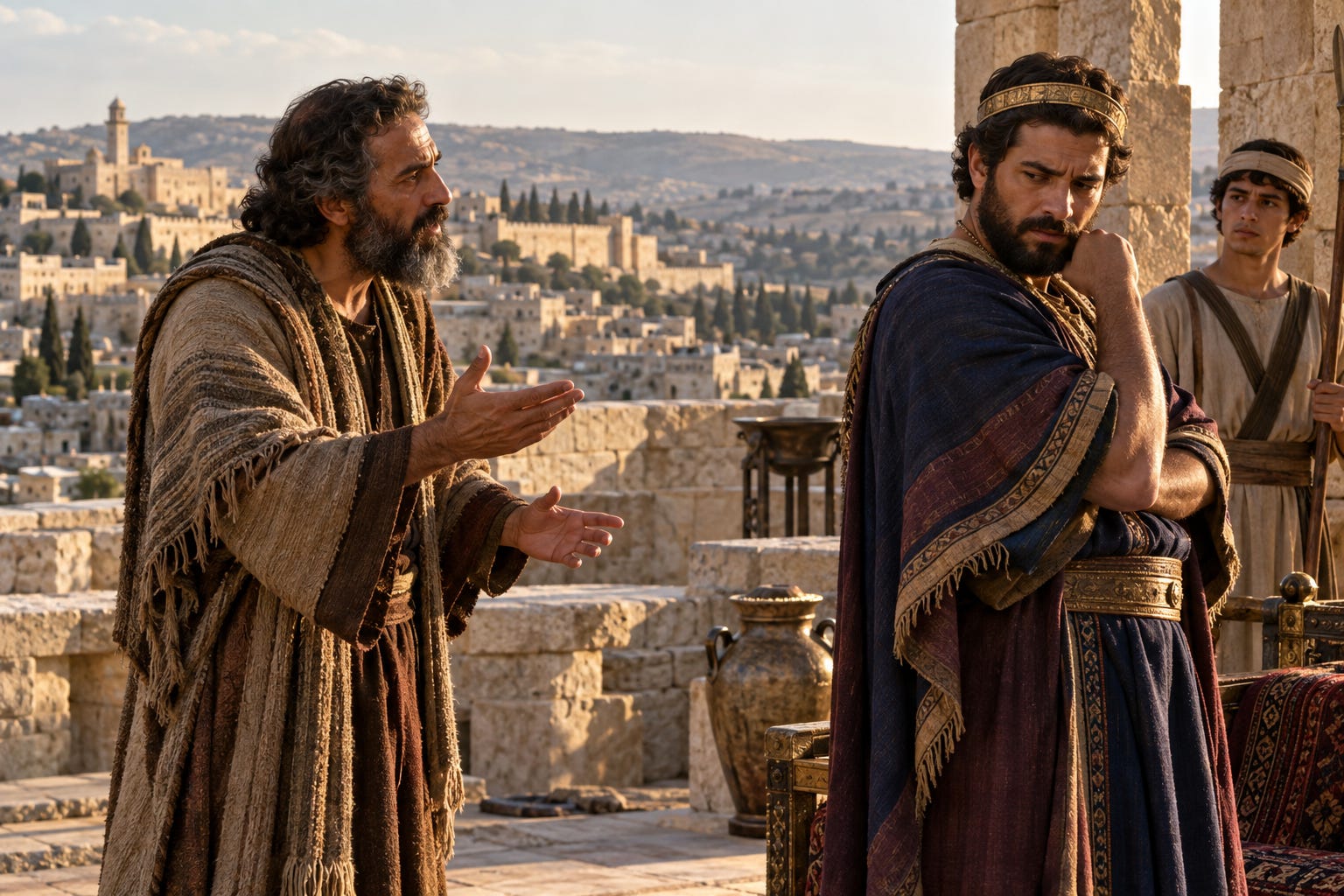
“Then the Lord spoke again to Ahaz, saying, “Ask a sign for yourself from the Lord your God; make it deep as Sheol or high as heaven.” But Ahaz said, “I will not ask, nor will I test the Lord!” Then he said, “Listen now, O house of David! Is it too slight a thing for you to try the patience of men, that you will try the patience of my God as well? Therefore the Lord Himself will give you a sign: Behold, a virgin will be with child and bear a son, and she will call His name Immanuel. He will eat curds and honey at the time He knows enough to refuse evil and choose good. For before the boy will know enough to refuse evil and choose good, the land whose two kings you dread will be forsaken.”
Isaiah 7:10-16 NASB1995
The Lord speaks to Ahaz again through His prophet Isaiah. He asks Ahaz to request a sign for himself as deep as Sheol or as high as heaven. Ahaz refuses to ask for a sign or to test the Lord. The Lord responds by telling him that he is trying the patience of God.
Here is what Enduring Word says about the first part of this passage:
a. Ask a sign for yourself: Through the prophet Isaiah, God invites Ahaz to ask for a sign. God has just challenged Ahaz to believe and be blessed, and now God offers to give Ahaz a basis for belief – a sign for yourself.
b. But Ahaz said, “I will not ask, nor will I test the LORD”: This sounds very spiritual from Ahaz. He almost seems to say what Jesus said in Matthew 4:7: “You shall not tempt the LORD your God.” Though the words are similar, the hearts are far apart. Ahaz refused to ask for a sign, because when God fulfilled the sign, he would be “obligated” to believe.
i. This was not tempting or testing God in a wrong way. It is never testing God to do as He says, and if the LORD invites us to test Him, we should. For example, in Malachi 3:10, the LORD invited Israel to give as He commanded, and thereby to try Me now in this.
ii. Again, perhaps Ahaz was bitter against the LORD, because of all the disaster Judah had already been through at the hands of Israel and Syria. Perhaps his mind is, “I want nothing to do with the God who allowed it to get this bad.”
iii. Haven’t we, in some way, to some degree, been in the same state of mind as Ahaz? Haven’t we rejected the gracious, free gifts of God for silly and strange reasons? “Here let us each descend and dive into his own conscience, to see whether we also have not matched Ahaz in his madness, or at leastwise coasted too near upon his unkind usage of the Lord, by rejecting his sweet offers of grace and motions of mercy, by slighting his holy sacraments, those signs and seals of the righteousness that is by faith.” (Trapp)
…
a. Is it a small thing for you to weary men, but will you weary my God also? The rulers of Judah treated other people poorly, but they treated the LORD even more poorly. If many of us expressed the same distrust we have towards the LORD towards other people, we might get a punch in the nose.
i. “How heartily angry is the prophet, how blessedly blown up in this case to so great dishonour done to God! We should be so too.” (Trapp)
ii. Spurgeon spoke well to this point: “Did I not hear some one say, ‘Ah, sir, I have been trying to believe for years.’ Terrible words! They make the case still worse. Imagine that after I had made a statement, a man should declare that he did not believe me, in fact, he could not believe me though he would like to do so. I should feel aggrieved certainly; but it would make matters worse if he added, ‘In fact I have been for years trying to believe you, and I cannot do it.’ What does he mean by that? What can he mean but that I am so incorrigibly false, and such a confirmed liar, that though he would like to give me some credit, he really cannot do it? With all the effort he can make in my favour, he finds it quite beyond his power to believe me? Now, a man who says, ‘I have been trying to believe in God,’ in reality says just that with regard to the Most High.”
This is an interesting perspective. Ahaz sounds spiritual in his response, but he doesn’t want to be “obligated” to believe because of a sign. Spurgeon says it best in this commentary that when you hear someone say that they have tried to believe you, realize how terrible those words are. If you were trying to convince someone of the truth over a long period of time and they refused to believe you, your patience would be mighty thin. Think of someone having this attitude towards the Most High!
This false piety points to the passage in Acts when Stephen is near the end of his testimony to the Sanhedrin:
““You men who are stiff-necked and uncircumcised in heart and ears are always resisting the Holy Spirit; you are doing just as your fathers did. Which one of the prophets did your fathers not persecute? They killed those who had previously announced the coming of the Righteous One, whose betrayers and murderers you have now become; you who received the law as ordained by angels, and yet did not keep it.””
Acts 7:51-53 NASB1995
Stephen was stoned to death right after this passage. Isaiah has great courage speaking the Lord’s words to a stiff-necked and unbelieving evil king.

Now we reach the part of this passage that is considered extremely controversial. A casual reader of this passage would immediately jump to the conclusion that this is a prophecy about Jesus. But there are caveats with some of the elements of the passage that create great consternation in the minds of biblical scholars. I tend to rely on more conservative, literal scholarship to understand what I’m reading (like Precept Austin and Enduring Word). Precept Austin quotes from Michael Rydelnik, from the Moody Bible Commentary on the ways Isaiah 7:14 has been interpreted:
Michael Rydelnik (Page 1019ff Moody Bible Commentary) has a simple summary of the ways Isaiah 7:14 has been interpreted:
This chapter contains one of the most controversial messianic predictions in the Hebrew Bible. Interpreters differ over a number of issues, such as the meaning of the Hebrew word ‘almah (translated “virgin” [v. 14] in the NASB), the way Isaiah’s sign (v. 14) relates to the context, how the original audience would have understood Isaiah’s words, and Matthew’s intention in citing this passage as a prediction of the virgin birth of Jesus (cf. Mt 1:18–25).
As a result of these disputed meanings, there are three primary interpretations of this passage, and even among these three, expositors have their own distinct perspectives.
(1) The first approach, held by many traditional Christian interpreters, sees the prophecy as a direct prediction of the virgin birth. Although there are a variety of ways that these interpreters come to this conclusion, they all agree that the word ‘almah means “virgin” and refers to the virgin mother of the Messiah.
(2) A second view, frequently held by traditional Jewish scholars and biblical critics, sees the passage as purely historical. In this view, a young woman in the eighth century BC would give birth to a child in a completely natural way.
(3) A third explanation of the passage, held by many other Christian interpreters, understands the passage as having dual or multiple fulfillments. These interpreters understand the passage to refer to the natural birth of a child in the eighth century BC. Nevertheless, they contend that this does not exhaust its meaning. Rather, by double fulfillment, typology, and progressive fulfillment, the prophecy also refers to the virgin birth.
This commentary will argue for the traditional interpretation, that the passage contains a direct prediction of the virgin birth of the Messiah.
Charles Spurgeon had this to say about the interpretations of Isaiah 7:14:
One of the most difficult in all the Word of God. It may be so; I certainly did not think it was until I saw what the commentators had to say about it, and I rose up from reading them perfectly confused.
According to some of the scholars who accept the possibility of a near-term and far-term prophecy from this passage, these are the possible outcomes (from a table in Precept Austin):
Near Fulfillment: Maher-shalal-hashbaz Isaiah 8:3,4,18
Future Fulfillment: Immanuel Mt 1:23
The reason for the two interpretations has to do with the rest of the passage that seems to indicate that when the child is born, before that child knows good from evil then the kings that give Ahaz such dread will be gone.
Let’a look at the larger passage in Matthew 1:
“Now the birth of Jesus Christ was as follows: when His mother Mary had been betrothed to Joseph, before they came together she was found to be with child by the Holy Spirit. And Joseph her husband, being a righteous man and not wanting to disgrace her, planned to send her away secretly. But when he had considered this, behold, an angel of the Lord appeared to him in a dream, saying, “Joseph, son of David, do not be afraid to take Mary as your wife; for the Child who has been conceived in her is of the Holy Spirit. She will bear a Son; and you shall call His name Jesus, for He will save His people from their sins.” Now all this took place to fulfill what was spoken by the Lord through the prophet: “Behold, the virgin shall be with child and shall bear a Son, and they shall call His name Immanuel,” which translated means, “God with us.” And Joseph awoke from his sleep and did as the angel of the Lord commanded him, and took Mary as his wife, but kept her a virgin until she gave birth to a Son; and he called His name Jesus.”
Matthew 1:18-25 NASB1995
Well, the Gospel of Matthew is good enough for me! One more commentary, again from Enduring Word:
d. Behold, the virgin shall conceive and bear a Son: The far or ultimate fulfillment of this prophecy goes far beyond Ahaz, to announce the miraculous virgin birth of Jesus Christ.
i. We know this passage speaks of Jesus because the Holy Spirit says so through Matthew: “Behold, the virgin shall be with child, and bear a Son, and they shall call His name Immanuel,” which is translated, “God with us.” (Matthew 1:23)
ii. We know this passage speaks of Jesus because the prophecy is addressed not only to Ahaz, but also to David’s entire house (O house of David!).
iii. We know this passage speaks of Jesus because it says the virgin shall conceive, and that conception would be a sign to David’s entire house. Those who deny the virgin birth of Jesus like to point out that the Hebrew word translated virgin (almah) can also be translated as “young woman.” The idea is that Isaiah was simply saying that a “young woman” would give birth, not a virgin. While the near fulfillment may have reference to a young woman giving birth, the far or ultimate fulfillment clearly points to a woman miraculously conceiving and giving birth. This is especially clear because the Old Testament never uses the word in a context other than virgin and because the Septuagint translates it categorically virgin (parthenos).
iv. We know this passage speaks of Jesus because it says He will be known as Immanuel, meaning “God with Us.” This was true of Jesus in fact, not only as a title. Immanuel speaks both of the deity of Jesus (God with us) and His identification and nearness to man (God with us).
e. Call His name Immanuel: Jesus is truly Immanuel, God with us. “Christ, indeed, was not called by this name Immanuel that we anywhere read of…but the import of this name is most truly affirmed and acknowledged to be fully made good in him.” (Trapp)
i. “He is, therefore, called God with us, or united to us; which cannot apply to a man who is not God…it denotes not only the power of God, such as he usually displays by his servant, but a union of person, by which Christ became God-man.” (Calvin)
ii. “In what sense then, is Christ GOD WITH US? Jesus is called Immanuel, or God with us, in his incarnation; God with us, by the influences of his Holy Spirit, in the holy sacrament, in the preaching of his word, in private prayer. And God with us, through every action of our life, that we begin, continue, and end in his name. He is God with us, to comfort, enlighten, protect, and defend us, in every time of temptation and trial, in the hour of death, in the day of judgment; and God with us and in us, and we with and in him, to all eternity.” (Clarke)
Good commentary! The bigger or far picture is the ultimate fulfillment of this prophecy.
By the way, Precept Austin notes this about eating curds and honey:
He will eat curds and honey The majority of scholars see the expression as indicating a land that has been devastated (cf Isa 7:20-25) so that virtually no agriculture is possible, and the only food available is wild honey and the produce of the flocks.
My next devotional examines Isaiah 7:17-25 - Trials that will come for Judah.
Heaven on Wheels Daily Prayer:
Dear Lord - I believe in the simplest explanation for this prophecy, that it is has been fulfilled in Jesus. Becoming too entangled in human interpretations can lead to doubt and sow seeds of dissension. Amen.
Citations and Credits:
Scripture quotations taken from the (NASB®) New American Standard Bible®, Copyright © 1960, 1971, 1977, 1995 by The Lockman Foundation. Used by permission. All rights reserved. www.Lockman.org.
Precept Austin was accessed on 09/23/2026 to review commentary for Isaiah 7:10-16.
Commentary from Enduring Word is used with written permission and without any alteration. ©1996-present The Enduring Word Bible Commentary by David Guzik – enduringword.com. At the link referenced, the bibliography used by David Guzik can be accessed.