


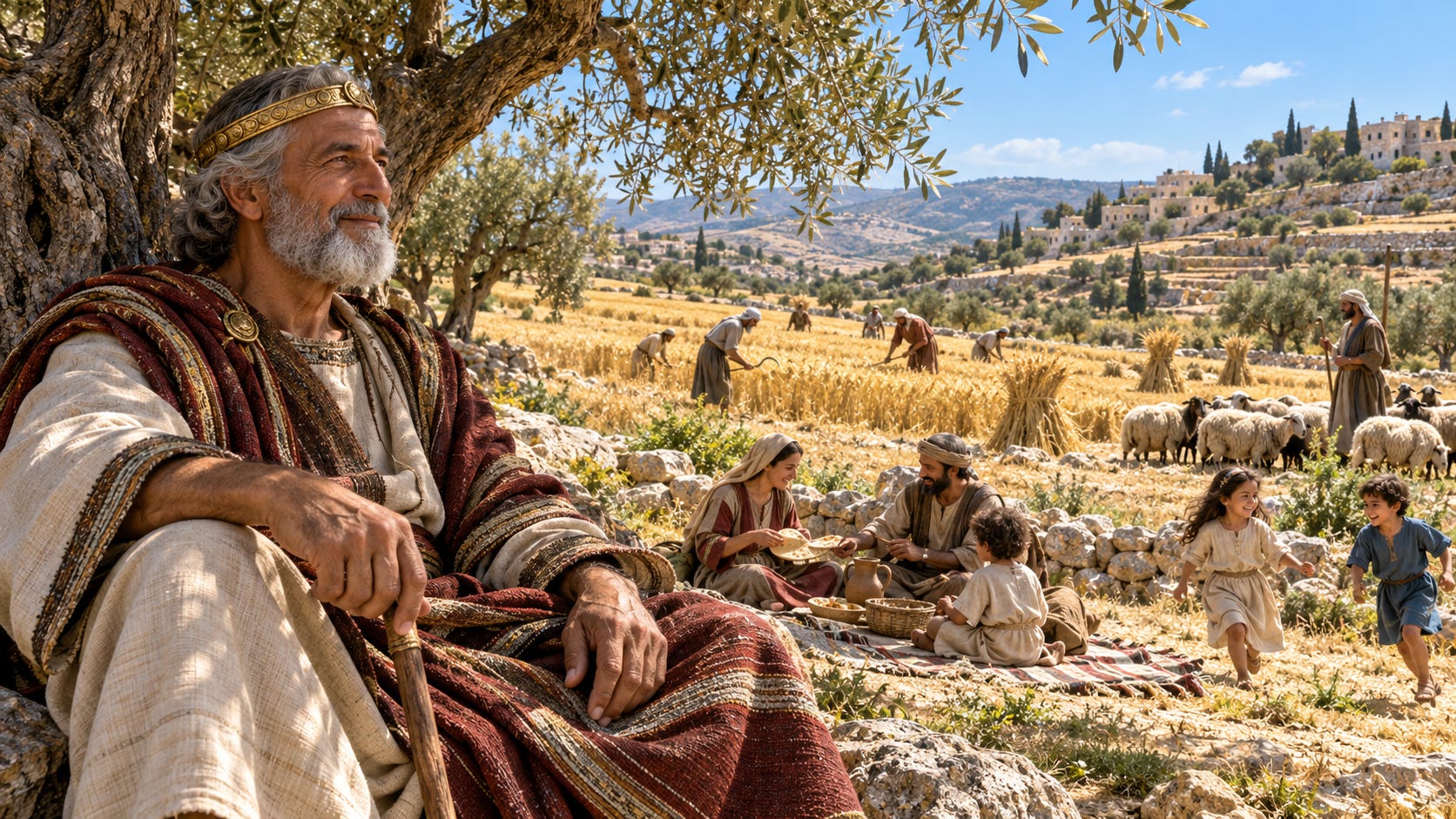
An older King David sits beneath an olive tree overlooking fields at harvest. Nearby, a family shares bread while children play and a shepherd tends his flock. David watches with a grateful, contemplative expression, recognizing God’s goodness in the everyday blessings surrounding him. Image generated with ChatGPT by OpenAI.
“I remain confident of this: I will see the goodness of the LORD in the land of the living.”
Psalms 27:13 NIV
We’re back in the Psalms, this time with a psalm of David. As you’d expect with documents that are 3,000 years old, what exactly David was experiencing in his life is unknown. David Guzik’s Enduring Word introduction to Psalm 27 explains:
This psalm is simply titled A Psalm of David. As with many of David’s psalms, it is impossible to confidently state which period of his life it comes from. It speaks of trouble from enemies, adversaries, false witnesses, and violent men, but this was true of many periods of King David’s life. There is such a marked change between the first half and the second half of this psalm that many suggest that it was two different psalms stitched together. Alexander Maclaren said this idea “has much in its favour”; but it neglects how the experience of the man or woman of God can change so much even within a day or a song.
The latter part of Psalm 27 is quite different from the first part. In the first six verses, David sings of his confidence in God and his desire for God’s presence; the last eight verses (of which Psalm 27:13 is a part) are a prayer.
When I write these devotionals, I usually take a look at multiple translations of the Bible. Most do a very good job of making the original Hebrew or Greek words understandable in English, but there are variations in the overall meaning of those words. For Psalms 27:13, I felt that the NASB 1995 translation had much more impact than the NIV translation I usually use. Here’s the NASB version:
“I would have despaired unless I had believed that I would see the goodness of the LORD In the land of the living.”
The NKJV translation also has the same “feeling” to it:
“I would have lost heart, unless I had believed That I would see the goodness of the LORD In the land of the living.”
Rather than saying that David would have “remained confident,” these two translations provide a much more powerful statement — that the King would have given up (lost heart, despaired). But he knew that God, who had helped him throughout his life, would find a way to display His goodness in his future life with the Lord as well. Charles Spurgeon quoted 17th Century theologian Richard Baxter in a commentary found on Enduring Word:
i. Some speculate that David meant the life to come when he wrote of the land of the living. One can fairly say that this is the land of the dying, “in which there are more dead than living, more under ground than above it; where the earth is fuller of graves than houses; where life lies trembling under the hand of death; and where death hath power to tyrannise over life! No, my soul, there only is the land of the living where there are none but the living; where there is a church, not militant, but triumphant; a church indeed, but no church-yard, because none dead, nor none that can die; where life is not passive, nor death active; where life sits crowned, and where death is swallowed up in victory.” (Baxter, cited in Spurgeon)
Another way to interpret “the land of the living” is David’s earthly life. With this interpretation, David would have been saying that he had that confidence (as seen in the NIV translation) that the Lord would continue to help him in the remainder of his life. That’s a strong reason to not surrender to despair or death.
Whether we interpret this verse to be about this life or the life to come, we have assurance that death will not be victorious over those who belong to the Lord.
Remember, we have hundreds of devotionals dedicated to the Book of Psalms. Read and learn more by clicking the button below:
Heaven On Wheels Daily Prayer:
Father in Heaven, I pray to You today with a heart filled with hope and gratitude. I trust that I will see Your goodness in my life, both now and when I am with You. Help me to always be strong and courageous throughout the inevitable times of trouble, and to reflect the love, forgiveness, and mercy of Jesus as I deal with other people. AMEN.