


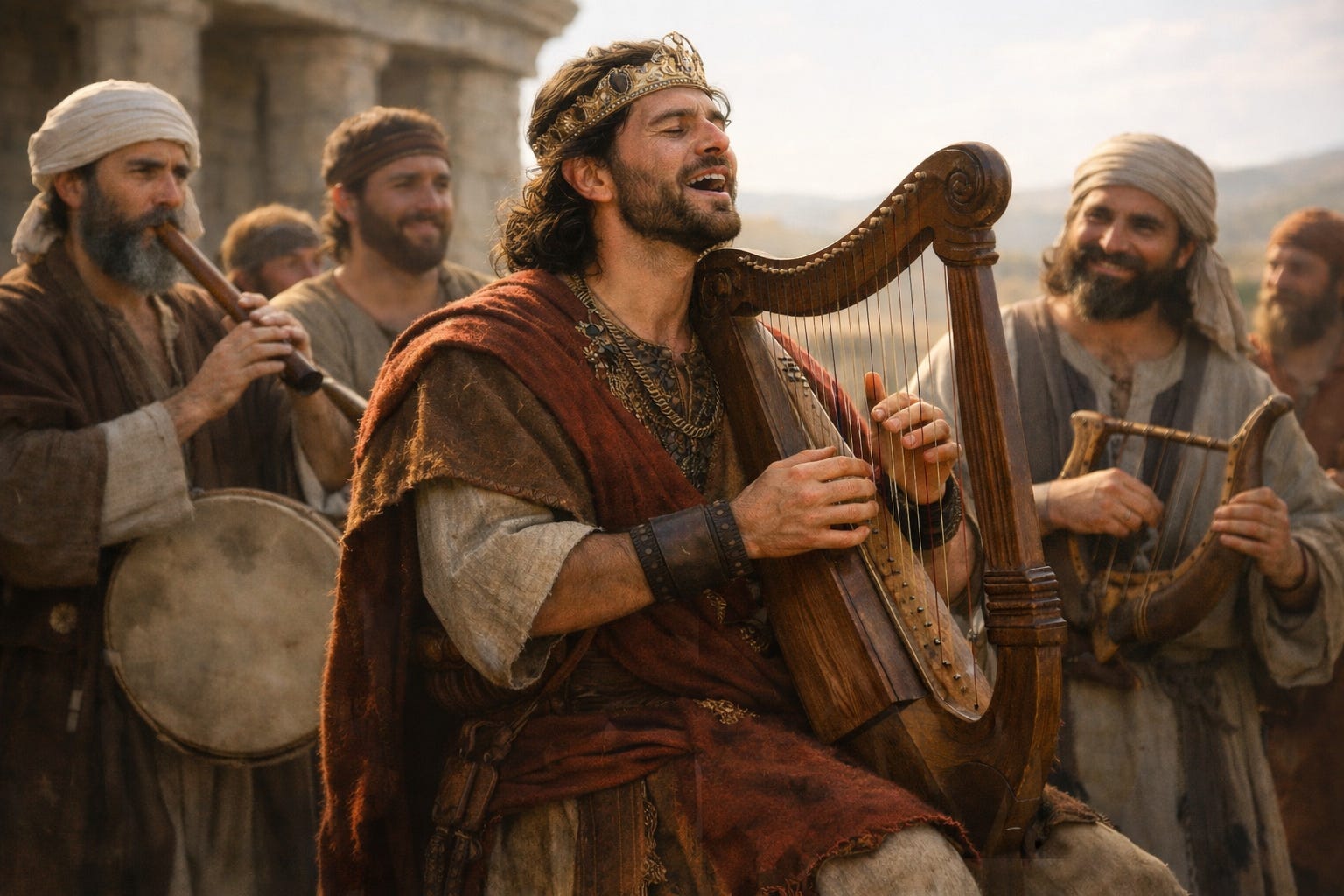
Image generated by ChatGPT (OpenAI) using the DALL·E model.
“I will give thanks to you, Lord, with all my heart; I will tell of all your wonderful deeds. I will be glad and rejoice in you; I will sing the praises of your name, O Most High.”
Psalms 9:1-2 NIV
This psalm is titled “For the director of music. To the tune of ‘The Death of the Son.’ A psalm of David.” We know that David wrote the song and he’s passing this along to his music director… but haven’t you ever wondered what the psalm would sound like? I was curious and had to find out if any of these tunes had been passed down through the ages.
Apparently, there are still fragments of the original tunes found in ancient synagogue and church chants. Many of the ancient manuscripts of the Psalms included what are referred to as “cantillation marks”, symbols to indicate how a song would be sung. A 20th century French musicologist (Suzanne Häik-Ventoura) came up with a theory on how those marks could be translated into modern musical notation; however, most other musicologists reject her findings. We’ll probably never know exactly how these psalms were sung…
However, “modern” composers including Johann Sebastian Bach and Gregorio Allegri wrote tunes to accompany the words of many psalms, and during the Reformation, many of the psalms were sung to popular tunes. The beautiful words are still inspiring musicians today. The Sons of Korah, the Robbie Seay Band, and Poor Bishop Hooper all have music based on the Psalms, with the Sons of Korah actually limiting their music to this source!
In the introduction to his Enduring Word commentary on Psalm 9, David Guzik notes that:
While most believe the title Muth Labben refers to a tune, others suggest that it refers to an instrument upon which the song was played. Some (as in the New King James Version) associate the title with the phrase The Death of the Son, and apply that title as the ancient Chaldee version does: “Concerning the death of the Champion who went out between the camps,” referring to Goliath. Perhaps David wrote this psalm remembering the victory over Goliath from the vantage point of many years since that triumph.
Enough music history, let’s get into the meaning of the words of this psalm. It’s another example of scriptural repetition, with each stanza beginning with the words “I will”. David begins by saying “I will give thanks to You, Lord, with all my heart”, meaning that he wants to direct all of his attention, his time, his being in thanking the Lord.
From the Enduring Word commentary we get these gems from Charles H. Spurgeon and James Montgomery Boice:
i. “Half heart is no heart.” (Spurgeon)
ii. “We do not praise God with our lips very much, if at all. And when we do, if we do, we praise him halfheartedly.... It is more often true that Christians complain of how God has been treating them, carry on excessively about their personal needs or desires, or gossip.” (Boice)
Next, David goes on to exclaim that “I will tell of all your wonderful deeds.” Are you ever stuck for things to pray about? Why not recall and tell yourself (and others!) about the great things that God has done for you, for others, for humankind as a whole? It’s a way to give Him the praise He is due.
The Hebrew word used to say “wonderful deeds” or “marvelous works” is פָּלָא, pālā'. It’s a word that translates to English as a list of superlatives: “to be marvelous, be wonderful, be surpassing, be extraordinary, separate by distinguishing action.”
David knows another way to praise God — to “be glad and rejoice in you”. This kind of praise doesn’t take a choir, a praise band, or a church full of voices filled in song. It can be something as simple as looking out a window and enjoying the day, then thinking of the Creator and celebrating His goodness, greatness, kindness, and love.
David isn’t content to just praise God by telling of his wonderful deeds or by being glad and rejoicing — in the next stanza he says he “will sing the praises of your name, O Most High.” He’s singing with his entire being again, singing praise to the name of God — YHWH! The phrase “O Most High” recognizes God’s absolute sovereignty over all of creation.
In Hebrew, this phrase was one beautiful word — עֶלְיוֹן (ʿelyôn) — with the meaning of “a king above all monarchs”. This word goes back to Genesis 14:18-20, when the king of Salem, Melchizedek, blessed Abram “by God Most High, Creator of heaven and earth”. Abram responded to the blessing by giving to the Lord a tithe, “a tenth of everything.”
We may never know exactly how King David or his musicians played and sang the music to this psalm, but we can still follow his example — give heartfelt thanks to the Lord, tell others of His greatness, be glad and rejoice in Him, and sing the praises of His name!
Do you love the Psalms as much as I do? You can read an ever-growing number of Heaven On Wheels devotionals that examine these beautiful songs of praise by clicking this link: Psalms.
Heaven On Wheels Daily Prayer:
Lord in Heaven, I thank You for Your magnificent creation, and for the joy and rejoicing it produces in my soul. Guide me in my life so that I always remember to tell others of Your infinite love and compassion, to be glad and rejoice in Your mercy and grace, and always seek to bring others to eternal salvation through Jesus Christ, our Lord. AMEN.