


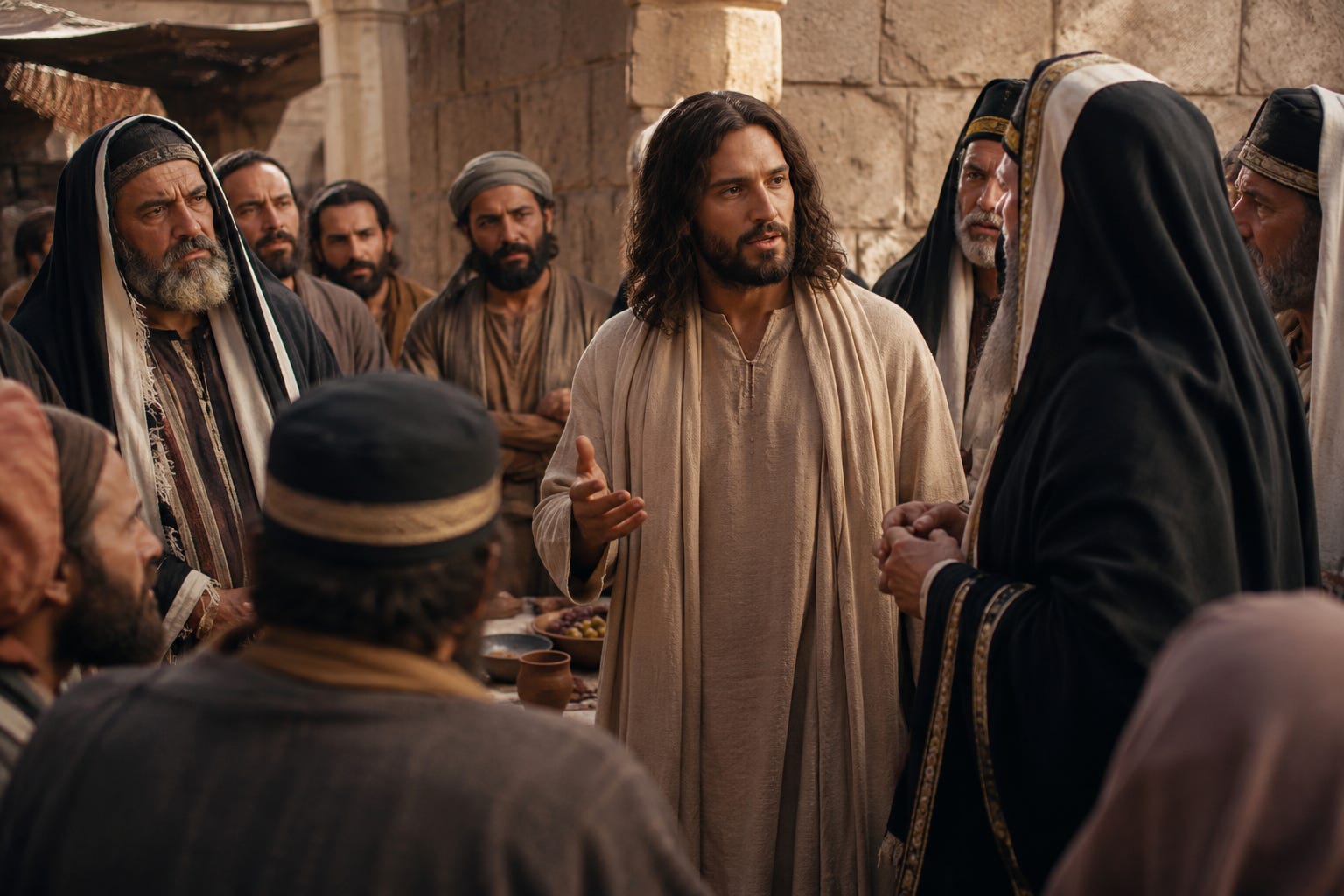
Image generated by ChatGPT (OpenAI) using the DALL·E model.
“I have not come to call the righteous, but sinners to repentance.”
Luke 5:32 NIV
These words of Jesus from the Gospel of Luke highlight the power of Christianity to transform people who choose to follow Him.
Just before He spoke these words, Jesus had confronted the Pharisees and Scribes who accused him of consorting with tax collectors and other notorious sinners. He didn’t correct their accusation, but instead said that “It is not the healthy who need a doctor, but the sick.” (Luke 5:31) Charles H. Spurgeon, in his Verse Expositions on the Gospel of Luke, pointed out that the criticism of the Pharisees and Scribes was quite useful:
The murmuring of those Pharisees and doctors of the law had one good result, for it led the Saviour to declare the purpose of his mission to the earth: “I came not to call the righteous, but sinners.”
And it is a wonderful mission! Jesus didn’t come to hang out with those who thought they were righteous. He wasn’t working to improve His social status among the religious elite. What He was doing was showing compassion and offering assistance to sinners who needed healing, including the Pharisees who were too spiritually blind to see that they also needed that healing.
Jesus wanted (and still wants) to call “sinners to repentance”. Repentance requires a change in the heart, a change in thinking, a change in living. The Greek word used here is μετάνοια (metanoia). This is actually a compound word: μετά “meta”, which means “change” and νοια “noia” meaning “mind” or “perspective”.
Repentance is a conscious decision where a person admits to him or herself that their old way of living was not good and that they need to change the path they’re on (sometimes drastically, other times subtly). Jesus is calling sinners, who know that they have done wrong in the past or are still embracing sin, to change their minds and behaviors by following Him.
Sadly, the Pharisees and religious scribes believed they were righteous, and most probably never realized that they were the ones who were in the most need of repentance! There are parallels of this verse in Matthew 5:3 in the Beatitudes, where Jesus said “Blessed are the poor in spirit, for theirs is the kingdom of heaven.” The poor in spirit are those who are aware of their spiritual shortcomings and realize their sinful ways.
Repentance is a rather hard concept to understand. It’s not just recognition of your sin, feeling sorrow at that knowledge of your shortcomings in the eyes of God, and turning away from evil. Almost anyone who does a little soul-searching can say “Yeah, I’ve sinned, I feel bad about it, and I’ll try not to do it again in the future.” To truly repent, one must then make a conscious and lifelong commitment to turn to God in faith and obedience.
Precept Austin offers this commentary on Luke 5:32 and the topic of repentance:
I have not come to call the righteous (dikaios) but sinners (hamartolos) to repentance (metanoia)- I have...come is in the verb is perfect tense - In other words Jesus "invaded" earth at a point in time with a distinct purpose and His purpose endures. It is a mission to sick sinners not those who are well think they are righteous (aka "don't need a physician"). Jesus is not endorsing the righteousness of the Pharisees, who did not see themselves as sinners in need of Christ's righteousness! They were self-righteous, sanctimonious hypocrites! This statement is in all three synoptic gospels, which is not surprising as this is the reason Jesus came to earth. This was (and is) His purpose. So Jesus does not dispute that there is a form of "righteousness" that men can have, but it is a dangerous "righteousness" because it produces in that man or woman a heart that is proud and fails to see their personal need for God's gift of righteousness found only in Christ. In Luke 19:10+ Jesus declares "the Son of Man has come to seek and to save that which was lost.” (We as His disciples should do likewise! Are you?) The righteous think they are "right" with God, which blinds them to seeing their true lost condition and their true need!
Repentance is a core concept of Christianity, yet it seems that most modern preachers shy away from teaching this concept to their congregations! That’s not just a recent development; even Charles Spurgeon saw this as a shortcoming of those behind the lectern in an 1876 sermon titled “The Plumbline”:
Side by side with that faith, God puts true repentance. When a man attempts to convert his fellow-man, he gives him a sham repentance, or perhaps he tells him that there is no need of any repentance at all. Certain preachers have been telling us, lately, that it is a very easy matter to obtain salvation, and that there is no need of repentance; or if repentance is needed, it is merely a change of mind. That is not the doctrine that our fathers used to preach, nor the doctrine that we have believed. That faith, which is not accompanied by repentance, will have to be repented of; so, whenever God builds, he builds repentance fair and square with faith. These two things go together; the man just as much regrets and grieves over the past as he sees that past obliterated by the precious blood of Jesus. He just as much hates all his sin as he believes that his sin has been all put away.
Jesus still calls sinners to repentance. Do we have strong enough faith and belief that we can act on that call?
Heaven On Wheels Daily Prayer:
Father in Heaven, thank You for sending Your Son to teach us to turn from lives of sin and to trust in Him for salvation. I am filled with gratitude for Your grace, allowing believers to seek forgiveness and redemption. I know I still sin, and I ask for Your help to recognize my need for repentance and to embrace the transformation that comes through faith in Jesus. AMEN.
Scripture quotations taken from THE HOLY BIBLE, NEW INTERNATIONAL VERSION®, NIV®. Copyright © 1973, 1978, 1984, 2011 by Biblica US, Inc.®. Used by permission.
Precept Austin was accessed on July 20, 2026 for commentary on Luke 5:32