


“Now the main point in what has been said is this: we have such a high priest, who has taken His seat at the right hand of the throne of the Majesty in the heavens, a minister in the sanctuary and in the true tabernacle, which the Lord pitched, not man. For every high priest is appointed to offer both gifts and sacrifices; so it is necessary that this high priest also have something to offer.”
Hebrews 8:1-3 NASB1995
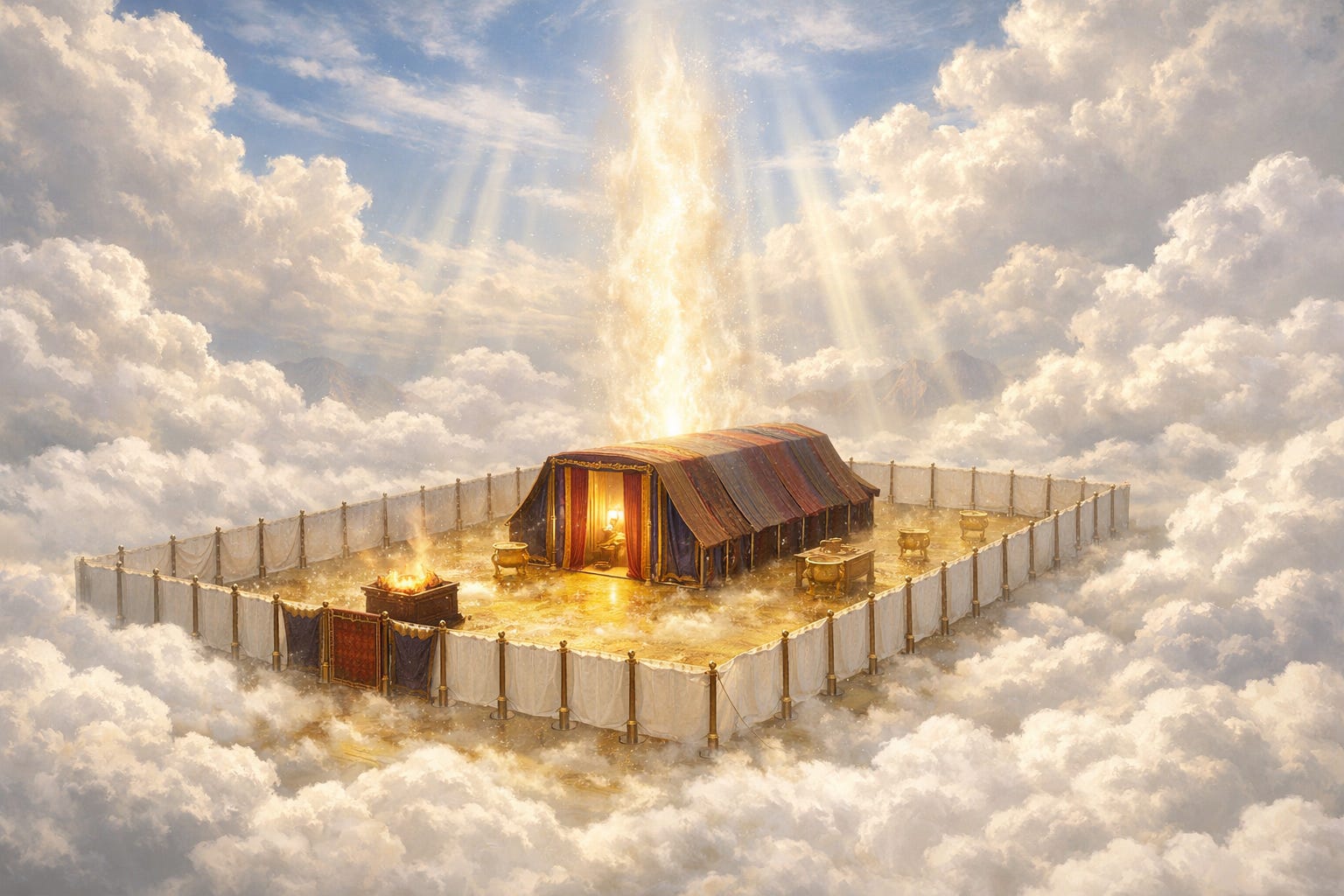
In my last devotional, I described this next passage at the beginning of Hebrews 8 as being about “a better ministry”. That’s also part of this chapter, but I recognized that verse 2 talks about the true tabernacle that is pitched by the Lord. Steve went to his AI tool and had it create the image at the top, of a “heavenly” tabernacle that contains the true high priest.
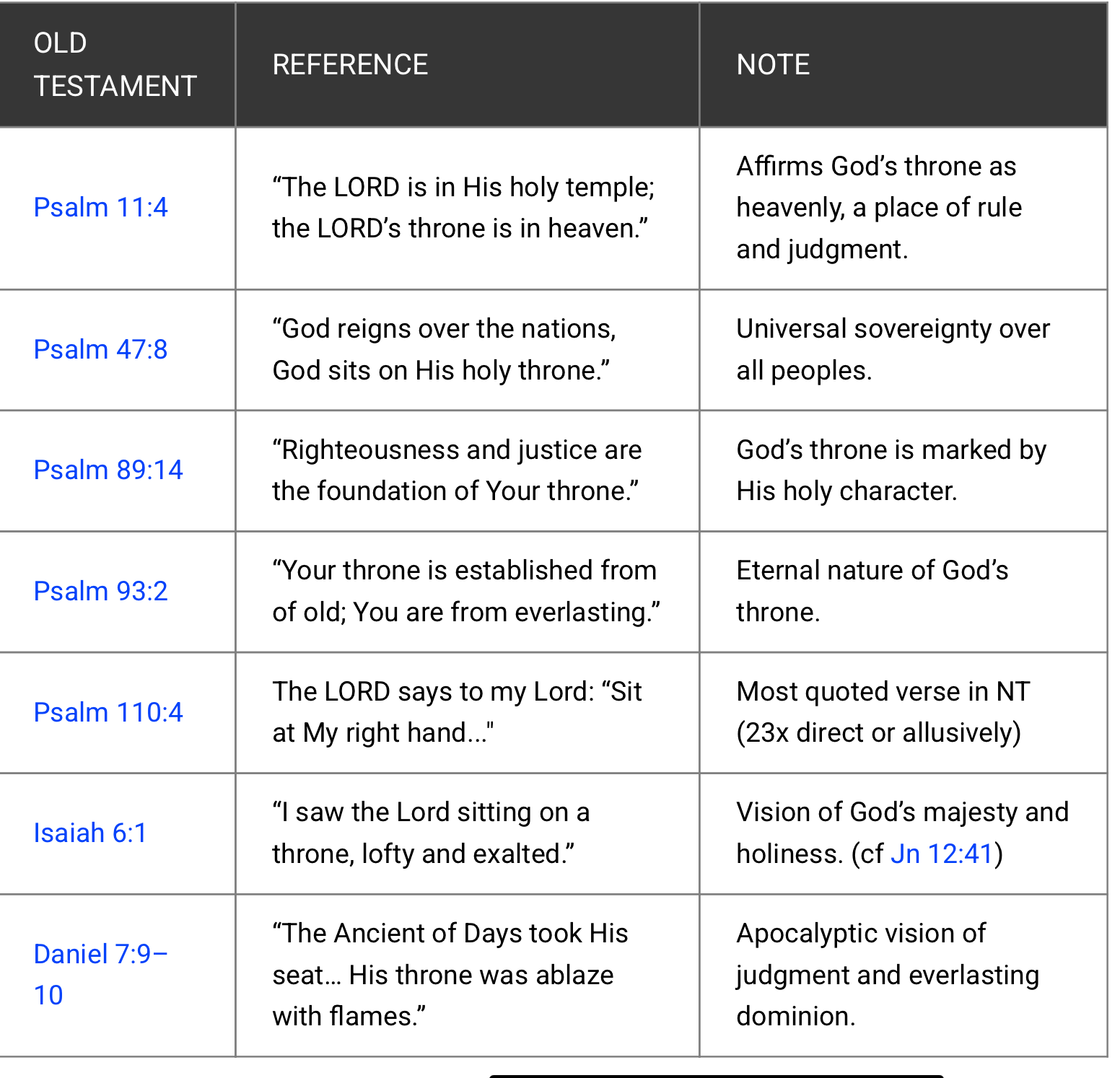
This high priest has taken His seat at the right hand of the throne of the Majesty in the heavens. He is a minister in the sanctuary and in the true tabernacle. I found these excellent tables in Precept Austin that have Old and New Testament references to the throne (I did screenshots of these tables and the links will not work):
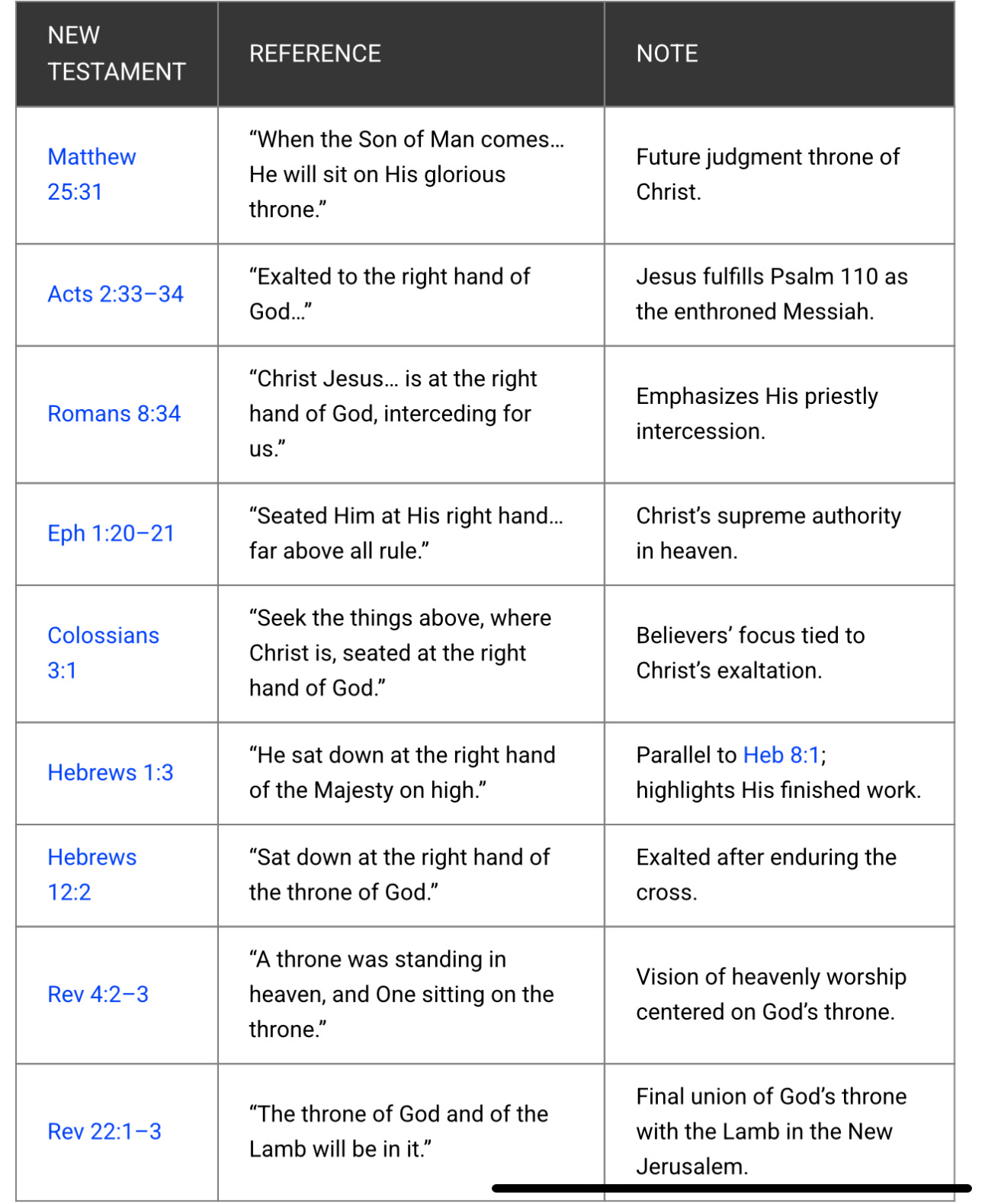
The Son is next to God and is equal to God and is exalted above all else. Hebrews is full of the words from these verses that are scattered throughout its passages.

I’m on a word study kick right now, so let’s look at several words from Hebrews 8:1-3; these are all from the lexicon in the Blue Letter Bible and they recur in Hebrews, as we have seen/will see:
Throne comes from the Greek noun θρόνος or thrónos (Strong’s G2362) with the following Biblical usages:
a throne seat
a chair of state having a footstool
assigned in the NT to kings, hence, kingly power or royalty
metaph. to God, the governor of the world
to the Messiah, Christ, the partner and assistant in the divine administration
hence divine power belonging to Christ
to judges i.e. tribunal or bench
to elders
Noted above in the tables are references to the throne of God in the OT and NT.
Heavens comes from the Greek noun οὐρανός or ouranós (Strong’s G3772) with the following Biblical usages:
the vaulted expanse of the sky with all things visible in it
the universe, the world
the aerial heavens or sky, the region where the clouds and the tempests gather, and where thunder and lightning are produced
the sidereal or starry heavens
the region above the sidereal heavens, the seat of order of things eternal and consummately perfect where God dwells and other heavenly beings
This noun is used 255 times in the New Testament. Jesus used it almost exclusively in the Gospels to refer to the region where God dwells.
Minister comes from the Greek noun λειτουργός or leitourgós (Strong’s G3011), with the following Biblical usages:
a public minister, a servant of the state
a minister, servant
so of military labourers
of the temple
of one busied with holy things
of a priest
of the servants of a king
Our Lord is exalted on high, yet is a servant and priest.
Sanctuary comes from the Greek adjective ἅγιος or hágios (Strong’s G40), which means the most holy thing or saint. Strong’s definitions from the lexicon has this definition: sacred (physically, pure, morally blameless or religious, ceremonially, consecrated):—(most) holy (one, thing), saint. Here is what Charles Spurgeon says about the sanctuary, as quoted in Precept Austin:
The sanctuary was a place in which only one person ever dwelt, and that was God Himself. The mysterious light that they called the Shekinah shone from between the wings of the cherubim; there were the pillar of cloud by day and the pillar of fire by night—the symbols of the divine presence. It was God’s house. No man lived with Him; no man could. The high priest went in but once a year, and out he went again to the solemn assembly.
But now, in Christ Jesus, in Whom dwells all the fullness of the Godhead bodily (Col 2:9), we find a sanctuary to reside in, for we dwell in Him; we are one with Him. God was in Christ, reconciling the world to Himself, not imputing their trespasses unto them (2Co 5:19); and as God was in Christ, so is it written, “You in me, and I in you” (John 17:23+). Such is the union between Christ and His people. Every believer is in Christ, even as God is in Christ. When a Christian loses the realization of the presence of the Lord Jesus Christ, Who is the “minister of the sanctuary and of the true tabernacle that the Lord set up, not man,” then it is, above all other seasons, that he sighs and cries for a renewal of communion with Christ. We would envy any, however poor and insignificant they may be, who can maintain unbroken fellowship with their Lord.
The veil separating us from the sanctuary of the Lord was torn on that day of His crucifixion and death:
“And behold, the veil of the temple was torn in two from top to bottom; and the earth shook and the rocks were split.”
Matthew 27:51 NASB1995
True comes from the Greek adjective ἀληθινός or alēthinós (Strong’s G228), with the following Biblical usages:
that which has not only the name and resemblance, but the real nature corresponding to the name, in every respect corresponding to the idea signified by the name, real, true genuine
opposite to what is fictitious, counterfeit, imaginary, simulated or pretended
it contrasts realities with their semblances
opposite to what is imperfect defective, frail, uncertain
true, veracious, sincere
This adjective modifies the noun for tabernacle, indicating that the only true tabernacle that exists is the one that our Lord inhabits in the heavenly realm.
Tabernacle comes from the Greek noun σκηνή or skēnḗ (Strong’s G4633), with the following Biblical usages:
tent, tabernacle, (made of green boughs, or skins or other materials)
of that well known movable temple of God after the pattern of which the temple at Jerusalem was built
The author of Precept Austin has an interesting perspective on the importance of the tabernacle; in the next devotional, there will be more discussion on typology (see the link in this excerpt):
In Heb 8:2, skene refers to the (definite article signifies its uniqueness) tabernacle but not the one made according to the Old Covenant, for that tabernacle was made largely of skins and was designed to be portable, emphasizing the essence of its impermanence. (See Tabernacle in the Wilderness) The tabernacle of the Old Covenant gave every impression of being a temporary structure, which it was. As an aside, it is fascinating to note that God inspired only two chapters to describe the creation, but took fifteen chapters to describe various aspects of the earthly Tabernacle (esp. Ex 25-40). Clearly, God was saying that the Tabernacle was an important picture, one which demanded the attention of the Jews and for that matter of all believers. And as many expositors have noted (see discussion of Typology), the Tabernacle of the Old Covenant was essentially a “giant portrait of Jesus Christ” (See related study on Covenant: Abrahamic versus Mosaic). Everywhere you look in the Tabernacle you can see the Messiah. And yet the Tabernacle on earth was but a dim picture of the true Tabernacle in heaven.
This is fulfilled in Revelation:
“And I heard a loud voice from the throne, saying, “Behold, the tabernacle of God is among men, and He will dwell among them, and they shall be His people, and God Himself will be among them, and He will wipe away every tear from their eyes; and there will no longer be any death; there will no longer be any mourning, or crying, or pain; the first things have passed away.””
Revelation 21:3-4 NASB1995
This highest of high priests offers both gifts and sacrifice (Himself), as noted in verse 3 of this passage. Charles Spurgeon has an interesting insight into how humans are hard-wired to know that sacrifice is required to access a supreme being:
Go where you may, you will discover that, as soon as ever people begin to say “God,” the next thing they say is “sacrifice”; and though their idea of God is often distorted, and their idea of sacrifice is distorted also, yet both ideas are there. Man, however degraded, cannot altogether forget that there is a God; and then, shrinking back from the awful majesty of the divine holiness, he at least hopes that there is a sacrifice by which his sins may be put away. He feels that there must be one if he is ever to be brought into connection with God; and so, in some form or other, the notion of sacrifice crops up wherever there is any religion at all. It may be in the ghastly form of human sacrifice, which is a hideous misinterpretation which has crept in under the darkness and gloom of heathenism or false teaching; or it may appear in the continued sacrifice of bullocks, or lambs, or other victims; but, somehow or other, the idea is there. Man seems to know, in his inmost nature, that he must bring a sacrifice if he would appear before God; and this is, by no means, an error on his part. However erroneous may be the form it takes, in its essence there is truth in it.
There must be an atonement. That is what it all comes to, or else pardon is impossible.
This theme of offering, gifts and sacrifice is prominent throughout the remaining passages of Hebrews.
My next devotional examines Hebrew 8:4-6 - Would Christ have been a priest on Earth?
Heaven on Wheels Daily Prayer:
Dear Lord - This devotional was a bit technical in its nature but I learn a lot from digging into words and commentary about Your marvelous, mysterious plan for us. Thank you for the inspirations! Amen.
Credits and Citations:
Scripture quotations taken from the (NASB®) New American Standard Bible®, Copyright © 1960, 1971, 1977, 1995 by The Lockman Foundation. Used by permission. All rights reserved. www.Lockman.org.
Precept Austin was accessed on 12/17/2025 to review commentary for Hebrews 8:1-3.
“G2362 - thronos - Strong’s Greek Lexicon (nasb95).” Blue Letter Bible. Web. 17 Dec, 2025. <https://www.blueletterbible.org/lexicon/g2362/nasb95/mgnt/0-1/>.
“G3772 - ouranos - Strong’s Greek Lexicon (nasb95).” Blue Letter Bible. Web. 17 Dec, 2025. <https://www.blueletterbible.org/lexicon/g3772/nasb95/mgnt/0-1/>.
“G3011 - leitourgos - Strong’s Greek Lexicon (nasb95).” Blue Letter Bible. Web. 17 Dec, 2025. <https://www.blueletterbible.org/lexicon/g3011/nasb95/mgnt/0-1/>.
“G40 - hagios - Strong’s Greek Lexicon (nasb95).” Blue Letter Bible. Web. 17 Dec, 2025. <https://www.blueletterbible.org/lexicon/g40/nasb95/mgnt/0-1/>.
“G228 - alēthinos - Strong’s Greek Lexicon (nasb95).” Blue Letter Bible. Web. 17 Dec, 2025. <https://www.blueletterbible.org/lexicon/g228/nasb95/mgnt/0-1/>.
“G4633 - skēnē - Strong’s Greek Lexicon (nasb95).” Blue Letter Bible. Web. 17 Dec, 2025. <https://www.blueletterbible.org/lexicon/g4633/nasb95/mgnt/0-1/>.