


“Now when these things have been so prepared, the priests are continually entering the outer tabernacle performing the divine worship, but into the second, only the high priest enters once a year, not without taking blood, which he offers for himself and for the sins of the people committed in ignorance. The Holy Spirit is signifying this, that the way into the holy place has not yet been disclosed while the outer tabernacle is still standing, which is a symbol for the present time. Accordingly both gifts and sacrifices are offered which cannot make the worshiper perfect in conscience, since they relate only to food and drink and various washings, regulations for the body imposed until a time of reformation.”
Hebrews 9:6-10 NASB1995
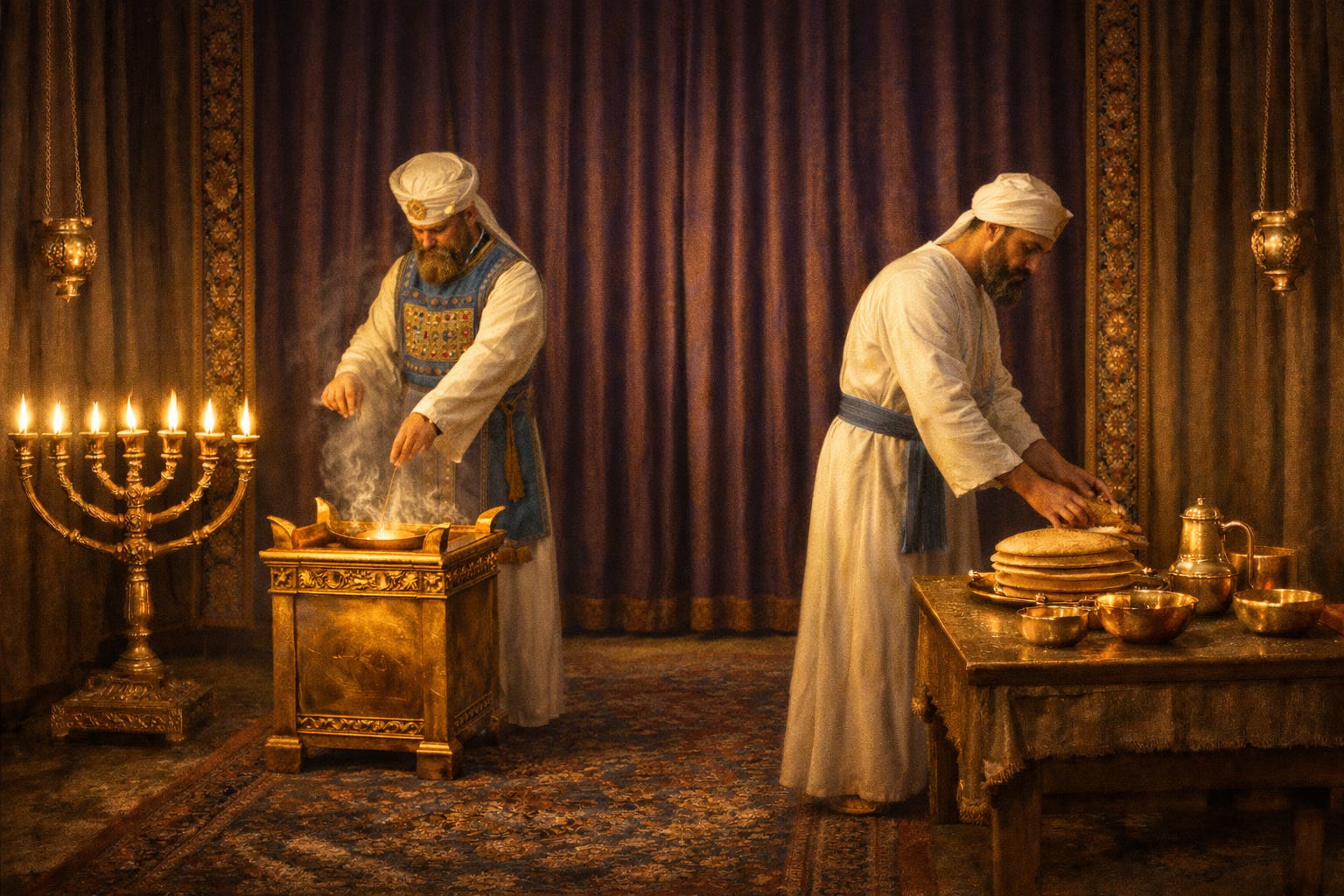
Our outer tabernacle scene that Steve created in AI now shows priests busily attending to the tasks in that place. According to this passage, they are continually entering the outer tabernacle in these tasks of divine worship. The curtain or veil is closed between this outer sanctuary and the “Holy of Holies”, the inner tabernacle containing the Ark of the Covenant and the presence of God. Only once a year, on the Day of Atonement, the high priest alone enters the inner sanctuary. He brings blood, which he offers for himself and for the sins of the people committed in ignorance.
Let’s do some word studies from the Blue Letter Bible for verses 6-7:
Priests comes from the Greek noun ἱερεύς or hiereús (Strong’s G2409), with the following Biblical usages:
a priest, one who offers sacrifices and in general in busied with sacred rites
referring to priests of Gentiles or the Jews,
metaph. of Christians, because, purified by the blood of Christ and brought into close intercourse with God, they devote their life to him alone and to Christ
That second usage is certainly interesting - as a Christian believer, we are all made priests that devote our lives to God and Christ. From Revelation 5:
“And they *sang a new song, saying,
“Worthy are You to take the book and to break its seals; for You were slain, and purchased for God with Your blood men from every tribe and tongue and people and nation.
You have made them to be a kingdom and priests to our God; and they will reign upon the earth.””
Revelation 5:9-10 NASB1995
Are continually comes from the Greek preposition διά or diá (Strong’s G1223), with the following Biblical usages:
through
of place
with
in
of time
throughout
during
of means
by
by the means of
through
the ground or reason by which something is or is not done
by reason of
on account of
because of for this reason
therefore
on this account
Continually implies always in place, time, and means. Does this mean the priests entered the outer tabernacle day and night? Other translations use “regularly” (NLT) or “always” (KJV, NKJV), so this is probably the case. God doesn’t sleep.
Divine worship comes from the Greek noun λατρεία or latreía (Strong’s G2999) with the following Biblical usages:
service rendered for hire
any service or ministration: the service of God
the service and worship of God according to the requirements of the Levitical law
to perform sacred services
Romans 12 uses this same Greek noun in this way (in bold):
“Therefore I urge you, brethren, by the mercies of God, to present your bodies a living and holy sacrifice, acceptable to God, which is your spiritual service of worship.”
Romans 12:1 NASB1995
Committed in ignorance comes from the Greek noun ἀγνόημα or agnóēma (Strong’s G51), which circles back to this Biblical usage:
a sin committed through ignorance or thoughtlessness
This is the only usage of this noun in the New Testament.
Let’s look at some commentary. First, here is what Charles Spurgeon says about the task of the high priest and how this compares to our one true High Priest, as quoted in Precept Austin:
The greatest of the Jewish high priests had to admit that they were sinners themselves, for they had to present sin-offerings on their own account, but our Lord Jesus has no sin of his own; hence in part his ability to bear our sin.....But the high priest could not go within the veil, because he was not perfect. He had to be sprinkled with the blood, and that made him officially perfect. It would not make him perfect merely to put on the breastplate, or to wear the ephod; he was not perfect till the blood had been sprinkled upon him, and then he went within the veil.
But when next year came around he was not fit to go within the veil till blood was sprinkled on him again. And the next year, though he was always a sanctified man, he was not always, officially, a perfect man. He had to be sprinkled with blood again. And so, year after year, the high priest who went within the veil needed afresh to be made perfect in order that he might obtain access to God.
We who are the priests of God have a right as priests to go to God’s mercy seat that is within the veil, but it would be to our death to go there unless we were perfect. But we are perfect, for the blood of Christ has been sprinkled on us, and, therefore, our standing before God is the standing of perfection. Our standing, in our own conscience, is imperfection, just as the character of the priest might be imperfect. But that has nothing to do with it. Our standing in the sight of God is a standing of perfection. When He sees the blood, as of old the destroying angel passed over Israel, so this day, when He sees the blood, God passes over our sins and accepts us at the throne of His mercy as if we were perfect.
It was an endless do-loop for the high priest before Christ came. The high priest was never perfect, but could be sprinkled in the blood of sacrifice to appear sanctified. And he would do this again a year later and a year later…
Steven Cole is quoted in Precept Austin on the sins of ignorance:
The author calls attention to the fact that old system provided a way for forgiveness for “the sins of the people committed in ignorance”. The Law stipulated that there was no sacrifice for sins of defiance (Nu 15:30-31). There is a sense, of course, in which virtually all of our sins stem from defiance toward God, but the reference in Numbers seems to refer to outrageous, blasphemous behavior that represented revolt or treason against God (Ronald Allen, Expositor's Bible Commentary, 2:830).
In this sense, there is a parallel in Hebrews 10:26-31, where the author strongly warns his readers against apostasy for which there is no sacrifice. The annual Day of Atonement ritual would have underscored to Israel a number of vital spiritual truths. It portrayed the absolute holiness of God and how our sin separates us from entering His presence. It showed the sin and defilement of all of the people, including the high priest. It showed that no one dared to enter God’s holy presence without the blood of an acceptable sacrifice. It showed that the people must approach God through the proper mediator, the high priest. It showed that if the proper sacrifice was offered, God would be propitiated or satisfied, so that He would not judge their sins. But, as glorious as all of this ritual was, it was inadequate, for two main reasons: (1) The old system provided limited access to God… (2) The old system provided limited efficacy of the sacrifices. (Hebrews 9:1-14 God's Remedy for Guilt).
More of this will be explored in Hebrews 10.

So now moving on to verses 8-10 in this passage, I think a few more word studies are in order; here are the verses for reference so you don’t have to scroll up to the top:
The Holy Spirit is signifying this, that the way into the holy place has not yet been disclosed while the outer tabernacle is still standing, which is a symbol for the present time. Accordingly both gifts and sacrifices are offered which cannot make the worshiper perfect in conscience, since they relate only to food and drink and various washings, regulations for the body imposed until a time of reformation.”
Signifying comes from the Greek verb δηλόω or dēlóō (Strong’s G1213), with the following Biblical usages:
to make manifest
to make known by relating, to declare
to give one to understand, to indicate, signify
Even though there was a holy place in the tabernacle, the true holy place had not yet been disclosed at the time the outer tabernacle was still standing.
Been disclosed comes from the Greek verb φανερόω or phaneróō (Strong’s G5319), with the following Biblical usages:
to make manifest or visible or known what has been hidden or unknown, to manifest, whether by words, or deeds, or in any other way
make actual and visible, realised
to make known by teaching
to become manifest, be made known
of a person
expose to view, make manifest, to show one’s self, appear
to become known, to be plainly recognised, thoroughly understood
who and what one is
A beautiful usage of this Greek verb is in 1 Timothy:
“By common confession, great is the mystery of godliness:
He who was revealed in the flesh,
Was vindicated in the Spirit,
Seen by angels,
Proclaimed among the nations,
Believed on in the world,
Taken up in glory.”
1 Timothy 3:16 NASB1995
Symbol comes from the Greek noun παραβολή or parabolḗ (Strong’s G3850), with the following Biblical usages:
a placing of one thing by the side of another, juxtaposition, as of ships in battle
metaph.
a comparing, comparison of one thing with another, likeness, similitude
an example by which a doctrine or precept is illustrated
a narrative, fictitious but agreeable to the laws and usages of human life, by which either the duties of men or the things of God, particularly the nature and history of God’s kingdom are figuratively portrayed
a parable: an earthly story with a heavenly meaning
a pithy and instructive saying, involving some likeness or comparison and having preceptive or admonitory force
an aphorism, a maxim
a proverb
an act by which one exposes himself or his possessions to danger, a venture, a risk
Our Lord spoke to the people using many parables, which are symbols (or perhaps types?) with heavenly meanings:
“All these things Jesus spoke to the crowds in parables, and He did not speak to them without a parable. This was to fulfill what was spoken through the prophet: “I will open My mouth in parables;
I will utter things hidden since the foundation of the world.””
Matthew 13:34-35 NASB1995
Conscience comes from the Greek noun συνείδησις or syneídēsis (Strong’s G4893), with the following Biblical usages:
the consciousness of anything
the soul as distinguishing between what is morally good and bad, prompting to do the former and shun the latter, commending one, condemning the other
the conscience
The exploration of “conscience” recurs in Hebrews 9, 10 and 11.
Reformation comes from the Greek noun διόρθωσις or diórthōsis (Strong’s G1357), with the following Biblical usages:
in a physical sense, a making straight, restoring to its natural and normal condition something which in some way protrudes or has got out of line, as broken or misshapen limbs
of acts and institutions, reformation
This is the only usage of this noun the New Testament.
The typology is thick in these passages in Hebrews 9. Once again, the physical tabernacle, in its flaws, points to the perfect tabernacle of Jesus. Our conscience can never be cleaned by sinful, flawed priests and the blood of animal sacrifices. Why would the Jewish believers in Christ want to return to that poor imitation of the perfect mediator and High Priest?

By the way, Precept Austin has a marvelous series of quotes by Charles Spurgeon on the conscience, which is like an eternal flame within our minds and souls:
Conscience may tell me that something is wrong, but how wrong it is conscience itself does not know. Did any man’s conscience, unenlightened by the Spirit, ever tell him that his sins deserved damnation? Did it ever lead any man to feel an abhorrence of sin as sin? Did conscience ever bring a man to such self-renunciation that he totally abhorred himself and all his works and came to Christ?
A man sees his enemy before him. By the light of his candle, he marks the insidious approach. His enemy is seeking his life. The man puts out the candle and then exclaims, “I am now quite at peace.” That is what you do. Conscience is the candle of the Lord. It shows you your enemy. You try to put it out by saying, “Peace, peace! Put the enemy out!” God give you grace to thrust sin out!
Conscience is like a magnetic needle, which, if once turned aside from its pole, will never cease trembling. You can never make it still until it is permitted to return to its proper place.
I recollect the time when I thought that if I had to live on bread and water all my life and be chained in a dungeon, I would cheerfully submit to that if I might but get rid of my sins. When sin haunted and burdened my spirit, I am sure I would have counted the martyr’s death preferable to a life under the lash of a guilty conscience
O believe me, guilt upon the conscience is worse than the body on the rack. Even the flames of the stake may be cheerfully endured, but the burnings of a conscience tormented by God are beyond all measure unendurable.
This side of hell, what can be worse than the tortures of an awakened conscience?
He was a fool who killed the watchdog because it alarmed him when thieves were breaking into his house. If conscience upbraids you, feel its upbraiding and heed its rebuke. It is your best friend.
Give me into the power of a roaring lion, but never let me come under the power of an awakened, guilty conscience. Shut me up in a dark dungeon, among all manner of loathsome creatures—snakes and reptiles of all kinds—but, oh, give me not over to my own thoughts when I am consciously guilty before God!
Fire such as martyrs felt at the stake were but a plaything compared with the flames of a burning conscience. Thunderbolts and tornadoes are nothing in force compared with the charges of a guilty conscience.
When a swarm of bees gets about a man, they are above, beneath, around, everywhere stinging, every one stinging, until he seems to be stung in every part of his body. So, when conscience wakes up the whole hive of our sins, we find ourselves compassed about with innumerable evils: sins at the board and sins on the bed, sins at the task and sins in the pew, sins in the street and sins in the shop, sins on the land and sins at sea, sins of body, soul, and spirit, sins of eye, of lip, of hand, of foot, sins everywhere. It is a horrible discovery when it seems to a man as if sin had become as omnipresent with him as God is.
The conscience of man, when he is really quickened and awakened by the Holy Spirit, speaks the truth. It rings the great alarm bell. And if he turns over in his bed, that great alarm bell rings out again and again, “The wrath to come! The wrath to come! The wrath to come! “
Nothing can be more horrible, out of hell, than to have an awakened conscience but not a reconciled God—to see sin, yet not see the Savior—to behold the deadly disease in all its loathsomeness, but not trust the good Physician, and so to have no hope of ever being healed of our malady.
I would bear any affliction rather than be burdened with a guilty conscience.
It is a blessed thing to have a conscience that will shiver when the very ghost of a sin goes by—a conscience that is not like our great steamships at sea that do not yield to every wave, but, like a cork on the water, goes up and down with every ripple, sensitive in a moment to the very approach of sin. May God the Holy Spirit make us so! This sensitiveness the Christian endeavors to have, for he knows that if he has it not, he will never be purified from his sin.
There are thousands of people in this country who would be greatly troubled in their minds if they did not go to church twice on Sundays. And they get comfort in this because their conscience is dead. If their conscience were really awakened, they would understand that there is no connection between conscience and outward forms.
So, so good! My conscience rang out constantly for His mercy and grace when I was wandering in the wilderness. Now that He is guiding me and has redeemed me, my conscience is at peace (well, most of the time - sin is still an enemy).
I hope that wasn’t too much of a disjointed journey through these verses in Hebrews 9. I’m writing this on Christmas, so it is a joy to know that we have a real sanctuary in the heavenly realm that is “once for all”.
My next devotional examines Hebrews 9:11-14 - The perfection of Christ as the High Priest.
Heaven on Wheels Daily Prayer:
Dear Lord - If anyone doubts You and Your sovereignty, we can ask them where a conscience comes from. Our conscience is a gift from You to help us stay aligned to true North. I am so grateful to You, Lord, as You came down from Heaven to guide us to the perfect sanctuary! Amen!
Credits and Citations:
Scripture quotations taken from the (NASB®) New American Standard Bible®, Copyright © 1960, 1971, 1977, 1995 by The Lockman Foundation. Used by permission. All rights reserved. www.Lockman.org.
Precept Austin was accessed on 12/25/2025 to review commentary for Hebrews 9:6-10
The Steven Cole sermon cited from Precept Austin comes from this source: https://bible.org/seriespage/lesson-25-god’s-remedy-guilt-hebrews-91-14, Copyright, Steven J. Cole, 2004, All Rights Reserved. Unless otherwise noted, all Scripture Quotations are from the New American Standard Bible, Updated Edition © The Lockman Foundation
“G2409 - hiereus - Strong’s Greek Lexicon (NASB95).” Blue Letter Bible. Web. 25 Dec, 2025. <https://www.blueletterbible.org/lexicon/g2409/nasb95/mgnt/0-1/>.
“G1223 - dia - Strong’s Greek Lexicon (NASB95).” Blue Letter Bible. Web. 25 Dec, 2025. <https://www.blueletterbible.org/lexicon/g1223/nasb95/mgnt/0-1/>.
“G2999 - latreia - Strong’s Greek Lexicon (NASB95).” Blue Letter Bible. Web. 25 Dec, 2025. <https://www.blueletterbible.org/lexicon/g2999/nasb95/mgnt/0-1/>.
“G51 - agnoēma - Strong’s Greek Lexicon (NASB95).” Blue Letter Bible. Web. 25 Dec, 2025. <https://www.blueletterbible.org/lexicon/g51/nasb95/mgnt/0-1/>.
“G1213 - dēloō - Strong’s Greek Lexicon (NASB95).” Blue Letter Bible. Web. 25 Dec, 2025. <https://www.blueletterbible.org/lexicon/g1213/nasb95/mgnt/0-1/>.
“G5319 - phaneroō - Strong’s Greek Lexicon (NASB95).” Blue Letter Bible. Web. 25 Dec, 2025. <https://www.blueletterbible.org/lexicon/g5319/nasb95/mgnt/0-1/>.
“G3850 - parabolē - Strong’s Greek Lexicon (NASB95).” Blue Letter Bible. Web. 25 Dec, 2025. <https://www.blueletterbible.org/lexicon/g3850/nasb95/mgnt/0-1/>.
“G4893 - syneidēsis - Strong’s Greek Lexicon (NASB95).” Blue Letter Bible. Web. 25 Dec, 2025. <https://www.blueletterbible.org/lexicon/g4893/nasb95/mgnt/0-1/>.
“G1357 - diorthōsis - Strong’s Greek Lexicon (NASB95).” Blue Letter Bible. Web. 25 Dec, 2025. <https://www.blueletterbible.org/lexicon/g1357/nasb95/mgnt/0-1/>.