


“Now even the first covenant had regulations of divine worship and the earthly sanctuary. For there was a tabernacle prepared, the outer one, in which were the lampstand and the table and the sacred bread; this is called the holy place. Behind the second veil there was a tabernacle which is called the Holy of Holies, having a golden altar of incense and the ark of the covenant covered on all sides with gold, in which was a golden jar holding the manna, and Aaron’s rod which budded, and the tables of the covenant; and above it were the cherubim of glory overshadowing the mercy seat; but of these things we cannot now speak in detail.”
Hebrews 9:1-5 NASB1995
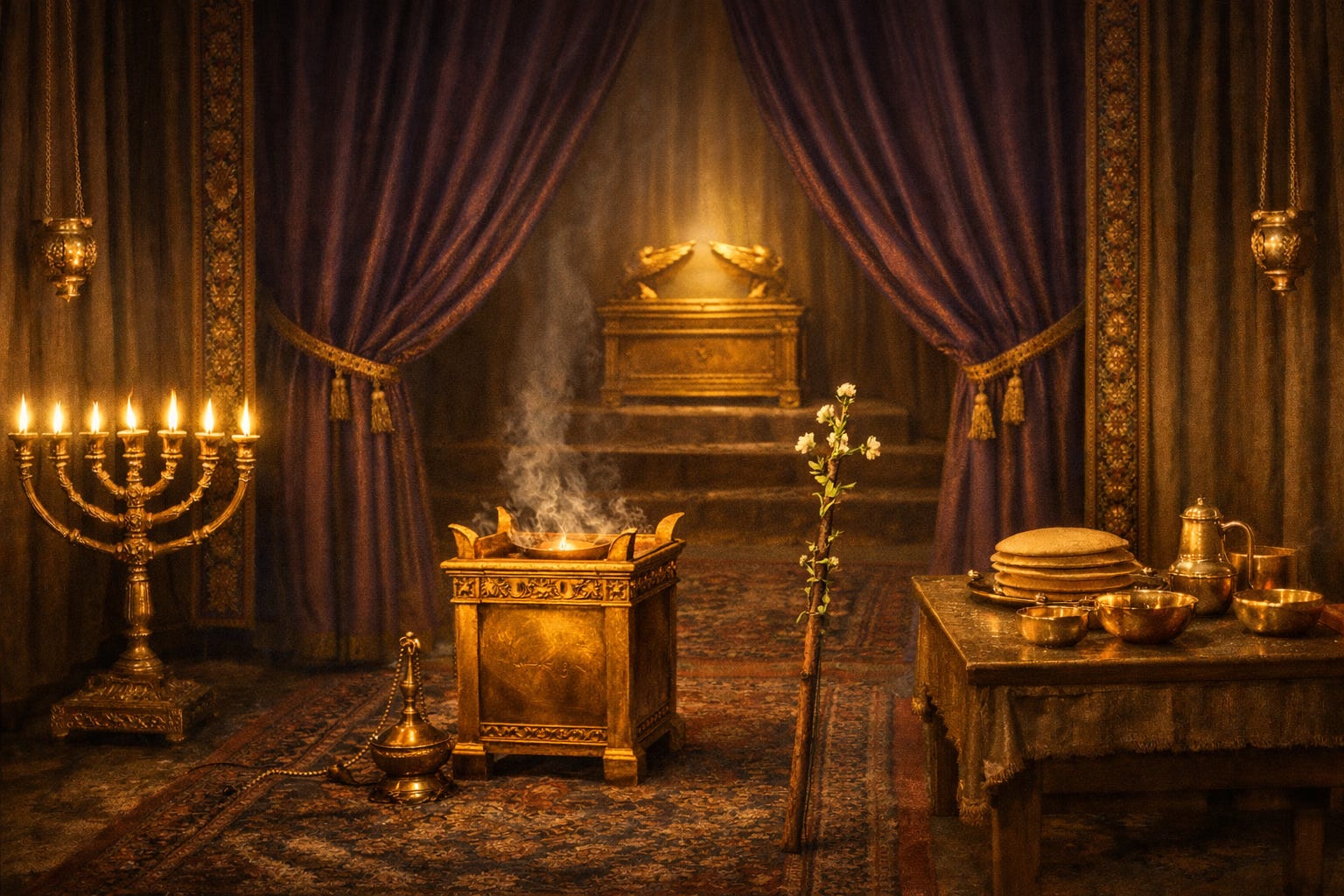
This journey through Hebrews has now reached Chapter 9. This devotional passage, which includes the first five verses, describes in more detail the earthly sanctuary. I had Steve create an AI image of the Tabernacle. This image is, of course, not totally correct, as the curtains (veil) to the Holy of Holies (with the Ark of the Covenant) would always be closed. But it does capture the various furniture elements, including the lampstand, the table with the sacred bread, the wood altar of incense with gold leaf, the jar holding manna and the rod of Aaron, which budded miraculously (Numbers 17:23). The latter two elements are normally described as being in the Ark of the Covenant along with the tablets, but the AI image shows them outside for reference. This image (and, interestingly, the description in this passage) also does not include two elements that are outside the Tabernacle tent walls and inside the fence, the Brazen Altar and the Laver for sanctification.
A couple of details about the tabernacle grounds are also intriguing, from Precept Austin:
The door of the Tabernacle always faced East (Ezekiel 11:1-12, Ezekiel 44:1,2, cf Ge 3:24+). The Tribe of Judah was encamped directly to the East of this door! (see Numbers 2:3+"toward the sunrise"!) (Jesus is the Lion of the Tribe of Judah - see Rev 5:5+)
Here is a decent description of these verses and links to the Old Covenant OT passages from Enduring Word:
a. The earthly sanctuary: The tabernacle ordained by the Old Covenant was planned by God, but planned for an earthly service.
b. For a tabernacle was prepared: The tabernacle was a tent 45 feet (15 meters) long, 15 feet (5 meters) wide, and 15 feet (5 meters) high, divided into two rooms. The larger room (the first part) was a 15 feet (5 meter) by 30 feet (10 meter) “holy place.” Behind the second veil was the smaller room was a 15 feet (5 meter) by 15 feet (5 meter), called the Holiest of All.
c. The lampstand: This setting for the lamps of the tabernacle had a middle stem and six branches stood in the first part. It was of an unspecified size, made of pure gold and provided the only light for the tabernacle (Exodus 25:31-40).
d. The table: This sat in the first part and was made of acacia wood covered with gold, 3 feet long, 1½ feet wide, and 2 feet 3 inches high. It held twelve loaves of showbread, each representing God’s fellowship with the twelve tribes of Israel (Exodus 25:23-30).
e. The sanctuary: This refers to the first part, known as the “holy place.” A veil (a thick curtain) separated the first part from the Holiest of All, also known as the “holy of holies” (Exodus 26:31-33).
f. The golden altar of incense: This was made of acacia wood covered with gold, 1½ feet (½ meter) square, and 3 feet (1 meter) high. It stood at the veil before the “holy of holies” and was used to burn incense (Exodus 30:1-8).
g. The ark of the covenant: This stood inside the Holiest of All and was a chest made of acacia wood covered with gold, 3¾ feet long, 2¼ feet wide, and 2¼ feet high, with rings for polls along its side to carry it without touching the ark itself (Exodus 25:10-22).
i. Inside the ark were the golden pot that had the manna (Exodus 16:33), Aaron’s rod that budded (Numbers 17:6-11), and the tablets of the covenant (Exodus 25:16).
· The manna reminded Israel of God’s provision and their ungratefulness.
· Aaron’s rod reminded Israel of their rebellion against God’s authority.
· The tablets of the covenant reminded Israel of their failure to keep the Ten Commandments and rest of the law.
h. The mercy seat: This was the ornate “lid” for the ark of the covenant, made with the designs of cherubim upon it. The blood of sacrifice was sprinkled upon it for the forgiveness of Israel’s sin on the Day of Atonement (Exodus 25:17-22).
i. As God looked down into the ark, He saw the symbols of Israel’s sin, rebellion and failure. But when the blood of sacrifice was applied to the mercy seat, the blood of sacrifice covered His sight of the sin of Israel.
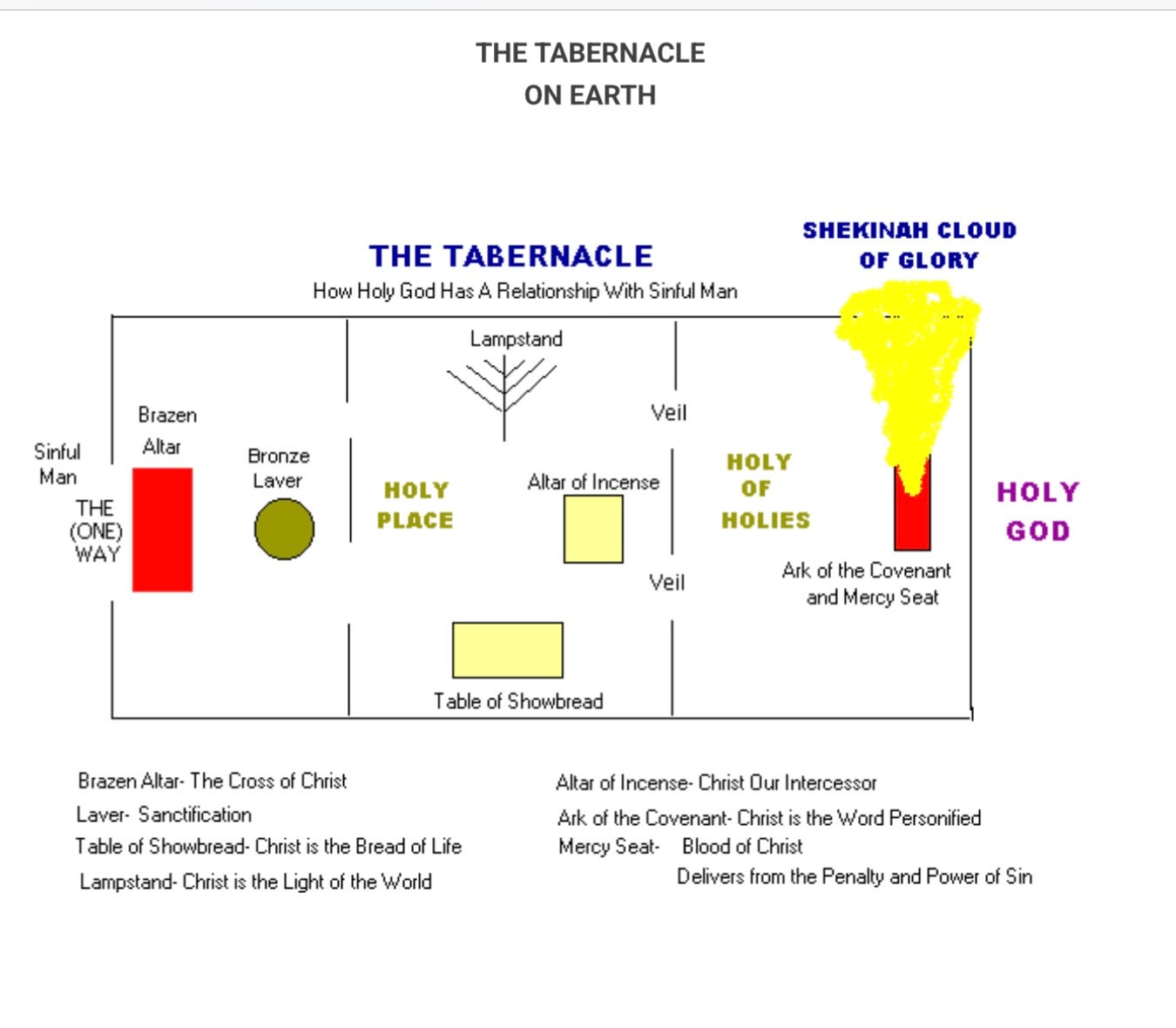
Now hopefully readers will recall my excursion into scriptural typology a couple of devotionals ago. The Old Covenant Tabernacle, is, pure and simple, a typology that represents Christ (not an allegory, but a shadow or picture or copy). Precept Austin has incredible details on the elements from many commentators, but suffice to say a picture from Bruce Hurt’s commentary is worth a thousand words; in particular, pay attention to the caption and types noted below the drawing:
Ray Stedman is quoted in Precept Austin (same link as the image above) with this remarkable insight; bracketed phrases are from Bruce Hurt or from me:
As the author [of Hebrews] points out in verses 1-10, the typology of the tabernacle has great meaning for believers today since it depicts the eternal verities which Moses saw and which were associated with the new covenant and its priesthood. If we wish to understand that new priesthood and covenant, we must carefully study the tabernacle, both its structure and its rituals. This teaching would be readily acceptable to the readers of this treatise who came from Jewish backgrounds. The writer builds on this knowledge to unfold the great advantages of the new ministry.
Recall that the writer had begun his discussion of the first covenant in Hebrews 8, writing…
Hebrews 8:7+ For if that first covenant had been faultless, there would have been no occasion sought for a second.
Hebrews 8:13+ When He said, “A new covenant,” He has made the first obsolete. But whatever is becoming obsolete and growing old is ready to disappear.
The term first covenant [Click for summary of Covenant in the Bible] refers to the Old Covenant which God made with the nation of Israel at Mt Sinai after they had been delivered from bondage in Egypt. The first covenant was a temporary covenant as signified by the earthly character of the sanctuary. Likewise, the tabernacle (think of a tent) was temporary. Temporary yes, but worthless, no. In fact the tabernacle was intended to hold such a central place in the life of Israel that Moses was warned not to deviate one iota from the pattern given him when he had it constructed. Everything about the Tabernacle was intended to be a word picture ultimately fulfilled in Jesus.
Keep in mind that the two unconditional covenants, Abrahamic and New, are related, and both are entered into by grace through faith. The New Covenant while a distinct covenant is in a sense an expansion of the Abrahamic Covenant, and adds the features that the Law would be written on hearts (implying the desire and power to obey) and forgiveness for sins was granted (not mentioned under the Abrahamic Covenant). The relationship between the Abrahamic, Old and New Covenants can be summarized as follows:
Abrahamic Covenant - Promise of Jesus Christ
Old Covenant - Picture of Jesus Christ
New Covenant - Person of Jesus Christ
The writer of Hebrews does not want to get bogged down in more details about the earthly Tabernacle so he ends this passage by saying he will not speak in more detail (verse 5). He is eager to get on to more of the typology presented by the Old Covenant that is fulfilled in Christ.
I’ll end this with the inestimable Charles Spurgeon and his commentary on Hebrews 9:1-5 as found in yet another Precept Austin repository :
That is to say, a material sanctuary, a sanctuary made out of such things as this world contains. Under the old covenant, there were certain outward symbols. Under the new covenant, we have not the symbols, but we have the substance itself. The old law dealt with types and shadows, but the gospel deals with the spiritual realities themselves.
That is, a sanctuary belonging to this world, a visible sanctuary. That first covenant was to a large degree a thing of outward rites and ceremonies, which the new covenant is not; that is a covenant of spiritual and unseen realities.
All this was by divine appointment; the form of the rooms, the style of the furniture, everything was ordained of God; and that not merely for ornament, but for purposes of instruction. As we shall see farther on, the Holy Ghost intended a significance, a teaching, a meaning, about everything in the old tabernacle, whether it was a candlestick, or a table, or the shewbread.
Because it was not his main purpose at that time, and he was writing an important Epistle upon the most vital truths and it would not do to encumber it with too many explanations.
My next devotional examines Hebrews 9:6-10 - Priestly service during the Old Covenant.
Heaven on Wheels Daily Prayer:
Dear Lord - I am grateful for these insights! I knew, but really didn’t know the typology of the Old Covenant Tabernacle. It all links together, as You intended! Amen.
Credits and Citations:
Scripture quotations taken from the (NASB®) New American Standard Bible®, Copyright © 1960, 1971, 1977, 1995 by The Lockman Foundation. Used by permission. All rights reserved. www.Lockman.org.
Precept Austin was accessed on 12/23/2025 to review commentary for Hebrews 9:1-5.
Commentary from Enduring Word by David Guzik is used with written permission. ©1996-present The Enduring Word Bible Commentary by David Guzik – enduringword.com.