


“For the Law, since it has only a shadow of the good things to come and not the very form of things, can never, by the same sacrifices which they offer continually year by year, make perfect those who draw near. Otherwise, would they not have ceased to be offered, because the worshipers, having once been cleansed, would no longer have had consciousness of sins? But in those sacrifices there is a reminder of sins year by year. For it is impossible for the blood of bulls and goats to take away sins.”
Hebrews 10:1-4 NASB1995
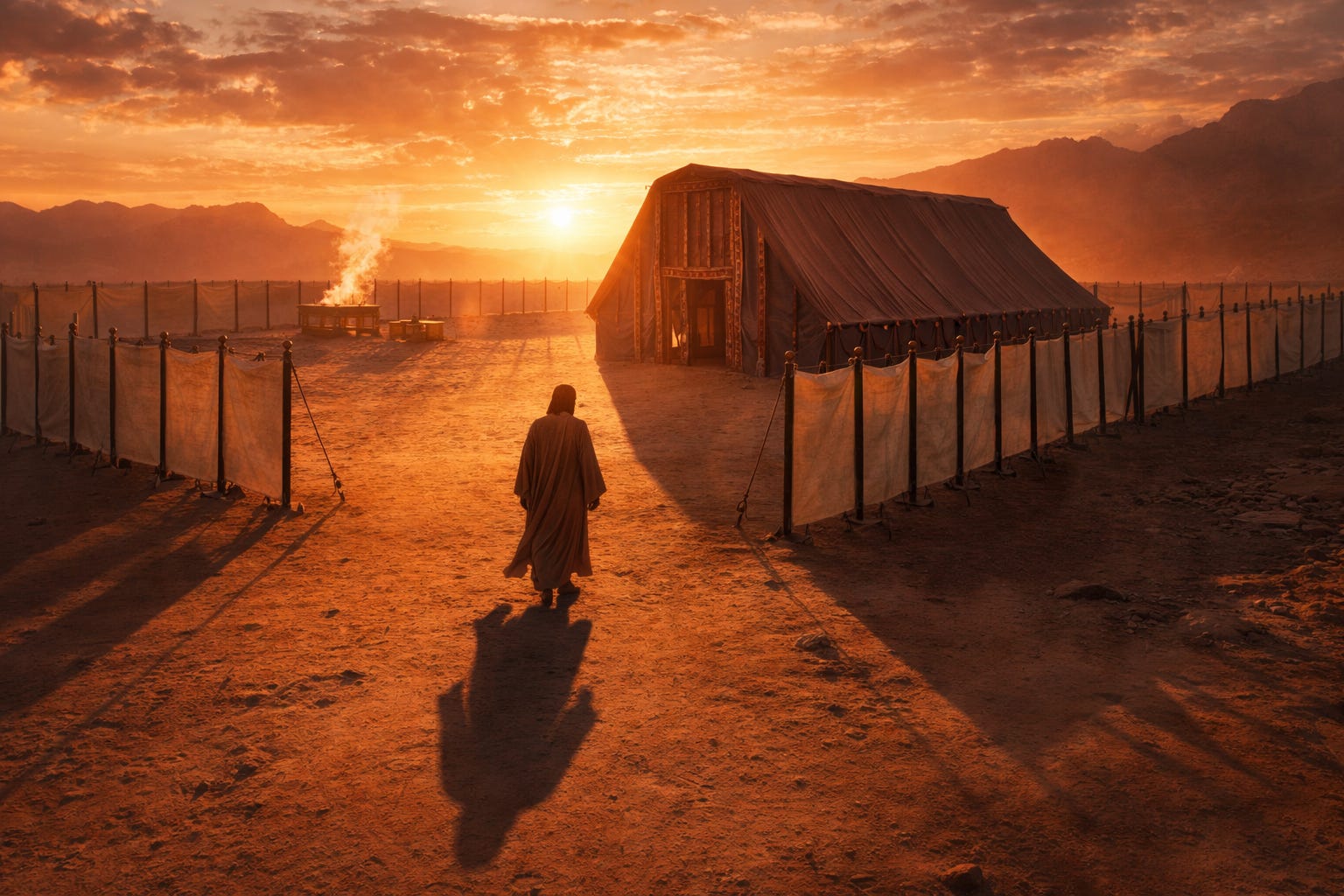
I’ll say one thing for the author of Hebrews: He knows the value of repetition in driving home the points that he is trying to make. Chapter 10 once again reiterates that the Law is only a shadow of the good things to come. I found the AI image that Steve created (above) to be quite compelling. Jesus is approaching the Tabernacle and He is apparent in His form and also has a sharp shadow behind Him. He is the very form of things to come! We don’t worship the shadow, we worship the Being, who is our Savior and Creator. He is replacing the Tabernacle and the Law. He has put sin behind us, but going back and relying on an annual animal sacrifice does not take away sins.
Two commentaries are quite good about this passage. First, I really liked this one from R. Kent Hughes, found on Precept Austin:
Soon after I began to date my future wife, Barbara, I obtained her picture—a beautiful black-and-white 8 x 10 photograph taken the year before we met—and it immediately became an item of pre-nuptial “worship.” It was one of those bare-shouldered, sorority-style pictures so popular at the time. She looked like an angel floating in the clouds. It became my portable hope, most often sitting on my desk, sometimes in my car, at other times propped in front of my plate and my love-struck eyes. However, the day came when we stood before God and our families and friends and pledged our lives to each other as she became mine. Suddenly I had gone from the possession of a one-dimensional portrait to the possession of the real thing, who smiled, talked, and laughed—a real, three-dimensional wife—a living, life-loving soul! And the picture? It remained just as beautiful, but from then on it received relatively scant attention.
But imagine that one day I appear before my wife holding the black-and-white photograph, and I say, “My dear, I’ve missed your picture, and I’m going back to it. I really am attached to the silhouette and the monochrome shading and the matte finish.” Then I passionately kiss the glass protecting the photograph, clutch it to my chest, and exit mumbling my devotion to the picture—“I love you, O photograph of my wife. You’re everything to me.” People’s suspicions that pastors are weird would be confirmed. Time to call for the men in the white jackets! How absurd for anyone, once having the substance, to go back to the shadow. Yet, some in the early church were forsaking the Covenant of Grace for the Old Covenant of the Law. And this is what the author of Hebrews wants to steel his people against as he concludes his comparison of the Old and New Covenants in 10:1–18. (See Hebrews: An Anchor for the Soul)
What a great anecdote! Why would we trade the real thing for a shadow or even a Black & White photo?
We have enjoyed traveling to various places in our lives. You can look at pictures and videos of scenic locations or fascinating cities for hours and hours and still not get the full sensation of the place until you are actually there! It’s one thing to watch the ball drop on New Year’s Eve in Times Square on TV; it is something altogether amazing and equally intimidating to walk into that busy place any time of the day or year and try to absorb the sights, sounds and craziness. It’s one thing to watch a video of my favorite National Park — Yellowstone — and see animals and geysers and beautiful streams and waterfalls. It’s quite another thing to be caught up in a Bison jam, have your window rolled down slightly and then have a big bison bull walk inches away from your vehicle (the temptation to pat his hide was quite strong, but I avoided that because we didn’t want our car wrecked)!

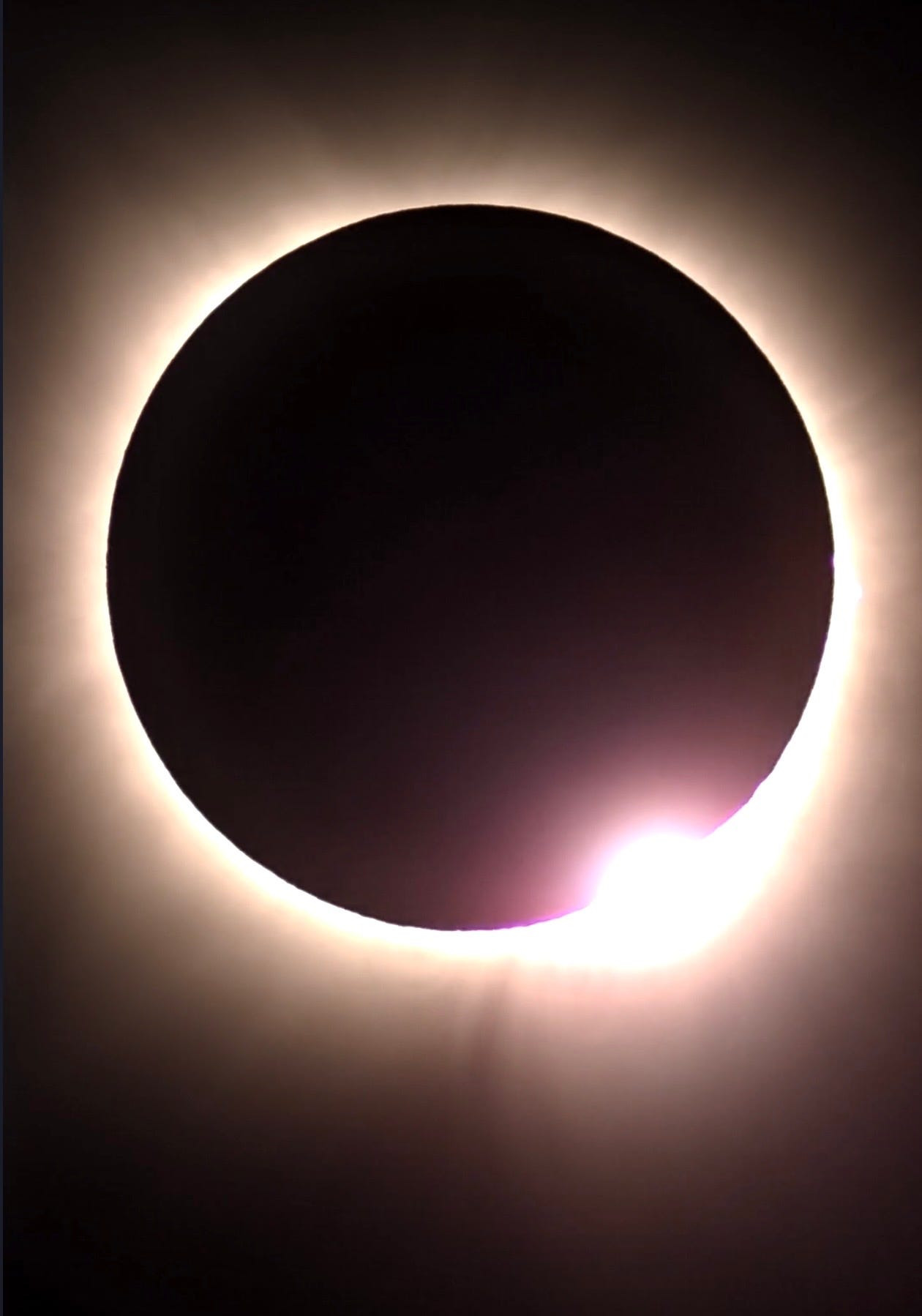
Probably one of the best events that must be experienced in person is one that is, ironically, involves a shadow! We have seen three total solar eclipses and it is truly a magnificent display of God’s creation! Pictures can never replace the sensations of the event itself: The temperature drops, the sky looks strange, birds fly into their nests, the shadow comes from the west at a remarkable speed (from 1100 mph at the equator to faster speeds at higher latitudes) and then you are plunged into a weird daytime darkness with sunsets all around the horizon. Suddenly, the sun reappears and the proper eclipse glasses go back on) and it’s daylight again! We hope to see two more eclipses in the next two years.
You can use a solar eclipse as an analogy for what the writer of Hebrews is trying to get across to the wobbly Jewish believers. Their acceptance of Christ brought them into the blazing full light of His glory. They are thinking about blocking out that light by going back to the old ways, which puts them into a deep shadow of doubt and confusion and fear, with eternal implications.
The second commentary is from Enduring Word:
a. Having a shadow of the good things to come: The Old Covenant (the law) was a mere shadow of the substance that is the New Covenant (also in Colossians 2:17 and Hebrews 8:5). Shadow means that the law communicated the outline and the figure of the fulfillment to come in Jesus, but was not the very image of the things.
i. Shadow isn’t a bad thing. Sometimes a shadow can tell you a lot. But the shadow is not the substance. The Old Covenant and its law were not themselves bad or evil, they are only incomplete and insufficient to bring total cleansing from sin, and to save. The shadow… can never… make those who approach perfect.
ii. Newell notes that here the law is called a shadow and not the very image of the things – it is not an eikon. “An image, or eikon, like a good statue or a photograph, reveals features and facts accurately. This a shadow cannot do… Now The Law had only shadows.” (Newell)
iii. “For example, you need a load of wood: you go to the wood man, and he takes you to a large oak tree in the far corner of the lot. Pointing to the long shadow it casts, he offers to sell you this shadow. Will you take it? Now, if God says that in the Law there was a shadow, not even the very image of the things – and of course, not the things themselves, why will you hold to the shadow?” (Newell)
iv. “When the sun is behind, the shadow is before; when the sun is before, the shadow is behind. So was it in Christ to them of old. The Sun was behind, and therefore the law or shadow was before; to us under grace the Sun is before, and now the ceremonies of the law, these shadows, are behind you, vanished away.” (Trapp)
v. “In effect he is saying: ‘Without Christ you cannot get beyond the shadows of God.’” (Barclay) The very image: The ancient Greek word eikon “Suggests what is in itself substantial and also gives a true representation of that which it images.” (Dods)
b. Would they not have ceased to be offered? The writer to the Hebrews repeats a familiar argument: the repetition of sacrifice shows its inherent weakness. If animal sacrifices had solved the sin problem, then they could have ceased to be offered.
c. For the worshipers, once purified, would have had no more consciousness of sins. But in those sacrifices there is a reminder of sins every year: Every repeated sacrifice was a reminder of sins. It brought the consciousness of sins to the people again and again. But the work of Jesus on the cross takes away sin!
i. “All they are is a reminder of sin. So far from purifying a man, they remind him that he is not purified and that his sins still stand between him and God.” (Barclay)
ii. “An atonement that needs constant repetition does not really atone; a conscience which has to be cleansed once a year has never been truly cleansed.” (Robinson)
d. For it is not possible that the blood of bulls and goats could take away sins: Animal sacrifice under the Old Covenant could cover sin. The Hebrew word for atonement is kophar, which literally means, “to cover.” Yet animal sacrifice could never take away sins. Only Jesus, the Perfect Sacrifice of the New Covenant, takes sins away.
i. “There was a kind of priestly tread-mill of sacrifice…There was no end to this process and it left men still conscious of their sin and alienated from God.” (Barclay)
ii. “‘Take away’ (aphaireo) is used of a literal taking off, as in Peter’s cutting off the ear of the high priest’s slave (Luke 22:50), or metaphorically as of the removal of reproach (Luke 1:25). It signifies the complete removal of sin so that it is no longer a factor in the situation. That is what is needed and that is what the sacrifices could not provide.” (Morris)
iii. “Hering, for example, points out that this distinguishes Christianity from the mystery religions, where the sacrifice of the god was repeated annually. In fact, there is no other religion in which one great happening brings salvation through the centuries and throughout the world. This is the distinctive doctrine of Christianity.” (Morris)
This is excellent commentary and worth reading slowly and more than once.
In my other readings, I found that there is an inadvertent side effect of the continued sacrificial system on sin - it would increase the amount of sinning! Here’s what Precept Austin says about this; the link to “The Purpose of the Law” goes to another page in Precept Austin that continues this discussion:
Excerpt from The Purpose of the Law - a “negative” effect -- As an aside one purpose of the law has an interesting (and unwanted) “side effect“ -- while law is given to reveal sin, what is amazing is that law in fact increases sin. This is one of the great dangers of a legalistic spirit. To say “I won’t” in reliance on my natural power is to put myself under the law which is exactly where my flesh wants me to be placed! Living under the “Law” never changes you [my emphasis]. If you focus only on what you shouldn’t do, you will be pulled more powerfully to do it. Here is a Scripture that supports this premise “For while we were in the flesh, the sinful passions, which were aroused by the Law, were at work in the members of our body to bear fruit for death.” (Romans 7:5+).....
Augustine - Nothing could be truer. For a prohibition always increases an illicit desire so long as the love of and joy in holiness is too weak to conquer the inclination to sin. So without the aid of divine grace it is impossible for man to love and delight in sanctity. (CITY OF GOD)
I will never forget an illustration of this by Charles Swindoll who described a beautiful “putting green” like lawn in his front yard. And to keep it pristine, he placed a sign so the kids would not ride their bikes over the lawn “STAY OFF THE LAWN.” You guessed it! Kids began to ride “rampant” over his “putting green” lawn. That’s the effect of the Law!!!
In Galveston, Texas, a hotel on the shore of the Gulf of Mexico put this notice in each room: NO FISHING FROM THE BALCONY Yet every day, hotel guests threw in their lines to the waters below. Then the management decided to TAKE DOWN THE SIGNS – Guess what happened? The fishing stopped! (For more discussion see The Purpose of the Law - a “negative” effect).
We are in the first week of another New Year. Resolutions are being tossed around by most people - to lose weight, to read the Bible more, to save more money. By February 1, most of those resolutions will be forgotten or overcome by events. Our fallen human natures gravitate towards the things that are fun, not good for our health, and even quite sinful! I always think of how easy it was for the bad boys in “Pinocchio” to corrupt the innocent puppet (that story has a great hidden Christian allegory, that being bad leads to becoming like an animal and being enslaved).
The good news is that the substance of Christ and His divine grace has overcome the shadow of the Law and of sin! The Son is shining!
My next devotional examines Hebrews 10:5-10 - A body has been prepared to do the will of God.
Heaven on Wheels Daily Prayer:
Dear Lord - Experiencing Your grace and knowing of Your atoning sacrifice on the Cross for us for all time to remove the consciousness of sin from our minds is like coming out of the shadow of a solar eclipse into the bright light of a Heavenly day. Amen.
Heaven on Wheels Daily Prayer:
Dear Lord - I have faith in You that I am continuing in my sanctification, after being justified by Your grace, repenting and believing in You. I have faith that the first sight I will see after death will be the joyous glory of Your light. Amen.
Credits and Citations:
Scripture quotations taken from the (NASB®) New American Standard Bible®, Copyright © 1960, 1971, 1977, 1995 by The Lockman Foundation. Used by permission. All rights reserved. www.Lockman.org.
Precept Austin was accessed on 01/06/2026 to review commentary for Hebrews 10:1-4. Within the Precept Austin commentary: R. Kent Hughes, “Hebrews: An Anchor for the Soul”, Volumes 1 & 2, Preaching the Word, May 15, 1993. Link to the Google book is embedded in the excerpt.
Commentary from Enduring Word is used with written permission and without any alteration. ©1996-present The Enduring Word Bible Commentary by David Guzik – enduringword.com. Within the Enduring Word commentary:
Newell, William R. Hebrews Verse by Verse (Chicago: Moody Press, 1947)
Trapp, John A Commentary on the Old and New Testaments, Volume Five (Eureka, California: Tanski Publications, 1997)
Barclay, William The Letter to the Hebrews (Philadelphia: Westminster Press, 1975)
No reference for Dods
Robinson, Theodore H. The Epistle to the Hebrews (London: Hodder and Stoughton, 1948)
Morris, Leon “1 Timothy-James” Daily Bible Commentary, Romans to Revelation (Philadelphia, A.J. Holman Company: 1974)