


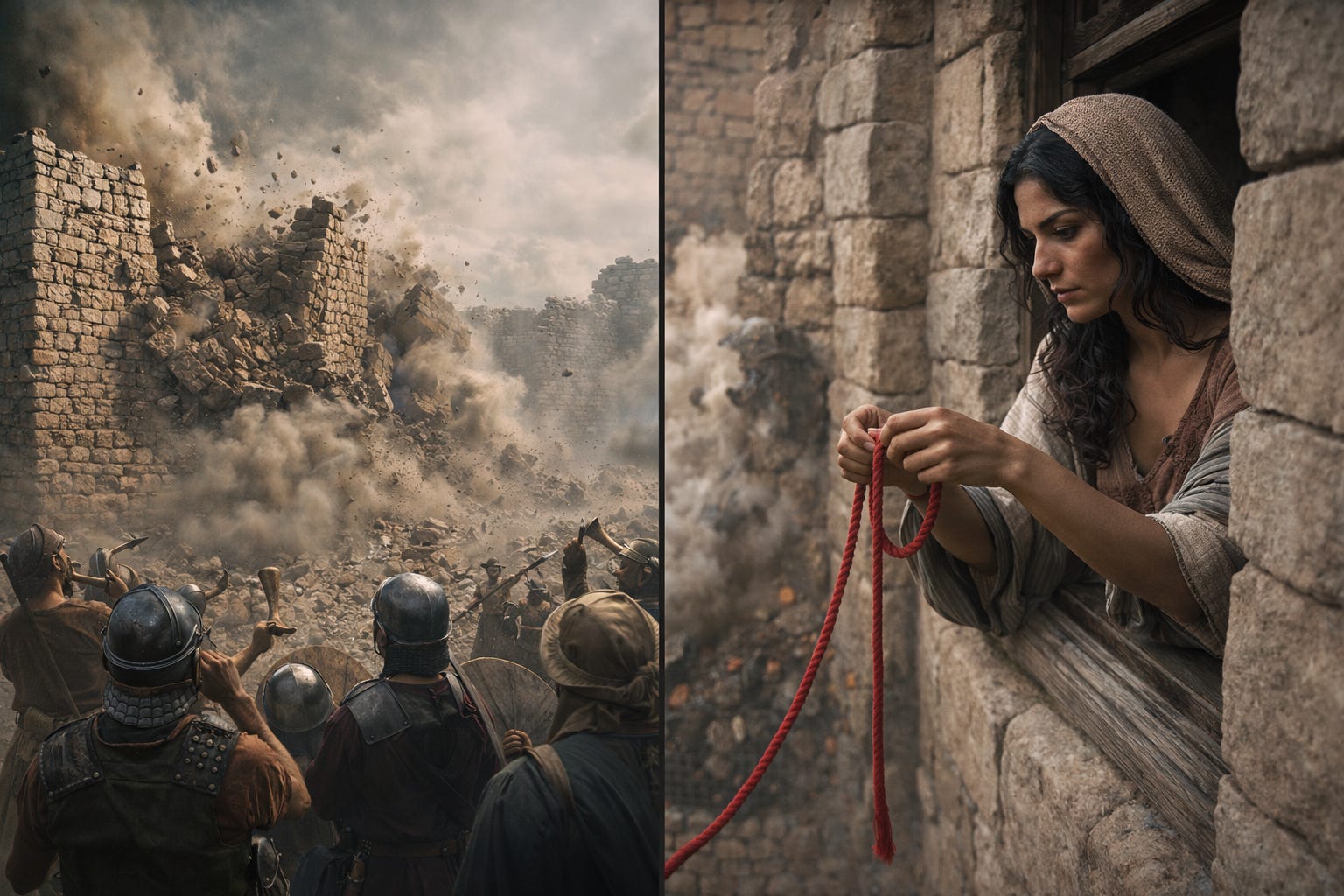
“By faith the walls of Jericho fell down after they had been encircled for seven days. By faith Rahab the harlot did not perish along with those who were disobedient, after she had welcomed the spies in peace.”
Hebrews 11:30-31 NASB1995
Two more examples of the power of faith are shown in the AI image that Steve created above and are described by the author of Hebrews in this passage. First, the walls of Jericho fell down after the city had been encircled by the Israelites for seven days. Second, Rahab, who is described as a harlot, believed in the God of the Israelites and welcomed the spies in peace.
Let’s look at the original OT passages for these two examples. First, the fall of the walls of Jericho comes from Joshua 6:
“You shall march around the city, all the men of war circling the city once. You shall do so for six days. Also seven priests shall carry seven trumpets of rams’ horns before the ark; then on the seventh day you shall march around the city seven times, and the priests shall blow the trumpets. It shall be that when they make a long blast with the ram’s horn, and when you hear the sound of the trumpet, all the people shall shout with a great shout; and the wall of the city will fall down flat, and the people will go up every man straight ahead.”
So Joshua the son of Nun called the priests and said to them, “Take up the ark of the covenant, and let seven priests carry seven trumpets of rams’ horns before the ark of the Lord.” Then he said to the people, “Go forward, and march around the city, and let the armed men go on before the ark of the Lord.” And it was so, that when Joshua had spoken to the people, the seven priests carrying the seven trumpets of rams’ horns before the Lord went forward and blew the trumpets; and the ark of the covenant of the Lord followed them. The armed men went before the priests who blew the trumpets, and the rear guard came after the ark, while they continued to blow the trumpets. But Joshua commanded the people, saying, “You shall not shout nor let your voice be heard nor let a word proceed out of your mouth, until the day I tell you, ‘Shout!’ Then you shall shout!” So he had the ark of the Lord taken around the city, circling it once; then they came into the camp and spent the night in the camp.
Now Joshua rose early in the morning, and the priests took up the ark of the Lord. The seven priests carrying the seven trumpets of rams’ horns before the ark of the Lord went on continually, and blew the trumpets; and the armed men went before them and the rear guard came after the ark of the Lord, while they continued to blow the trumpets. Thus the second day they marched around the city once and returned to the camp; they did so for six days.
Then on the seventh day they rose early at the dawning of the day and marched around the city in the same manner seven times; only on that day they marched around the city seven times. At the seventh time, when the priests blew the trumpets, Joshua said to the people, “Shout! For the Lord has given you the city. The city shall be under the ban, it and all that is in it belongs to the Lord; only Rahab the harlot and all who are with her in the house shall live, because she hid the messengers whom we sent. But as for you, only keep yourselves from the things under the ban, so that you do not covet them and take some of the things under the ban, and make the camp of Israel accursed and bring trouble on it. But all the silver and gold and articles of bronze and iron are holy to the Lord; they shall go into the treasury of the Lord.” So the people shouted, and priests blew the trumpets; and when the people heard the sound of the trumpet, the people shouted with a great shout and the wall fell down flat, so that the people went up into the city, every man straight ahead, and they took the city.”
Joshua 6:3-20 NASB1995
Note that Rahab is mentioned in this passage from Joshua 6 that she and her family would be spared. Her story is from Joshua 2:
“Then Joshua the son of Nun sent two men as spies secretly from Shittim, saying, “Go, view the land, especially Jericho.” So they went and came into the house of a harlot whose name was Rahab, and lodged there. It was told the king of Jericho, saying, “Behold, men from the sons of Israel have come here tonight to search out the land.” And the king of Jericho sent word to Rahab, saying, “Bring out the men who have come to you, who have entered your house, for they have come to search out all the land.” But the woman had taken the two men and hidden them, and she said, “Yes, the men came to me, but I did not know where they were from. It came about when it was time to shut the gate at dark, that the men went out; I do not know where the men went. Pursue them quickly, for you will overtake them.” But she had brought them up to the roof and hidden them in the stalks of flax which she had laid in order on the roof. So the men pursued them on the road to the Jordan to the fords; and as soon as those who were pursuing them had gone out, they shut the gate.
Now before they lay down, she came up to them on the roof, and said to the men, “I know that the Lord has given you the land, and that the terror of you has fallen on us, and that all the inhabitants of the land have melted away before you. For we have heard how the Lord dried up the water of the Red Sea before you when you came out of Egypt, and what you did to the two kings of the Amorites who were beyond the Jordan, to Sihon and Og, whom you utterly destroyed. When we heard it, our hearts melted and no courage remained in any man any longer because of you; for the Lord your God, He is God in heaven above and on earth beneath. Now therefore, please swear to me by the Lord, since I have dealt kindly with you, that you also will deal kindly with my father’s household, and give me a pledge of truth, and spare my father and my mother and my brothers and my sisters, with all who belong to them, and deliver our lives from death.” So the men said to her, “Our life for yours if you do not tell this business of ours; and it shall come about when the Lord gives us the land that we will deal kindly and faithfully with you.”
Then she let them down by a rope through the window, for her house was on the city wall, so that she was living on the wall. She said to them, “Go to the hill country, so that the pursuers will not happen upon you, and hide yourselves there for three days until the pursuers return. Then afterward you may go on your way.” The men said to her, “We shall be free from this oath to you which you have made us swear, unless, when we come into the land, you tie this cord of scarlet thread in the window through which you let us down, and gather to yourself into the house your father and your mother and your brothers and all your father’s household. It shall come about that anyone who goes out of the doors of your house into the street, his blood shall be on his own head, and we shall be free; but anyone who is with you in the house, his blood shall be on our head if a hand is laid on him. But if you tell this business of ours, then we shall be free from the oath which you have made us swear.” She said, “According to your words, so be it.” So she sent them away, and they departed; and she tied the scarlet cord in the window.”
Joshua 2:1-21 NASB1995
These two stories are quite remarkable. Who in the world would suggest the scheme to make the walls of Jericho fall down except for God? Joshua has faith in God over any reluctance to participate in such a strange marching event for seven days and he is able to persuade the other Israelites. This story has been used by skeptics to dismiss stories in the Old Testament. However, according to this devotional from Richard De Haan on Precept Austin recent archaeological evidence (published in 1990) has confirmed the story about Jericho, which is believed to have happened about 1400 B.C.:
DEVOTIONAL - THE BIBLE STANDS - Unbelievers have long scoffed at the biblical story of the fall of the ancient city of Jericho. That’s why I was delighted to see this headline on the front page of the newspaper: NEW STUDY BACKS BIBLICAL VERSION OF JERICHO’S DEMISE
The Associated Press article began,
“The walls of Jericho did come tumbling down as recounted in the Bible, according to an archaeological study.” Archaeologist Bryant G. Wood of the University of Toronto said, “When we compare the archaeological evidence at Jericho with the biblical narrative describing the Israelite destruction of Jericho, we find remarkable agreement.” Wood noted that the Bible places the event after spring harvest and indicates that the Israelites burned the city—both facts confirmed by the archaeological remains. Once again, archaeology bears testimony to the truthfulness of Scripture.
Our belief in the authenticity of the Bible does not depend on scientific research but on its claim to be God’s Word. As 2 Timothy 3:16 tells us, “All Scripture is given by inspiration of God.” We can therefore have complete confidence in what it says.
It’s a fact—the walls of Jericho did indeed fall. The Bible stands!— Richard De Haan
The Bible stands like a mountain towering
Far above the works of men;
Its truth by none ever was refuted,
And destroy it they never can. —Lillenas
©1917, 1945 Hope Publishing Co.To the wise, God’s Word is sufficient.
It’s nice when science confirms Biblical Scripture, but it is certainly unnecessary for believers. God can raze a city with tireless marchers using ram’s horns and carrying the Ark of the Covenant or He can send fire down upon a city or He can send floods.

What else do we know about Rahab, other than the fact that she had a shady past, believed in the one true God and was spared, along with her family during the destruction of Jericho? Let’s look at Matthew 1:
“The record of the genealogy of Jesus the Messiah, the son of David, the son of Abraham: Abraham was the father of Isaac, Isaac the father of Jacob, and Jacob the father of Judah and his brothers. Judah was the father of Perez and Zerah by Tamar, Perez was the father of Hezron, and Hezron the father of Ram. Ram was the father of Amminadab, Amminadab the father of Nahshon, and Nahshon the father of Salmon. Salmon was the father of Boaz by Rahab, Boaz was the father of Obed by Ruth, and Obed the father of Jesse. Jesse was the father of David the king.
David was the father of Solomon by Bathsheba who had been the wife of Uriah. Solomon was the father of Rehoboam, Rehoboam the father of Abijah, and Abijah the father of Asa. Asa was the father of Jehoshaphat, Jehoshaphat the father of Joram, and Joram the father of Uzziah. Uzziah was the father of Jotham, Jotham the father of Ahaz, and Ahaz the father of Hezekiah. Hezekiah was the father of Manasseh, Manasseh the father of Amon, and Amon the father of Josiah. Josiah became the father of Jeconiah and his brothers, at the time of the deportation to Babylon.
After the deportation to Babylon: Jeconiah became the father of Shealtiel, and Shealtiel the father of Zerubbabel. Zerubbabel was the father of Abihud, Abihud the father of Eliakim, and Eliakim the father of Azor. Azor was the father of Zadok, Zadok the father of Achim, and Achim the father of Eliud. Eliud was the father of Eleazar, Eleazar the father of Matthan, and Matthan the father of Jacob. Jacob was the father of Joseph the husband of Mary, by whom Jesus was born, who is called the Messiah.
So all the generations from Abraham to David are fourteen generations; from David to the deportation to Babylon, fourteen generations; and from the deportation to Babylon to the Messiah, fourteen generations.”
Matthew 1:1-17 NASB1995
This lineage is from Abraham to Joseph, the husband of Mary and it includes a mention of Rahab being the mother of Boaz with Salmon. It would be interesting, indeed, to see Mary’s lineage. Aha, we have that lineage in Luke 3:23-38! It describes the ancestry of Mary by calling Joseph the “son” of Eli or Heli, who is actually Mary’s father. Here’s a story about the Luke lineage from Gotquestions.org:
Mary’s lineage, as recorded by Luke, does not mention Mary, but that’s to be expected—including women’s names in genealogies was not standard practice. It begins this way: “[Jesus] was the son, so it was thought, of Joseph, the son of Heli” (Luke 3:23). This comment affirms the truth of Jesus’ virgin birth (see Luke 1:29–38). Joseph was a “son” of Heli by virtue of his marriage to Mary, who would have been the daughter of Heli (Matthew 1:16 lists Joseph’s biological father as Jacob).
Some notable points in Mary’s lineage are that she was a descendant of Abraham, Isaac, and Jacob (Luke 3:34); she was specifically of the tribe of Judah (verse 33). She was also a descendant of Boaz (verse 32) and David (verse 31). Significantly, Luke traces Mary’s lineage all the way back to Adam (verse 38). This fits with Luke’s purpose as he wrote to Gentiles and emphasized that Jesus is the Son of God who came to save all people (cf. Luke 2:10–11).
Another issue relating to Mary’s lineage is her relation to Elizabeth, the mother of John the Baptist. Luke says that Mary was related to Elizabeth, who was in the tribe of Levi (Luke 1:5, 36). An argument sometimes put forward by those who deny the credentials of Christ is that, if Mary was Elizabeth’s “cousin,” then Mary must also have been a Levite. Some translations, such as the KJV, do state that Mary was the “cousin” of Elizabeth (Luke 1:36). However, the English word cousin does not have to imply a close relation, and other versions of the Bible translate the word as “relative” (NKJV, ESV, CSB, BSB). Even if Elizabeth and Mary were close relatives, it was still possible for them to be of different tribes, as women were identified with their father’s tribe, not their mother’s. Elizabeth’s father was a Levite, making her a Levite by birth, but her mother may have been of Judah. Conversely, Mary’s mother may have been a Levite and kin to Elizabeth’s family, while Mary’s father was of Judah. Luke’s genealogy shows that Heli, whom we assume to be Mary’s father, was a direct descendant of Judah, not Levi. In addition, the angel Gabriel affirmed Jesus’ Judean lineage, telling Mary that “he will be very great and will be called the Son of the Most High. The Lord God will give him the throne of his ancestor David” (Luke 1:32, NLT). David was of the tribe of Judah.
Regardless of Mary’s specific lineage, that Jesus is a descendant of David and Judah is beyond doubt. Other Bible verses also point to the fact of Judah being the tribe of Jesus’ heritage, as the rightful Messiah and Savior of all (Hebrews 7:14; Revelation 5:5).
Faith is believing that God will provide, even if the methods are unorthodox. Faith is believing that God will provide because you stood by His people and their faith, even when all of the other walls fall down around you. Faith is believing that God’s promises will be fulfilled, perhaps long after you are gone.
Enduring Word has good commentary on these two verses from Hebrews:
a. By faith the walls of Jericho fell down: At Jericho, the people of Israel had a daring faith. There was no turning back, having already crossed the river Jordan at flood stage, which cut off any line of retreat.
b. After they were encircled for seven days: At Jericho the people of Israel had an obedient faith. They did not really understand what God was doing, yet they obeyed nonetheless.
c. After they were encircled for seven days: At Jericho the people of Israel had a patient faith. The walls did not fall down for the first six days, yet they kept marching as God commanded.
d. For seven days: At Jericho the people of Israel had an anticipating faith. They knew God would act on the seventh day when they shouted.
….
a. By faith the harlot Rahab did not perish: Joshua 2 tells us of Rahab, who might seem an unusual example of faith. Yet her willingness to become a traitor to the gods of Canaan and to identify with Yahweh with His people despite the cost is worthy of praise.
i. “She was a harlot, a woman that was a sinner, and universally known to be such. Desperate attempts have been made to find some other meaning for the word rendered harlot, but they have been utterly fruitless.” (Spurgeon). Spurgeon described Rahab’s faith like this:
· Saving faith.
· Singular faith.
· Stable faith.
· Self-denying faith.
· Sympathizing faith.
· Sanctifying faith.
b. When she had received the spies with peace: When the Hebrew spies came to Rahab, she declared He is God in heaven above and on earth beneath (Joshua 2:11). This was proof of her faith. It was not strong faith and it was not perfect faith, but her faith was commendable nonetheless.
i. Clement of Rome, the earliest Christian writer outside of the Bible, was the first to see a symbol of the blood of Jesus in the scarlet cord that Rahab set outside her window (Joshua 2:18).
This commentary has a convenient checklist of attributes of faith from these two OT stories:
Daring
Obedient
Patient
Anticipatory
Saving
Singular
Stable
Self-denying
Sympathizing
Sanctifying
I also find the Clement insight into the symbology of the scarlet cord to be quite interesting but we also have to be careful not to subscribe supernatural symbololgy to every little thing in the Bible.
My next devotional examines Hebrews 11: 32-34 - More stories of faith.
Heaven on Wheels Daily Prayer:
Dear Lord - Please guide me into a faith that is daring, obedient, patient, anticipatory, saving, singular, stable, self-denying, sympathizing and sanctifying! Amen.
Credits and Citations:
Scripture quotations taken from the (NASB®) New American Standard Bible®, Copyright © 1960, 1971, 1977, 1995 by The Lockman Foundation. Used by permission. All rights reserved. www.Lockman.org.
Precept Austin was accessed on 02/05/2026 to review commentary for Hebrews 11:30-32.
Gotquestions.org was accessed on 02/05/2026 to answer the question, What was Mary’s lineage? © COPYRIGHT 2002-2026 GOT QUESTIONS MINISTRIES. ALL RIGHTS RESERVED.
Commentary from Enduring Word is used with written permission and without any alteration. ©1996-present The Enduring Word Bible Commentary by David Guzik – enduringword.com. Within the Enduring Word commentary:
Spurgeon, Charles Haddon The New Park Street Pulpit, Volumes 1-6and The Metropolitan Tabernacle Pulpit, Volumes 7-63 (Pasadena, Texas: Pilgrim Publications, 1990)