


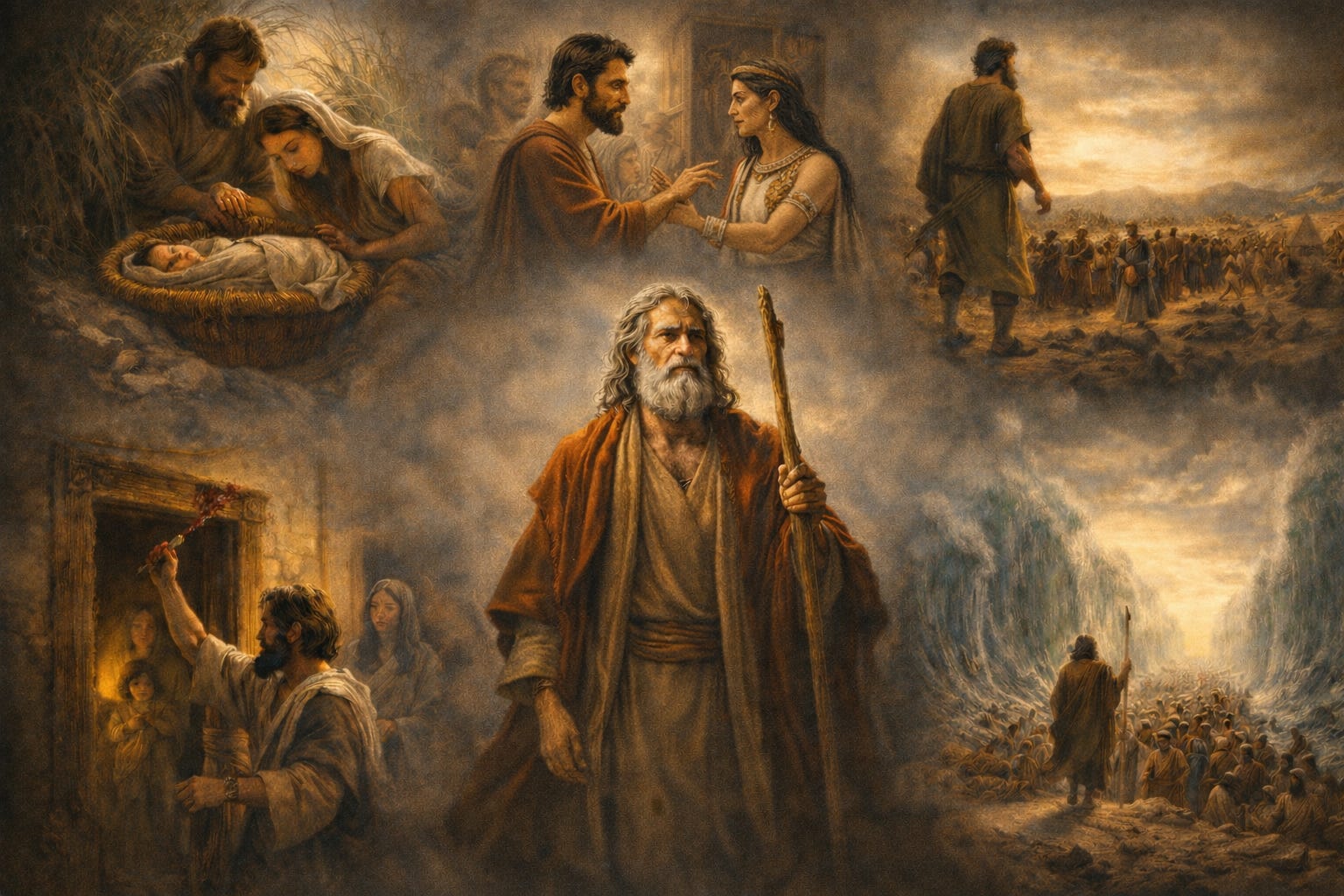
“By faith Moses, when he was born, was hidden for three months by his parents, because they saw he was a beautiful child; and they were not afraid of the king’s edict. By faith Moses, when he had grown up, refused to be called the son of Pharaoh’s daughter, choosing rather to endure ill-treatment with the people of God than to enjoy the passing pleasures of sin, considering the reproach of Christ greater riches than the treasures of Egypt; for he was looking to the reward. By faith he left Egypt, not fearing the wrath of the king; for he endured, as seeing Him who is unseen. By faith he kept the Passover and the sprinkling of the blood, so that he who destroyed the firstborn would not touch them. By faith they passed through the Red Sea as though they were passing through dry land; and the Egyptians, when they attempted it, were drowned.”
Hebrews 11:23-29 NASB1995
Five examples of faith from the life of Moses are described in this next passage of Hebrews 11. First, in the upper left in the AI image at the top, by faith his parents hid him for three months after he was born and demonstrated they were not afraid of the king’s edict. So who are the parents of Moses? This commentary from a sermon by Steven Cole excerpted in Precept Austin describes these slaves in Egypt and describes their choice to obey in faith:
Moses’ parents are not named in Hebrews or in the original story in Exodus 2. Exodus 6:20 names Amram as the father and Jochebed as the mother of Moses and Aaron, his older brother by three years. But since the Jews often called ancestors from many generations back, “father” or “mother,” we can’t be certain that these were the immediate parents (Walter Kaiser, Expositor’s Bible Commentary, ed. by Frank Gaebelein [Zondervan], 2:308). The oldest child in the family was a sister, Miriam.
The Jews had gone from the privileged position they enjoyed in Egypt under Joseph to the despised position as hard labor slaves. Because of his fear that the Jews were multiplying too rapidly, Pharaoh had issued the command to throw all newborn Jewish boys into the Nile River.
In such dire circumstances, this Jewish couple had a “beautiful” son (Heb. 11:23 is based on Ex 2:2, Septuagint - LXX). Since most parents would think that every child they have is “beautiful,” there must have been something exceptional about Moses. Stephen (Acts 7:20) calls him “beautiful to God” (literal translation). John Calvin points out that since Scripture forbids us from making judgments based on external appearance, Moses’ parents must have seen something in this baby boy to make them hope that he would be the promised deliverer of his people (Calvin’s Commentaries [Baker], on Heb. 11:23, p. 292). Because they thought that God had destined him for such a great role, they defied the king’s edict and hid him for three months. That choice, based on faith, entailed short-term suffering, but eternal blessings.
…
The author [of Hebrews] states that faith was at the heart of this important decision. God often works through the faith of unknown parents or grandparents to raise up an unusually gifted leader to accomplish great things for God. Except for their well-known son, this couple would have lived in obscurity as lowly slaves. But God used their courageous faith in a mighty way. Zacharias and his wife, Elizabeth, were childless, elderly, but faithful people. God used them to bear John the Baptist and to rear him to be bold in faith. Mary was an obscure Jewish girl who was willing to believe God’s word, even though it meant ridicule for her to conceive a son without a husband. God used her to bring forth the Savior.
Years ago, I was reading the autobiography of the great British preacher, Charles Spurgeon. As I was jogging in the woods one day, I prayed a “go-for-broke” prayer: I asked God to bless my ministry as He had blessed Spurgeon’s ministry. Spurgeon was the most phenomenal of the 19th century. Thousands packed his church each week. They measured attendance by how many were turned away! Thousands came to faith in Christ under his preaching. Hundreds of pastors were trained at his pastor’s college. Orphans were cared for at his orphanages. He has more books in print by volume than any other author in history, and God still uses them greatly. So my prayer was no small prayer!
But right after I prayed, the question popped into my mind, “What about John Spurgeon?” He was Charles’ father. He was a faithful pastor in a small English town. If he had not been the father of a famous son, John Spurgeon would be unknown in history. There have been thousands of godly, faithful pastors like him, but only a few like his son. The Lord was saying, “Be as faithful as John Spurgeon in shepherding My flock and in leading your family. I’ll determine whether to use you as I used Charles Spurgeon.”
What a great story about John and Charles Spurgeon! You might ask a similar question - what about the offspring of the legendary Charles Spurgeon? Well, according to Wikipedia, he and his wife Susannah had twin sons. One of those sons did become a preacher at the Metropolitan Tabernacle but was not as well-known as his father. Being the parent or the child of a famous person is challenging! These two unsung people of God hid Moses until he could be found and cared for by the daughter of the Pharaoh, with his own mother as the nursemaid!

But then came the first test of faith for Moses himself in this passage, when he refused to be called the son of Pharaoh’s daughter. He walked away from the honor and the riches to be with the people of God and endure what they endured as slaves in Egypt. Again, turning to the Steven Cole sermon quoted in Precept Austin:
(1) Moses chose to suffer the pain of alienation and misunderstanding from his adoptive family.
Pharaoh’s daughter had rescued Moses from death, adopted him as her own son, and raised him in the splendor of the palace. If he had even survived in his natural family, he would have been doomed to a difficult life as a slave. Instead, he grew up enjoying the most luxurious living conditions imaginable. Acts 7:22 says that he “was educated in all the learning of the Egyptians, and he was a man of power in words and deeds.”
Imagine the hurt feelings and misunderstanding that must have swept over Pharaoh’s daughter when Moses chose to walk away from everything that she had provided and identify himself with these slave laborers! Pharaoh must have been outraged when he heard about it: “The ungrateful wretch! After all that we’ve done for him!” When you choose to follow Jesus Christ, which may involve walking away from the education and comfortable lifestyle that your family has provided for you, you will suffer the pain of alienation and being misunderstood.
(2) Moses chose to suffer the loss of the world’s honors, pleasures, and wealth.
As the son of Pharaoh’s daughter, Moses enjoyed a position of honor higher than almost anyone else in Egypt. When he identified himself with the Jewish slaves, he became the object of contempt and scorn. As a family member in Pharaoh’s court, Moses enjoyed whatever pleasures anyone could seek. He lived in luxury (picture the splendor of King Tut’s tomb!). He ate the best food available. He wore the nicest, newest clothes. If he had wanted, he could have enjoyed the pleasures of the most beautiful women in Egypt. He had wealth to buy anything he wanted or to live without working for the rest of his life. But when Moses chose to obey God by faith, he instantly lost it all!
It’s not necessarily sin to enjoy a position of honor and the comfortable life that wealth provides. Joseph enjoyed both while following God. But when God called Moses to give it up and lead Israel out of bondage, at that point it would have been sin for him to continue living as he was. Also, the Bible does not deny that sin brings passing pleasure. If it didn’t, we would not be tempted by it! But finally, it brings eternal misery. Don’t be deceived!
(3) Moses chose to suffer being identified with a despised bunch of slaves.
As the son of Pharaoh’s daughter, Moses ran in the top circles of Egyptian society. He knew everybody who was anybody. He frequently ate at the king’s table. People sought out Moses as an influential man. But he chose to give up all that status and live among these wretched slave-laborers!
(4) Moses chose to suffer the world’s reproach.
Imagine the gossip in Egyptian high society! “He did what? Unbelievable! What an idiot!” Ridicule is a powerful thing. People go to great lengths to cover up embarrassing mistakes that would cause them shame (e.g. Watergate, or Bill Clinton’s lies about his private life). But Moses chose a course that he knew would bring him the world’s reproach!
Why would a man knowingly choose such suffering? Was he a masochist? Was he insane? No, actually he was quite shrewd. Like the man who sold everything he had to buy the pearl of great price (Matt. 13:45-46), Moses gained something better.
…
(1) Moses’ choice of faith was carefully considered.
He made this choice after “he had grown up” (Heb 11:24; Ex 2:11). Stephen tells us that he was 40 (Acts 7:23). Perhaps he had lived in Pharaoh’s court long enough to become thoroughly nauseated with the superficiality that he saw every day. The word considering (Heb 11:26) refers to “belief resting on external proof,” especially, “careful judgment” (G. Abbott-Smith, A Manual Greek Lexicon of the New Testament [Charles Scribners’ Sons], p. 119). Moses carefully weighed in the balance what the world had to offer on one side and what God had to offer on the other side. The world’s side was momentarily attractive, but lightweight. God’s side was momentarily difficult, but satisfying in the long haul. Moses chose to believe God and reject the world. So must everyone who wants to go to heaven (1John 2:15).
(2) Moses’ choice of faith was a critical choice with far-reaching consequences.
The crisis that pushed Moses over the line to renounce Egypt and choose ill-treatment with God’s people was when he saw the Egyptian beating one of the Hebrew slaves (Ex 2:11). Moses’ response was not an impulsive reaction that he later regretted. He had been considering, weighing, the greater riches of Christ against the lightweight treasures of Egypt. So when the moment came, he acted decisively by killing the Egyptian and taking his stand with God and His people. That critical choice affected not only Moses, but many generations of Jews after him.
In Common Sense Christian Living ([Thomas Nelson], p. 161), Edith Schaeffer tells how her husband, Fran, came from an unbelieving home. His parents did not want him to go to college or to become a pastor. But at age 19, he tearfully chose what he believed God was leading him to do, in opposition to his parents. Years later, his parents became Christians. Fran felt that they never would have believed if his choice had been the opposite one. And, his choice led to his children becoming Christians, not to mention the thousands of people that have benefited from his many books. Your choice to trust Jesus Christ affects your eternal destiny, but it also has far-reaching consequences for your children and their children, as well as for many with whom you will have contact.
(3) Moses’ choice of faith required weighing the short-term against the long-term.
“He was looking to the reward.” Faith banks on eternity. In the short-term, Moses had to endure ill-treatment with a bunch of refugee slaves in the wilderness. But in light of eternity, as Paul put it (Ro 8:18+), “the sufferings of this present time are not worthy to be compared with the glory that is to be revealed to us.” He also wrote (2Co 4:17), “For momentary, light affliction is producing for us an eternal weight of glory far beyond all comparison.” If you want to believe the gospel, you must weigh the passing, momentary pleasures of sin against eternal punishment in hell. Weigh momentary affliction against eternal joy in heaven. Then choose!
Faith requires careful consideration, an understanding of the consequences of faith, and the choice for the long-term. When God calls you to obedience, He is calling you to obedience!
One little tiny detail that this passage (verses 24-26) neglects to mention is the fact that after killing the Egyptian who was beating an Israelite, Moses fled into the wilderness for decades, which is not exactly a stellar example of bold faith or demonstrating a lack of fear. He only returned to lead the people after encountering God in the burning bush. But the point is still a good one. Moses identified more with the people of Israel even with his luxuriant upbringing in the royal family. He needed time, but did indeed become the great leader for the exodus of the people of God.

Interestingly, many commentators are also not certain about the point being made in verse 28: By faith he left Egypt, not fearing the wrath of the king; for he endured, as seeing Him who is unseen. Is it referring to the first time Moses fled, as noted in my comments above, or was this when he led the people in the exodus? Steven Cole continues to examine these passages in a second sermon excerpted in Precept Austin. From this sermon, the first obstacle to faith is powerful opposition:
1. Faith overcomes powerful opposition by seeing the unseen God (He 11:27).
Moses left Egypt twice: first, after he killed the Egyptian slave driver; and, again in the exodus. To which departure does this verse refer? The chronological order, along with the singular reference (“he left”) favor the first departure. But Exodus 2:14, 15 says that Moses was afraid when he learned that the news of his killing the Egyptian was known, and that he fled from Pharaoh’s attempt to kill him. So the phrase, “not fearing the wrath of the king,” favors the second departure.
Those who argue for the first departure explain that Moses fled, not out of personal fear of Pharaoh, but because he was aware of his destiny as the deliverer of the covenant people (Philip Hughes, A Commentary on the Epistle to the Hebrews [Eerdmans], pp.497-499). I find that unconvincing. The author has already inverted the chronological order twice in this chapter (compare Heb 11:17, 18, 19, 20, 21with He 11:13; also, in He 11:21). A singular reference is used in He 11:28describing the Passover, even though the entire Jewish nation did it. So I understand He 11:27 to refer to the exodus, when Moses courageously stood up to Pharaoh. He 11:28, 29 refer to two events that took place during the exodus. There are three lessons in He 11:27:
A. Faith often puts us into opposition with powerful forces.
From somewhere-I’m not sure where-many Christians have the naïve notion that when you yield your life to God and begin to follow His purpose, all of your problems evaporate! Maybe it’s from the “sales pitch,” “Would you like an abundant life? Follow Jesus!” People think, “Sure, I could handle an abundant life!” So they sign up for the program, only to encounter abundant trials. Life before they trusted Christ was relatively calm compared to what they experience afterwards!
The verb, “left,” may be translated “forsook” (Heb 11:27NKJV). It refers to what we saw in 11:24, 25, 26, that when Moses refused to be called the son of Pharaoh’s daughter, he forfeited the treasures of Egypt. When Moses forsook Egypt, he didn’t step into something better. Instead, he embraced a difficult situation that had no chance of success, apart from God’s power. To stand against Pharaoh was suicidal, unless God protected Moses. To lead two million people into the desert without food or water was genocidal, unless God protected them. Pharaoh was a powerful despot with an army of trained warriors at his disposal. Moses was leading a disorganized bunch of untrained, defenseless slaves. Humanly speaking, it was not even a contest.
When you believe the gospel and submit to Jesus Christ, you declare yourself to be the enemy of the prince of the power of the air, who commands an army of evil spirits intent on your destruction. That’s why the Christian life is often portrayed as warfare. Don’t be surprised by opposition; expect it!
B. Faith enables us to obey God without fear.
Moses encountered the wrath of the king. Whenever you attempt to follow God’s path for your life, someone will get angry at you. In Moses’ case, it was Pharaoh. In your case, it may be a family member, an employer, a professor at the university, or a friend. The more powerful that person is, the more difficult it is to fear God more than you fear that person. Proverbs 19:12 observes, “The king’s wrath is like the roaring of a lion.” If there were no cage separating you from the lion’s roar, it would be rather frightening! But Moses stood before Pharaoh and boldly said, “Thus says the Lord God of Israel, ‘Let My people go…” (Ex 5:1).
….
C. Faith overcomes powerful opposition by seeing the unseen God.
Moses did not fear the wrath of the king, “for he endured, as seeing Him who is unseen.” There is intended irony in that phrase. “No one has seen God at any time” (1John 4:12). Moses had seen a manifestation of God at the burning bush. He spoke with God “face to face, just as a man speaks to his friend” (Ex 33:11). He would later ask to see God, and God allowed him to see His “back” (Ex 33:22, 23). Jesus told the twelve, “He who has seen Me has seen the Father” (John 14:9).
Thus when we are fearful, we need to draw near to the Lord Jesus by faith. “Seeing Him who is unseen” takes us back to Hebrews 11:1, that faith is “the conviction [or, proof] of things not seen.” Faith is like a telescope that brings a distant object into visible focus. If fear is looming larger than your faith, take time to draw near to God in His Word and prayer. As Paul instructs us (Php 4:6, Php 4:7), “Be anxious for nothing, but in everything by prayer and supplication with thanksgiving let your requests be made known to God. And the peace of God, which surpasses all comprehension, will guard your hearts and your minds in Christ Jesus.” Don’t leave out the thanksgiving! That’s how you express faith and submission to God in your prayers. Faith overcomes powerful op-position by seeing the unseen God.
I really like these sermons, which is why I’m sharing excerpts from them. Faith allows us to obey God without fear, even when our enemies are powerful!

From the Steven Cole sermon, the second obstacle to faith is God’s impending judgment. Here’s more from Steven Cole on Moses and his obedience to the first Passover requirement as part of the ten plagues on Egypt:
2. Faith trusts in God’s sacrifice for deliverance from His judgment (He 11:28).
Moses has just endured the wrath of the king; now he has to be saved from the wrath of God.
“By faith he kept the Passover and the sprinkling of the blood, so that he who destroyed the first-born would not touch them.”
At the culmination of the plagues, God gave Moses instructions for how Israel was to observe the Passover (Ex 12). At the heart of that celebration was the sacrifice of an unblemished male lamb. Its blood was to be smeared on the doorposts and lintel of each house. God warned that He would go through the land on that night and kill every firstborn male in homes that did not have the blood on the doorposts.
The New Testament is clear that Christ is our Passover Lamb who was slain (1Cor. 5:7). If you have seen the Jews for Jesus presentation, “Christ in the Passover” you know that not just the lamb, but just about every detail in that ceremony, speaks about Jesus Christ and His sacrifice on the cross. It was at the Passover that Jesus took the bread and the wine and instituted the Lord’s Supper as a remembrance of His death. Note three applications of Hebrews 11:28:
A. All people face the threat of God’s impending judgment.
It was not only the Egyptians, but also the Jews, who faced God’s impending judgment of the death of their firstborn if they did not apply the blood of the lamb to their doorposts. Being a Jew by birth would not have spared anyone. Being a decent, hard-working person who had never committed a crime would not have gained an exception. While Moses• faith is mentioned in He 11:28, his faith did not cover all of the Jewish homes. Each home had to apply the blood as God had commanded or they would suffer the consequences.
Romans 3:23-note states,
“for all have sinned and fall short of the glory of God.”
…
B. God has appointed a way of deliverance from His judgment through the blood of a substitute.
The elaborate instructions for how to carry out the Passover may have seemed like a hassle to some. For one thing, it was not cheap. Every family had to sacrifice a lamb, or if the family was too small, they could join another family (Ex 12:4). The blood had to be applied to the doorposts and lintel. God specifically warned them (Ex 12:13)
The blood shall be a sign for you on the houses where you live; and when I see the blood I will pass over you, and no plague will befall you to destroy you when I strike the land of Egypt.
The blood of the Passover lamb was a type, of course, of the blood of Jesus Christ (See discussion of Typology = Biblical types). When Jesus died on the cross, He died as a substitute for sinners. As John wrote (1Jn 2:2),
and He Himself is the propitiation for our sins; and not for ours only, but also for those of the whole world.
In other words, the offer is extended to every sinner, Jew or Gentile: It obviously does not mean that Christ actually paid for all the sins of all people, or else all would be saved, which Scripture plainly denies. Rather, it means that Christ’s sacrifice extends to all who by faith embrace the gospel” (John Calvin, Calvin’s Commentaries [Baker], on 1Jn 2:2, p. 173). Thus…
C. God’s way of deliverance must be applied by faith in order to be effective.
To be delivered through the Passover blood, Moses and the Israelites had to trust God’s word and do what He told them to do. If anyone disputed it by saying, “It’s not logical that sprinkling blood on your doorposts would protect your oldest son from death,” his son would have died. It would not have been enough to say mentally, “I believe,” but not apply the blood. To be saved from the destroyer, the person had to believe God’s warning by applying the blood.
The same is true with the blood of Christ. You can argue that God is a God of love, not judgment, and that you don’t need the blood of Christ to be saved. You will someday learn too late that He is a God who judges sinners. Perhaps you grew up in a Christian home and you believe in a general sense, but you have not personally fled to the cross. James (Jas 2:19-note) warns us that the demons also believe in that manner, but they will not be saved. Unlike the Passover, it is not enough for your father to believe on your behalf.
To be saved, you must acknowledge that as a sinner you deserve God’s judgment. You must abandon all trust in yourself or your good works as a means of salvation. And you must trust in Christ’s blood as God’s payment for your sins. Every sinner must apply the blood of Christ to his or her heart by faith to be saved from God’s judgment.
Salvation is not a freebie for everyone in the world and faith and repentance must be the entry tickets into that salvation. I saw a news article recently where the current mayor of Boston, in this fight over illegal immigration in our nation, actually said that every single person in the world has a “legal right” to come and seek shelter in the United States. Besides the obvious problems (who pays for this and where will 8.3 billion people live if they all came here), this simplistic thinking can be compared to the universalists who claim that God should not be a judge if He is also God of love and that everyone “should be saved” regardless of their sin and belief. That’s not the way it works! We have a powerful God and He is a rightful judge.

Finally, from the Steven Cole sermon, there is a third obstacle to faith, which are problems that are overwhelming. One more excerpt:
3. Faith trusts God for deliverance from overwhelming problems (He 11:29).
This verse shifts from Moses’ faith to the faith of Israel. I do not know why the shift did not take place in He 11:28, since all Israel had to believe in the Passover sacrifice. Either way, there is a difficulty, in that as the author of Hebrews has already told us, the generation that came out of Egypt was evil and unbelieving (He 3:8, 9, 10, 11, 12).
The apostle Paul explained that although all Israel was baptized into Moses, so to speak, when they passed through the sea, “with most of them God was not well-pleased; for they were laid low in the wilderness” (1Co 10:2, 5). But here the author indicates that they passed through the Red Sea by faith.
Probably the solution is that the faith of the believing remnant (note) is generalized to cover the entire nation (John Owen, An Exposition of Hebrews [The National Foundation for Christian Education], 7:170; Calvin, p. 299 adopts a similar solution). There is a similar situation in the New Testament when everyone on the ship with Paul was saved because of Paul’s faith, even though they did not believe God. In both cases, it was temporal deliverance only for the unbelievers. But the exodus pictures spiritually how genuine faith delivers us from overwhelming problems, beginning with the salvation of our souls. Briefly, note two things:
A. Faith does not exempt us from overwhelming problems, but rather it often leads us into such problems.
If Israel had stayed in Egypt, they wouldn’t be in the mess they were in at the Red Sea. Some of the unbelievers sarcastically said to Moses (Ex 14:11),
Is it because there were no graves in Egypt that you have taken us away to die in the wilderness?
But the fact is, Moses had not led them to the dire situation that they were in; God had led them there and He had hardened Pharaoh’s heart so that he would chase after them (Ex 14:1, 2, 3, 4, 5, 6, 7, 8, 9)!
So by God’s direct actions, this defenseless bunch of slaves had the Red Sea in front of them and Pharaoh’s army charging at them from behind. They were doomed unless God intervened, which He planned to do. But they had to learn that salvation is completely from Him. There was no place for human ingenuity or some scheme to escape. God led them into this desperate situation to teach them to trust Him as their only option.
That’s how God grows our faith. We know in our heads that we must trust Him totally, but we don’t believe it in practice until He throws us into situations where there is no way out if He does not act. We need to learn in experience that “salvation belongs to the Lord” (Ps 3:8-Spurgeon’s note).
B. God delights to turn our overwhelming problems into exhibitions of His mighty power when we trust Him.
The situation that the enemy thought would bring them an easy victory led to their defeat. God miraculously piled the water up as a wall on both sides for Israel to walk through on dry ground (Ex 14:21, 22). He moved the pillar of cloud behind them until they all passed through. Then He let the Egyptians pursue them in blind fury. They should have looked to both sides and seen the trap. But as John Owen observes (pp. 173-174),
There is no such blinding, hardening lust in the minds or hearts of men, as hatred of the people of God and desire for their ruin.
The Egyptians abandoned reason and common sense and rushed into the sea to their own destruction. And so a helpless, defenseless, unorganized band of two million slaves were delivered from a powerful, well-equipped army. Nothing is too difficult for the Lord (Jer 32:17)!
Salvation belongs to the Lord and the situation may be dire enough that only death is the escape from endless persecution or an insurmountable health problem. But nothing is too difficult for the Lord!
One last little tidbit from Charles Spurgeon, from the repository found on Precept Austin:
For faith can do what unbelief must not attempt to do, and when unbelief tries to follow in the footsteps of faith, it becomes its own destroyer. You must have -real faith in God, or you cannot go where faith would take you; but with faith you may go through the cloud or through the sea, and find yourself safe on the other side.
In verse 29 you have the difference between faith and presumption: faith goes through the sea, presumption is drowned in the sea.
My next devotional examines Hebrews 11:30-31 - The faith that brought down walls and saved Rahab.
Heaven on Wheels Daily Prayer:
Dear Lord - Help me to be overcome the obstacles to faith from fierce opposition, fear of judgment and fear of overwhelming problems. Amen.
Credits and Citations:
Scripture quotations taken from the (NASB®) New American Standard Bible®, Copyright © 1960, 1971, 1977, 1995 by The Lockman Foundation. Used by permission. All rights reserved. www.Lockman.org.
Precept Austin was accessed on 02/03/2026 to review commentary for Hebrews 11:23-29. Within the Precept Austin commentary: The following sermons by Steven Cole were excepted:
Lesson 40 on Hebrews:
https://bible.org/seriespage/lesson-40-faith’s-choice-hebrews-1123-26
Lesson 41 on Hebrews:
https://bible.org/seriespage/lesson-41-overcoming-faith-hebrews-1127-29
Copyright, Steven J. Cole, 2004, All Rights Reserved.
Unless otherwise noted, all Scripture Quotations are from the New American Standard Bible, Updated Edition © The Lockman Foundation
Commentary from Enduring Word is used with written permission and without any alteration. ©1996-present The Enduring Word Bible Commentary by David Guzik – enduringword.com. Enduring Word commentary was accessed but not used for this devotional.