


“And what more shall I say? For time will fail me if I tell of Gideon, Barak, Samson, Jephthah, of David and Samuel and the prophets, who by faith conquered kingdoms, performed acts of righteousness, obtained promises, shut the mouths of lions, quenched the power of fire, escaped the edge of the sword, from weakness were made strong, became mighty in war, put foreign armies to flight.”
Hebrews 11:32-34 NASB1995
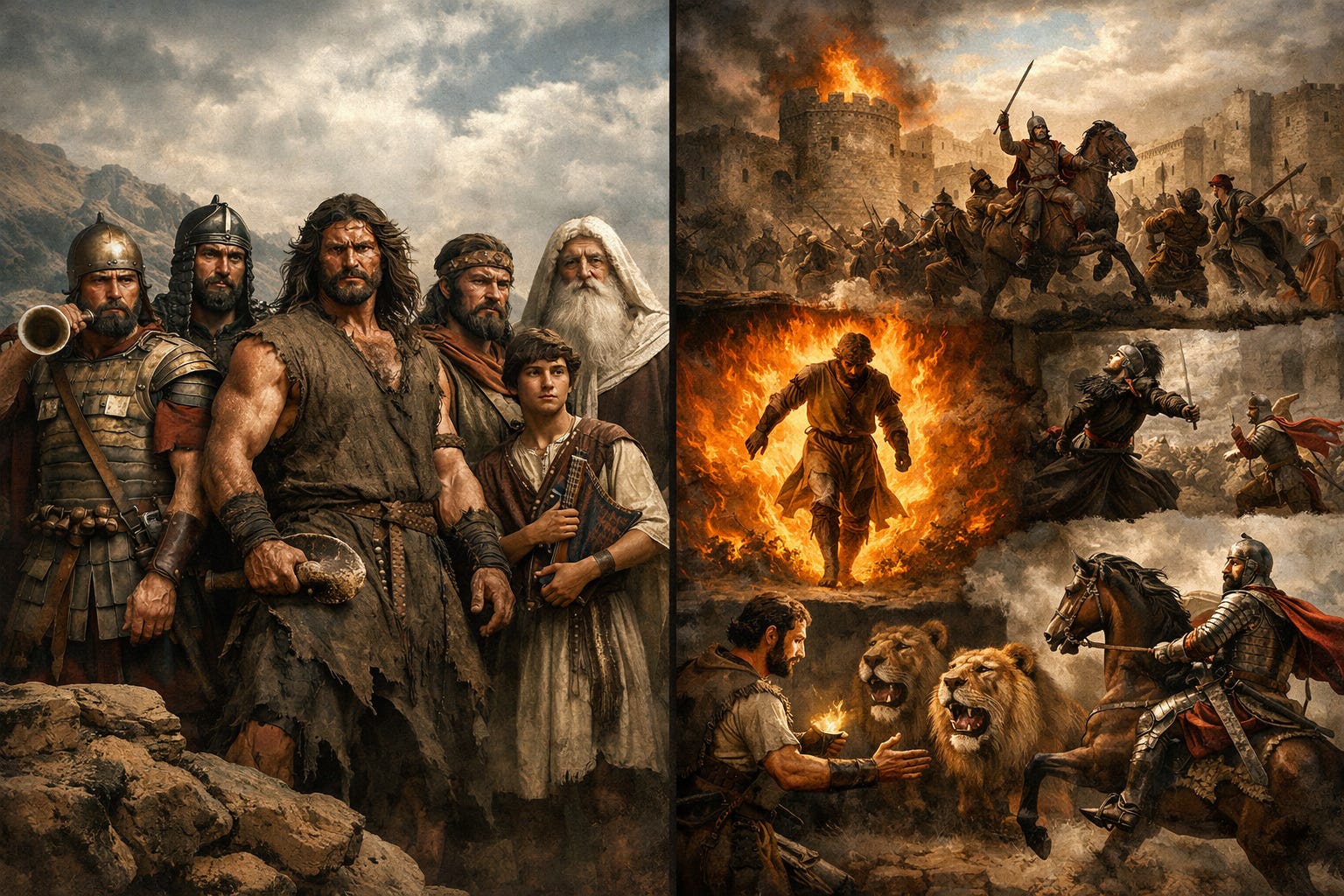
Well, I must admit I did laugh a little bit at this AI image for Hebrews 11:32-34. It’s obviously Samson in the middle of the group on the left side, but perhaps via “Conan the Barbarian”.
The author of Hebrews realizes that there are many more stories of faith that he could tell to his intended audience. These examples are men of God in the OT who through their faith conquered kingdoms, performed acts of righteousness, obtained promises, shut the mouth of lions, quenched the power of fire, escaped the edge of the sword, became strong from weakness, became might in war, and put foreign armies to flight. Gideon, Barak, Samson and Jepthtah are from the time of the book of Judges, while we know of David and Samuel and obviously one of the prophets in the collective group is Daniel.
Enduring Word commentary goes into a little more detail on these many stories of faith:
a. Subdued kingdoms: Some of these were David, Joshua, King Asa, Jehoshaphat, King Hezekiah, and King Josiah.
b. Worked righteousness: Some of these were Elijah, Elisha, and the other prophets in general; King Josiah also.
c. Obtained promises: Among these we could include Caleb, Gideon, and Barak.
d. Stopped the mouths of lions: These include Daniel, David, and Benaiah (one of David’s mighty men).
d. Quenched the violence of fire: Among these are Shadrach, Meshach, and Abednego.
e. Escaped the edge of the sword: David escaped the sword of Goliath and the sword of Saul, Moses escaped the sword of Pharaoh, and Elijah escaped the sword of Jezebel.
f. Out of weakness were made strong: Among these are Sarah, Gideon, Abraham, Esther, and King Hezekiah.
i. “Many of us may never have to brave the fiery stake, nor to bow our necks upon the block, to die as Paul did; but if we have grace enough to be out of weakness made strong, we shall not be left out of the roll of the nobles of faith, and God’s name shall not fail to be glorified in our persons.” (Spurgeon)
g. Became valiant in battle: Some of the many in this description are David, King Asa, and Jehoshaphat.
Charles Spurgeon jumped on the phrase that some of these exemplars of faith were made strong from their weakness. Here is an excerpt from a lovely sermon of his that was quoted on Precept Austin (and this sermon is quoted in the Enduring Word commentary above):
THOSE who out of weakness were made strong are written among the heroes of faith, and are by no means the least of them. Believers “quenched the violence of fire, escaped the edge of the sword, out of weakness were made strong.” Who shall tell which of the three grand deeds of faith is the greatest? Many of us may never have to brave the fiery stake, nor to bow our necks upon the block, to die as Paul did; but if we have grace enough to be out of weakness made strong, we shall not be left out of the roll of the nobles of faith, and God’s name shall not fail to be glorified in our persons.
Brethren, as believers in the Lord Jesus, we are called to two things, namely, to do and to suffer for his name’s sake. Certain saints are summoned to active marching duty, and others are ordered to keep watch on the walls. There are warriors on the field of conflict, and sentries in the box of patience.
Both in doing and in suffering, if we are earnest and observant, we soon discover our own weakness. “Weakness” is all we possess. “Weakness” meets us everywhere. If we have to work for the Lord, we are soon compelled to cry, “Who is sufficient for these things?” and if we are called to suffer for him, our weakness, in the case of most of us, is even greater: many who can labor without weariness cannot suffer without impatience. Men are seldom equally skilled in the use of the two hands of doing and bearing. Patience is a grace which is rarer and harder to come at than activity and zeal. It is one of the choicest fruits of the Spirit, and is seldom found on newly-planted trees. The fact soon comes home to us that we are weak where we most of all desire to be strong.
Our longing is to be able both to do and to suffer for our Lord, and to do this we must have strength from above, and that strength can only come to us through faith. I have read you this glorious eleventh [chapter] of Hebrews, which describes the mighty men of faith, the men of renown. They accomplished all their feats by a power which was not in them by nature. They were not naturally strong either to do or to suffer. If they had been, they would not have required faith in God; but being men of like passions with ourselves, they needed to trust in the Lord, and they did so. They were quite as weak as the weakest of us; but by their faith they laid hold on heavenly strength until they could do all things. There was nothing in the range of possibility, or, I might say, nothing within the lines of impossibility, which they could not have performed. They achieved everything that was necessary in the form of service, and they bore up gloriously under the most fearful pressure of suffering, simply and only by faith in God, who became their Helper. You and I may be very weak at this time, but we can be made strong out of just such weakness. We need not wish to have any strength of our own, for by faith we can reach to any degree of power in the Lord.
We can have all imaginable strength for the grandest achievements desirable, if we have faith in God. Upon this simple but most practical matter I am going to speak to you at this time. We all wish to be strong. Medicines, embrocations, foods, baths, and all sorts of inventions are advertised as means of increasing strength. We are all in heavenly things so weak, that the idea of being made strong should be very attractive to us. Let us learn, then, how others “out of weakness were made strong,” and let us follow on to enjoy their privilege by copying their conduct. Let me ask you to note, first, faith makes men strong for holy doing; and, secondly, faith makes men strong for patient suffering. We shall go over the ground which I marked out in my introduction…
Dear friend, would you like to do something great for God? Have you heard the motto of our early missionaries,
“Attempt great things for God”?
Does that thought burn within your heart? Do you long to be of some great use? “Oh, yes,” says one, “I would attempt great things for God, but I am terribly weak.” Make the attempt by faith in God, for it is written about people “who through faith subdued kingdoms, worked righteousness, obtained promises, stopped the mouths of lions, quenched the violence of fire, escaped the edge of the sword, out of weakness were made strong, became valiant in battle, turned to flight the armies of the aliens” (Heb. 11:33, 34). If you feel incapable, throw yourself on the infinite capacity of God. As long as you are willing to be used, as long as God has given you a concern and a labor of spirit for the souls of others, you need not fear. You may by faith get to work in all your feebleness, for “as your days so shall your strength be” (Dt 33:25). Has not the Lord said to you, “My grace is sufficient for you, for My strength is made perfect in weakness” (2Cor. 12:9-note)? Is not this word true? (Read the full sermon on Hebrews 11:34 - The Best Strengthening Medicine) (See Spurgeon’s related sermon on Hebrews 11:34 God’s Cure For Man’s Weakness).
The links go to two sermons that Spurgeon preached on Hebrews 11:34. So many of the men of God bemoaned a lack of strength or will or even the ability to speak to the masses as impediments to doing His will when asked. But others gained their strength (mental, physical, spiritual) by falling immediately into obedience to His will.
My next devotional examines Hebrews 11:35-39 - The sufferings of the people of faith.
NOTE: I’m getting closer to the end of this devotional excursion into the book of Hebrews, with two more chapters to go. My next series after I finish Hebrews will be on the Epistle to the Ephesians, then I plan a LONG excursion through the book of Isaiah, Lord willing.
Heaven on Wheels Daily Prayer:
Dear Lord - Please strengthen me to do Your will and to endure suffering in Your name. Amen.
Credits and Citations:
Scripture quotations taken from the (NASB®) New American Standard Bible®, Copyright © 1960, 1971, 1977, 1995 by The Lockman Foundation. Used by permission. All rights reserved. www.Lockman.org.
Precept Austin was accessed on 02/08/2026 to review commentary for Hebrews 11:32-34.
Commentary from Enduring Word is used with written permission and without any alteration. ©1996-present The Enduring Word Bible Commentary by David Guzik – enduringword.com. Within the Enduring Word commentary:
Spurgeon, Charles Haddon The New Park Street Pulpit, Volumes 1-6and The Metropolitan Tabernacle Pulpit, Volumes 7-63 (Pasadena, Texas: Pilgrim Publications, 1990)