


“By faith Abraham, when he was tested, offered up Isaac, and he who had received the promises was offering up his only begotten son; it was he to whom it was said, “In Isaac your descendants shall be called.” He considered that God is able to raise people even from the dead, from which he also received him back as a type. By faith Isaac blessed Jacob and Esau, even regarding things to come. By faith Jacob, as he was dying, blessed each of the sons of Joseph, and worshiped, leaning on the top of his staff. By faith Joseph, when he was dying, made mention of the exodus of the sons of Israel, and gave orders concerning his bones.”
Hebrews 11:17-22 NASB1995
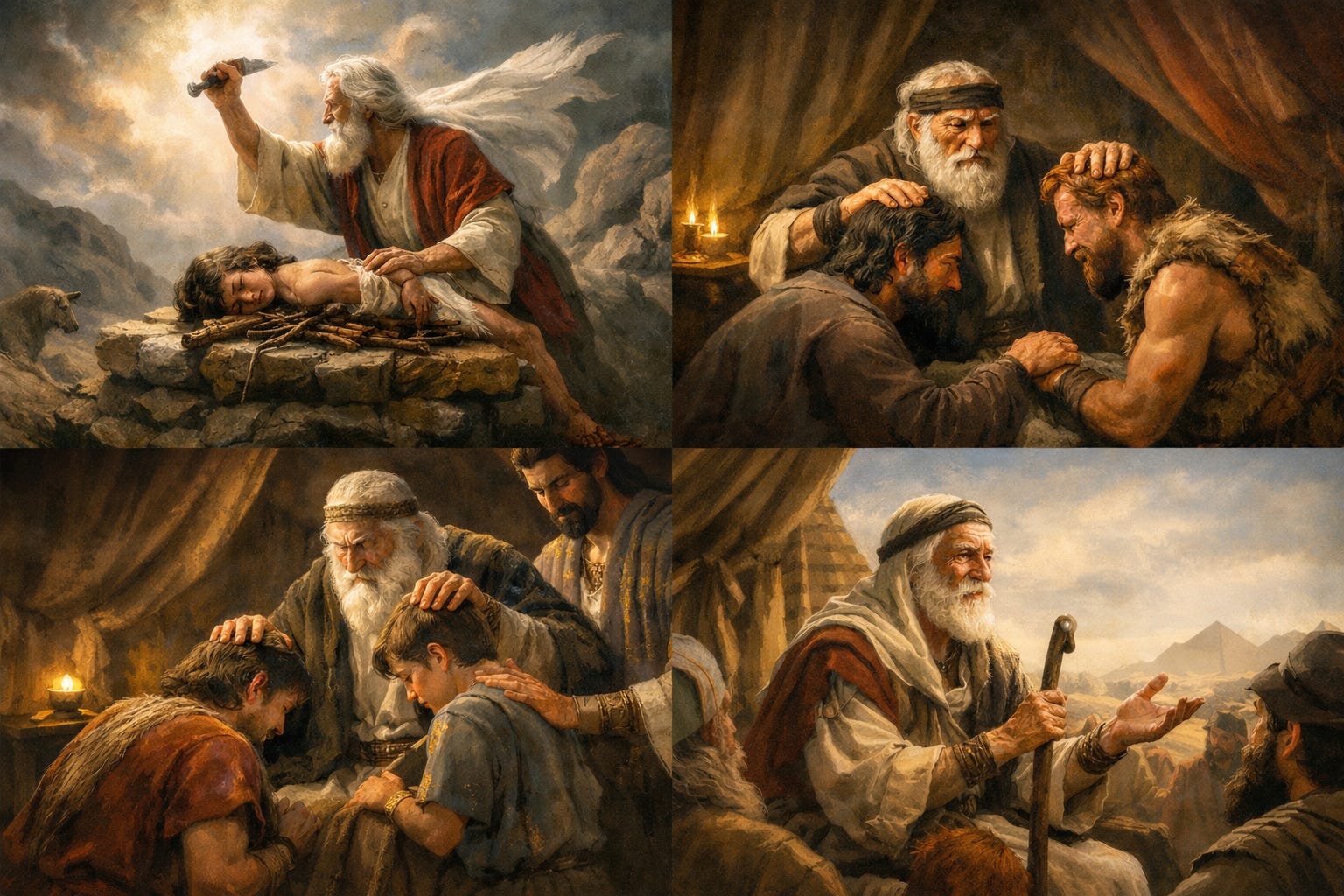
The AI image that Steve requested from ChatGPT at the top has four scenes: Abraham with Isaac, Isaac with Jacob and Esau, Jacob blessing the sons of Joseph, and Joseph mentioning the exodus and the orders for his bones. Four generations are showing their faith.
Let’s look at the first story of faith and do some word studies from the Blue Letter Bible:
When he was tested comes from the Greek verb πειράζω or peirázō (Strong’s G3985), with the following Biblical usages:
to try whether a thing can be done
to attempt, endeavour
to try, make trial of, test: for the purpose of ascertaining his quality, or what he thinks, or how he will behave himself
in a good sense
in a bad sense, to test one maliciously, craftily to put to the proof his feelings or judgments
to try or test one’s faith, virtue, character, by enticement to sin
to solicit to sin, to tempt
of the temptations of the devil
after the OT usage
of God: to inflict evils upon one in order to prove his character and the steadfastness of his faith
men are said to tempt God by exhibitions of distrust, as though they wished to try whether he is not justly distrusted
by impious or wicked conduct to test God’s justice and patience, and to challenge him, as it were to give proof of his perfections.
Many of the New Testament usages of this word are in a negative sense: The temptations of Jesus by the devil, the tests of Jesus coming from the Pharisees to try and trap him, the examples in Acts and other epistles of those who distrusted God and put Him “to the test”, and the temptations that fallen humans endure. But in this case, this was a test by God of Abraham’s quality of faith.
Offered up comes from the Greek verb προσφέρω or prosphérō (Strong’s G4374), with the following Biblical usages:
to bring to, lead to
one to a person who can heal him or is ready to show him some kindness, one to a person who is to judge him
to bring a present or a thing, to reach or hand a thing to one
to put to
to be borne towards one, to attack, assail
to behave one’s self towards one, deal with one
This same verb in a similar context is used to describe people being brought to Jesus so He could cure their ailments or to describe offerings to God. So also in this case, Isaac is brought as an offering to God. Let’s look at the original text from Genesis:
“Now it came about after these things, that God tested Abraham, and said to him, “Abraham!” And he said, “Here I am.” He said, “Take now your son, your only son, whom you love, Isaac, and go to the land of Moriah, and offer him there as a burnt offering on one of the mountains of which I will tell you.” So Abraham rose early in the morning and saddled his donkey, and took two of his young men with him and Isaac his son; and he split wood for the burnt offering, and arose and went to the place of which God had told him. On the third day Abraham raised his eyes and saw the place from a distance. Abraham said to his young men, “Stay here with the donkey, and I and the lad will go over there; and we will worship and return to you.” Abraham took the wood of the burnt offering and laid it on Isaac his son, and he took in his hand the fire and the knife. So the two of them walked on together. Isaac spoke to Abraham his father and said, “My father!” And he said, “Here I am, my son.” And he said, “Behold, the fire and the wood, but where is the lamb for the burnt offering?” Abraham said, “God will provide for Himself the lamb for the burnt offering, my son.” So the two of them walked on together.
Then they came to the place of which God had told him; and Abraham built the altar there and arranged the wood, and bound his son Isaac and laid him on the altar, on top of the wood. Abraham stretched out his hand and took the knife to slay his son. But the angel of the Lord called to him from heaven and said, “Abraham, Abraham!” And he said, “Here I am.” He said, “Do not stretch out your hand against the lad, and do nothing to him; for now I know that you fear God, since you have not withheld your son, your only son, from Me.” Then Abraham raised his eyes and looked, and behold, behind him a ram caught in the thicket by his horns; and Abraham went and took the ram and offered him up for a burnt offering in the place of his son. Abraham called the name of that place The Lord Will Provide, as it is said to this day, “In the mount of the Lord it will be provided.”
Then the angel of the Lord called to Abraham a second time from heaven, and said, “By Myself I have sworn, declares the Lord, because you have done this thing and have not withheld your son, your only son, indeed I will greatly bless you, and I will greatly multiply your seed as the stars of the heavens and as the sand which is on the seashore; and your seed shall possess the gate of their enemies. In your seed all the nations of the earth shall be blessed, because you have obeyed My voice.””
Genesis 22:1-18 NASB1995
Abraham’s test is one of the most severe in the Bible, only surpassed by the test that Christ met, yet Abraham passes the test with flying colors. How are you situated in your faith for passing a test of this magnitude? We did our intercessory prayers today that included prayers from people at the church or those using the prayer request on-line. Some prayers are so tragic - many prayer requests describe fighting serious illnesses, facing financial difficulties and dealing with family crises. Others are pleas for minor things, but He will still hear them. When I started to have this vision problem in my left eye (the surgery in December only lightly relieved the distortion and acuity problems) I asked for healing; now I pray for the strength to endure the problems with my vision, especially when reading texts and writing these devotionals. I have faith that I will see well enough now and perfectly in that heavenly citadel.
My vision problem is so small compared to others and their travails. We both recently read a book entitled “Wounded Tiger: The Transformational True Story of the Japanese Pilot Who Led the Pearl Harbor Attack (A World War 2 Nonfiction Novel)” by T. Martin Bennet (go to this link to see the book on Amazon). This was one of the best books I have read in recent years and I highly recommend it to believers and WWII history junkies at the same time. I don’t want to give away the entire plot, but the three main real-life characters are Mitsuo Fuchida (the leader of the surprise attack on Pearl Harbor), Jake DeShazer (a bombardier on one of the 1942 Doolittle Raid bombers) and Ann Covell (the grown daughter of missionaries who escaped from Japan to the Philippines at the beginning of WWII). In each case, especially the stories of Jake and Ann, we tremble at the faith in Christ that they both embraced given the circumstances they endured. Fuchida is the beneficiary of those deep faiths and he came to Christ in the years just after the war. God was definitely at work in these people, just like in Abraham and Issac.
Isaac in these circumstances is a type (see this Precept Austin discussion about typology), a pointer to Christ. Isaac was offered up as a sacrifice but was spared. Abraham believed that Isaac could be resurrected from the dead to fulfill the covenant with God. The commentary from Enduring Word is quite good:
a. By faith Abraham, when he was tested, offered up Isaac: The verb tense for offered up indicates that as far as Abraham was concerned the sacrifice was complete. In his will and in his purpose he really did sacrifice his son.
b. Offered up his only begotten son: Though Abraham had another son (Ishmael, the son of his fleshly attempt to fulfill God’s promise), God did not recognize the other son (Genesis 22:1-14) – so Isaac could be called his only begotten son.
c. Accounting that God was able: The ancient Greek word translated accounting means just what it sounds like in English. It is a term from arithmetic expressing “a decisive and carefully reasoned act.” (Guthrie) This means that Abraham calculated God’s promise worthy of confidence.
d. From the dead, from which he also received him: As far as Abraham was concerned, Isaac was as good as dead and it was from the dead that he received him back, in a manner that prefigured the resurrection of Jesus.
i. Bruce wonders if this is not the incident that Jesus referred to in John 8:56 when Jesus said: Your father Abraham rejoiced to see My day; and he saw it, and was glad.
ii. When Abraham was confronted with a promise and a command from God which seemed to contradict each other, he did what we all should do: he obeyed the command and let God take care of the promise. God was more than able to do this.
A really good piece of advice in this commentary: We should obey the command from God and let Him take care of the promise, even if they seem contradictory.

The next three verses demonstrate the faith in the promises of God, unto death, demonstrated by the patriarchs Isaac, Jacob and Joseph. Steven Cole has a sermon outline about these three patriarchs, as excerpted in Precept Austin:
1. Isaac’s blessing of Jacob and Esau shows faith in God’s promises, even when circumstances seem to contradict those promises (He 11:20).
2. Jacob’s blessing of Joseph’s sons and his worship show faith in God’s promises, even when circumstances seem to contradict those promises (He 11:21).
A. Jacob’s blessing of Joseph’s sons shows faith in God’s promises, even when circumstances seem to contradict those promises.
There are three applications of this story.
(1) God’s ways are not man’s ways; God’s ways according to His sovereign choice, will triumph over man’s ways.
(2) As parents and grandparents, we should seek spiritual blessings for our children above worldly success.
(3) God is sovereign in assigning different gifts and places to His children, both materially and spiritually.
B. Jacob’s worship shows faith in God’s promises, even when circumstances seem to contradict those promises.
3. Joseph’s mention of the exodus and his order about his bones show faith in God’s promises, even when circumstances seem to contradict those promises (He 11:22).
Another good commentary is from Jack Arnold, quoted in Precept Austin, on what verses 20-22 mean in Hebrews 11:
My own personal study in the Book of Hebrews, especially the eleventh chapter, has been just super and has come at a very needy time in my own experience to walk by faith. However, in my study of these three verses, I had a difficult time at first getting any real spiritual truth. I came to the conclusion that there are two themes in these verses: 1) facing death by faith and 2) accepting God’s promises by faith.
Soren Kiekegaard, the Danish theologian and philosopher, made a profound statement. He said, “There comes a midnight when all men must unmask.” All men wear masks and all try to hide their true identity. For every one of us, in one way or another, life is a masquerade. We seek to hide our faults from others, to cover our inadequacies, so they will not be seen. We think that the masks we are wearing hide our real selves from those who would know us. Some men grapple with life more honestly and a few of their masks come down in this life, but no one has defeated totally the problem of hypocrisy.
However, there is a final midnight when we shall all be unmasked and that midnight is the time of death when all of a man’s life will be laid bare before Almighty God. Most men fear death; they do not want to talk about it or think about it. Perhaps you are even now saying to yourself, “I’m interested in life not death. I want to talk about life - don’t bring up death!” Fear of death is natural because death is man’s greatest foe. But as with all other foes, death must be faced.
Someone has said, “Life is not comprehended truly or lived fully unless the idea of death is grappled with honestly.”
Billy Graham has said, “We are not prepared to live until we are prepared to die.” We must gain the victory over the fear of death, or life will not reach its richest and deepest meaning for us.
Because people run from death, they never stop long enough to consider the reasons for their intense fear of it. One very obvious reason men fear death is that they do not know what lies beyond this life and what the final time of unmasking will be like. If we only knew what to expect, it would not be so bad. In other difficulties, we can usually find someone whom we can trust to guide us through hard times. In other circumstances, there is someone who has had the same experience, who can tell us what to expect, and how best to face it. Yet death is not that way. There is no mere human who can help a person in death, for there is no one who has experienced death who ever came back to tell us about it.
There is someone who died and rose from the dead who knows all about death-- that is Jesus Christ, the God-Man. Only God, as He is revealed in Christ, can help a person at the moment of death, for only a deep faith in the living God can ever take away the fear of death.
In Hebrews 11:20-22, we have three men, Isaac, Jacob and Joseph, all of whom were facing death. Yet, as we are going to find, none expressed fear of dying. Each one, instead, was marked by confidence and hope. They were desirous right up to the end of their lives to see God’s promises fulfilled. They had learned in their lifetime to trust God and, therefore, were ready to trust God in death. They were men of faith and the man of faith does not have to fear because the man of faith dies as he lives - by faith.
Unless you and I trust Jesus in life, we will have no one whom we can trust in death.
The writer of Hebrews is making the point to the wobbly believers that these great men of the Old Testament had confidence and hope in the promises of God, right up to the end. We need to trust Jesus in life, because there is no one but Him who we can trust with death.
By the way, something came to me when writing this and reading the commentary. After the disciples and followers saw Jesus after His Resurrection, have you noticed that not a single one of them asked Jesus what heaven was like? All they had to do was just look at the risen Lord to know what the promise for them was going to be.
My next devotional examines Hebrews 11:23-29 - The faith of Moses.
Heaven on Wheels Daily Prayer:
Dear Lord - Help me to gain victory over the fear of death, to know that death in faith is a new life in You. Amen.
Credits and Citations:
Scripture quotations taken from the (NASB®) New American Standard Bible®, Copyright © 1960, 1971, 1977, 1995 by The Lockman Foundation. Used by permission. All rights reserved. www.Lockman.org.
Precept Austin was accessed on 02/01/2026 to review commentary for Hebrews 11:17-22. Within the Precept Austin commentary: Sermon notes by Steven Cole, Dying Faith, is Copyright 2004 © Steven Cole.
Commentary from Enduring Word is used with written permission and without any alteration. ©1996-present The Enduring Word Bible Commentary by David Guzik – enduringword.com. Within the Enduring Word commentary:
Guthrie, Donald Hebrews (Grand Rapids, Michigan: Eerdmans Publishing Company, 1983)
Bruce, F.F. The Epistle to the Hebrews(Grand Rapids, Michigan: Eerdmans Publishing Company, 1964)