


“By faith Abraham, when he was called, obeyed by going out to a place which he was to receive for an inheritance; and he went out, not knowing where he was going. By faith he lived as an alien in the land of promise, as in a foreign land, dwelling in tents with Isaac and Jacob, fellow heirs of the same promise; for he was looking for the city which has foundations, whose architect and builder is God. By faith even Sarah herself received ability to conceive, even beyond the proper time of life, since she considered Him faithful who had promised. Therefore there was born even of one man, and him as good as dead at that, as many descendants as the stars of heaven in number, and innumerable as the sand which is by the seashore.”
Hebrews 11:8-12 NASB1995
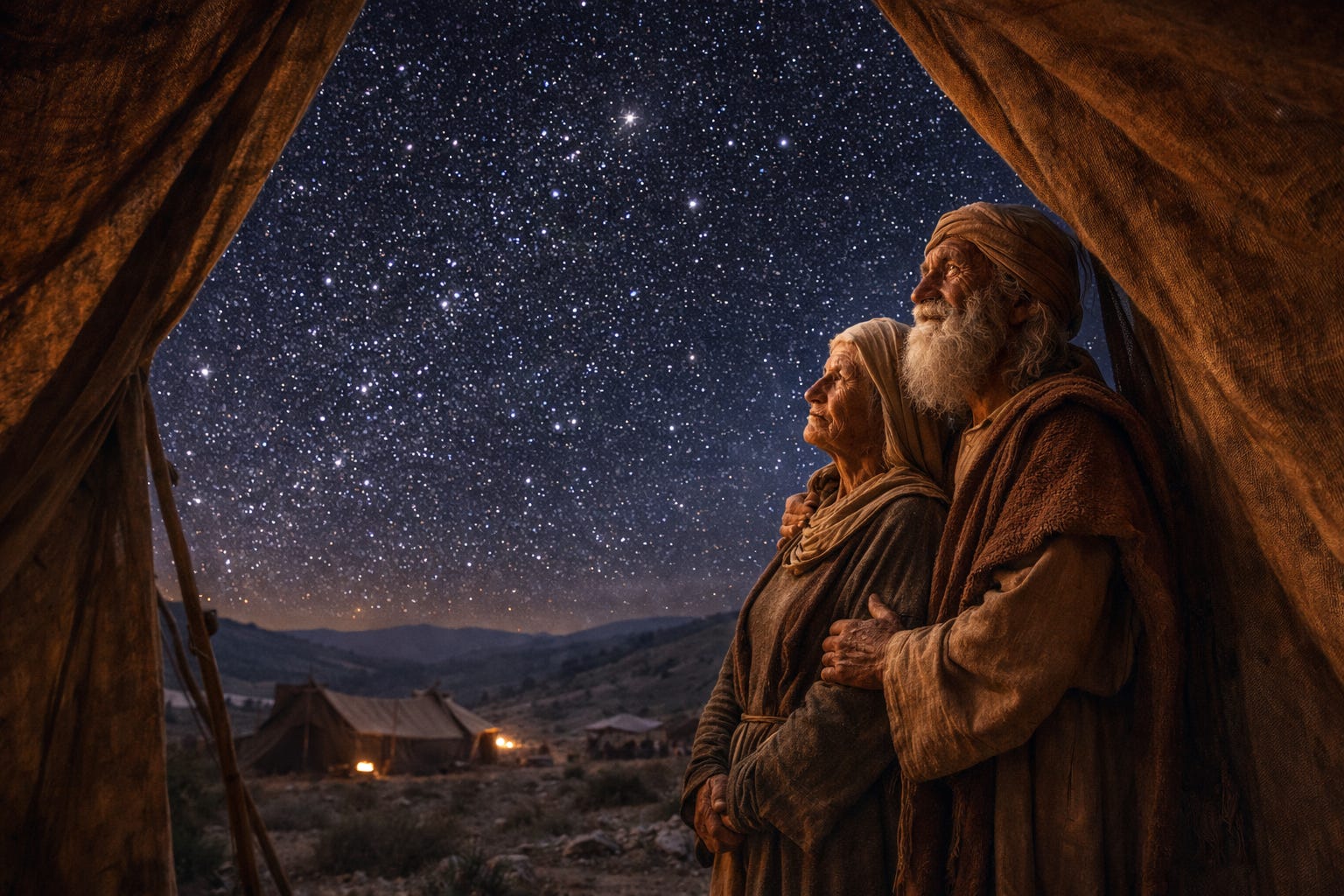
Steve asked Chat GPT to create the image at the top, showing Abraham and Sarah at their tent entrance looking up at the stars. We both thought that this was so beautiful and it shows the depth of detail that this AI program is currently manifesting. A tool for good or bad? We will have to keep an eye on AI, that’s for sure, but we can enjoy something as beautiful as this reverent scene.
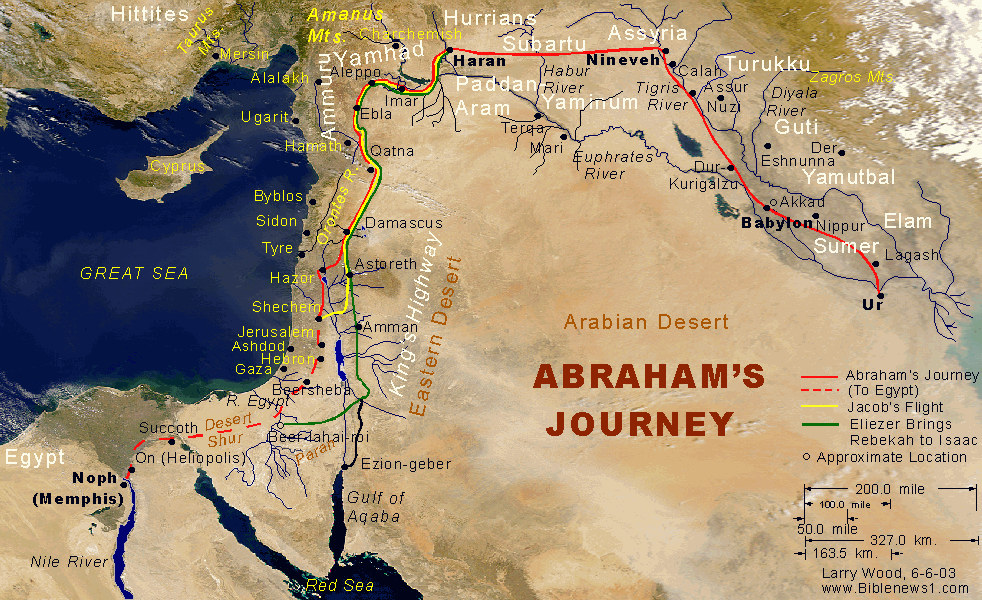
This passage of Hebrews 11 describes the faith of Abraham and Sarah. Abram (“exalted father’) who was renamed Abraham (“father of multitudes”) by God, was called by God to leave the land of Ur and travel to a distant land, not knowing where he was going or what the final destination would be. He obeyed and lived by faith and dwelt in tents as an alien in the land of promise, as did his son Isaac and his grandson Jacob. The map below, from Precept Austin, shows the journey of Abraham; the original source is noted in the lower right hand corner of the map:
The late John MacArthur is quoted in Precept Austin talking about the Christian faith that is not by sight and the example of Abraham:
There are only two ways to live. One way, by far the most common, is to live by sight, to base everything on what you can see. This is the empirical way. The other way, far less common, is to live by faith, to base your life primarily and ultimately on what you cannot see. The Christian way, of course, is the faith way. We have never seen God, or Jesus Christ, or heaven, or hell, or the Holy Spirit. We have never seen any of the people who wrote the Bible or an original manuscript of the Bible. Though we see the results of them, we have never seen any of the virtues that God commands or any of the graces that He gives. Yet we live in the conviction of all these things by faith. We bank our earthly lives and our eternal destiny on things which we have never seen. That is the way the people of God have always lived....
The rabbis had long taught that Abraham pleased God because of his works. They believed that God looked around the earth and finally found an outstandingly righteous man, Abraham, who because of his goodness was selected to be the father of God's chosen people. That false teaching needed to be corrected. It was necessary to show, from the Old Testament itself, that Abraham was not righteous in himself but was counted righteous by God because of his faith. (See Genesis 15:6+) For a Jew to accept the truth that salvation is by faith, he would have to be shown that this truth applied to Abraham. The Jews were right in looking to Abraham as a great example. The problem was that they looked at him in the wrong way. They knew that he pleased God, but they had to be shown that God was pleased with him not because of any good works he did, but because he trusted Him.
The New Testament makes it clear that Abraham was the first true man of faith. Since his time, everyone who trusts in God, Jew or Gentile, is spiritually a child of Abraham. "Therefore, be sure that it is those who are of faith who are sons of Abraham" (Gal. 3:7; cf. v. 29). Those who trusted God before the Flood—such as Abel, Enoch, and Noah—were only partial examples of faith. Abraham was the first established man of faith, and he is the pattern, the prototype, of faith for men of all ages. (See Hebrews MacArthur New Testament Commentary - Page 326)
Faith means stepping out in obedience to God’s will. Let’s look at the first few verses of Genesis 12 to see what the Lord said to Abram:
“Now the Lord said to Abram,
“Go forth from your country,
And from your relatives
And from your father’s house,
To the land which I will show you;
And I will make you a great nation,
And I will bless you,
And make your name great;
And so you shall be a blessing;
And I will bless those who bless you,
And the one who curses you I will curse.
And in you all the families of the earth will be blessed.””
Genesis 12:1-3 NASB1995
Abraham was looking for the city that has firm foundations and is built and constructed by God. Perhaps he was looking far into the future to the new Jerusalem as given to John in a vision in the book of Revelation or perhaps even to his own death and his entry into a heavenly citadel. Ray Pritchard, quoted in Precept Austin has a thought-provoking commentary on this city:
Living by faith means never taking your eyes off heaven....Abraham looked for a city with foundations—that is, for a “city,” not a lonely spot in the desert. He wanted to live in a place filled with other people. He also looked for a city with “foundations,” a place with security and permanence that could not be found in a tent. That meant he was looking for a city designed and built by God. Why? Because all earthly cities eventually crumble to dust.....If this moment is golden for you, enjoy it but don’t grasp it too tightly because it won’t last forever.
That’s the way it is with all earthly cities. Nothing built by man lasts forever. No wonder Abraham was looking for a city built and designed by God. Revelation 21 describes that city as “the new Jerusalem, coming down out of heaven from God” (v. 2). In his vision John saw a city of breathtaking beauty, shining with the glory of God, “its radiance like a most rare jewel, like a jasper, clear as crystal” (v. 11). Christians have always looked to the New Jerusalem as the final abode for the people of God, the place where we will spend eternity together in the presence of the Lord. But note this. Heaven is a city. It’s a real place filled with real people. That’s the city Abraham was looking for when he left Ur of the Chaldees.....
Following God’s will doesn’t guarantee worldly success. He had his heart set on heaven, and that explains why he could:
• Leave the beautiful city of Ur.
• Walk away from his career.
• Leave his friends far behind.
• Live in tents until the end of his life.
• Start all over again in a new land.
• Die without seeing all that God had promised.Abraham knew he was going to heaven, and that changed his whole perspective on life. He knew not just that he was going to die, but that after death he was going to enter a city God had designed and made.
This city is not a solitary retreat in the wilderness. A city is filled with other people! This city is also a place of permanence and security. Abraham died without seeing all of God’s promises, but he still believed in God’s promises. As believers, we have this same wonderful promise for eternity!
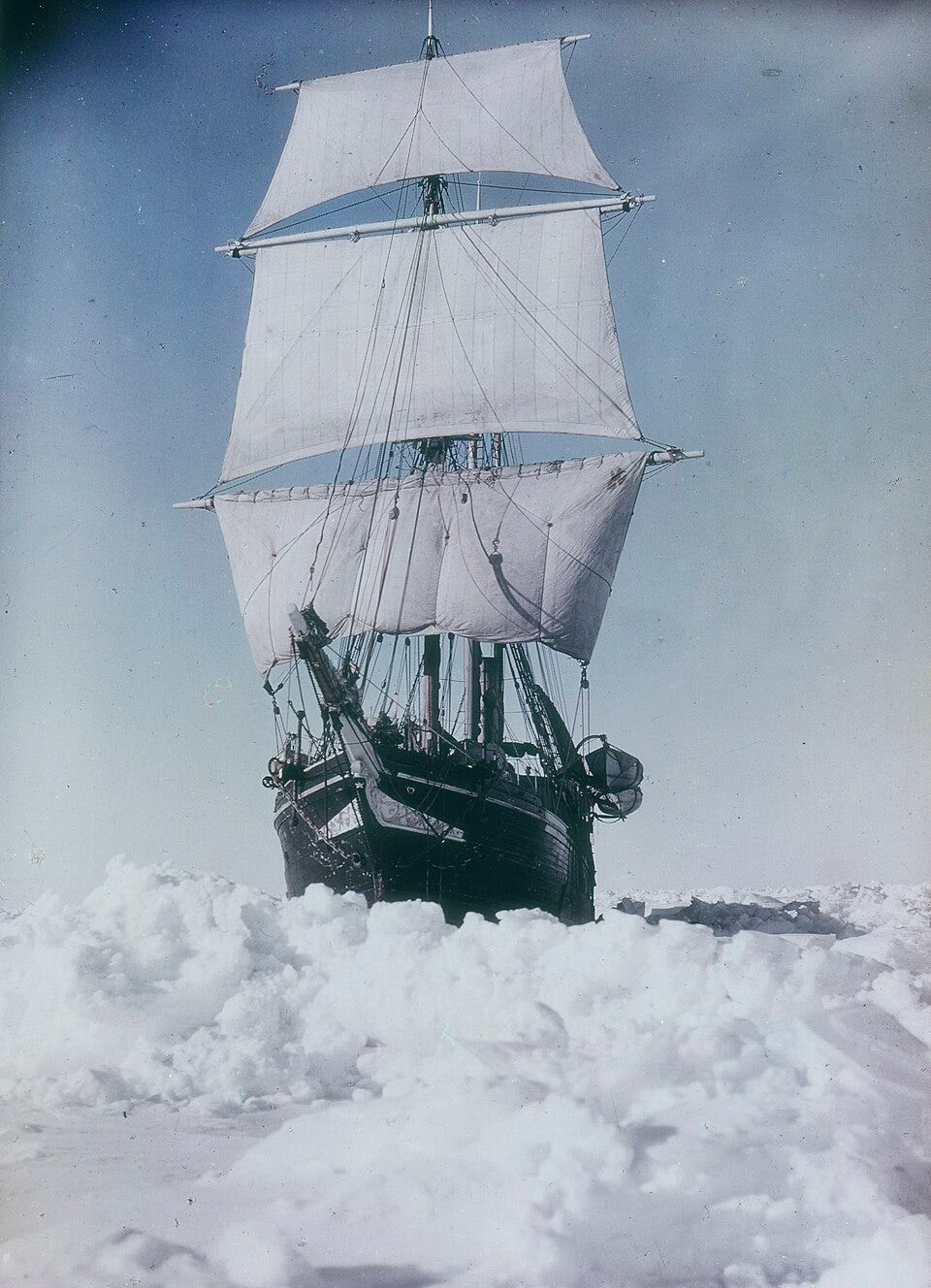
I also like this example of hope and faith, from the remarkable story of the Shackleton Antarctic expedition, as quoted in Precept Austin:
In January 1915 the ship Endurance was trapped and crushed in the ice off the coast of Antarctica. The group of polar explorers, led by Ernest Shackleton, survived and managed to reach Elephant Island in three small lifeboats. Trapped on this empty island, far from normal shipping lanes, they had one hope. On 24 April 1916, 22 men watched as Shackleton and five others set out in a tiny lifeboat for South Georgia, an island 800 miles away. The odds seemed impossible, and if they failed, they would all certainly die. Amazingly, more than four months later, a boat appeared on the horizon with Shackleton on its bow shouting, “Are you all well?” And the call came back, “All safe! All well!” What held those men together and kept them alive over those months? Faith and hope placed in the promise of one man. They believed that Shackleton would find a way to save them. As we look at our own problems, we don’t need to give up. We can have hope in the certainty and promises of One Man—Jesus, our God and Saviour.
If you have never known about the Ernest Shackleton expedition, it is a story that is strains credulity but it really happened! At this Amazon link is one of the highly recommended historical books about the expedition.
The second part of this passage talks about the faith of Sarah. She considered God faithful, to help her bear a child at an age that is a “scientific impossibility”. Her faith wasn’t perfect - when she first heard the news that she would bear a son, she laughed! Well, so did Abraham, so neither one reacted properly when they first heard this news. But Sarah continued in faith. I like this Ray Pritchard sermon excerpt that was found on Precept Austin:
When God writes their story in Hebrews 11, He makes sure that Sarah gets equal billing with Abraham. It’s true that Abraham gets more space, but she made the Book! Husbands, take notice. Make sure your wife is included in every victory. Abraham couldn’t make a child by himself. He needed Sarah in order to produce Isaac. What if God had worked a miracle in Abraham but not in Sarah? What if she had said, “No thanks. I’m too old. I don’t want to be changing diapers when I’m 90"? In order to fulfill the promise, God had to work several miracles. First, he had to touch their old, tired, worn-out bodies and make them able to reproduce. Second, he had to touch their hearts so that they would have faith to believe the first miracle had taken place.
But there is another side to all this. Sarah didn’t live to see the ultimate end of her faith. Genesis 23:1 says that she was 127 years old when she died, meaning that she lived for 37 years after Isaac was born. But she didn’t live long enough to meet Isaac’s wife Rebekah. She never met her grandsons Jacob and Esau. And she never knew about her many great-grandchildren or the tribes of Israel that would emerge from the unruly sons of Jacob. All of that was hidden to her because she only lived long enough to experience the great miracle of Isaac’s birth and then to see him grow up. She would not see the descendants as numerous as the stars in the sky or the sand on the seashore.
Rarely will any of us see the full results of what we lived for. That, too, is part of the life of faith....Faith is the great divider. By your life, you may influence the next Abraham, the next Sarah, the next David, the next Daniel, the next Esther. Your faith may light a fire for God that will burn long after you are gone.....God may arrange things so that your faith bears vast fruit in the years to come. Your legacy will be most clearly seen after you have gone to heaven....May the Holy Spirit take the truth of the Word and enlarge your faith to believe God for great things now and in the future. Amen. (The Blessing of a Believing Spouse)
I love the words in that sermon! None of us can know what effect we have on others in this life until we have gone to heaven. We can light a fire by faith that burns long after we are gone.

In the AI image at the top of this devotional, perhaps Sarah and Abraham are gazing with wonder at the stars that they can see and pondering God’s promise that their descendants would be as many as the stars in heaven. I can just hear some smug atheist pointing out that scientists estimate that there are trillions and trillions of stars in the universe, so how can the descendants of Abraham (which includes Christians, too, by the way, and Muslims also describe themselves as descendants of Abraham) ever meet those numbers? Well, Abraham and Sarah had no telescopes, but only their eyes to see God’s magnificent creation. On a really clear and dark night, the average observer of the heavens TODAY (with decent eyesight and lots of patience) might see almost 10,000 individual stars. We know now in the 21st century that those cloudy areas in the night sky are other galaxies and star clusters with millions of stars, but that was not known 2,000 years before Christ.
It doesn’t take long to have many descendants, if anyone is familiar with both geometric and exponential numeric series and how populations grow. Isaac fathered Jacob and Esau, Jacob fathered 12 sons (and also daughters) and by the time the tribes of Israel escaped from Egypt they numbered in the millions. Yesterday, we watched “Schindler’s List” again in commemoration of International Holocaust Remembrance Day. Oskar Schindler’s efforts spared about 1,200 Jews from being sent to the death camps. According to Wikipedia, as of 2012 there were more than 8,500 descendants of those 1,200 (it’s certainly a larger number than that now, but more current estimates are not available). Those 1,200 Jews all came from Poland where the pre-WWII Jewish population was over 3 million; the core Jewish population now in Poland, in 2026, is estimated at less than 10,000. Sarah could look far into the future and see the glory of God’s promises, even through the most tragic circumstances.
In my previous devotionals , I listed four examples of faith from the Creation, Abel, Enoch and Noah I’ve carried them over to here and now add the examples from Abraham and Sarah:
(Creation) Faith in God’s Word that He created the worlds from things that are not visible.
(Abel) Faith in God manifested in obedience, worship and sacrifice.
(Enoch) Faith in God found through walking with Him every step of every day.
(Noah) Faith in God carried through adversity and pressure from unbelievers leading to trust in things not yet seen to become an heir of righteousness.
(Abraham) Faith in God requires us to take a step into the unknown and away from what is familiar to us. That faith is anchored in the promises of the city of God.
(Sarah) Faith in God sees miracles that overcome physical limitations.
My next devotional examines Hebrews 11:13-15 - Living faith gives us faith in death!
Heaven on Wheels Daily Prayer:
Dear Lord - Please guide me into the deep faith of Abraham and Sarah, so that I can step away from what is comfortable into the unknown. Amen.
Credits and Citations:
Scripture quotations taken from the (NASB®) New American Standard Bible®, Copyright © 1960, 1971, 1977, 1995 by The Lockman Foundation. Used by permission. All rights reserved. www.Lockman.org.
Precept Austin was accessed on 01/28/2026 to review commentary for Hebrews 11:8-12. Within the Precept Austin commentary: A link is included to a Ray Pritchard full sermon. Copyright © 2020 Keep Believing Ministries
Commentary from Enduring Word is used with written permission and without any alteration. ©1996-present The Enduring Word Bible Commentary by David Guzik – enduringword.com. Enduring Word commentary was accessed but not used for this devotional.