


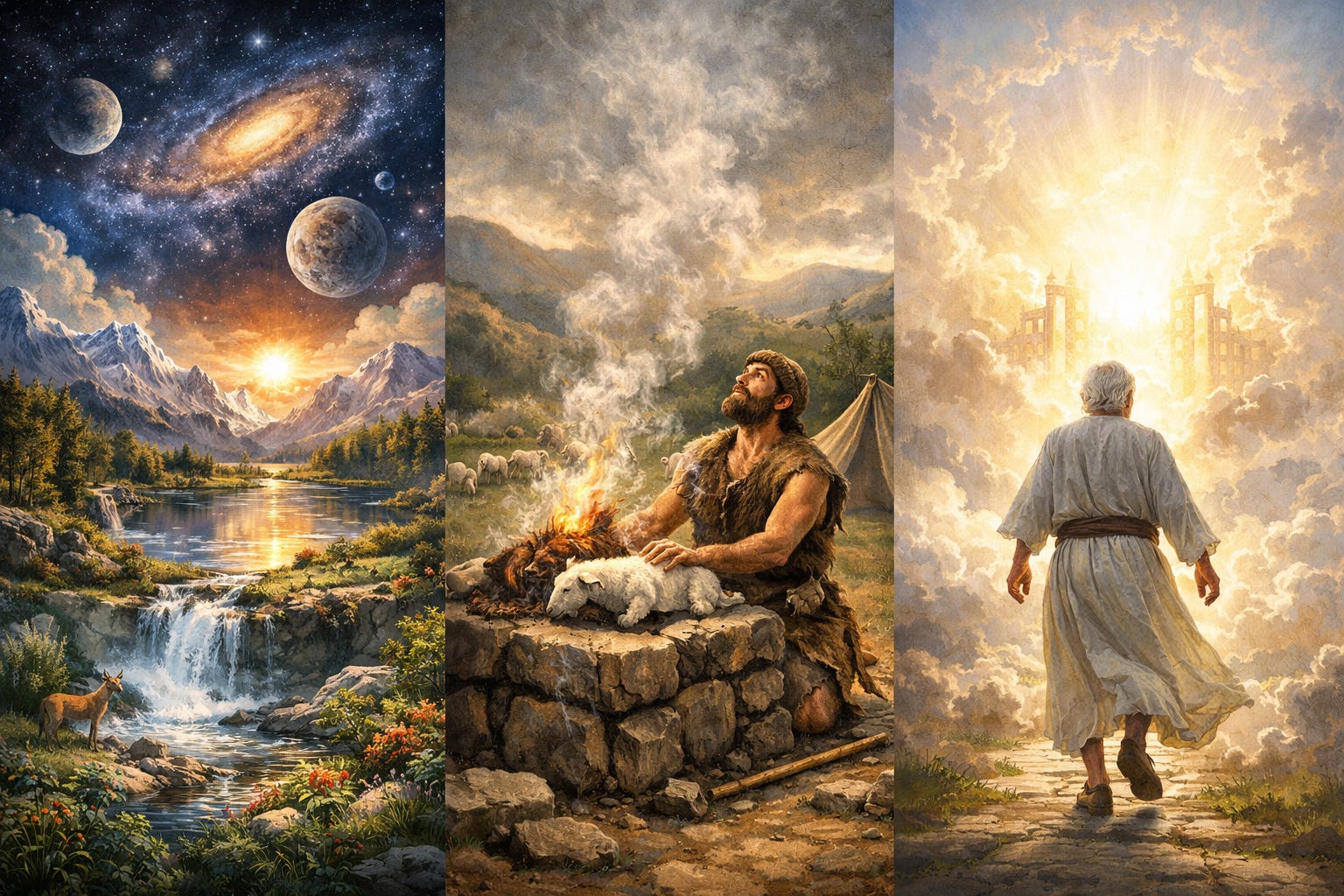
“By faith we understand that the worlds were prepared by the word of God, so that what is seen was not made out of things which are visible. By faith Abel offered to God a better sacrifice than Cain, through which he obtained the testimony that he was righteous, God testifying about his gifts, and through faith, though he is dead, he still speaks. By faith Enoch was taken up so that he would not see death; and he was not found because God took him up; for he obtained the witness that before his being taken up he was pleasing to God.”
Hebrews 11:3-5 NASB1995
Well, ChatGPT AI is getting a bit scary. I told Steve what I wanted for this devotional, which would be a triptych showing the three examples of faith from this passage: Creation, Abel and Enoch. Without any second tries or tweaks, the image above was the result. This is obviously a very valuable tool that we also have to watch like hawks (I saw the Terminator movies, too).
In this passage, the author of Hebrews talks about three things that demonstrate faith. First, we understand, by faith, that the worlds were prepared by the word of God. What is seen was NOT made out of things which are visible. Let’s do some word studies from the Blue Letter Bible lexicon:
We understand that comes from the Greek verb νοιέω or noiéō (Strong’s G3539), with the following Biblical usages:
to perceive with the mind, to understand, to have understanding
to think upon, heed, ponder, consider
An interesting verse that uses this verb that could be said to be related in its context is Romans 1:20:
“For since the creation of the world His invisible attributes, His eternal power and divine nature, have been clearly seen, being understood through what has been made, so that they are without excuse.”
Romans 1:20 NASB1995
Worlds comes from the Greek αἰών or aiṓn (Strong’s G165), with the following Biblical usages:
for ever, an unbroken age, perpetuity of time, eternity
the worlds, universe
period of time, age
This can mean the physical universe or the perpetuity of time.
Things which are visible comes from the Greek verb φαίνω or phaínō (Strong’s G5316), with the following Biblical usages:
to bring forth into the light, cause to shine, shed light
shine
to shine, be bright or resplendent
to become evident, to be brought forth into the light, come to view, appear
of growing vegetation, to come to light
to appear, be seen
exposed to view
to meet the eyes, strike the sight, become clear or manifest
to be seen, appear
to appear to the mind, seem to one’s judgment or opinion
The worlds (physical universe and/or perpetuity of time) were NOT made out things that are evident, clear or manifest to our senses. This is remarkable! At the most basic level, everything in the universe can be distilled down to the subatomic level, which is only beginning to be understood by scientists and is not visibly seen. And time is measured indirectly through seeing movements in the universe (Earth’s revolutions around the sun, for example, or the length of a day). There is no time “particle” but time by God’s standards is linear and in one direction since creation. The speed of light can be used to measure time, but this is, again, a derivation. And that light is composed of both particles (photons) and waves, to make things even more amazing. What God used to create the things that are seen from things that are not visible is another substance that can’t be measured or seen: Love.
Just to mess with everyone’s minds, here is a chart that is in an article on Wikipedia on subatomic particles. None of these have been directly seen, as I noted, but their characteristics have only derived from the behaviors observed in particle physics:
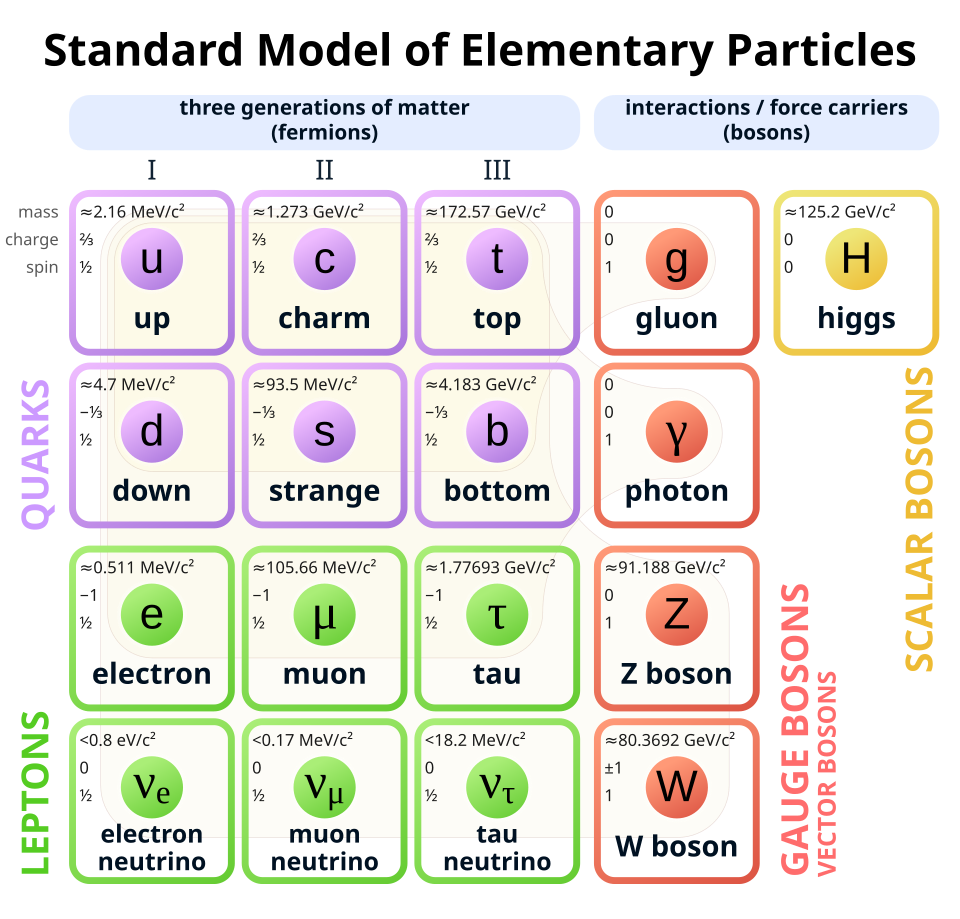
It is perplexing to me why physicists are not on their knees worshipping God, who created this complexity and constancy through His Word. Instead, most of them would probably describe themselves as atheists and they muddle around with the ideas of multiverses (multiple or infinite universes) to get past the evident intelligent design in our universe that is manifested from elementary particles to massive galaxies to DNA to mathematics. Sinful men, which includes atheist physicists, suppress the truth in unrighteousness. By having faith, we can see the loving God who can speak a universe and time into being that is made by things that are not visible.
This commentary by the late John MacArthur, found on Precept Austin, is quite good:
Bertrand Russell spent most of his 90 years as a philosopher. His most certain conviction was that Christianity was the greatest enemy of mankind, because it taught of a tyrannical God who stifled man’s rightful freedom. He admitted at the end of his life that philosophy “was a wash-out,” that it held no answers for anything. He had written that “we must conquer the world by intelligence,” and yet all of his own great intellect and all of the other intellects who looked to themselves for answers never found an answer. Russell’s greatest faith was in the idea that there is no God. He rejected the only source of answers, meaning, and hope. Most philosophy is mere doodling with words, as many people do with a pencil. Without revelation, a source of basic truth, the best it can do is make verbal squiggles. Some are more impressive than others, but none can lay claim to the truth or to ultimate meaning. Paul warned the Colossians, “See to it that no one takes you captive through philosophy and empty deception, according to the tradition of men” (Col. 2:8).....Through faith we understand that the worlds were framed by the Word of God, a truth the world’s most brilliant thinkers have not discovered and cannot discover on their own. It is beyond the realm of scientific investigation, but it is not beyond knowing—if we are willing to be taught by the Word of God.
An evangelist of many years ago told the beautiful story of two little boys he once visited in a London hospital.The cots were side-by-side. One boy had a dangerous fever, the other had been struck by a truck and his body was badly mangled. The second one said to the first, “Say, Willie, I was down to the mission Sunday school and they told me about Jesus. I believe that if you ask Jesus, He will help you. They said that if we believe in Him and pray to God, then when we die He’ll come and take us with Him to heaven.” Willie replied, “But what if I’m asleep when He comes and I can’t ask Him?” His friend said, “Just hold up your hand; that’s what we did in Sunday school. I guess Jesus sees it.” Since Willie was too weak to hold up his arm, the other boy propped it up for him with a pillow. During that night, Willie died, but when the nurse found him the next morning, his arm was still propped up. We can be sure that the Lord saw his arm, because the Lord sees faith and the Lord accepts faith. By faith Willie saw the way to heaven. By faith he saw what the learned will never discover on their own. God’s greatest truths are discovered by simple faith. It is not the world’s way to truth, but a thousand years from now—if the Lord tarries that long—the world will still be devising and rejecting its theories. The person of faith knows the truth now. Faith is the only way to God. (See Hebrews Commentary).

Photo of Widow’s mite (ancient coin) by Steve Sande
The second faith lesson in this passage is about Abel and his sacrifice that was done out of faith. Let’s refresh our minds with the story from Genesis:
“Again, she gave birth to his brother Abel. And Abel was a keeper of flocks, but Cain was a tiller of the ground. So it came about in the course of time that Cain brought an offering to the Lord of the fruit of the ground. Abel, on his part also brought of the firstlings of his flock and of their fat portions. And the Lord had regard for Abel and for his offering; but for Cain and for his offering He had no regard. So Cain became very angry and his countenance fell. Then the Lord said to Cain, “Why are you angry? And why has your countenance fallen? If you do well, will not your countenance be lifted up? And if you do not do well, sin is crouching at the door; and its desire is for you, but you must master it.” Cain told Abel his brother. And it came about when they were in the field, that Cain rose up against Abel his brother and killed him.”
Genesis 4:2-8 NASB1995
Was the grain offering unacceptable to God or was the attitude of Cain unacceptable? God saw something coming from faith in Abel’s offering, but did not see the same thing in Cain. This commentary from Enduring Word identifies the differences:
By faith Abel offered to God a more excellent sacrifice than Cain, through which he obtained witness that he was righteous, God testifying of his gifts; and through it he being dead still speaks.
a. By faith Abel offered to God a more excellent sacrifice: The difference between the sacrifice of Cain and the sacrifice of Abel (Genesis 4:3-5) was not between animal and vegetable. The difference was that Abel’s sacrifice was made by faith.
i. “Abel’s sacrifice was preferred to his brother’s for no other reason than that it was sanctified by faith; for surely the fat of brute animals did not smell so sweetly, that it could, by its odour, pacify God.” (Calvin)
b. God testifying of his gifts: It is likely that God testified of His pleasure with Abel’s sacrifice by consuming it with fire from heaven, as happened at the dedication of the tabernacle (Leviticus 9:24), the temple (2 Chronicles 7:1) and upon offerings made by David (1 Chronicles 21:26) and Elijah (1 Kings 18:38).
c. Through it he being dead still speaks: Right off with his example of Abel, the writer reminds us that faith is not necessarily rewarded on earth. But God Himself testifies to the righteousness of the faithful. Abel’s blood still speaks to us, reminding us of the value of eternity.
The size of the offering doesn’t matter to God - the attitude and faith of the believer who offers it is what matters. This is apparent in one of the best lessons about faith that Jesus taught:
“And He looked up and saw the rich putting their gifts into the treasury. And He saw a poor widow putting in two small copper coins. And He said, “Truly I say to you, this poor widow put in more than all of them; for they all out of their surplus put into the offering; but she out of her poverty put in all that she had to live on.””
Luke 21:1-4 NASB1995
Ostentatious giving does not impress God. He wants our obedience and faith and if we have those things then we are naturally generous in our sowing into His kingdom on Earth. I have what has been called a “widow’s mite” coin (an antique tiny coin from 2,000 years ago) with my cross necklace (see photo above) as a reminder to pray for righteouness, obedience and faith and to sow into His promises accordingly. I also pray that I am not martyred for that faith, as Abel was, but He provides us with the strength and courage in all circumstances.

Enoch is mentioned briefly in Genesis 5 but his story is fleshed out a little bit more in Hebrews. He walked with God and pleased God so much that he was taken up to Heaven without having to die. Here is what Gotquestions.org has to say about this Enoch:
It is only the Enoch mentioned in Genesis 5:18 that the Bible gives any significant information about. This Enoch was the great-great-great-great-grandson of Adam. Genesis 5:22–24 says, “After he became the father of Methuselah, Enoch walked faithfully with God 300 years and had other sons and daughters. Altogether, Enoch lived a total of 365 years. Enoch walked faithfully with God; then he was no more, because God took him away.”
Hebrews 11:5 gives a little more detail: “By faith Enoch was taken from this life, so that he did not experience death: ‘He could not be found, because God had taken him away.’ For before he was taken, he was commended as one who pleased God.” This being “taken away” is what Enoch is most famous for. Only two people in the Bible are said to have been chosen by God to escape death, Enoch and Elijah. Enoch appears to have been given this privilege due to being a man who walked faithfully with God (Genesis 5:24) and pleased God (Hebrews 11:5). For what purpose was Enoch taken away? The Bible does not specifically say. The most common assumption is so that he could serve as one of the two witnesses, alongside Elijah, in the end times.
One more word study for this verse about Enoch is probably appropriate. Enoch was “taken up” by God.
Taken up comes from the Greek verb μετατίθημι or metatíthēmi (Strong’s G3346), with the following Biblical usages:
transpose (two things, one of which is put in place of the other)
to transfer
to change
to transfer one’s self or suffer one’s self to be transferred
to go or pass over
to fall away or desert from one person or thing to another
This is a positive usage. Enoch was transferred or translated directly from this life to eternal life, without having to suffer death. Some commentary I read said that Enoch’s walk with God was so consistent and so abiding that eventually the space between this life for him and the next with God got smaller and smaller and the threshold was crossed. Precept Austin quotes T.B. Baker on what it means to walk with God:
I. WHAT IS IMPLIED IN THE TERM.
II. I SHALL PRESCRIBE SOME MEANS, IN THE LAWFUL USE OF WHICH BELIEVERS ARE ENABLED TO KEEP UP THEIR WALK WITH GOD.
1. By studying the Scriptures.
2. By constant and earnest prayer.
3. By watching the dealings of God without.
4. The motions of God within.
5. Walking in ordinances.
6. Walking in providences.
7. In the communion of saints.
8. And by meditation.III. I SHALL OFFER SOME MOTIVES TO STIR US UP TO THIS HOLY PRACTICE. It is most honourable: most pleasing: and abundantly beneficial to the souls of men.
1. This walking is by faith in Christ (2Co 5:7).
2. Looking to the promises of God (1Ti 4:8).
3. Trusting to the wisdom of God (Rom 8:28). (T. B. Baker.)
So the three examples of faith are:
Faith in God’s word that He created the worlds from things that are not visible.
Faith in God manifested in obedience, worship and sacrifice.
Faith in God found through walking with Him every step of every day.
My next devotional examines Hebrews 11:6-7 - Without faith it is impossible to please God; the faith of Noah.
Heaven on Wheels Daily Prayer:
Dear Lord - Please help me to be in awe of Your creation and how it is constantly reinforced by the findings of science. Please help me to properly worship and submit to Your will. Please help me to walk with You, every step of every day. Amen.
Credits and Citations:
Scripture quotations taken from the (NASB®) New American Standard Bible®, Copyright © 1960, 1971, 1977, 1995 by The Lockman Foundation. Used by permission. All rights reserved. www.Lockman.org.
“G3539 - noeō - Strong’s Greek Lexicon (NASB95).” Blue Letter Bible. Web. 24 Jan, 2026. <https://www.blueletterbible.org/lexicon/g3539/nasb95/mgnt/0-1/>.
“G165 - aiōn - Strong’s Greek Lexicon (NASB95).” Blue Letter Bible. Web. 24 Jan, 2026. <https://www.blueletterbible.org/lexicon/g165/nasb95/mgnt/0-1/>.
“G5316 - phainō - Strong’s Greek Lexicon (NASB95).” Blue Letter Bible. Web. 24 Jan, 2026. <https://www.blueletterbible.org/lexicon/g5316/nasb95/mgnt/0-1/>.
“G3346 - metatithēmi - Strong’s Greek Lexicon (NASB95).” Blue Letter Bible. Web. 24 Jan, 2026. <https://www.blueletterbible.org/lexicon/g3346/nasb95/mgnt/0-1/>.
Precept Austin was accessed on 01/24/2026 to review commentary for Hebrews 11:1-2. Within the Precept Austin commentary: The MacArthur New Testament commentary (see link in the excerpt above).
Commentary from Enduring Word is used with written permission and without any alteration. ©1996-present The Enduring Word Bible Commentary by David Guzik – enduringword.com. Within the Enduring Word commentary:
Calvin, John Hebrews and I and II Peter, translated by W.B. Johnston (Grand Rapids, Michigan: Eerdmans, 1963)
Gotquestions.org was accessed on 1/24/2026 to answer the question, Who was Enoch in the Bible? © COPYRIGHT 2002-2026 GOT QUESTIONS MINISTRIES.