


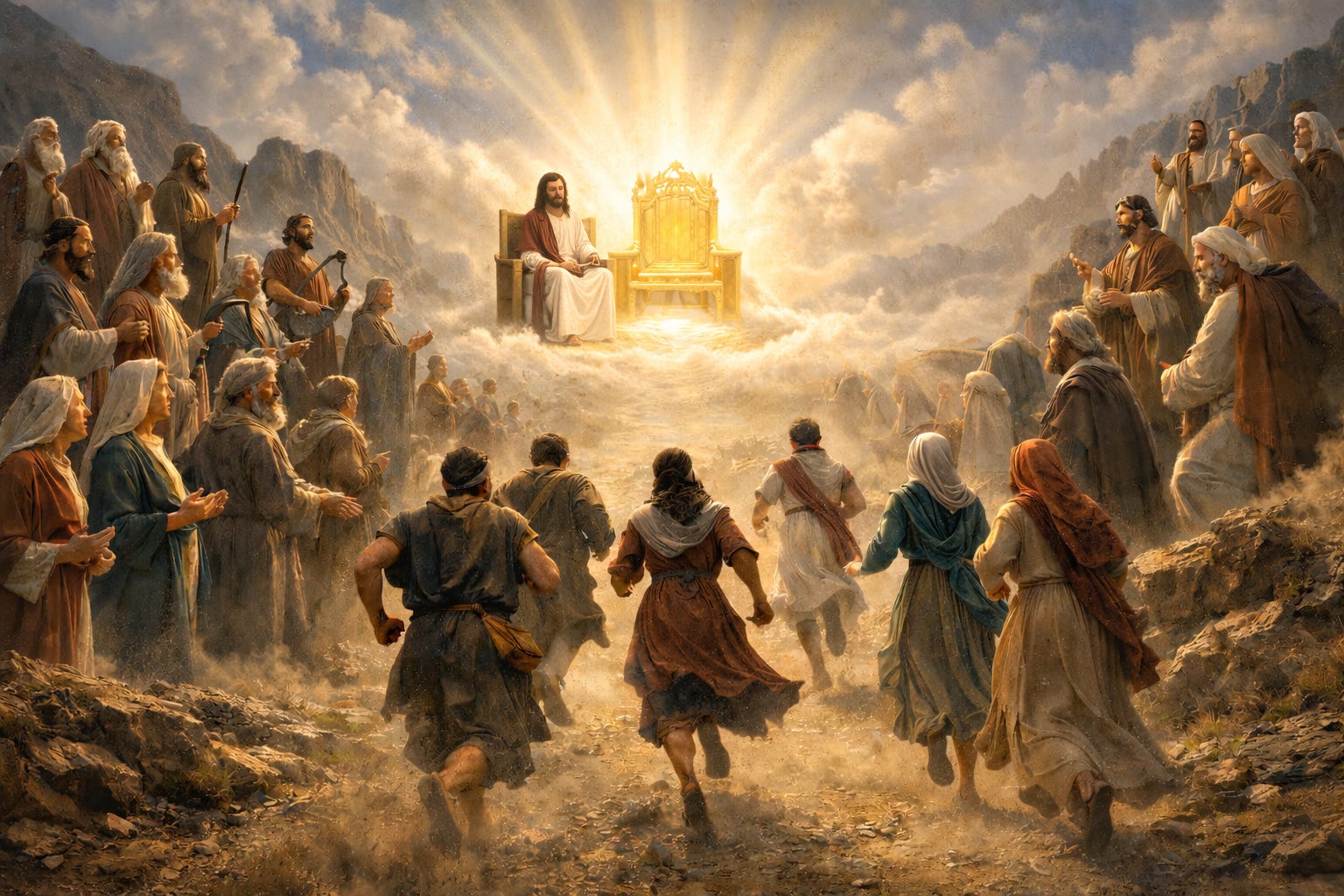
“Therefore, since we have so great a cloud of witnesses surrounding us, let us also lay aside every encumbrance and the sin which so easily entangles us, and let us run with endurance the race that is set before us, fixing our eyes on Jesus, the author and perfecter of faith, who for the joy set before Him endured the cross, despising the shame, and has sat down at the right hand of the throne of God.
For consider Him who has endured such hostility by sinners against Himself, so that you will not grow weary and lose heart.”
Hebrews 12:1-3 NASB1995
Verses 1 and 2 in Hebrews 12 are likely underlined or marked in many Bibles. I like the AI image that Steve had created at the top - a great group of Biblical men and women are surrounding those running towards the glory of Jesus!
Let’s do a few word studies from the Blue Letter Bible lexicon:
Cloud comes from the Greek noun νέφος or néphos (Strong’s 3509), with the following Biblical usages:
a cloud, a large dense multitude, a throng
used to denote a great shapeless collection of vapour obscuring the heavens as opposed to a particular and definite masses of vapour with some form or shape
a cloud in the sky
There are so many witnesses to the truth of God’s promises that they are a throng or large, dense multitude. This is the only usage of this noun in the NT.
Witnesses comes from the Greek noun μάρτυς or mártys (Strong’s 3144), with the following Biblical usages:
a witness
in a legal sense
an historical sense
one who is a spectator of anything, e.g. of a contest
in an ethical sense
those who after his example have proved the strength and genuineness of their faith in Christ by undergoing a violent death
Witnesses to the truth of God’s promises are many in the OT, even though they did not live to see that promise fulfilled. Witnesses to the suffering, death and resurrection of Christ are also many! They were witnesses historically and ethically (true martyrs to the faith). This word is, in fact, the source of the word martyr.
Encumbrance comes from the Greek noun ὄγκος or ónkos (Strong’s 3591), with the following Biblical usages:
whatever is prominent, protuberance, bulk, mass
hence a burden, weight, encumbrance
What weighs us down in the race towards His (and our) joy? The burdens AND pleasures of this world are both encumbrances (I’m not necessarily talking about sin). Working for a living, family pressures, even the pleasant pressures of “vacations” and acquisitions of stuff are all encumbrances. Those encumbrances make us want to look back instead of keeping our eyes forward in our race. This is the only usage of this word in the NT.
[Sin] which so easily entangles us comes from the Greek adjective εὐπερίστατος or euperístatos (Strong’s G2139), with the following Biblical usages:
skillfully surrounding i.e. besetting
Saying “the devil made me do it” is a cop out. Sin is all around us and very attractive or entangling. I’ll have more about this in some commentary coming up. This is the only usage of this adjective in the NT.
Endurance comes from the Greek noun ὑπομονή or hupŏmŏnē (Strong’s G5281), with the following Biblical usages:
steadfastness, constancy, endurance
in the NT the characteristic of a man who is not swerved from his deliberate purpose and his loyalty to faith and piety by even the greatest trials and sufferings
patiently, and steadfastly
a patient, steadfast waiting for
a patient enduring, sustaining, perseverance
We have studied this noun before, because perseverance can be described as one of the attributes of faith (patience is a fruit of the spirit). Luke 21:19 says it succinctly:
“By your endurance you will gain your lives.”
Luke 21:19 NASB1995
Fixing our eyes comes from the Greek verb ἀφοράω or aphoráō (Strong’s G872), with the following Biblical usages:
to turn the eyes away from other things and fix them on something
We have to look forward, not to the right or left. We don’t look at the cloud of witnesses, we fix our eyes on Jesus!

Enduring Word has excellent commentary on verses 1 & 2 of this passage:
a. Since we are surrounded by so great a cloud of witnesses: In the mind’s eye, the author pictured these previous champions of faith as spectators from the heavens, cheering us as we press on to overcome present discouragement as in an athletic competition.
i. The author thought of many more than just the 18 specifically mentioned in Hebrews 11. The ancient Greek word translated cloud was a figure of speech indicating a large group, and this is so great a cloud of witnesses. That cloud probably includes great men and women of God who have come since those Hebrews 11 saints, known and unknown to history. We are also under angelic observation (Ephesians 3:10-11) and the world watches our faith and conduct. We are surrounded by them, as spectators in a stadium surround and observe the players.
ii. The idea of the heroes of faith in the past being spectators as we live lives of faith has made some think that in heaven, people can and do observe what goes on earth. This single passage may suggest this, but it is inconclusive to prove this.
iii. We rightly think of heaven as a place where people are always happy and untroubled. It is hard to think that those in heaven are happy and untroubled if they see what is happening on the earth. So, it is difficult to say that people in heaven are actually observing us.
iv. Others consider that these witnesses are not witnessing us as we conduct our lives. Instead, they are witnesses to us of faith and endurance, in all they have lived and experienced. They have the spirit of martyrs – the root of the ancient Greek word translated witnesses.
v. “Both the Greeks and the Latins frequently use the term cloud, to express a great number of persons or things.” (Clarke)
b. Let us lay aside every weight, and the sin: Sin can hold us back. But there are also things that may not be sin (every weight) but are merely hindrances that can keep us from running effectively the race God has for us.
i. Our choices are not always between right and wrong, but between something that may hinder us and something else that may not. Is there a weight in your life you must lay aside?
c. The sin which so easily ensnares us: The words easily ensnares translate a difficult ancient Greek word (euperistaton), which can be translated four ways: “easily avoided,” “admired,” “ensnaring,” or “dangerous.”
i. Let us lay them all aside:
· Some sins can be easily avoided, but are not.
· Some sins are admired, yet must be laid aside.
· Some sins are ensnaring and thus especially harmful.
· Some sins are more dangerous than others are.
ii. If such ensnaring sins were really the work of demonic possession or demonic influence in the Christian, this would be an ideal place for the Holy Spirit to address this. Yet we are never given reason to blame our sin on demons; the appeal is simply for us to, in the power of the Holy Spirit, lay aside every weight, and the sin which so easily ensnares us.
d. Let us run with endurance: What is needed is endurance, to finish what we have begun in Jesus Christ – a race that is set before us.
i. “He stands with us at the starting-point, and earnestly says to us, not ‘Run,’ but, ‘Let us run.’ The apostle himself is at our side as a runner.” (Spurgeon)
ii. God has set before you – and each of us – a race. You must run it, and it will involve effort and commitment. Being passive never runs or wins a race. God wants us to run the race and to finish it right.
iii. Endurance is needed to run that race. Endurance translates the ancient Greek word hupomone, “which does not mean the patience which sits down and accepts things but the patience which masters them… It is a determination, unhurrying and yet undelaying, which goes steadily on and refuses to be deflected.” (Barclay)
iv. In Acts 20:24 Paul pictured himself as a runner who had a race to finish, and nothing would keep Paul from finishing the race with joy. In that passage, Paul spoke of my race – he had his race to run, we have our own – but God calls us to finish it with joy, and that only happens with endurance.
e. The race that is set before us: Race is the ancient Greek word agona, a word used for conflict or struggle of many kinds, and a favorite word of Paul (Philippians 1:30, Colossians 2:1, 1 Thessalonians 2:2, 1 Timothy 6:12, 2 Timothy 4:7).
…
a. Looking unto Jesus: The New American Standard Version translates this beautifully as, fixing our eyes on Jesus. We can only run the race as we look to Jesus and have our eyes locked on to Him. He is our focus, our inspiration, and our example.
i. In the ancient Greek, looking unto Jesus uses a verb that implies a definite looking away from other things and a present looking unto Jesus.
ii. “The Greek word for ‘looking’ is a much fuller word than we can find in the English language. It has a preposition in it which turns the look away from everything else. You are to look from all beside to Jesus. Fix not thy gaze upon the cloud of witnesses; they will hinder thee if they take away thine eye from Jesus. Look not on the weights and the besetting sin-these thou hast laid aside; look away from them. Do not even look upon the race-course, or the competitors, but look to Jesus and so start in the race.” (Spurgeon)
iii. We must guard against seeing Jesus as only an example; He was and is so much more. But He also remains the ultimate example of Christian endurance. “Looking unto Jesus means life, light, guidance, encouragement, joy: never cease to look on him who ever looks on you.” (Spurgeon)
b. The author and finisher of our faith: Jesus is not only the author of our faith; He is the finisher of it also. The idea of He who has begun a good work in you will complete it until the day of Jesus Christ (Philippians 1:6) was comforting indeed to these discouraged Christians.
i. One may say that Jesus is with us at the starting line and the finish line and all along the way of the race that He sets before us.
c. Who for the joy that was set before Him: Jesus did not regard the cross itself as a joy. But He could look past the horror of the cross to enjoy the joy beyond it. The same mentality would enable these Jewish Christians (and we ourselves) to endure.
d. Endured the cross: Jesus was able to endure the ordeal of the cross because He understood the good that would come of it – the good of a redeemed, rescued people honoring God for all eternity.
i. Knowing all the good that would flow from this most agonizing experience, Jesus was able to do it and to endure it with triumph. Through the ordeal of the cross:
· Jesus kept His tongue.
· Jesus kept His course.
· Jesus kept His progress.
· Jesus kept His joy.
· Jesus kept His love.
e. Despising the shame: One of the most prominent elements of the torture of the cross was its extreme shame. Jesus did not welcome this shame – He despised it – yet He endured through it to victory.
i. Shame is a significant trial. Daniel 12:2 says that shame will be an aspect of the terrors of hell: And many of those who sleep in the dust of the earth shall awake, some to everlasting life, some to shame and everlasting contempt. Jesus bore this hellish shame to accomplish our redemption.
· Jesus bore a shameful accusation: blasphemy.
· Jesus bore shameful mocking.
· Jesus bore a shameful beating.
· Jesus wore a shameful crown.
· Jesus wore a shameful robe.
· Jesus bore a shameful mocking even as He prayed on the cross.
ii. This is a stumbling block to many. They will do just about anything for Jesus except endure shame or embarrassment. Spurgeon spoke boldly to Christians who could not bear the shame that comes from the world for following Jesus: “Yet you are a coward. Yes, put it down in English: you are a coward. If anybody called you so you would turn red in the face; and perhaps you are not a coward in reference to any other subject. What a shameful thing it is that while you are bold about everything else you are cowardly about Jesus Christ. Brave for the world and cowardly towards Christ!”
iii. “I heard of a prayer the other day which I did not quite like at first, but there is something in it after all. The good man said, ‘Lord, if our hearts are hard, make them soft; but if our hearts are too soft, make them hard.’ I know what he meant, and I think I can pray that last prayer for some of my friends who are so delicate that a sneer would kill them. May the Lord harden them till they can despise the shame!” (Spurgeon)
f. And has sat down at the right hand of the throne of God: This speaks of Jesus’ glorification. The same promise of being glorified (though in a different sense) after our shame is true for the Christian.
There’s a lot to unpack in this commentary. Here are some takeaways:
A cloud of witnesses is available to us as exemplars of perseverance and faith. Does that cloud also watch what we are doing in our race? I think that they do see it but they also know the outcome. For Steve and I, the outcome here in this mortal life was in serious doubt for many years but I would hope there was cheering from that cloud of witnesses when we were brought back to faith.
Some sins are easily avoided, but we stumble right in. Some sins are admirable when we are caught up in the trap of envy. Some sins ensnare us throughout our lives and are especially harmful. Some sins are downright dangerous, of course. You carry around an infinitely precious being within you (the Holy Spirit) and He is grieved by sin.
Each person must run their race to Him in their own way. It doesn’t do any good to see someone running faster than us or to fret about the slowpokes. A relay racer never looks right or left, but only focuses on the next relay runner waiting for the baton to pass. Paul loved using the Greek word for race in his epistles.
Jesus is with us at the starting line and Jesus kept His joy throughout His trial and ordeals.
Shame for all of us is a serious stumbling block and Jesus endured the worst shame (He despised it). Our doom-scrolling social media world is filled with people shaming others for their political stances, their beliefs, the way they dress, the concerns they have, you name it. Harden your hearts to the sneers of the world!
In the Biblical usages noted above for an entangling sin, it described it as “besetting”, which means constantly troubling or attacking. From Precept Austin here is a great example of something that is besetting:
A well-known author once told this story of an account he had with sea gulls: “Several years ago our family visited Niagara Falls. It was spring, and ice was rushing down the river. As I viewed the large blocks of ice flowing toward the falls, I could see that there were dead fish embedded in the ice. Gulls by the score were riding down the river feeding on the fish. As they came to the brink of the falls, their wings would go out, and they would escape from the falls. “I watched one gull which seemed to delay and wondered when it would leave. It was engrossed in the fish, and when it finally came to the brink of the falls, out went its powerful wings. The bird flapped and flapped and even lifted the ice out of the water, and I thought it would escape. But it had delayed too long so that its claws had frozen into the ice. The weight of the ice was too great, and the gull plunged into the abyss.” How sad that even though the bird had plenty of time to fly away, because it delayed it paid the price. Now think of this story in terms of the Christian life. When we become overly enthralled with the things of this world, they can bring us down and cause our spiritual death. The finest attractions of this world become deadly when we become overly attached to them. If we cannot give up the things of this world and focus on Christ, we cannot be used by Him. Our eyes must be upward on Christ rather than downward on this world.
An 18th century theologian John Angell James is also quoted on Precept Austin with a handy list of those entangling sins:
Study then your situation, circumstances, and constitution. You cannot be ignorant which temptation and sin, you are most liable to succumb to. You must know in what way you have most frequently wounded your conscience, and occasioned to yourself shame and sorrow.
Is it an unsanctified temper?
Is it an impure imagination?
Is it a proud heart?
Is it a vain mind?
Is it a taste for worldly company?
Is it a proneness to envy and jealousy?
Is it a love of money?
Is it a tendency to exaggeration in speech?
Is it a fondness for pleasure?
Is it a disposition to censoriousness and backbiting?
Study yourselves! Examine your own heart! You must find out this matter, and it requires no great pains in order to know it. It floats upon the surface of the heart, and does not lie hidden in its depths. There, there, is your danger! As long as that one sin, be it what it may, is indulged, you cannot advance in the Christian life! Other sins are like unnecessary clothing to the racer. Besetting sins are like a ball and chain around his ankle!
I’m not sure I would say a fondness for pleasure is a sin, but the pleasures of this world can entrap us if we focus on them instead of the end of our race. The world is certainly distracting! I would expect the young man in the photo below to either be struck by lightning or fall into the water!

Enduring Word has two good examples of keeping our eyes fixed on Jesus and the end of our race and not even looking too much at the cloud of witnesses:
In 1954 a memorable event occurred at the Empire Games in Vancouver where the eyes of the world were fixed on Roger Bannister and John Landy, the two fastest milers in the world at that time. It was being called the "Miracle Mile" as the world was waiting to see the first sub-four minute mile race. And it lived up to expectations as Landy quickly took the lead in the first laps but then he made a mistake from which he could not recover. He took a moment to look over his left shoulder to see were Bannister was and in that moment Bannister shot past him and dashed ahead to beat Landy by five yards and run a sub-four minute mile. Landy's "fatal lapse of concentration" was a picture of what the writer of Hebrews was saying in this verse. Fixing your eyes on Jesus, blocking out all distractions, running to win the race of your life.
Bible teacher Tony Evans tells of a farmer who was teaching his son to plow with a mule. ""To make straight furrows, son, just pick out an object beyond the field and keep your eyes fixed on it."" The boy nodded his understanding, and the farmer left. When he came back an hour later, the farmer was shocked to see a field of twisted furrows. ""What happened, son? I thought I told you to keep your eye on an object beyond the field."" ""I did, Dad,"" the boy replied, pointing to the ""standard"" he had chosen--a cow in the adjoining pasture! That humorous story holds a serious lesson. Whether you're plowing a field or running the race called the Christian life, it's critical that you keep your eyes on the right target. Despite all the great men and women of faith the Hebrews had just read about, only Jesus Himself was worthy of their undivided loyalty and attention.
Verse 3 of Hebrews 12 tells us to consider Jesus, who endured such hostility from sinners. Enduring Word has more good commentary on this verse:
a. Consider Him who endured such hostility from sinners against Himself: Even in their difficulty if they would consider Jesus they could be encouraged, not discouraged, knowing that they were following in the footsteps of Jesus. As Paul wrote, if indeed we suffer with Him, that we may also be glorified together. (Romans 8:17)
i. Think of all the hostility Jesus endured from sinners:
· At His own synagogue in Nazareth they wanted to kill Him.
· The religious leaders constantly tried to trap and embarrass Him.
· They lied about Jesus, saying He was a drunkard and a glutton.
· He was betrayed by one of His own disciples.
· He was mocked and beaten by many.
· His own people cried out against Him, “Crucify Him!”
ii. “If in the Sunday-school a class seems unmanageable; if the boys cannot be taught; if the girls seem so giddy; if in the little village station the hearers seem, so dull, so inattentive, so careless, and so forgetful; if in any other sphere of labor you do not seem to be appreciated, but to meet with very serious rebuffs, never mind. These are nothing compared with the contradictions which the Saviour endured, and yet swerved he never, and therefore swerve not you.” (Spurgeon)
b. Lest you become weary and discouraged in your souls: Knowing that Jesus doesn’t ask more of us than what He has Himself experienced, and that He knows exactly what we are going through keeps us from becoming weary and discouraged in your souls.
Do not become weary and discouraged! One more little tidbit from Precept Austin:
HOW TO RUN THE RACE
Find a trainer: Rely on the Holy Spirit for His help.
Follow a game plan: Read God’s Word.
Work out regularly: Put your faith into action.No pain, no gain.
Know pain, great gain..
My next devotional examines Hebrews 12:4-6 - Do not lightly regard the discipline of the Lord.
Heaven on Wheels Daily Prayer:
Dear Lord - Please help me stay on track in my race towards heavenly glory in Your presence! Amen.
Credits and Citations:
Scripture quotations taken from the (NASB®) New American Standard Bible®, Copyright © 1960, 1971, 1977, 1995 by The Lockman Foundation. Used by permission. All rights reserved. www.Lockman.org.
“G3509 - nephos - Strong’s Greek Lexicon (NASB95).” Blue Letter Bible. Web. 11 Feb, 2026. <https://www.blueletterbible.org/lexicon/g3509/nasb95/mgnt/0-1/>.
“G3144 - martys - Strong’s Greek Lexicon (NASB95).” Blue Letter Bible. Web. 11 Feb, 2026. <https://www.blueletterbible.org/lexicon/g3144/nasb95/mgnt/0-1/>.
“G3591 - ogkos - Strong’s Greek Lexicon (NASB95).” Blue Letter Bible. Web. 11 Feb, 2026. <https://www.blueletterbible.org/lexicon/g3591/nasb95/mgnt/0-1/>.
“G2139 - euperistatos - Strong’s Greek Lexicon (NASB95).” Blue Letter Bible. Web. 11 Feb, 2026. <https://www.blueletterbible.org/lexicon/g2139/nasb95/mgnt/0-1/>.
“G5281 - hypomonē - Strong’s Greek Lexicon (NASB95).” Blue Letter Bible. Web. 11 Feb, 2026. <https://www.blueletterbible.org/lexicon/g5281/nasb95/mgnt/0-1/>.
“G872 - aphoraō - Strong’s Greek Lexicon (NASB95).” Blue Letter Bible. Web. 11 Feb, 2026. <https://www.blueletterbible.org/lexicon/g872/nasb95/mgnt/0-1/>.
Precept Austin was accessed on 02/11/2026 to review commentary for Hebrews 11:8-12.
Commentary from Enduring Word is used with written permission and without any alteration. ©1996-present The Enduring Word Bible Commentary by David Guzik – enduringword.com. WI thin the Enduring Word commentary:
Clarke, Adam The New Testament with A Commentary and Critical Notes, Volume II (New York: Eaton & Mains, 1831)
Spurgeon, Charles Haddon The New Park Street Pulpit, Volumes 1-6and The Metropolitan Tabernacle Pulpit, Volumes 7-63 (Pasadena, Texas: Pilgrim Publications, 1990)
Barclay, William The Letter to the Hebrews (Philadelphia: Westminster Press, 1975)