



“And inasmuch as it is appointed for men to die once and after this comes judgment, so Christ also, having been offered once to bear the sins of many, will appear a second time for salvation without reference to sin, to those who eagerly await Him.”
Hebrews 9:27-28 NASB1995
The last two verses of Hebrews 9 have a lot to unpack. The author reminds us that it is appointed for men (and women) to die once. After death comes judgment. Christ was also offered once to bear the sins of many. He will not be doing this again.
Let’s do some word studies from the Blue Letter Bible lexicon:
It is Appointed comes from the Greek verb ἀπόκειμαι or apókeimai (Strong’s G606) with the following Biblical usages:
to be laid away, laid by, reserved
reserved for one, awaiting him
We have a reservation set for us that cannot be avoided or deferred (we don’t know when it is, but it will happen). There are no repeating lifetimes to “get it right”. You have only this lifetime. Enduring Word notes something interesting about this principle:
iv. It is important to note that the principle of it is appointed for men to die once is not an absolute principle. There are some unique, remarkable exceptions. Enoch (Genesis 5:24) and Elijah (2 Kings 2:11) never died once. Several people in the Bible were raised from the dead (1 Kings 17:22, 2 Kings 13:20-21, Matthew 9:25, John 11:43-44, Acts 20:9-11), and therefore died twice. Those taken in the rapture (1 Thessalonians 4:17) will never die once. Yet these remarkable, unique exceptions do not deny the principle of it is appointed for men to die once; they are exceptions that prove the rule.
To die comes from the Greek verb ἀποθνήσκω or apothnḗskō (Strong’s G599), with the following Biblical usages:
to die
of the natural death of man
of the violent death of man or animals
to perish by means of something
of trees which dry up, of seeds which rot when planted
of eternal death, to be subject to eternal misery in hell
In this context, the author is talking about 1.a through 1.c, the natural or violent death of man or to perish by some mechanism.
Judgment comes from the Greek noun κρίσις or krísis (Strong’s G2920), with the following Biblical usages:
a separating, sundering, separation
a trial, contest
selection
judgment
opinion or decision given concerning anything
esp. concerning justice and injustice, right or wrong
sentence of condemnation, damnatory judgment, condemnation and punishment
the college of judges (a tribunal of seven men in the several cities of Palestine; as distinguished from the Sanhedrin, which had its seat at Jerusalem)
right, justice
Our judgment is a selection, a separation, a decision, a rendering of God’s perfect justice. At our trial our mediator is Christ! This trial is going on as we speak because we are eternal beings, destined for one place (Heaven) or another (Hell) and our passage at death informs us of the outcome of this judgment. This is very challenging on when and how this judgment (or judgments) take place and the temporary nature of our souls in heaven or hell before the final and eternal judgment. I’m not going to pretend I understand this eschatology, so it is best to be prepared through faith and trust in Him that you will awaken after death bathed in the Light of the Lord.
Note that the phrase “once” is used twice in verse 27 and in the first part of verse 28: We die once and Christ was offered once to bear the sins of many. We have studied that word before; it has the great meanings of “once, one time, once for all”.
Precept Austin has a series of great statements running between various commentaries on verse 27:
Death is not an accident
but an appointment!Death closes the door to earth,
but opens the court of heaven.Man’s final breath
brings God’s final verdict.Our last appointment on earth
is our first appointment with God.One life, one death—then everything is weighed,
and the result declared: “after this, judgment.”Every life ends
at the bar of God’s justice.Every grave
leads to God’s gavel.Human destiny ends
in accountability before God.

Was it the “luck of the draw” or an indifferent universe that put all of those Americans who fought and died in WWII into that huge cemetery in the photo above? There are many similar cemeteries across Europe and in the Pacific. This cemetery in the Netherlands is operated by the American Battle Monuments Commission, has 8,288 buried here and a wall listing 1,722 more that are (still) missing in action. For the most part, these were young men, many in their teens and twenties and just getting started in life. There are six recipients of the Medal of Honor (the highest medal for valor in the Armed Services) buried here and one Major General, Maurice Rose, who was the highest ranking Army officer killed by enemy fire during World War II.
From God’s Word here in Hebrews, these deaths were appointed. We see the tragedy of so many who died during the war, but appointments for death come from old age, disease, accidents, war, other types of violence and acts of nature that can be found in our fallen world. It’s a good question, by the way, to ponder this judgment for those deaths that happen before birth or in infancy. You can read a good answer at Gotquestions.org.
The soldiers who survived the war often looked back and wondered why they were spared when their friends were not. But in the vast and mysterious realm of Heaven, these deaths occurred exactly when they were appointed by God. Many soldiers were believers, but it is sobering to know that so many were not. That appointment for each of us can come at any time, so that increases our urgency for ensuring as many as possible come to the Lord and repent and trust Him, through evangelization and missionary efforts.
Richard W. De Haan has a great story about this appointment, quoted in Precept Austin:
I heard a popular senator who was swept out of office after only one term. His defeat came as a complete surprise to opponents and supporters alike. In his concession speech, the losing candidate wryly commented that recent events reminded him of an epitaph he once saw on an old tombstone. It said:
I EXPECTED THIS -- BUT NOT SO SOON.
Death is certain for all! The Bible says, “It is appointed for me to die once” (Heb. 9:27). For some of us that day is closer than we think. The sensible person faces up to the fact of death and makes provision for this final episode of his earthly life.
There’s only one way to prepare for eternity -- trusting Christ as Savior. Those who come to God through Him will enter heaven when they have drawn their last breath. But for unbelievers, that fateful moment will seal their never-ending doom.
Are you ready for the inevitable? Jesus said, “He who hears My word and believes in Him who sent Me has everlasting life, and shall not come into judgment, but has passed from death into life” (Jn. 5:24). If you’ve never done so, place your faith in Christ, acknowledging that He died for your sins and rose victorious from the grave. Then, whether the expected comes sooner or later, you’ll be ready! -- Richard W. De Haan

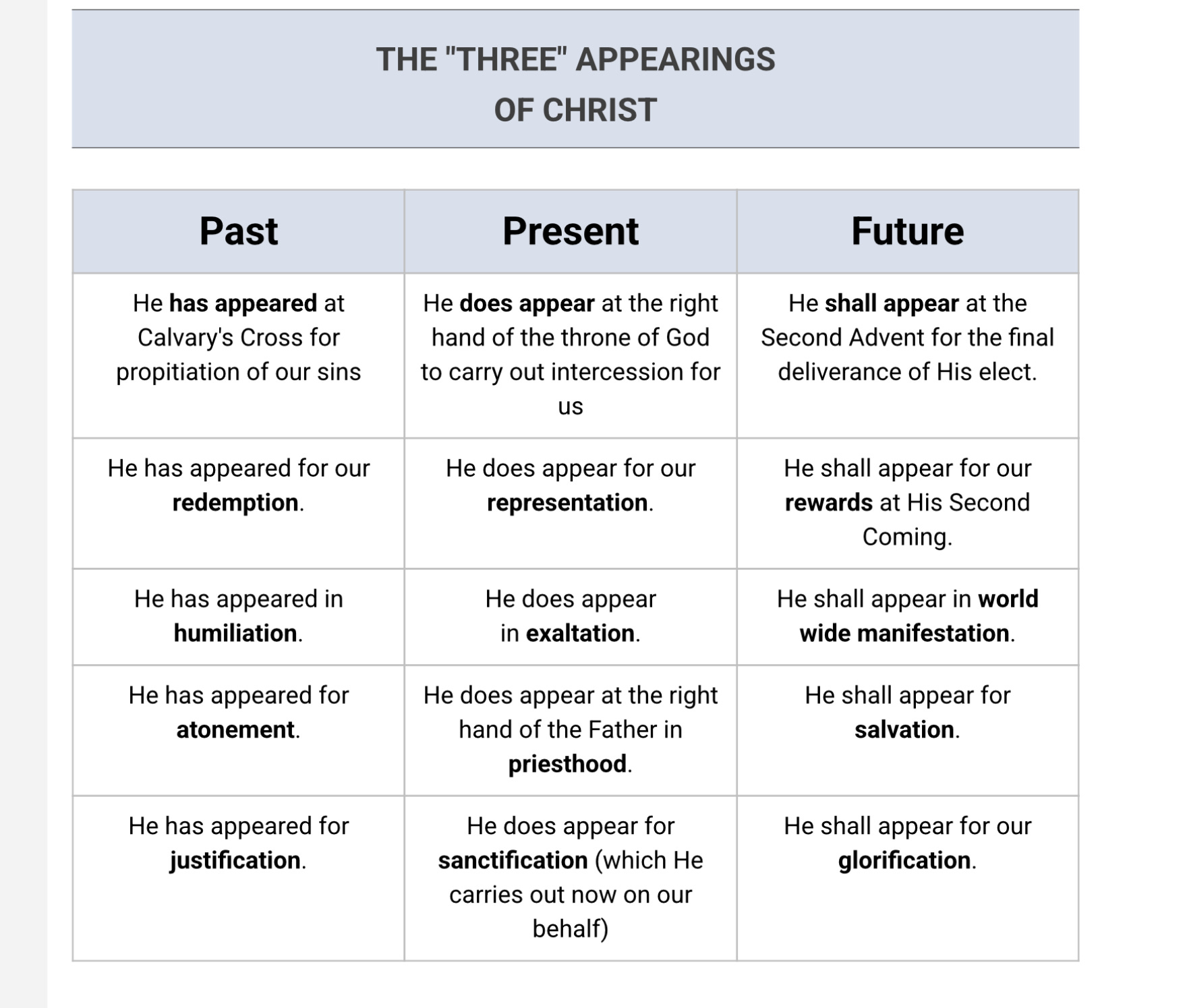
The last part of verse 28 tells us that Christ will appear a second time to the world, not referencing sin but for the salvation of those who wait for Him eagerly. This table from Precept Austin describes the past, present and future of Christ:
Steven Cole also has a great sermon excerpt in Precept Austin (same link) about this second advent:
Christ’s Second Coming will not be with reference to sin, since that issue was completely resolved at His first coming. Rather, He will appear for salvation for those who eagerly await Him. There are three tenses to our salvation. We were saved in the past at the moment we trusted in Christ. Presently, we are being saved as God works His holiness into our daily lives. And, in the future when Christ comes, we shall be saved completely and finally. “When He appears, we will be like Him, because we will see Him just as He is” (1 John 3:2). Because of this great promise,
Those whom Christ has saved eagerly await His coming. The picture behind the last phrase of 9:28 is of Jewish believers on the Day of Atonement. Their high priest took the blood and went out of their sight, behind the veil, to make atonement for their sins. The minutes that he was there seemed like hours, as they anxiously awaited his reappearance. Finally, he came out again, and the people rejoiced because they knew that God had accepted their offering and their sins were covered (see F. F. Bruce, Commentary on the Epistle to the Hebrews [Eerdmans], pp. 223-224). Even so, our High Priest has gone into the true Holy of Holies in heaven, out of our sight. He took His own blood with Him. We eagerly wait to see Him come again, because then all of God’s promises of salvation will be fully realized!
Do you eagerly await the coming of our Lord? As Paul faced martyrdom, he wrote, “In the future there is laid up for me the crown of righteousness, which the Lord, the righteous Judge, will award to me on that day.” Then he added, “and not only to me, but also to all who have loved His appearing” (2Ti 4:8). If, because Jesus Christ is your Savior you love His appearing, then He will not mete out judgment, but as the righteous Judge, He will award you the crown of righteousness.
Conclusion - Years ago, in a frontier town, a horse bolted and ran away with a wagon that had a little child in it. A young man risked his life to catch the horse, stop it, and rescue the child. Sadly, the rescued child grew up to become a lawless man. One day he stood before a judge to be sentenced for a serious crime. The prisoner recognized the judge as the same man who, years before, had saved his life. He pled for mercy on the basis of that experience. But the words from the bench silenced all his pleas: “Young man, then I was your savior; today I am your judge, and I must sentence you to be hanged” (“Our Daily Bread,” 8/84).
Today, Jesus Christ offers salvation to all who will trust in Him. But if we refuse to turn to Him in faith, one day we will stand before Him as our righteous Judge. Will you die and face judgment? Or, will you trust in Christ’s supreme sacrifice of Himself for your sins and receive His salvation? (Hebrews 9:23-28 Judgment or Salvation?)
Judgment includes a not-guilty verdict, not just a guilty one, so believers can look forward to their final Salvation and deliverance through faith and trust!
My next devotional examines Hebrews 10:1-4 - More on the inadequacies of the law.
Heaven on Wheels Daily Prayer:
Dear Lord - I have faith in You that I am continuing in my sanctification, after being justified by Your grace, repenting and believing in You. I have faith that the first sight I will see after death will be the joyous glory of Your light. Amen.
Credits and Citations:
Scripture quotations taken from the (NASB®) New American Standard Bible®, Copyright © 1960, 1971, 1977, 1995 by The Lockman Foundation. Used by permission. All rights reserved. www.Lockman.org.
Precept Austin was accessed on 01/04/2026 to review commentary for Hebrews 9:27-28. Within the Precept Austin commentary, the Steven Cole sermon excerpt comes from this sermon (see link) Copyright, Steven J. Cole, 2004, All Rights Reserved. Unless otherwise noted, all Scripture Quotations are from the New American Standard Bible, Updated Edition © The Lockman Foundation
Commentary from Enduring Word is used with written permission and without any alteration. ©1996-present The Enduring Word Bible Commentary by David Guzik – enduringword.com.
“G606 - apokeimai - Strong’s Greek Lexicon (NASB95).” Blue Letter Bible. Web. 4 Jan, 2026. <https://www.blueletterbible.org/lexicon/g606/nasb95/mgnt/0-1/>.
“G599 - apothnēskō - Strong’s Greek Lexicon (NASB95).” Blue Letter Bible. Web. 4 Jan, 2026. <https://www.blueletterbible.org/lexicon/g599/nasb95/mgnt/0-1/>.
“G2920 - krisis - Strong’s Greek Lexicon (NASB95).” Blue Letter Bible. Web. 4 Jan, 2026. <https://www.blueletterbible.org/lexicon/g2920/nasb95/mgnt/0-1/>.
Loved the explanation and examples given on these verses will share with others