


“Obey your leaders and submit to them, for they keep watch over your souls as those who will give an account. Let them do this with joy and not with grief, for this would be unprofitable for you. Pray for us, for we are sure that we have a good conscience, desiring to conduct ourselves honorably in all things. And I urge you all the more to do this, so that I may be restored to you the sooner.”
Hebrews 13:17-19 NASB1995
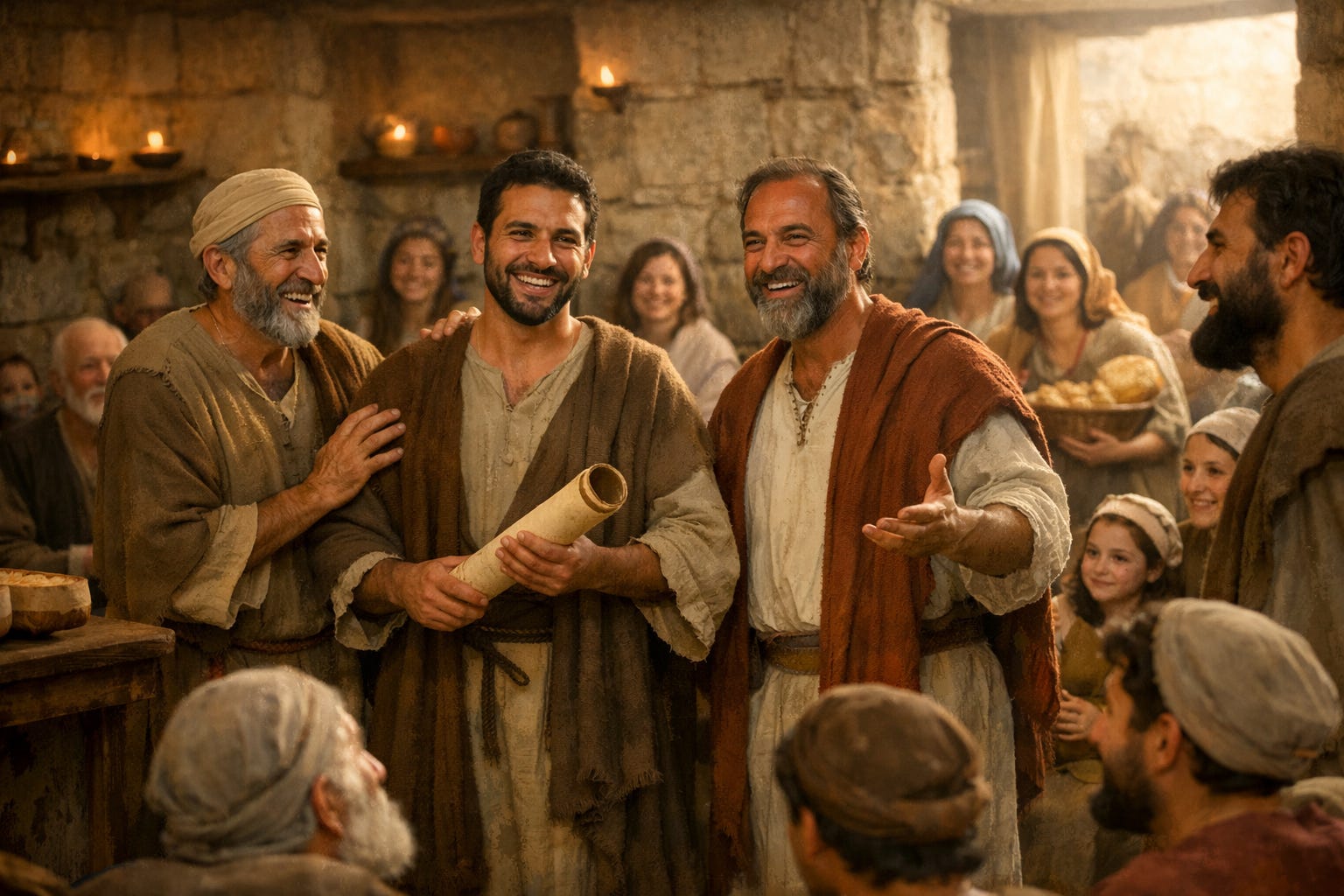
The last exhortation in Hebrews is about our leaders. The commentary is divided - is this talking about church leaders only or does this include any leader (company, community, nation)? I personally think this is referring to our religious leaders, as they are the ones who are supposed to keep watch over our souls and account for them. The second part of this passage supports that idea, as we are to pray for these leaders so that they conduct themselves honorably in all things. And the message also becomes personalized here at near the end of Hebrews. The AI image today that Steve asked for could very well be Paul and Timothy, or two other leaders of the early church.
First, an aside about AI: Not that long ago (maybe a few short months) an AI image of a group of people was fill of errors (six fingers, missing arms, strange facial features). Now the people look more and more real, as do the details in the scene. I just hope the prediction in the Terminator movies is not coming true. These are powerful tools, which we use ONLY for image generation and never for writing!
Enduring Word has interesting commentary about this passage:
a. Obey those who rule over you, and be submissive: We are to be submissive to the leaders God gives us (assuming they have the character mentioned in Hebrews 13:7). We are simply told to obey those who rule over us. When speaking on the authority of God’s Word, leaders do have a right to tell us how to live and walk after God.
i. Sadly, some take the idea of submission to leaders in the church much too far. The “Shepherding Movement” was a clear example of this kind of abuse (which many seem to welcome, wanting someone else to be responsible for their lives). “A teacher should teach us to submit to God, not to himself.” (Chuck Smith)
b. As those who must give account: We obey and submit to our leaders because God put them in a place of responsibility and accountability over us. Of course, this does not relieve individual responsibility but it puts an additional accountability and responsibility upon leaders.
c. Let them do so with joy and not with grief, for that would be unprofitable for you: Cooperative conduct is not only a joy to leaders, but it is profitable for the whole body. It is for our own sake that we should obey and submit to God-appointed leaders.
So there’s a term I’ve never heard before: The “Shepherding Movement”. Let’s take a look at Gotquestions.org to find out what this is about:
The Shepherding Movement is a controversial method of church leadership that grew out of the Charismatic movement in the 1970s. It is also called the “Discipleship Movement” and is related to heavy shepherding. The Shepherding Movement, which began as “Christian Growth Ministries” in Ft. Lauderdale, Florida, reached its peak in the 1980s, but its impact has since lessened. The Shepherding Movement has received well-deserved criticism for its cult-like manipulation and intimidation tactics and its emphasis on the non-biblical idea of a “spiritual covering.”
The basic idea of the Shepherding Movement is one of submission to authority. The Shepherding Movement called for five leaders at the top of a global leadership pyramid. These men were responsible for one another’s spiritual health and keeping each other on track by “covenant relationships” and mutual accountability. Beneath each of those five “shepherds” were five other people, responsible for one another but submitted to the authority of their shepherd. And so on, down the line. Each of these groups of five was called a “submission,” and their devotion to their shepherds was absolute. No major decisions were made without first consulting with one’s shepherd—marriage and career choices included.
The Shepherding Movement set up an alternate structure for the church that does not exist in Scripture. By creating a hierarchy of submission and authority, the five original “shepherds” promoted a legalistic paradigm in which the Holy Spirit was hindered and believers suffered spiritual abuse under authoritarian supervisors. Christ is the head of the church, and all the parts of the body are to look to Him for guidance, provision, and protection (Ephesians 5:23). The Shepherding Movement put roadblocks between Christ and His church, creating an unnecessary and harmful chain of command. People in the movement had to choose between the authority of their shepherd and the authority of the Great Shepherd.
Many of the original leaders of the Shepherding Movement or Discipleship Movement have admitted that the movement was a mistake and have disassociated themselves with it. But how much damage was done? The church must be wary of those who would take advantage of them. As Paul warned the Ephesians, “Savage wolves will come in among you and will not spare the flock. Even from your own number men will arise and distort the truth in order to draw away disciples after them. So be on your guard!” (Acts 20:29–31).
This Shepherding Movement sounds just like a pyramid scheme or some weird secret fraternal society. Like any other profession (or perhaps even more so for the ministry), some people becoming pastors are attracted to power and abuse, but then there are others who are very weak in their proclamations of faith, their congregational care and their understanding of the reliability of Scripture, succumbing to every human frailty to make friends and be popular.

Brian Bell has a excellent commentary in outline form quoted on Precept Austin about this subject:
Some churches give their pastor too much authority.
Problem today – abuse of this position.
He’s God’s anointed – as they are blindly taken advantage of.
This does not mean unqualified blanket obedience.
That smacks of Jim Jones & his 900+ followers in 1978 that drank the cyanide laced Kool-Aid in Guyana.
Or the 1993 siege of the Branch Davidian compound near Waco, Texas as the self-proclaimed messiah David Karesh led 80 to their deaths.
Of course these leaders who take advantage of the sheep ignore Jesus own words: You know that those who are considered rulers over the Gentiles lord it over them, and their great ones exercise authority over them. Yet it shall not be so among you; but whoever desires to become great among you shall be your servant.
Some churches give their pastor too little authority.
Problem today – lack of respect for the position.
The pastor used to be highly esteemed in his town/city. He was known as being an intellectual, faithful, holy.
Now he has been reduced to a novice shrink; or an untrustworthy huckster just out for your money. Or one who peddles his latest religious wares (like a beautiful gold pendant with his name/ministry plastered all over it)
Today, due to our ever-present Christian media, via radio & TV, what the average pastor receives after a sermon is, that was pretty good pastor, but when I heard pastor so & so teach it he brought out…
His pastoral authority gets lost in the fog of the ever popular, ever articulate, & ever popular Radio preacher. So what is the proper balance? vs.17
He is a leader…not a dictator who drives the sheep from behind. He is a shepherd who goes before & leads the way [Nehemiah, A servant who leads & a leader who serves]
As has also been said, He who thinks he leads, and has no one following him, is only taking a walk.
1 Thes.5:12: And we urge you, brethren, to recognize those who labor among you, and are over you in the Lord and admonish you, and to esteem them very highly in love for their work’s sake.
They watch out for your souls [watch = to be w/o sleep]
Like the shepherds in Lk.2:8 who were watching over their flocks by night.
They loose [lose] sleep over you. They are to be caring & conscientious shepherds over you.
A church leader is to lead wisely & lovingly as those who must give an account. [yet, not to the congregation but to the Lord]
Our relationship, is serious business for both of us. [so let’s make a deal...] :)
Let them do so with joy and not with grief/groaning.
Note…the responsibility for making the operations of a church a joy & not a burden, is placed on the congregation, not on their leaders.
How can you as a congregation make it a joy?…glad you asked. What he said, simply obeying & submitting to all proper teaching & all biblical counseling you receive.
Let’s be clear…I’m not suggesting this for our church…No…God is demanding it.
Does your conduct give your leaders reason to report joyfully about you?
The congregation has a responsibility here - to make the operations of a church a joy and not a burden. We do not want pastoral abuse nor do we want leadership that has too little authority.
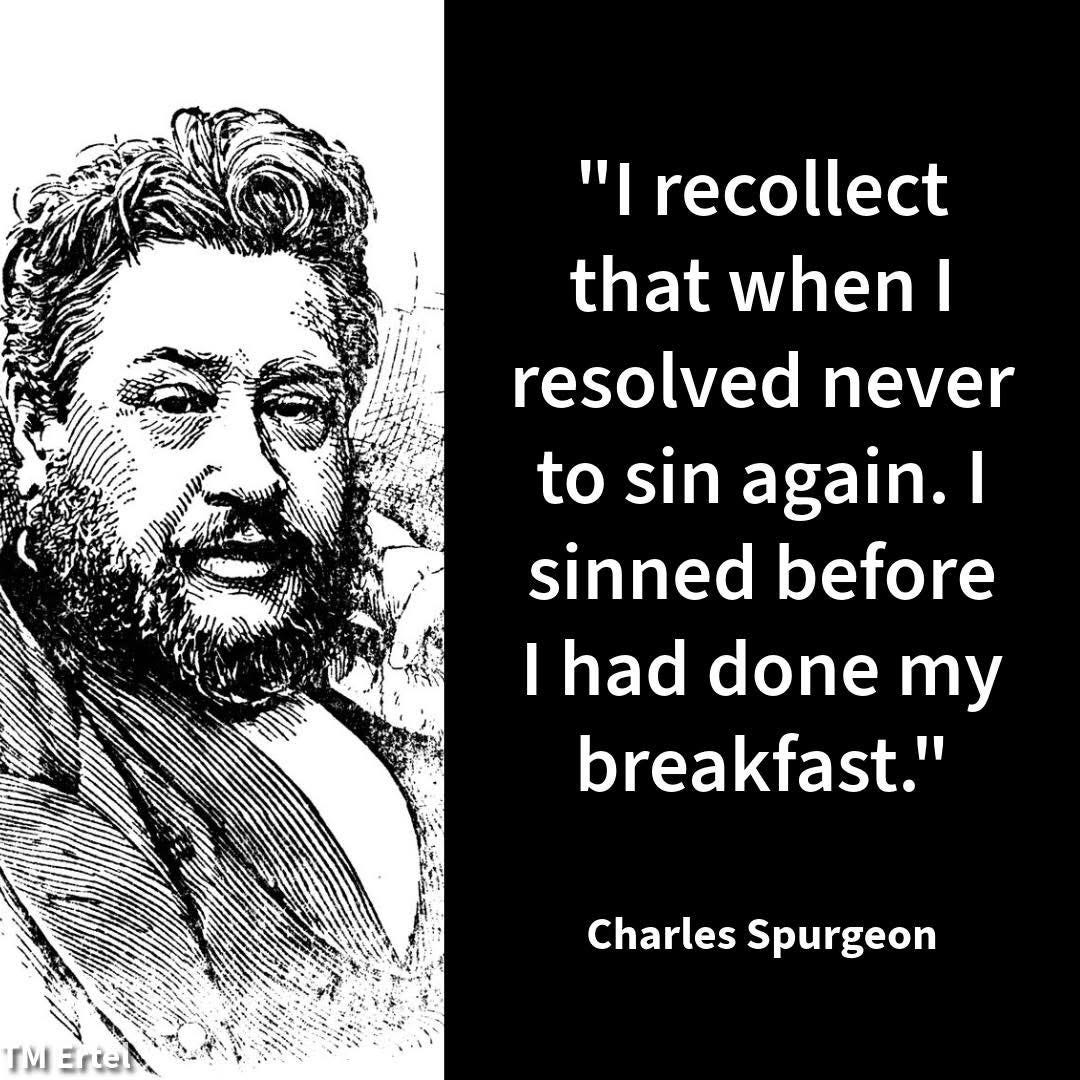
In the second part of this passage, the author of Hebrews asked the believers to pray for him. He is sure that he has a good conscience and desires to conduct himself honorably in all things, but prayer helps keep this in alignment. Charles Spurgeon is quoted on Precept Austin talking about the conscience, from various works and sermons:
Conscience may tell me that something is wrong, but how wrong it is conscience itself does not know. Did any man’s conscience, unenlightened by the Spirit, ever tell him that his sins deserved damnation? Did it ever lead any man to feel an abhorrence of sin as sin? Did conscience ever bring a man to such self-renunciation that he totally abhorred himself and all his works and came to Christ?
A man sees his enemy before him. By the light of his candle, he marks the insidious approach. His enemy is seeking his life. The man puts out the candle and then exclaims, “I am now quite at peace.” That is what you do. Conscience is the candle of the Lord. It shows you your enemy. You try to put it out by saying, “Peace, peace! Put the enemy out!” God give you grace to thrust sin out!
Conscience is like a magnetic needle, which, if once turned aside from its pole, will never cease trembling. You can never make it still until it is permitted to return to its proper place.
I recollect the time when I thought that if I had to live on bread and water all my life and be chained in a dungeon, I would cheerfully submit to that if I might but get rid of my sins. When sin haunted and burdened my spirit, I am sure I would have counted the martyr’s death preferable to a life under the lash of a guilty conscience
O believe me, guilt upon the conscience is worse than the body on the rack. Even the flames of the stake may be cheerfully endured, but the burnings of a conscience tormented by God are beyond all measure unendurable.
This side of hell, what can be worse than the tortures of an awakened conscience?
He was a fool who killed the watchdog because it alarmed him when thieves were breaking into his house. If conscience upbraids you, feel its upbraiding and heed its rebuke. It is your best friend.
Give me into the power of a roaring lion, but never let me come under the power of an awakened, guilty conscience. Shut me up in a dark dungeon, among all manner of loathsome creatures—snakes and reptiles of all kinds—but, oh, give me not over to my own thoughts when I am consciously guilty before God!
Fire such as martyrs felt at the stake were but a plaything compared with the flames of a burning conscience. Thunderbolts and tornadoes are nothing in force compared with the charges of a guilty conscience.
When a swarm of bees gets about a man, they are above, beneath, around, everywhere stinging, every one stinging, until he seems to be stung in every part of his body. So, when conscience wakes up the whole hive of our sins, we find ourselves compassed about with innumerable evils: sins at the board and sins on the bed, sins at the task and sins in the pew, sins in the street and sins in the shop, sins on the land and sins at sea, sins of body, soul, and spirit, sins of eye, of lip, of hand, of foot, sins everywhere. It is a horrible discovery when it seems to a man as if sin had become as omnipresent with him as God is.
The conscience of man, when he is really quickened and awakened by the Holy Spirit, speaks the truth. It rings the great alarm bell. And if he turns over in his bed, that great alarm bell rings out again and again, “The wrath to come! The wrath to come! The wrath to come! “
Nothing can be more horrible, out of hell, than to have an awakened conscience but not a reconciled God—to see sin, yet not see the Savior—to behold the deadly disease in all its loathsomeness, but not trust the good Physician, and so to have no hope of ever being healed of our malady.
I would bear any affliction rather than be burdened with a guilty conscience.
It is a blessed thing to have a conscience that will shiver when the very ghost of a sin goes by—a conscience that is not like our great steamships at sea that do not yield to every wave, but, like a cork on the water, goes up and down with every ripple, sensitive in a moment to the very approach of sin. May God the Holy Spirit make us so! This sensitiveness the Christian endeavors to have, for he knows that if he has it not, he will never be purified from his sin.
There are thousands of people in this country who would be greatly troubled in their minds if they did not go to church twice on Sundays. And they get comfort in this because their conscience is dead. If their conscience were really awakened, they would understand that there is no connection between conscience and outward forms.
There are some really good nuggets in these various statements about conscience. Every time I read something from Spurgeon I gain more insight. I pray that the Holy Spirit refines my conscience every single day to weed out the sin that lurks within my soul.
Do you pray for your pastors and church leaders every week? I realized that is a gap in the list of intercessory prayers that we maintain, so I’m going to fix that right now! We always had the prayer requests and mission prayer, but not for our specific leaders. Our church leaders seem confident, but I’m sure that prayers for them would be so appropriate every week before they give their messages and lead their worship teams. Remember, it is up to us, as members of the congregation, to make church a spiritual joy and not a burden.
My next devotional will be last one from the book of Hebrews (Hebrews 13:20-25). It will cover the benediction and greetings at the end of this extraordinary epistle. I will have a summary of Hebrews after that and then will dive into Ephesians with an introduction to that beloved epistle. Thank you and bless you for reading!
Heaven on Wheels Daily Prayer:
Dear Lord - Help us to bring joy to our church gatherings and to pray for our church leadership on a regular basis. Amen.
Credits and Citations:
Scripture quotations taken from the (NASB®) New American Standard Bible®, Copyright © 1960, 1971, 1977, 1995 by The Lockman Foundation. Used by permission. All rights reserved. www.Lockman.org.
Precept Austin was accessed on 03/07/2026 to review commentary for Hebrews 13:17-19.
Commentary from Enduring Word is used with written permission and without any alteration. ©1996-present The Enduring Word Bible Commentary by David Guzik – enduringword.com. Within the Enduring Word commentary:
Smith, Chuck New Testament Study Guide (Costa Mesa, California: The Word for Today, 1982)
Gotquestions.org was accessed on 03/07/2026 to answer the question, What is the Shepherding Movement? © COPYRIGHT 2002-2026 GOT QUESTIONS MINISTRIES. ALL RIGHTS RESERVED.