


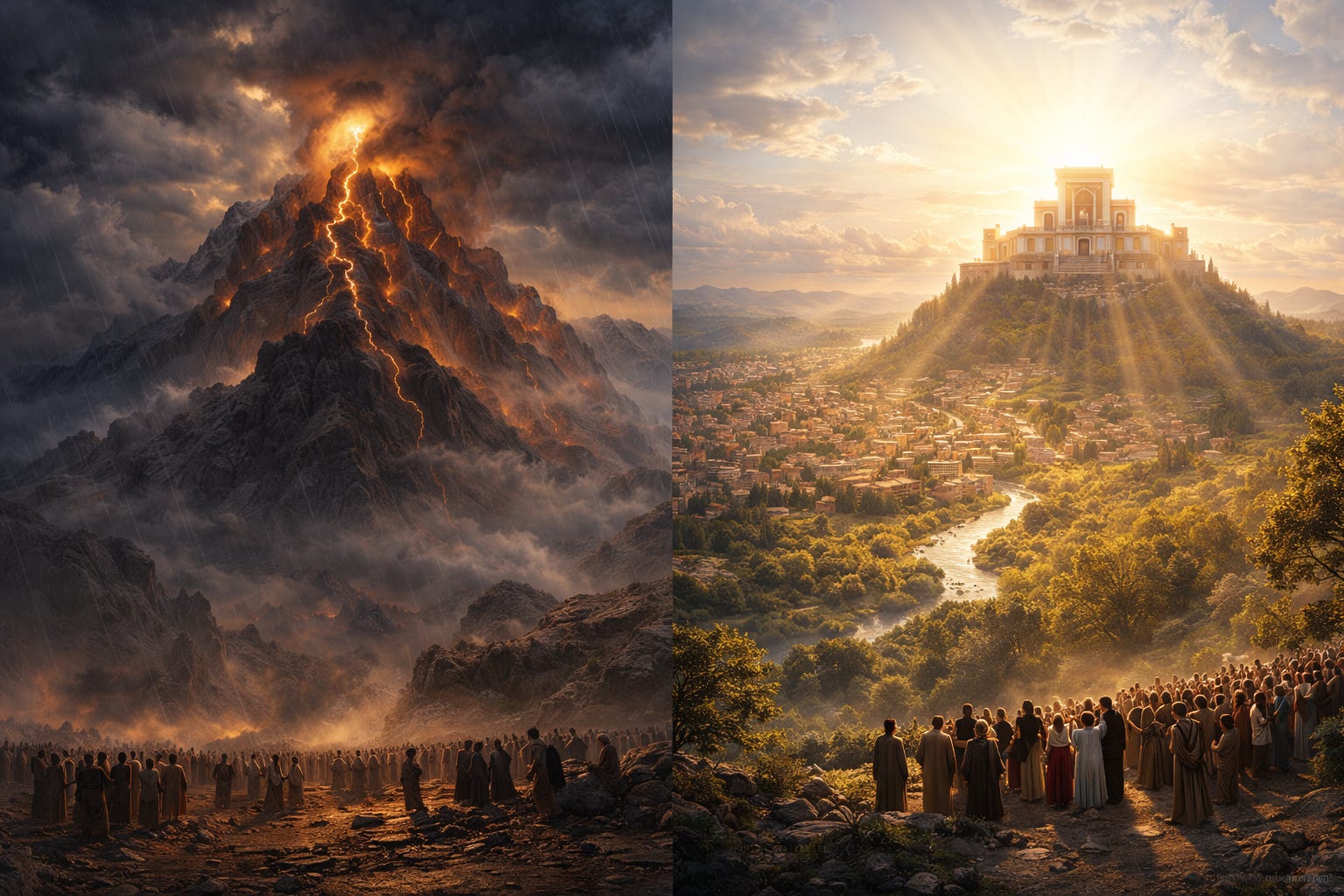
“For you have not come to a mountain that can be touched and to a blazing fire, and to darkness and gloom and whirlwind, and to the blast of a trumpet and the sound of words which sound was such that those who heard begged that no further word be spoken to them. For they could not bear the command, “If even a beast touches the mountain, it will be stoned.” And so terrible was the sight, that Moses said, “I am full of fear and trembling.” But you have come to Mount Zion and to the city of the living God, the heavenly Jerusalem, and to myriads of angels, to the general assembly and church of the firstborn who are enrolled in heaven, and to God, the Judge of all, and to the spirits of the righteous made perfect, and to Jesus, the mediator of a new covenant, and to the sprinkled blood, which speaks better than the blood of Abel.”
Hebrews 12:18-24 NASB1995
A very interesting comparison is made in this next passage, between Mount Sinai, where the Israelites camped and were in fear of the sights and sounds of God’s presence, and Mount Zion, where the city of the living God beckons to the believers. The AI image that Steve asked for of these two holy mountains contrasts the darkness and gloom of Mt. Sinai on the left with the beauty of Mt. Zion on the right. The experience at Mt. Sinai is documented in Exodus:
“The Lord also said to Moses, “Go to the people and consecrate them today and tomorrow, and let them wash their garments; and let them be ready for the third day, for on the third day the Lord will come down on Mount Sinai in the sight of all the people. You shall set bounds for the people all around, saying, ‘Beware that you do not go up on the mountain or touch the border of it; whoever touches the mountain shall surely be put to death. No hand shall touch him, but he shall surely be stoned or shot through; whether beast or man, he shall not live.’ When the ram’s horn sounds a long blast, they shall come up to the mountain.” So Moses went down from the mountain to the people and consecrated the people, and they washed their garments. He said to the people, “Be ready for the third day; do not go near a woman.”
So it came about on the third day, when it was morning, that there were thunder and lightning flashes and a thick cloud upon the mountain and a very loud trumpet sound, so that all the people who were in the camp trembled. And Moses brought the people out of the camp to meet God, and they stood at the foot of the mountain.
Now Mount Sinai was all in smoke because the Lord descended upon it in fire; and its smoke ascended like the smoke of a furnace, and the whole mountain quaked violently. When the sound of the trumpet grew louder and louder, Moses spoke and God answered him with thunder. The Lord came down on Mount Sinai, to the top of the mountain; and the Lord called Moses to the top of the mountain, and Moses went up. Then the Lord spoke to Moses, “Go down, warn the people, so that they do not break through to the Lord to gaze, and many of them perish. Also let the priests who come near to the Lord consecrate themselves, or else the Lord will break out against them.” Moses said to the Lord, “The people cannot come up to Mount Sinai, for You warned us, saying, ‘Set bounds about the mountain and consecrate it.’ ” Then the Lord said to him, “Go down and come up again, you and Aaron with you; but do not let the priests and the people break through to come up to the Lord, or He will break forth upon them.” So Moses went down to the people and told them.”
Exodus 19:10-25 NASB1995
The fear and trembling of the people and Moses before the power of God and the burden of the law is evident in this passage in Hebrews and the related one in Exodus. The elements of fire, darkness, whirlwinds and trumpet sounds are found elsewhere in the Bible, as noted by Precept Austin:
1) Fire
For it came about when the flame went up from the altar toward heaven, that the angel of the LORD ascended in the flame of the altar. When Manoah and his wife saw this, they fell on their faces to the ground. (Judges 13:20)
Then the fire of the LORD fell, and consumed the burnt offering and the wood and the stones and the dust, and licked up the water that was in the trench. (1Ki 18:38)
2) Darkness
Then Solomon said, “The LORD has said that He would dwell in the thick cloud (KJV = Darkness) (1Ki8:12)
3) Tempest
The LORD is slow to anger and great in power, And the LORD will by no means leave the guilty unpunished. In whirlwind and storm is His way, And clouds are the dust beneath His feet. (Nah 1:3)
4) The trumpet
Now Mount Sinai was all in smoke because the LORD descended upon it in fire; and its smoke ascended like the smoke of a furnace, and the whole mountain quaked violently. When the sound of the trumpet grew louder and louder, Moses spoke and God answered him with thunder. (Ex 19:18-19)
The trumpet is also associated with the end time when God will manifest himself
And He will send forth His angels with A GREAT TRUMPET and THEY WILL GATHER TOGETHER His elect from the four winds, from one end of the sky to the other. (Mt 24:51) (Comment: At the end of the Great Tribulation)
Behold, I tell you a mystery; we shall not all sleep, but we shall all be changed in a moment, in the twinkling of an eye, at the last trumpet; for the trumpet will sound, and the dead will be raised imperishable, and we shall be changed. (1Cor 15:51-52)
For the Lord Himself will descend from heaven with a shout, with the voice of the archangel, and with the trumpet of God; and the dead in Christ shall rise first. (1 Th 4:16)
Enduring Word has good commentary on what Mt. Sinai represented:
a. For you have not come to the mountain that may be touched and that burned with fire: Exodus 19:10-25 explains what it was like when Israel came to Mount Sinai.
· The mountain was fenced off; there was no trespassing on pain of death.
· They were commanded to wash their clothes and abstain from sexual relations.
· There was thunder, lightning and a thick cloud.
· There was the sound of a trumpet, calling forth the nation to meet with God.
· There was more smoke, like a furnace, and earthquakes.
· Then the trumpet sounded long – until Moses spoke, and God Himself answered.
· God spoke to Israel from Sinai, but warned them in every way possible to stay away.
b. So that those who heard it begged that the word should not be spoken to them anymore: The reaction of Israel was understandable: they were terrified (Exodus 20:18-21). They wanted the experience to stop, not to continue.
i. Even Moses was afraid: Moses said, “I am exceedingly afraid and trembling”(Deuteronomy 9:19).
ii. All this fear did not succeed in promoting holiness among the people of Israel. It did not succeed in changing the heart of Israel. 40 days later, they worshipped a gold calf and said it was the god that brought them out of Egypt.
This is so fascinating! It’s like a comparison between the desert wilderness and terrifying aspects of Mordor and Mount Doom to the beautiful kingdom of Gondor or the elvish sanctuary of Lothlorien or the peaceful retreat of the Shire in the Lord of the Rings trilogy. But Mordor causes beings to tremble because of evil, not because of the unbearable goodness, holiness and power of God. David Guzik makes a really good point in this commentary that in spite of the warnings and admonitions and the “hands off” signs and the terrifying noises and darkness, the people STILL turned to worshipping an idol less than 40 days after Moses ascended Mt. Sinai to receive the first set of the Ten Commandments.
One thing that I realized when going back to the passage in Exodus is that God, when He speaks to the people beginning in Exodus 20, doesn’t just lay out the precepts that became the Ten Commandments, He also goes on for the next three chapters of Exodus laying out many of the ordnances and laws (some quite convoluted) that are repeated in Leviticus and Deuteronomy and required an army of priests to monitor for the people. I probably knew this, but I guarantee my eyes glazed over when reading those passages in Exodus doing a “Bible in One Year” plan, just like many stop their plans when they get to Leviticus.
The writer of Hebrews is asking the wobbly believers if they want to return to that wilderness mountain and that terrifying experience and those many laws that were absolutely impossible to fulfill (people can’t even keep the Ten Commandments) or if they would rather look forward to the lightness and beauty and freedom from the law that comes with the sacrifice of Christ on the cross and believing in Him.

The contrast between Mt. Sinai and Mt. Zion could not be clearer - the New Covenant is filled with light and joy and peace and the beautiful prospect of eternity with God, washed clean of our sins by the blessed Son. I really like this commentary from Enduring Word on this contrast and what Mt. Zion really means:
a. But you have come to Mount Zion: We are in a different place. Our relationship with God is not modeled after Israel’s experience on Mount Sinai. We come to God’s other mountain: Zion, the name of the hill upon which Jerusalem sits. The law came to Sinai; the cross was on Zion.
b. The city of the living God: There was no city at Mount Sinai; it was out in the desolate desert.
c. The heavenly Jerusalem: Sinai was associated with Egypt; Zion is associated with heaven.
d. To an innumerable company of angels: A few angels delivered the law to Moses on Mount Sinai; yet Mount Zion has an innumerable company of angels.
e. To the general assembly and church of the firstborn who are registered in heaven: What God gave at Mount Sinai was mainly for Israel; what God gave at Mount Zion is for all and it spans all the redeemed, both the church and the general assembly of the redeemed, all together.
f. To God the Judge of all, and to the spirits of just men made perfect: Mount Zion doesn’t do away with God as Judge of all – not at all. Rather, the work Jesus did on Mount Zion satisfies the justice of God, bringing forth the spirits of just men made perfect.
g. To Jesus the Mediator of the new covenant: Mount Sinai was all about an old covenant based on earning and deserving. Mount Zion is based on a new covenant with Jesus the Mediator based on believing and receiving.
h. To the blood of sprinkling that speaks of better things than that of Abel: The blood of Abeldoes not mean the blood he shed in his martyrdom. Rather, it was the blood of the sacrifice he made – the first recorded sacrifice from man to God in the Bible. The blood of Jesus speaks better thingsthan the blood of animal sacrifice, the blood of Abel.
i. Yet it is true that the blood of Jesus the Messiah speaks better things than that of the blood of Abel the martyr. The blood of Abel cried, justice must be satisfied, bring vengeance. The blood of Jesus cried, justice has been satisfied, bring mercy.
i. But you have come to Mount Zion: The lesson is plain. We shouldn’t come to Mount Zion as if we were coming to Mount Sinai. So put away your hesitation, be encouraged and get bold in coming to God.
i. Consider the contrasts between Mount Sinai and Mount Zion.
· Mount Sinai was marked by fear and terror – Mount Zion is a place of love and forgiveness.
· Mount Sinai is in the desert – Mount Zion is the city of the Living God.
· Mount Sinai spoke of earthly things – Mount Zion speaks of heavenly things.
· At Mount Sinai, only Moses was allowed to draw near to God – at Mount Zion, an innumerable company, a general assembly is invited to draw near.
· Mount Sinai was characterized by guilty men in fear – Mount Zion features just men made perfect.
· At Mount Sinai, Moses was the mediator – at Mount Zion, Jesus is the mediator.
· Mount Sinai brought an Old Covenant, which was ratified by the blood of animals – Mount Zion brought a New Covenant, which is ratified by the blood of God’s precious Son.
· Mount Sinai was all about exclusion, keeping people away from the mountain – Mount Zion is all about invitation.
· Mount Sinai is all about Law – Mount Zion is all about grace.
ii. Of course, the idea of the superiority of the New Covenant is also repeated. It shows that these Jewish Christians should not even consider going back and preferring the religion of Mount Sinai to the relationship of Mount Zion.
The realm of Mt. Zion in this passage in Hebrews describes a church of the firstborn who are enrolled in heaven, a God who judges all and the spirits of the righteous made perfect. Why is it called the church of the firstborn? Gotquestions.org has a good answer to that:
“The spirits of the righteous made perfect” refers to all believers but may, at least temporarily, refer to those who have already died in the Lord—they are now made perfect. The “church of the firstborn” is comprised of all those whose names are written in heaven—believers of all ages, dead or alive. The Greek word for “church” simply means “assembly,” and that’s how the NLT and CSB translate it.
But why is it called the church of the “firstborn?” Does firstborn describe the members of the church in some way? Or does firstborn refer to someone else?
In the New Testament, Christ is described as “the firstborn over all creation” (Colossians 1:15). This refers to His position as rightful heir over all creation. This seems to be similar to the way the word is used in Hebrews 1:6.
Colossians 1:18 and Revelation 1:5 speak of Jesus as the “firstborn from the dead.” This refers to the fact that He is the first to be resurrected and given a resurrection body; it also implies that many more resurrections will follow. Romans 8:29 says that Christ is the firstborn of many brothers and sisters. So, the “church of the firstborn” is simply another way of saying the “gathering of people in Jesus Christ.” The term firstborn emphasizes that He is preeminent over all creation and the first of many to be resurrected and given a glorified body.
Mount Sinai versus Mount Zion (Old Covenant versus New Covenant):
Fear and terror versus love and forgiveness.
A remote wilderness versus a glorious city (the name “city” implies many people living in harmony).
Earthly things versus heavenly things.
Guilty men in fear versus perfect, just men washed of their sins.
A man (Moses) as the mediator versus the Son of God as the mediator.
We are told to stay away from Sinai but are invited to Zion.
Impossible law versus eternal grace.
A perfect seven!
My next devotional examines Hebrews 12:25-29 - The Unshakeable Kingdom
Heaven on Wheels Daily Prayer:
Dear Lord - I eagerly race towards Mt. Zion and Your heavenly promises! I am in deep gratitude for my salvation! Amen.
Credits and Citations:
Scripture quotations taken from the (NASB®) New American Standard Bible®, Copyright © 1960, 1971, 1977, 1995 by The Lockman Foundation. Used by permission. All rights reserved. www.Lockman.org.
Precept Austin was accessed on 02/19/2026 to review commentary for Hebrews 12:18-24
Commentary from Enduring Word is used with written permission and without any alteration. ©1996-present The Enduring Word Bible Commentary by David Guzik – enduringword.com.
Gotquestions.org was accessed on 12/19/2026 to answer the question, What does “church of the firstborn” mean in Hebrews 12:23? © COPYRIGHT 2002-2026 GOT QUESTIONS MINISTRIES. ALL RIGHTS RESERVED