


“For this reason He is the mediator of a new covenant, so that, since a death has taken place for the redemption of the transgressions that were committed under the first covenant, those who have been called may receive the promise of the eternal inheritance. For where a covenant is, there must of necessity be the death of the one who made it. For a covenant is valid only when men are dead, for it is never in force while the one who made it lives.”
Hebrews 9:15-17 NASB1995
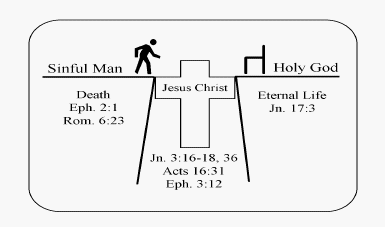
“For this reason” Christ is the mediator because He cleanses our conscience from dead works so we can serve the living God, hearkening back to the last devotional. As I studied commentary for this passage, I was thunderstruck by some of the things that I discovered (for example, the idea of progressive revelation - more on this later). I have probably bumped into this idea and others before, but Hebrews is the most explicit of the epistles in bridging the gap between the Old and New Covenants. Here’s a drawing from Precept Austin that shows this mediation role and how it bridges the gap between sinful man and a Holy God:
The New Covenant was dependent on a death, just like an heir identified in a last will and testament has a promise of an estate that is finally awarded upon the death of the one who made that last will and testament. The shadow deaths in the Old Covenant were from the blood of sacrificial animals, pointing forward to the promise of an eternal inheritance in the New Covenant. Enduring Word has a decent explanation of this:
g. He is the Mediator of the new covenant, by means of death: Jesus’ work as a Mediator is fundamentally accomplished at His death. His heavenly work of mediation looks back to that perfect sacrifice.
h. For the redemption of the transgressions under the first covenant: Jesus’ payment on the cross accomplished redemption for those under the first covenant. Every sacrifice for sin made in faith under the Mosaic command was an IOU paid in full at the cross.
…
a. For a testament is in force after men are dead: A testament (in the sense of a “last will and testament”) only takes effect when the person who made the testament dies. Therefore Jesus had to die for the testament – the covenant – to take effect.
i. “The same word in the Greek is used for ‘covenant’ and ‘testament,’ and although the double use is difficult, there seems to be no doubt that in verse 15 the word means ‘covenant,’ and in verses 16 and 17 ‘testament,’ and then in verse 18 ‘covenant’ again.” (Thomas)
ii. “If there be a question about whether a man is alive or not, you cannot administer to his estate, but when you have certain evidence that the testator has died then the will stands. So is it with the blessed gospel: if Jesus did not die, then the gospel is null and void.” (Spurgeon)
b. Therefore not even the first covenant was dedicated without blood: Clearly, death was necessary to the Old Covenant. Virtually every part of the sacrificial system under the Law of Moses was touched by blood in some way or another.
The death of Jesus was necessary for the Gospel to live. He is both the author of the last will and testament of salvation and its executor (or mediator). The people who had faith in God before Christ came to Earth were looking forward to the promised Messiah and the final sacrifice that was needed. This idea is called progressive revelation. Hold on to your hats and glasses, because this quite the wild ride! Forgive me if you are familiar with these concepts, because I am still a novice Bible scholar, but I’m certainly learning by writing!
Here are some excerpts from an article on this idea from Gotquestions.org (this is probably a longer excerpt than the terms and conditions on that website would allow, but this is so important):
The term “progressive revelation” refers to the idea and teaching that God revealed various aspects of His will and overall plan for humanity over different periods of time, which have been referred to as “dispensations” by some theologians. To dispensationalists, a dispensation is a distinguishable economy (i.e., an ordered condition of things) in the outworking of God’s purpose. Whereas dispensationalists debate the number of dispensations that have occurred through history, all believe that God revealed only certain aspects of Himself and His plan of salvation in each dispensation, with each new dispensation building upon the prior one.
While dispensationalists believe in progressive revelation, it is important to note that one does not have to be a dispensationalist to embrace progressive revelation. Nearly all students of the Bible recognize the fact that certain truths contained in Scripture were not fully revealed by God to prior generations. Anyone today who does not bring an animal sacrifice with him when he wishes to approach God or who worships on the first day of the week rather than the last understands that such distinctions in practice and knowledge have been progressively revealed and applied throughout history.…
Some charge that those holding to progressive revelation espouse two different methods of salvation—one that was in place before the first coming of Christ, and another that came after His death and resurrection. Such a claim is refuted by L. S. Chafer who writes, “Are there two ways by which one may be saved? In reply to this question it may be stated that salvation of whatever specific character is always the work of God in behalf of man and never a work of man in behalf of God. . . . There is, therefore, but one way to be saved and that is by the power of God made possible through the sacrifice of Christ.”
If this is true, then how can the revelations in the Old and New Testaments concerning salvation be reconciled? Charles Ryrie sums up the matter succinctly in this way: “The basis of salvation in every age is the death of Christ; the requirement for salvation in every age is faith; the object of faith in every age is God; the content of faith changes in the various ages.” In other words, no matter when a person has lived, their salvation is ultimately dependent on the work of Christ and a faith placed in God, but the amount of knowledge a person had concerning the specifics of God’s plan has increased through the ages via God’s progressive revelation.
Regarding the Old Testament saints, Norman Geisler offers the following: “In short, it appears that at most, the normative Old Testament salvific requirements (in terms of explicit belief) were (1) faith in God’s unity, (2) acknowledgment of human sinfulness, (3) acceptance of God’s necessary grace, and possibly (4) understanding that there would be a coming Messiah.”Is there evidence in Scripture to support Geisler’s claim? Consider this passage, which contains the first three requirements, in Luke’s Gospel:
“Two men went up into the temple to pray, one a Pharisee and the other a tax collector. The Pharisee stood and was praying this to himself: ‘God, I thank You that I am not like other people: swindlers, unjust, adulterers, or even like this tax collector. ‘I fast twice a week; I pay tithes of all that I get.’ But the tax collector, standing some distance away, was even unwilling to lift up his eyes to heaven, but was beating his breast, saying, ‘God, be merciful to me, the sinner!’ I tell you, this man went to his house justified rather than the other; for everyone who exalts himself will be humbled, but he who humbles himself will be exalted” (Luke 18:10-14).
This event took place before the death and resurrection of Christ, so it clearly involves a person who has no knowledge of the New Testament gospel message as it is articulated today. In the tax collector’s simple statement (“God be merciful to me, the sinner!”) we find (1) a faith in God, (2) an acknowledgement of sin, and (3) an acceptance of mercy. Then Jesus makes a very interesting statement: He says the man went home “justified.” This is the exact term used by Paul to describe the position of a New Testament saint who has believed the gospel message and put his trust in Christ: “Therefore, since we have been justified by faith, we have peace with God through our Lord Jesus Christ” (Romans 5:1).
The fourth on Geisler’s list is missing in Luke’s account—the understanding of a coming Messiah. However, other New Testament passages indicate that this may have been a common teaching. For example, in John’s account of Jesus and the Samaritan woman at the well, the woman says, “I know that Messiah is coming (He who is called Christ); when that One comes, He will declare all things to us” (John 4:25). However, as Geisler himself acknowledged, faith in Messiah was not a “must have” for Old Testament salvation.…
Scripture plainly states that faith is the key to salvation for all people down through history, but how could God save people without their knowing of Christ’s sacrifice for them? The answer is that God saved them based on their response to the knowledge that they did have. Their faith looked forward to something that they could not see, whereas today, believers look back on events that they can see.
This article has the following graphic that succinctly explains this idea:
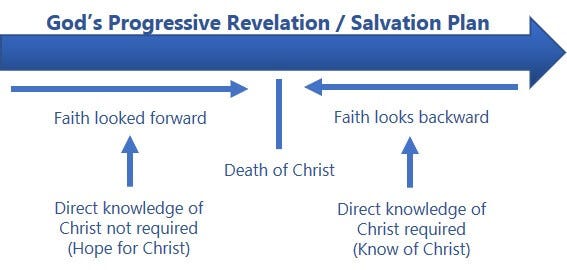
The writer of Hebrews is remarkably astute. He is telling the wobbly Jewish believers that they have direct knowledge of Christ looking backwards and they do not need to go further back in time to a partial revelation because all has been revealed now for their salvation. This idea explains why the OT faithful were seen as living and/or in heaven in the Gospels (Elijah and Moses appearing at the Transfiguration; Abraham embracing the poor man Lazarus in heaven in the parable of the Rich Man and Lazarus).
I won’t go down another bunny path that these verses insinuate, but readers should note this phrase: those who have been called may receive the promise of the eternal inheritance. We can get into idea of the elect or those who are called all day long, but readers should note that in this believer’s belief, God calls us to Him. My personal experience testifies to that truth. Those who are called can be anyone (we don’t know the called by their appearance or their location on Earth ), hence the need for vigorous evangelism.
One more thought from this passage: Christianity is often viewed by outsiders as a bloodthirsty religion, requiring the suffering and death of the Son of God to fulfill God’s New Covenant. I like this introduction from a sermon from Steven Cole, found on Precept Austin:
Since the time of Christ, people have stumbled over the doctrine that Christ had to shed His blood to atone for our sins. When Jesus announced to the twelve that He had to go to Jerusalem where He would suffer and die, the apostle Peter rebuked Him, saying, “God forbid it, Lord! This should never happen to You!” (Matt. 16:21, 22). The apostle Paul wrote, “For the word of the cross is foolishness to those who are perishing….” He went on to say, “but we preach Christ crucified, to Jews a stumbling block and to Gentiles foolishness, but to those who are the called, both Jews and Greeks, Christ the power of God and the wisdom of God” (1Cor 1:18, 23, 24).
Liberal theologians hate the idea of Christ’s blood paying for our sins. They have called such views “slaughterhouse religion.” They ridicule Christians who believe in a God who would be petty enough to be angry over our sins, and pagan enough to be appeased by blood. The playwright, George Bernard Shaw, bitterly attacked the Anglican Book of Common Prayer, saying, “It is saturated with the ancient-and to me quite infernal-superstition of atonement by blood sacrifice, which I believe Christianity must completely get rid of, if it is to survive among thoughtful people” (cited in “Our Daily Bread,” 8/79).
But from the start of human history, God has made it plain that forgiveness of sins is only possible through the shed blood of an acceptable substitute. When Adam and Eve sinned, they became aware of their own nakedness and sewed fig leaves together to try to cover their guilt and shame. But God did not accept their approach. Instead, He clothed the guilty couple with the skin of a slaughtered animal (Ge 3:21). In so doing, God demonstrated in a graphic way the horrific penalty of sin, but also His great mercy in providing an acceptable substitute.
God no doubt explained to Adam and Eve and their children the type of sacrifices that He would accept. Abel obeyed God by bringing a sacrifice from his flock, but Cain presented to God an offering from the fruit of the ground. God had regard for Abel’s offering, but He had no regard for Cain’s offering (Gen. 4:3-5). In anger, Cain murdered his brother. And in his pride and rebellion, Cain became the father of those who hate God’s ordained way of forgiveness through the shedding of blood.
Pagan religions have always practiced appeasing the gods or spirits through blood sacrifices. Sometimes they have even gone so far as to offer human sacrifices, including their own children. But we would be mistaken to think that the Jews adopted their sacrificial system by copying the pagans. Rather, as John Calvin pointed out, “all the heathen sacrifices were corruptions, which had derived their origin from the institutions of God” (Calvin’s Commentaries [Baker reprint], on He 9:16, p. 209).
Perhaps some in the Hebrew church had unbelieving Jewish friends who ridiculed them because they believed in a crucified Messiah. But the author is pointing out that the entire Jewish system of worship was based on blood sacrifices, and that God instituted that system to point ahead to the one all-sufficient sacrifice of Jesus Christ. To go back to the old system would be to return to a system that never could cleanse their consciences and to abandon the eternal redemption that God provided in Christ (He 9:12, 13, 14).
By the way, in all of the years of “Bible in One Year”, I never grasped the sacrificial atonement of the animal skins for Adam and Eve that God required (resulting in the death of an animal in Eden), replacing the inadequate leaves that they found.
Is YOUR name listed in the last will and testament of our eternal Savior and Mediator?
My next devotional examines Hebrews 9: 18-22 - The blood of the covenant.
Heaven on Wheels Daily Prayer:
Dear Lord - I need not look any further back in time except to Your sacrifice on the Cross to find all I need for salvation. And looking forward reveals the joy of eternal life. Amen.
Credits and Citations:
Scripture quotations taken from the (NASB®) New American Standard Bible®, Copyright © 1960, 1971, 1977, 1995 by The Lockman Foundation. Used by permission. All rights reserved. www.Lockman.org.
Commentary from Enduring Word is used with written permission and without any alteration. ©1996-present The Enduring Word Bible Commentary by David Guzik – enduringword.com. Within the Enduring Word commentary:
Spurgeon, Charles Haddon The New Park Street Pulpit, Volumes 1-6and The Metropolitan Tabernacle Pulpit, Volumes 7-63 (Pasadena, Texas: Pilgrim Publications, 1990)
NOTE: No bibliographical reference was seen for the cited source “Thomas”.
Enduring Word was accessed on 12/29/2025 to review commentary for Hebrews 9:15-17. The Steven Cole sermon excerpt is from the full sermon at this link: https://bible.org/seriespage/lesson-26-forgiveness-through-christ’s-blood-hebrews-915-22. Copyright, Steven J. Cole, 2004, All Rights Reserved. Unless otherwise noted, all Scripture Quotations are from the New American Standard Bible, Updated Edition © The Lockman Foundation
Gotquestions.org was accessed on 12/29/2025 to answer the question, What is progressive revelation as it relates to salvation? © COPYRIGHT 2002-2025 GOT QUESTIONS MINISTRIES. ALL RIGHTS RESERVED.