



“Now if He were on earth, He would not be a priest at all, since there are those who offer the gifts according to the Law; who serve a copy and shadow of the heavenly things, just as Moses was warned by God when he was about to erect the tabernacle; for, “See,” He says, “that you make all things according to the pattern which was shown you on the mountain.” But now He has obtained a more excellent ministry, by as much as He is also the mediator of a better covenant, which has been enacted on better promises.”
Hebrews 8:4-6 NASB1995
Jesus would not be a priest at all if He were on earth, as He was of the tribe of Judah, not Levi. This passage contains something known as a scriptural typology. Those who were identified as priests according to the Law served as a copy and shadow of heavenly things. Before discussing typology a little bit more (I believe I have explored that topic before but I’m too lazy to search all of my devotionals), here are a couple of word studies (of course) from the Blue Letter Bible lexicon:
Copy comes from the Greek noun ὑπόδειγμα or hupŏdĕigma (Strong’s G5262), with the following Biblical usages:
a sign suggestive of anything, delineation of a thing, representation, figure, copy
an example: for imitation
of the thing to be imitated
for a warning, of a thing to be shunned
Shadow comes from the Greek noun σκιά or skiá (Strong’s G4639), with the following Biblical usages:
shadow
shade caused by the interception of light
an image cast by an object and representing the form of that object
a sketch, outline, adumbration
This theme of a copy or shadow recurs later in Hebrews.
Moses is warned to erect the tabernacle according to the pattern he was shown on the mountain by God. This copy of a heavenly manifestation is a forerunner of the better covenant. Here is what Precept Austin says about this type; there are a couple of links to other resource on typology at this comprehensive website (comments in brackets were added by me):
What he [the author of Hebrews] is referring to here is the fact that the ministry of the Levitical was a "typical" ministry or a type (Typology = the study of types) of that which was to come. The doctrine of typology seems to be largely neglected in the modern church either because of ignorance or because of exposure to some proponents who have grossly distorted this interpretative method. Some may have heard such fanciful typological interpretations, that they automatically tend to shy away at any mention of the word type or typology (I [Bruce Hurt] was once in this group, primarily because of ignorance). And so here the writer of Hebrews is referring to the temporary tabernacle which prefigured an eternal, heavenly tabernacle. The tabernacle passed away, but the truth it was meant to teach endures and this subject will be explained in more detail in Hebrews 9.
Rather than dive too deeply into this branch of Biblical study, here is another good summary from Precept Austin on the components of a typology:
The essential components of typology include…
(1) Correspondence - There is a correspondence (agreement of things with one another) between the events of the OT and their fulfillment in the NT. Stated another way, the type and the antitype (see Gk antitupon) have a natural correspondence or resemblance.
Example: The type, the Passover Lamb in Exodus 12:3, 4, 5ff provided redemption by his blood corresponds with the antitype, “Christ our Passover” (1Co 5:7), by Whose blood we have been redeemed (1Pe 1:18, 19-notes).
(2) Historicity (historical actuality or authenticity) - The types are historical and are not allegorical (symbolic representations) and speak of events which actually occurred in time and space in the Old Testament. In short, typology deals with events that are historically true and actually happened. To reiterate, typology should not be confused with allegorical interpretation which assigns so-called “deeper meanings” to biblical persons, events, things or institutions. Donald Campbell emphasizes this distinction explaining that…
A type is based upon a recognition of the literal meaning of a given text of Scripture. Springing from that literal meaning, however, is a foreshadowing of someone or something yet to come. The allegory minimizes and often destroys the literal and historical, “the milk,” in favor of the secondary sense, “the meat.” This method of interpretation is to be avoided at all costs. (Ibid - emphasis in bold mine [Bruce Hurt])
The actual history of the biblical story is unimportant in allegorical interpretation whereas in typology the history is essential. And thus the original historical event is viewed as the type and the later corresponding event is the antitype that parallels, fulfills and/or even transcends the type (as Christ the antitype did Adam the type - see note above). (See Tony Garland’s helpful discussion on the Rise of Allegorical Interpretation)
The historical context and grammatical meaning of the Old Testament texts must to be sought out and adhered to diligently or otherwise the OT events would have had no validity if they had not actually happened. Typology seeks to interpret how these historical texts foreshadowed the historical Christ.
(3) Predictiveness - This feature arises out of the fact that God works according to the patterns that are revealed in the OT and they find their fulfillment in the NT. It follows that the types of the Old Testament point forward to their ultimate fulfillment in the NT. Type is similar to prophecy in that both point to the future, but the difference is seen in the form of prediction. In addition prophecy is the more specific and may be used to teach a doctrine, whereas a type should be employed to illustrate a doctrine elsewhere taught.
OK….Got that? A type is historical and literal but not allegorical. That’s quite challenging to grasp in many ways, but typology is especially relevant to the book of Hebrews. Here’s a screen shot of a table from Precept Austin on the truly innate types/antitypes in the New Testament; note how many of these are in Hebrews (if you go to the link on the doctrine of typology in the first excerpt from Precept Austin, you can activate the links):
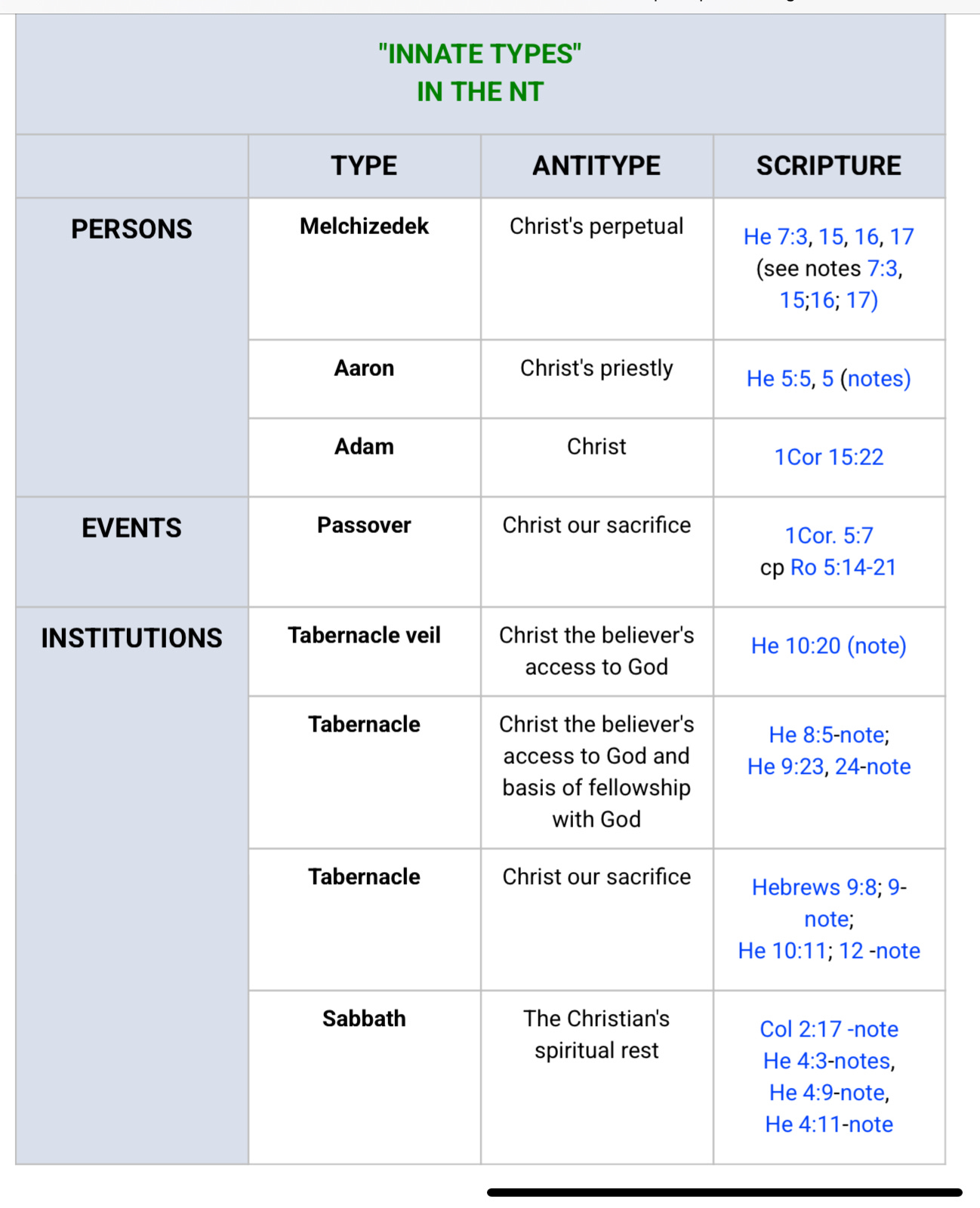
Better promises are from a better covenant that brought by the more excellent ministry of our heavenly Mediator! He is our high priest, our sacrifice (one and done for all time) and our tabernacle! Perhaps this commentary from Charles Spurgeon, quoted in Precept Austin would be helpful:
In the tabernacle everything was done according to the pattern seen in the holy mount by Moses; in the temple no sacrifice was presented but according to divine command. The whole Aaronic ritual was very impressive. The priests in their holy robes, pure white linen garments, the golden altar, candlestick, and table, the fire, the smoke, the incense; the whole thing was calculated very much to impress the mind. The first covenant provided a very magnificent service, such as never will be excelled, but for all that, costly, divinely arranged, impressive, yet it could not put away sin; and the evidence of this is found in the fact that after one day of atonement they needed another atonement next year.
God set aside that first covenant. He put it away as an outworn and useless thing; and He brought in a new covenant—the covenant of grace; and in our text we see what is the tenor of it: “I will put my laws into their mind, and write them in their hearts” (Jer 31:33). This is one of the most glorious promises that ever fell from the lips of infinite love. God said not, “I will come again, as I came on Sinai, and thunder at them.” No, but, “I will come in gentleness and mercy, and find a way into their hearts.” He said not, “I will take two great tables of stone, and with my finger write out my law before their eyes.” No, but, “I will put my finger upon their hearts, and there will I write my law.” He said not, “I will give promises and threatenings that shall be the safeguard of this new covenant”; but, “I will with my Spirit graciously operate upon their minds and their hearts, and so I will sweetly influence them to serve me—not for reward, nor from any servile motive, but because they know me, and they love me, and they feel it to be their delight to walk in the way of my commandments.”
The copy and shadow were rituals and constant sacrifices and atonements and detailed plans of a Tabernacle. We as believers know what the perfect antitype is that was ultimately fulfilled in the New Testament: Jesus Christ our Lord!
I also like this commentary from Enduring Word:
But now He has obtained a more excellent ministry, inasmuch as He is also Mediator of a better covenant, which was established on better promises.
a. He has obtained a more excellent ministry: No earthly priest could take away sin the way Jesus did. Therefore Jesus’ ministry is far better than the ministry of the priesthood under the Law of Moses.
b. Mediator of a better covenant: Jesus has mediated for us a better covenant, a covenant of grace and not of works, guaranteed for us by a cosigner (Hebrews 7:22). It is a covenant marked by believing and receiving instead of by earning and deserving.
i. Jesus is our Mediator for this greater covenant. Mediator is the ancient Greek word mesites, which means “one who stands in the middle between two people and brings them together.” (Barclay)
ii. Moses was the mediator of the Old Covenant because he “brought the two parties together.” Jesus is the Mediator of the New Covenant, a better covenant, bringing us to God the Father.
iii. Jesus’ covenant is a better covenant, better than any of the previous covenants God made with men. The covenant of Jesus fulfills the other covenants described in the Bible.
· There is an eternal covenant between the members of the Godhead that made possible the salvation of man (Hebrews 13:20).
· God’s redemptive plan was continued through the covenant He made with Abraham(Genesis 12:1-3).
· The Mosaic covenant was another step in God’s redemptive plan (Exodus 24:3-8).
· The Davidic covenant was yet another step in God’s redemptive plan (2 Samuel 7:1-16).
· The redemptive plan of God was fulfilled in the New Covenant (Luke 22:14-20).
c. Which was established on better promises: Jesus has better promises for us. These are promises to see us through the most desperate and dark times. These are promises that become alive to us through the Spirit of God. These are promises of blessing and undeserved favor instead of promises to curse and judge.
How blessed are we that He came down to us! How appropriate is this scripture for the season of Advent. It is fulfilled!
My next devotional examines Hebrews 8:7-12 - God’s prophetic promise.
Heaven on Wheels Daily Prayer:
Dear Lord - It is a beautiful thing to see how history in the OT points to Christ as the fulfillment of Your covenant with humanity. Thank you for bringing me back to the fold (today as I write this on December 19, I can see on our calendar that we came to Christ on this day in 2006). I love the idea of typology instead of allegory; it helps confirm and cement the true reality of our relationship with You. Amen.
Credits and Citations:
Scripture quotations taken from the (NASB®) New American Standard Bible®, Copyright © 1960, 1971, 1977, 1995 by The Lockman Foundation. Used by permission. All rights reserved. www.Lockman.org.
Precept Austin was accessed on 12/19/2025 to review commentary for Hebrews 8:4-6 and to review Typology.
“G5262 - hypodeigma - Strong’s Greek Lexicon (nasb95).” Blue Letter Bible. Web. 19 Dec, 2025. <https://www.blueletterbible.org/lexicon/g5262/nasb95/mgnt/0-1/>.
“G4639 - skia - Strong’s Greek Lexicon (nasb95).” Blue Letter Bible. Web. 19 Dec, 2025. <https://www.blueletterbible.org/lexicon/g4639/nasb95/mgnt/0-1/>.
Commentary from Enduring Word by David Guzik is used with written permission. ©1996-present The Enduring Word Bible Commentary by David Guzik – enduringword.com. Within the Enduring Word commentary:
Barclay, William The Letter to the Hebrews (Philadelphia: Westminster Press, 1975)