


“And without faith it is impossible to please Him, for he who comes to God must believe that He is and that He is a rewarder of those who seek Him. By faith Noah, being warned by God about things not yet seen, in reverence prepared an ark for the salvation of his household, by which he condemned the world, and became an heir of the righteousness which is according to faith.”
Hebrews 11:6-7 NASB1995
I decided to include both verses 6 and 7 in this devotional, although verse 6 by itself could be a long treatise. This is a verse that people usually mark in their Bibles when doing a “Bible in One Year Plan”, but by itself it doesn’t have the context of the examples of faith that the author of Hebrews is showcasing in chapter 11, especially the preceding example of Enoch and the following example of Noah.
Without faith it is impossible to please Him. Let’s do a word study on impossible from the Blue Letter Bible lexicon:
Impossible comes from the Greek adjective ἀδύνατος or adýnatos (Strong's G102), with the following Biblical usages:
without strength, impotent, powerless, weakly, disabled
unable to be done, impossible
We are without strength, powerless, disabled without faith and cannot please Him. Those who come to God must believe that He IS, that He exists, then all things are possible. It is just as much a leap of faith (or quite a bit more so, IMHO) to say there is no God when the evidence of His existence is everywhere around us. But what kind of God do we envision, since no one has seen God? Precept Austin quotes from John MacArthur on what God is (and isn’t):
John MacArthur writes that "In his book, Your God is Too Small, J. B. Phillips describes some of the common gods that people manufacture. One is the grand old man god, the grandfatherly, white-haired, indulgent god who smiles down on men and winks at their adultery, stealing, cheating, and lying. Then there are [is] the resident policeman god, whose primary job is to make life difficult and unenjoyable, and the god in a box, the private and exclusive sectarian god. The managing director god is the god of the deists, the god who designed and created the universe, started it spinning, and now stands by far away watching it run down. God is not pleased with belief in any of these idolatrous substitutes." (See Hebrews MacArthur New Testament Commentary - Page 307).
It is nearly impossible to imagine God, but He doesn’t fall into any of these poorly executed ideas from simple-minded humans. He is Jehovah, the great I AM, the self-existent, eternal and infinite being. Precept Austin has more attributes in an adjunct study of Jehovah (I’m borrowing the key concepts):
He is (besides self-existent, eternal and infinite):
Transcendent
Personal
Holy
Righteous
Unchangeable
Our Guide
Our Portion
Our Helper
The One who Hears Prayers
Our Best Thought at Night
Our Sovereign and King
Our Redeemer
The Word
The Bread of Life*
The Light of the World*
The Door*
The Good Shepherd*
The Way, the Truth and the Life*
The Resurrection and the Life*
The Vine*
(*These are from the “I Am’ statements of Jesus in the Gospels. Jesus is Jehovah). I could probably add many more attributes to this list but you get the point. If we believe that He IS through eyes of faith, then we can know Him as a rewarder of those who seek Him. Oh, and He is Love!
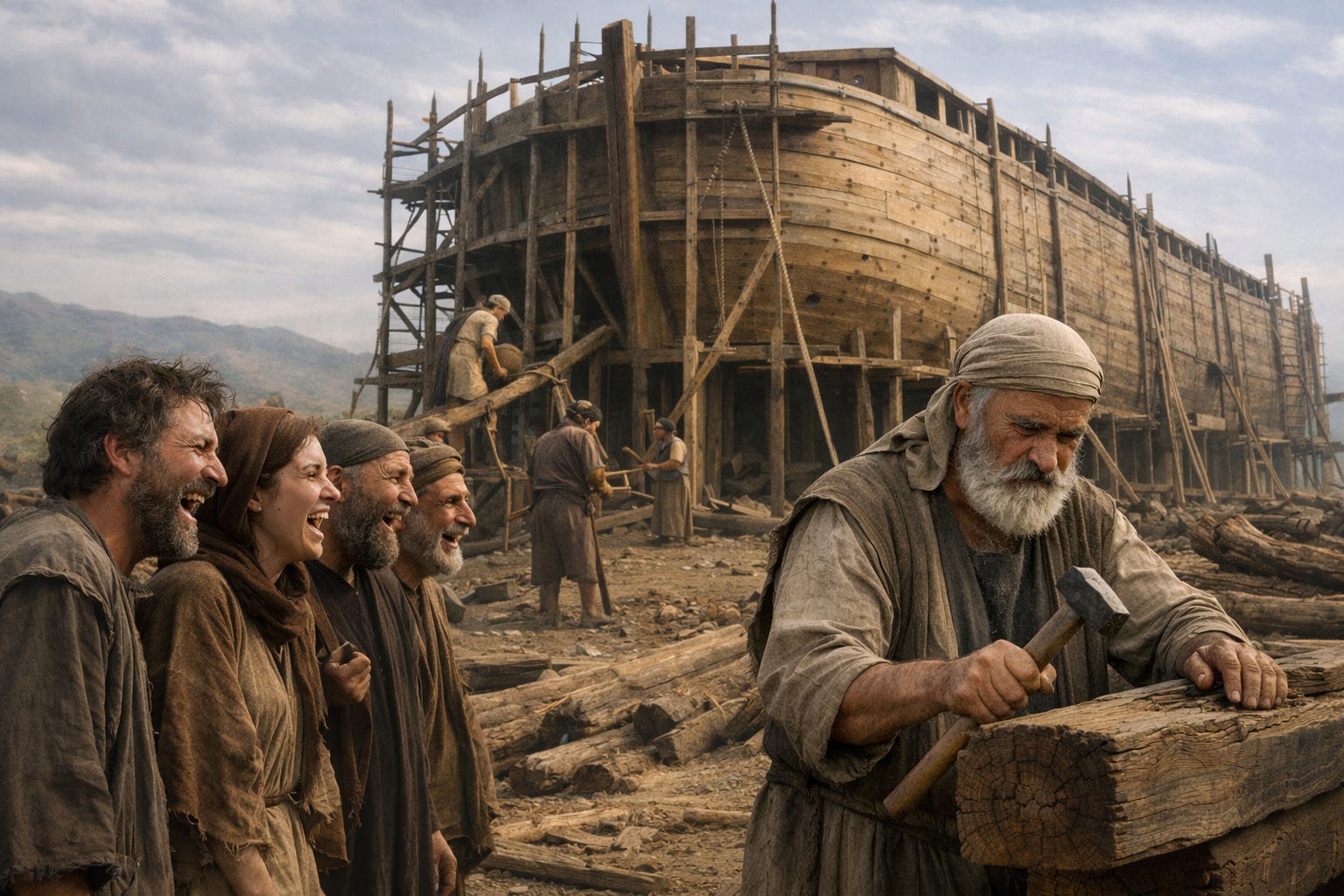
The AI image at the top that Steve had created shows a man of faith, Noah, working on a massive project (the Ark) while bystanders laugh and scoff. Noah believed on faith that there was a future event that would require this vessel to save him and his family and the non-human creatures that God created and called good. Noah walked with God. Let’s look at Noah’s story again, in Genesis 6:
“Then the Lord saw that the wickedness of man was great on the earth, and that every intent of the thoughts of his heart was only evil continually. The Lord was sorry that He had made man on the earth, and He was grieved in His heart. The Lord said, “I will blot out man whom I have created from the face of the land, from man to animals to creeping things and to birds of the sky; for I am sorry that I have made them.” But Noah found favor in the eyes of the Lord.
These are the records of the generations of Noah. Noah was a righteous man, blameless in his time; Noah walked with God. Noah became the father of three sons: Shem, Ham, and Japheth.
Now the earth was corrupt in the sight of God, and the earth was filled with violence. God looked on the earth, and behold, it was corrupt; for all flesh had corrupted their way upon the earth.
Then God said to Noah, “The end of all flesh has come before Me; for the earth is filled with violence because of them; and behold, I am about to destroy them with the earth. Make for yourself an ark of gopher wood; you shall make the ark with rooms, and shall cover it inside and out with pitch. This is how you shall make it: the length of the ark three hundred cubits, its breadth fifty cubits, and its height thirty cubits. You shall make a window for the ark, and finish it to a cubit from the top; and set the door of the ark in the side of it; you shall make it with lower, second, and third decks. Behold, I, even I am bringing the flood of water upon the earth, to destroy all flesh in which is the breath of life, from under heaven; everything that is on the earth shall perish. But I will establish My covenant with you; and you shall enter the ark—you and your sons and your wife, and your sons’ wives with you. And of every living thing of all flesh, you shall bring two of every kind into the ark, to keep them alive with you; they shall be male and female. Of the birds after their kind, and of the animals after their kind, of every creeping thing of the ground after its kind, two of every kind will come to you to keep them alive. As for you, take for yourself some of all food which is edible, and gather it to yourself; and it shall be for food for you and for them.” Thus Noah did; according to all that God had commanded him, so he did.”
Genesis 6:5-22 NASB1995

Here is what the inimitable Charles Spurgeon says about Noah, as quoted in Precept Austin:
Noah obeyed at all costs. To build the huge vessel must have cost Noah a great deal of money and labor. He could not get everybody to work at the absurd task of building a vessel on dry land. As they would be laughed at, his workmen would be sure to demand extra pay. Possibly he had to pay double wages to everyone employed on the ark. The patriarch was content to sink all his capital and all his income in this singular venture. It was a poor speculation—so everybody told him—and yet he was quite willing to put all his eggs into that one basket. God had bidden him build, and build he would, feeling that the divine command insured him against risk. Can we do the same?
Noah went on obeying under daily scorn. The men of that generation mocked him. He went out and preached to them, but many would not hear him, for they thought him mad. Those who did listen to him said to each other, “He is building a vessel upon dry land—is he sane? We are scientific, and therefore we know how absurd his preaching is; no one ever heard of the world being drowned by a flood.” I cannot reproduce the letters that were written about the sturdy patriarch, nor can I recount the spiteful things that were said by the gossips, but I have no doubt they were very clever, and very sarcastic. Those productions of genius are all forgotten now, but Noah is remembered still. For all the scorning of many he went on obeying his God: he stuck to the lines on which God had placed him, and he could not be turned to the right hand or to the left, because he had a real faith in God. (Sermon Noah's Faith, Fear, Obedience, and Salvation)
Noah became an heir of the righteousness, which is according to faith. Let’s do a word study on righteousness:
Righteousness comes from the Greek noun δικαιοσύνη or dikaiosýnē (Strong’s G1343), with the following Biblical usages:
in a broad sense: state of him who is as he ought to be, righteousness, the condition acceptable to God
the doctrine concerning the way in which man may attain a state approved of God
integrity, virtue, purity of life, rightness, correctness of thinking feeling, and acting
in a narrower sense, justice or the virtue which gives each his due
As Spurgeon said in his sermon about Noah, he stuck to the lines on which God had placed him and was not turned to the right or the left because of his faith. Obeying God in faith now brings believers into the Ark of God’s protection before the days of judgment are upon us.
In my last devotional, I listed three examplesof faith from the Creation, Abel and Enoch. I’ve carried them over to here and now add the example from Noah:
(Creation) Faith in God’s Word that He created the worlds from things that are not visible.
(Abel) Faith in God manifested in obedience, worship and sacrifice.
(Enoch) Faith in God found through walking with Him every step of every day.
(Noah) Faith in God carried through adversity and pressure from unbelievers leading to trust in things not yet seen to become an heir of righteousness.
My next devotional examines Hebrews 11:8-12 - The faith of Abraham and Sarah.
Heaven on Wheels Daily Prayer:
Dear Lord - I pray that I come to You every day, Lord, in faith that You are and that you are a rewarder for this who believe. Amen.
Credits and Citations:
Scripture quotations taken from the (NASB®) New American Standard Bible®, Copyright © 1960, 1971, 1977, 1995 by The Lockman Foundation. Used by permission. All rights reserved. www.Lockman.org.
“G102 - adynatos - Strong’s Greek Lexicon (NASB95).” Blue Letter Bible. Web. 26 Jan, 2026. <https://www.blueletterbible.org/lexicon/g102/nasb95/mgnt/0-1/>.
“G1343 - dikaiosynē - Strong’s Greek Lexicon (NASB95).” Blue Letter Bible. Web. 26 Jan, 2026. <https://www.blueletterbible.org/lexicon/g1343/nasb95/mgnt/0-1/>.
Precept Austin was accessed on 01/26/2026 to review commentary for Hebrews 11:1-2. Within the Precept Austin commentary: The MacArthur commentary (see link in the excerpt above).
Commentary from Enduring Word is used with written permission and without any alteration. ©1996-present The Enduring Word Bible Commentary by David Guzik – enduringword.com. Enduring Word commentary was accessed but not used for this devotional.