



“Therefore, do not throw away your confidence, which has a great reward. For you have need of endurance, so that when you have done the will of God, you may receive what was promised.
For yet in a very little while,
He who is coming will come, and will not delay.
But My righteous one shall live by faith;
And if he shrinks back,
My soul has no pleasure in him.
But we are not of those who shrink back to destruction, but of those who have faith to the preserving of the soul.”
Hebrews 10:35-39 NASB1995
Hebrews 10 ends with another exhortation to the wobbly believers. The author does not want them to throw away their confidence, which has a great reward. They also need endurance so that they can receive what was promised. Let’s do a couple of word studies from the Blue Letter Bible lexicon!
Confidence comes from the Greek noun παῤῥησία or parrhēsía (Strong’s G3954) with the following Biblical usages:
freedom in speaking, unreservedness in speech
openly, frankly, i.e without concealment
without ambiguity or circumlocution
without the use of figures and comparisons
free and fearless confidence, cheerful courage, boldness, assurance
the deportment by which one becomes conspicuous or secures publicity
This confidence is cheerful courage, boldness, the assurance of a great reward. As the photo at the top says, difficult roads lead to beautiful destinations. This word has been used three times previously in Hebrews, including once before in Hebrews 10 (verse 19).
Endurance comes from the Greek noun ὑπομονή or hupŏmŏnē (Strong’s G5281), with the following Biblical usages:
steadfastness, constancy, endurance
in the NT the characteristic of a man who is not swerved from his deliberate purpose and his loyalty to faith and piety by even the greatest trials and sufferings
patiently, and steadfastly
a patient, steadfast waiting for
a patient enduring, sustaining, perseverance
Endurance requires patience, faith, and perseverance, a constancy of purpose. Note that the usage 1.a, above, is perfectly aligned with the author’s intent. He wants the believers to not swerve from their deliberate purpose and loyalty to Christ even in the worst trials and sufferings.
So how can we lose our confidence? Charles Spurgeon has a handy list of ways this can happen from a sermon excerpted on Precept Austin (the link in the first item goes to the original sermon for more details):
(1) You can cast it away by changing it for self-confidence… (See full sermon for more explanation of each of the following points)
(2) Some, however, cast away their confidence by giving way to sin… My brothers and sisters, we cannot enjoy confidence towards God if we live in disobedience. Old Master Brooks says, “Assurance will make us leave off sinning, or sinning will make us leave off assurance;” and, depend upon it, it will. He who lives in the light of God’s countenance must mind what he is at. Kings’ favorites live under a jealous eye. More is expected from those who lean their heads upon Christ’s bosom than from any other of the disciples. You cannot grieve your heavenly Father and yet feel the same confidence towards him…
(3) There is another way of losing our confidence, and that is by getting into worldly company and mixing up with the gay and frivolous… A deadening influence will come over your intimate communion with God if you are on close terms with unbelievers. You cannot walk with God and his enemies. You cannot be in league with Christ and Belial at the same time, or sit at your Master’s table and expect him to smile upon you after you have partaken of the cup of devils. Do not lose your sweet confidence and holy boldness in God’s presence by associating with the world, but come ye out from among them and be ye separate…
(4) You can very easily lose your confidence by changing your aim in life. The Christian’s aim in life is to live for God’s glory. If he does so, no persecution can ever shake him. If his goods be spoiled he says, “If it glorifies God for me to lose my property I am no loser. I gave my goods to God years ago.” If he is put in prison, he says, “I have lost my liberty, but I am no loser; I gave up my liberty to God long ago.” If they tell him that he will die, he says, “Well, I am no loser, for I gave him my life long ago. I am altogether Christ’s.” While your object is God you will be bold as a lion, but a sordid motive is the mother of cowardice.
(5) Alas, dear friends, some unhappy professors have apparently cast away their confidence in utter unbelief. They set out with a great confidence of a certain sort. Like Pliable, from the City of Destruction, they were going to have the Celestial City, and enjoy it for ever; but they fell into the Slough of Despond, and they felt that their confidence could not be kept up, and so they got out of the slough on the side that was nearest their own house, and went back through sheer despair of better things. May God keep you from this!…
This commentary from Enduring Word on confidence and endurance is also quite good:
a. Therefore do not cast away your confidence: These discouraged Christians were in danger of casting away their confidence in Jesus, and relapsing into an Old Covenant relationship with God.
i. Do not cast away your confidence: “Do not throw it away…neither men nor devils can take it from you, and God will never deprive you of it if you continue faithful. There is a reference here to cowardly soldiers, who throw away their shields, and run away from the battle. This is your shield, your faith in Christ, which gives you the knowledge of salvation; keep it, and it will keep you.” (Clarke)
b. You have need of endurance: They, and we, have need of endurance to receive the promise of God after we have done the will of God. The toughest and most discouraging trials are when we are called to obey God’s will when the fulfillment of His promise seems so far away. This is why we need endurance. Faithfulness during the time when the promise seems unfulfilled is the measure of your obedience and spiritual maturity.
i. This endurance is built through trials, the testing of our faith (James 1:2-4).
The off-ramps and alternate roads designed by the enemy are traps for believers, even when we are not directly persecuted or made to suffer for our beliefs. Be wary of a secondary path that seems easy at first. These off-ramps thrive on the impatience of the average human being, with the need for self-gratification now rather than waiting and enduring for the promises of God.
The photo below shows a poorly maintained back road. In our road trip travels, I have usually done the navigation. I don’t like interstate highways for several reasons: Too many big trucks, limited views of the countryside, no charming small towns to experience, people driving excessive speeds, and just plain monotony. Trading that for secondary roads has its hazards, though, as we found in Montana a few years ago towing a trailer where I tried to avoid I-90 and we ended up on rough dirt roads for about 40 miles (we were too far into the alternate route to turn back). On another trip in Idaho/Montana with our small RV I recommended a route that actually had a state highway number on it and it eventually became a rugged and challenging dirt pass with lots of sharp rocks (we had to have a flat fixed a day later). It was quite scenic, if you could ignore the language coming from the poor driver.
I’m more cautious now, knowing that back roads in many parts of the western US will most likely be a problem and we now stick to the main highways or ones that we know are not likely to end up as dirt lanes through cow pastures in this part of the country. However, the back roads in the Midwest and southern/eastern parts of the country are usually quite delightful (except near Orlando, Florida). My point (and I do have one) with this lesson is that off-ramps often lead to treasures in THIS world, but we want to stay the course and persevere on the direct highway to His promises, because those off-ramps can also lead to spiritual danger.

The next verses are referring to Habakkuk 2:3-4 (this is the Hebrew translation):
“For the vision is yet for the appointed time;
It hastens toward the goal and it will not fail.
Though it tarries, wait for it;
For it will certainly come, it will not delay.
“Behold, as for the proud one,
His soul is not right within him;
But the righteous will live by his faith.”
Habakkuk 2:3-4 NASB1995
This is, once again, a warning about the second coming of our Lord. In the quoted version in Hebrews, the word little comes from the Greek adjective μικρός or mikrós (Strong’s G3398), which is where our word micron comes from, a very infinitesimal measurement. Precept Austin has more than one great list of quotes about being ready for Him in their commentary for this passage. I culled some of the best ones and listed them below:
He who loves the coming of the Lord is not he who affirms it is far off, nor is it he who says it is near. It is he who, whether it be far or near, awaits it with sincere faith, stead-fast hope and fervent love. - Augustine
The only remedy for all this mass of misery is the return of our Lord Jesus Christ. Why do we not plead for it every time we hear the clock strike? - Anthony Ashley Cooper
Precisely because we cannot predict the moment, we must be ready at all moments. - C. S. Lewis
Uncertainty about the date of the Lord’s return is calculated to keep believers in an attitude of constant expectation and to preserve them from despondency. - J. C. Ryle
If I knew that our Lord would come this evening, I should preach just as I mean to preach; and if I knew he would come during this sermon, I would go on preaching until he did. - C. H. Spurgeon
The fact that Jesus Christ is to come again is not a reason for star-gazing, but for working in the power of the Holy Ghost. - C. H. Spurgeon
During World War II occurred early in the war when the Japanese army stormed the Philippines and forced United States General Douglas MacArthur to leave the islands. Upon leaving the Philippines, General MacArthur declared his famous promise, “I shall return.” And he did, walking ashore a victor at Leyte in the Philippines several years later. In an even more famous quote, the Captain of the hosts, the Lord Jesus Christ declared to His fearful band of disciples “I will come again” (John 14:3)
I love that Spurgeon quote - we are not to be star-gazing but should be working in the power of the Holy Spirit as we wait.
I also wanted to share this tidbit of insight, from Enduring Word about Habakkuk 2.4:
c. Now the just shall live by faith: We need to follow in the footsteps of the just who will live by faith, and endure to see the promise fulfilled.
i. Every word in Habakkuk 2:4 is important, and the Lord quotes it three times in the New Testament just to bring out the fullness of the meaning.
· In Romans 1:17 Paul quotes this same passage from Habakkuk 2:4 with the emphasis on faith: “The just shall live by faith.”
· In Galatians 3:11 Paul quotes this passage from Habakkuk 2:4 with the emphasis on just: “The just shall live by faith.”
· Here in Hebrews 10:38 the emphasis is on live: “The just shall live by faith.”
The just, or the righteous, will live by faith. We must endure!

The final verse of Hebrews 10 says that we are not those who shrink back into destruction (some translations use perdition), but are those who have faith for the preserving of the soul. The author is confident that his audience will not shrink back from their new-found belief in Jesus, but will continue to persevere for the preserving of their souls. I like this table I found in Precept Austin:
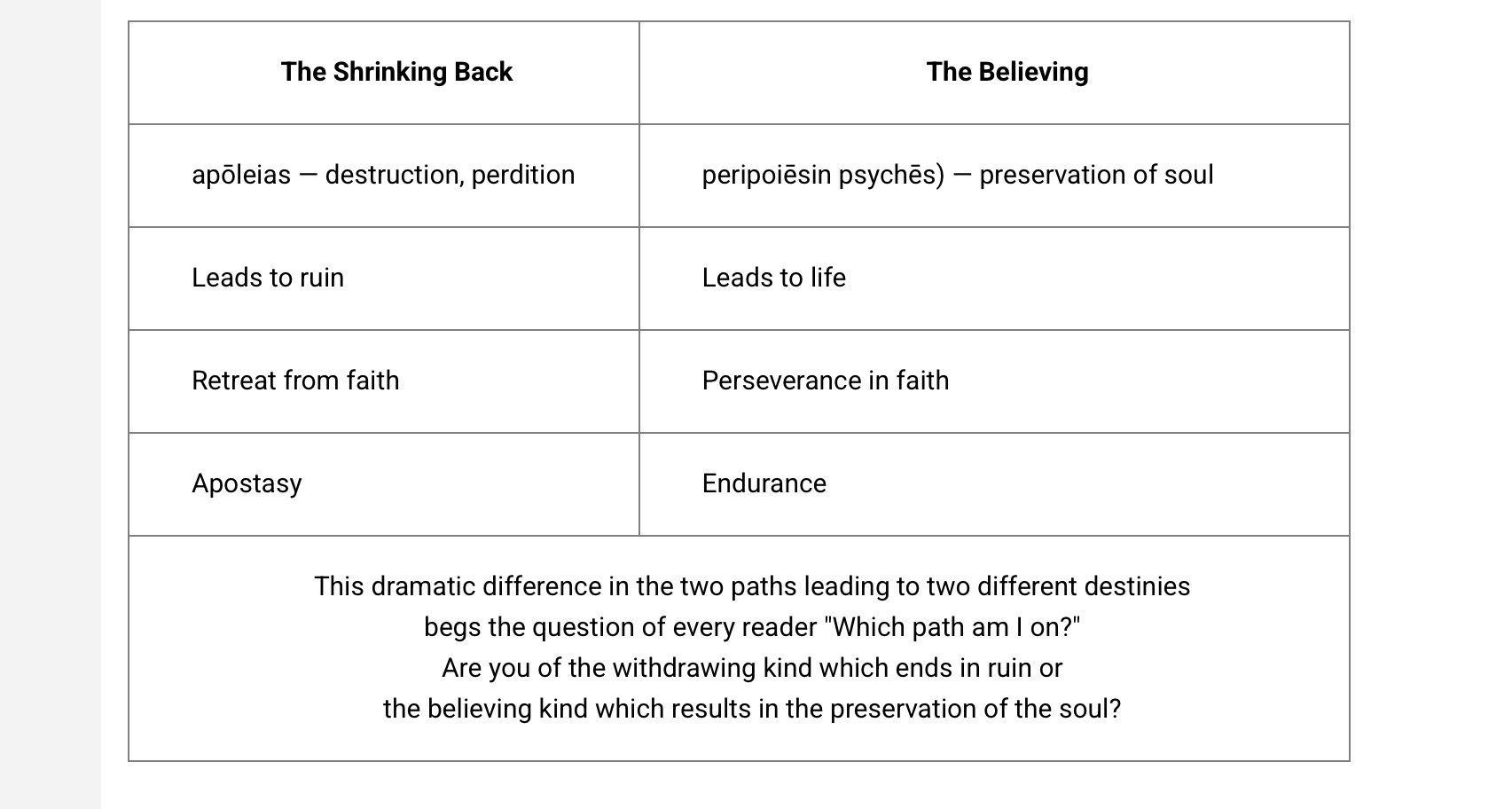
Great questions to ask yourself: Which path am I on? Where has the seed of my faith been sown? Are you the withdrawing kind that ends in ruin? I’ll end this with an excerpt of a sermon by Steven Cole that was found on Precept Austin:
Jesus’ parable of the sower (Matt. 13:3-23; Mark 4:3-20; Luke 8:5-15) serves as a useful backdrop to our text. Jesus described the seed of the Word as sown on four types of soil. Some fell beside the road, where the birds ate it, so that it never took root and sprouted. This represents unbelievers who hear the gospel, but do not understand or believe it. Other seed fell on the rocky ground, where there was no depth of soil. It quickly sprang up, but it had no roots, and so it withered. This represents those who hear the Word and immediately receive it with joy. But when affliction or persecution arises, they quickly fall away. The third soil is infested with thorns. The seed sprouts, but the thorns, representing worries, riches, and pleasures of this life (Luke 8:14), choke out the word so that it does not bring forth any fruit. The fourth type is good soil, representing those who hear, understand, and accept the Word, and bear fruit with perseverance (Luke 8:15). In my understanding, only the fourth type of soil represents true believers who “have faith to the preserving of the soul” (Heb. 10:39). The rocky soil and the thorny soil both make a profession of faith for a while but eventually, they “shrink back to destruction.” In other words, genuine saving faith endures trials and bears fruit. The amount of fruit will vary (“some a hundredfold, some sixty, and some thirty,” Matt. 13:23), but there will be observable evidence of a transformed heart. True believers may fail under pressure, as Peter did when he denied Jesus. Every believer struggles daily against sin, not always victoriously. But if God has changed the heart and if His saving life is “in the vine,” the person will repent, endure in faith, and bear fruit unto eternal life. (Enduring Faith)
My next devotional examines Hebrews 11:1 - A beautiful definition of faith.
Heaven on Wheels Daily Prayer:
Dear Lord - Please help me to have confidence, endurance and faith in the preserving of my soul! Amen.
Credits and Citations:
Scripture quotations taken from the (NASB®) New American Standard Bible®, Copyright © 1960, 1971, 1977, 1995 by The Lockman Foundation. Used by permission. All rights reserved. www.Lockman.org.
“G3954 - parrēsia - Strong’s Greek Lexicon (NASB95).” Blue Letter Bible. Web. 20 Jan, 2026. <https://www.blueletterbible.org/lexicon/g3954/nasb95/mgnt/0-1/>.
“G5281 - hypomonē - Strong’s Greek Lexicon (NASB95).” Blue Letter Bible. Web. 20 Jan, 2026. <https://www.blueletterbible.org/lexicon/g5281/nasb95/mgnt/0-1/>.
Precept Austin was accessed on 01/20/2026 to review commentary for Hebrews 10:5-39. Within the Precept Austin commentary: Steven Cole Sermon (link to full sermon is at the end of the extract). Copyright, Steven J. Cole, 2004, All Rights Reserved. Unless otherwise noted, all Scripture Quotations are from the New American Standard Bible, Updated Edition © The Lockman Foundation
Commentary from Enduring Word is used with written permission and without any alteration. ©1996-present The Enduring Word Bible Commentary by David Guzik – enduringword.com. Within the Enduring Word commentary:
Clarke, Adam The New Testament with A Commentary and Critical Notes, Volume II (New York: Eaton & Mains, 1831)