


“Therefore it was necessary for the copies of the things in the heavens to be cleansed with these, but the heavenly things themselves with better sacrifices than these. For Christ did not enter a holy place made with hands, a mere copy of the true one, but into heaven itself, now to appear in the presence of God for us; nor was it that He would offer Himself often, as the high priest enters the holy place year by year with blood that is not his own. Otherwise, He would have needed to suffer often since the foundation of the world; but now once at the consummation of the ages He has been manifested to put away sin by the sacrifice of Himself.”
Hebrews 9:23-26 NASB1995
OK, time for a little confession - I read through this passage for today several times and must admit that I found it very challenging. I’ve never heard these verses expounded upon in a sermon or featured as a meme on social media and I can imagine my reaction when sleepwalking through a Bible in One Year plan was to read them quickly and then let my eyes glaze over. But here they are and I’ll heavily rely on commentary to help us get through this. Oh, and fair warning, this could also be controversial!
First, I like this commentary from Enduring Word; be advised that David Guzik includes a criticism of Catholicism in this excerpt:
a. It was necessary that the copies of the things in the heavens should be purified with these: It was acceptable for the copies of the things in the heavens in the earthly sanctuary to be “purified” with imperfect sacrifices. But the heavenly things themselves could only be purified with a perfect offering.
i. “Purification implies, not only cleansing from defilement, but also dedication or consecration. All the utensils employed in the tabernacle service were thus purified though incapable of any moral pollution.” (Clarke)
b. For Christ has not entered the holy places made with hands… but into heaven itself: Jesus’ sacrifice was made on earth, but it is the basis for His continuing work as our mediator and High Priest in heaven. The writer to the Hebrews proclaims it: now to appear in the presence of God for us. It’s not hard to believe that Jesus does appear in the presence of God. But to believe that He appears there for us is glorious!
c. Not that He should offer Himself often: Jesus’ ministry for us continues in heaven, but not in the sense of continuing to atone for our sin. His ministry continues for us in intercession and defending us against the accuser of God’s people (Revelation 12:10). But it does not continue in the sense that He should offer Himself often. His sacrifice was once-for-all, and perfectly satisfied God’s holy justice.
i. This passage and principle is a direct rebuke to the Roman Catholic practice and theology of the mass. In the mass, the Roman Catholic Church desires to repeat – not remember, but repeat– the atoning sacrifice of Jesus innumerable times. This is absolutely indefensible Scripturally, and denies the finished work of Jesus Christ on the cross. The Scriptures make it plain: not that He should offer Himself often.
d. He then would have had to suffer often since the foundation of the world: If the sacrifice of Jesus were not perfect, then it would have to be continual and constant – even since the foundation of the world. Imperfect sacrifices must be repeated continually but a perfect sacrifice can be made once for all time, and genuinely put away sin (not just cover sin, as with sacrifice under the Old Covenant). The message is clear: He has appeared to put away sin by the sacrifice of Himself.
i. This principle of sacrifice explains why the suffering of hell must be eternal for those who reject the atoning work of Jesus. They are in hell to pay the penalty of their sin, but as imperfect beings they are unable to make a perfect payment. If the payment is not perfect, then it has to be continual and constant – indeed, for all eternity. A soul could be released from hell the moment its debt of sin was completely paid – which is another way of saying never.
As we have read going through Hebrews, Christ’s sacrifice is once and for all for those who believe; it satisfies God’s holy justice. It does not have to be restated and reinstated over and over again, which is a way of denying its completion. You don’t lose your “state of grace” if you forget to go to confession or miss out on communion or don’t have last rites or you weren’t baptized as an infant or your worship team uses contemporary music. I don’t intend to pursue more controversies between various sects, so I won’t go further down the bunny trail of criticism of Catholicism. However, I will provide a link to Gotquestions.org where you can read their evaluation of those beliefs.
Guzik also has an interesting point in that last paragraph of his commentary: Those who reject the atoning work of Jesus can never pay the debt of their sin; it must be constant and continual. So that reinforces the eternity of hell.
When Steve and I first returned to faith, we explored several options, but as we have matured in our understanding, we are mostly pleased with our choices that are grounded in Protestantism (tending towards the reformed side). But let’s also not forget one of my favorite flow charts. I always feel like sharing this when friends and acquaintances pound the drum for their denomination being the only one that is “correct”; most of the time, what they consider “correct” is works-based and often created by men. Where we have to be centered is in the Word of God! (That’s not an invitation to get into an argument about Bible translations).
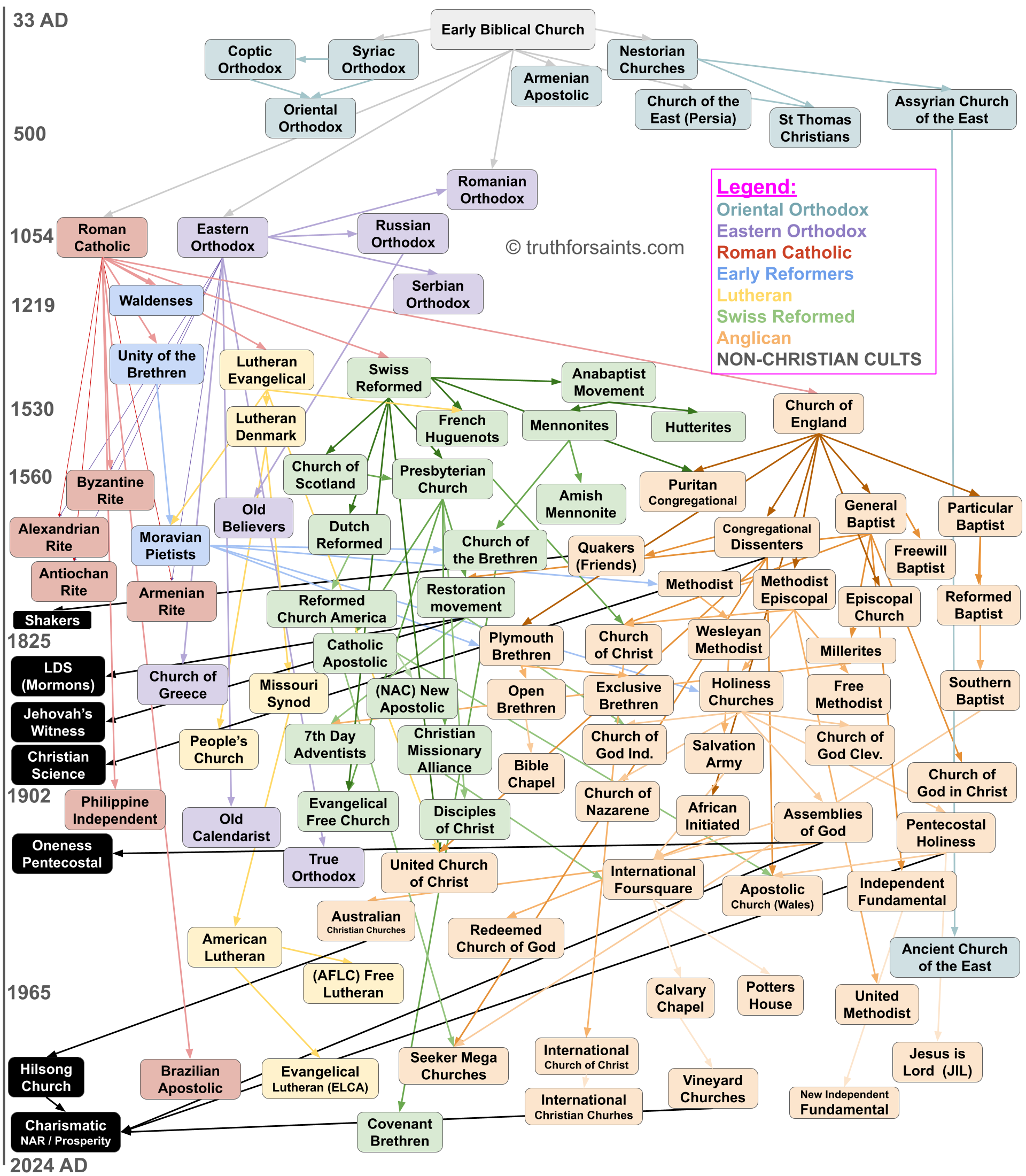
Note the copyright on the flowchart, in case you are interested in the source.
Charles Spurgeon also has a good way of describing this atonement, as quoted in Precept Austin; read the full sermon of his at this link:
What are you resting in at the present moment? Have you been saying in your soul, ‘I am the child of Christian parents; I have never gone into profanity, or open sin; it must be all right with me’? Or have you said in your heart, ‘I was christened in my infancy; I have been confirmed; I have paid due attention to the ceremonials of my church, and therefore I am saved’? Or have you said, ‘I have kept the commandments from my youth up; I have neither wronged man nor blasphemed God’?
I tell you solemnly that these grounds of confidence are utterly worthless. If you could have been saved by your baptism, do you think Christ would have died? If your good works could have opened the gates of heaven for you, do you think that the Christ of God himself would have bled for sinners? If it had been possible for your godly ancestry to have lifted you to the skies, do you suppose that Jesus Christ would have been ‘obedient unto death, even the death of the cross’? All other confidence which begins, proceeds and ends with anything else save the person and the work of Jesus, will deceive you in the hour of death and at the day of judgment, and therefore I say to you, do not for a moment entertain it; away with it, confide in it no longer!
If I saw you trusting yourself upon a bridge which I knew would snap in the centre when your weight came fairly upon it, I should not be unkind, but only following the instincts of humanity in warning you not to trust in it. And I do so warn you now that other refuge there is none save in Christ Jesus; if you seek another refuge you insult God, you do despite to Jesus Christ and you cast yourself into a tenfold jeopardy, for he that does not believe in Jesus Christ must be lost.
Perfectly stated!
There is a phrase in the last verse of this passage that is quite intriguing: ..but now once at the consummation of the ages He has been manifested to put away sin by the sacrifice of Himself. Let’s do some word studies from the Blue Letter Bible Lexicon.
Once comes from the Greek adverb ἅπαξ or hápax (Strong’s G530), with the following Biblical usages:
once, one time
once for all
We studied this adverb before. I love the “once, one time; once for all”.
Consummation comes from the Greek noun συντέλεια or syntéleia (Strong’s G4930), with the following Biblical usages:
completion, consummation, end
When the disciples asked Jesus about the end of the age, here is one of the things He said in Matthew:
“So it will be at the end of the age; the angels will come forth and take out the wicked from among the righteous, and will throw them into the furnace of fire; in that place there will be weeping and gnashing of teeth.”
Matthew 13:49-50 NASB1995
Ages comes from the Greek noun αἰών or aiṓn (Strong’s G165), with the following Biblical usages:
for ever, an unbroken age, perpetuity of time, eternity
the worlds, universe
period of time, age
Biblically, we are, right now, at the end of the ages. People can talk about geologic ages and historical eras all they want, but His return (see the next devotional for Hebrews 9:27-28) is imminent. I don’t necessarily mean tomorrow, but it could happen tomorrow! It could happen tonight! All of the fussing and fighting over the pleasures and foolishness of this world are being played out right at the “end of the age”.
He has been manifested comes from the Greek verb φανερόω or phaneróō (Strong’s G5319) with the following Biblical usages:
to make manifest or visible or known what has been hidden or unknown, to manifest, whether by words, or deeds, or in any other way
make actual and visible, realised
to make known by teaching
to become manifest, be made known
of a person
expose to view, make manifest, to show one’s self, appear
to become known, to be plainly recognised, thoroughly understood
who and what one is
1 Timothy 3 has a beautiful use of this verb:
“By common confession, great is the mystery of godliness:
He who was revealed in the flesh,
Was vindicated in the Spirit,
Seen by angels,
Proclaimed among the nations,
Believed on in the world,
Taken up in glory.”
1 Timothy 3:16 NASB1995
Put away comes from the Greek noun ἀθέτησις or athétēsis (Strong’s G115), with the following Biblical usages:
abolition, disannulling, put away, rejection; from the Strong’s definition - cancellation.
Let’s reiterate: Once/one time/once for all here at the completion of this perpetuity of time, He has been made visible/real/has appeared to cancel/abolish/reject sin by His sacrifice.
This is the centerpiece of our existence!

Three more commentaries are worth examining. William McDonald is quoted in Precept Austin with this interpretation of what we see under the New Covenant:
Under the New Covenant, there is:
1. Positive finality—He has appeared once for all. The work never needs to be repeated.
2. A propitious time—He appeared at the end of the ages, that is, after the Old Covenant had conclusively demonstrated man’s failure and powerlessness.
3. A perfect work—He appeared, to put away sin. The emphasis is on the words put away. It was no longer a matter of annual atonement. Now it was eternal forgiveness.
4. A personal sacrifice—He put away sin by the sacrifice of Himself. In His own body He bore the punishment which our sins deserved. (Believer’s Bible Commentary)
And Charles Spurgeon, from the same sermon referenced above, has this to say:
Christ not only came to put away some of the attributes of sin such as the filth of it, the guilt of it, the penalty of it and the degradation of it, but he came to put away sin itself, for sin, you see, is the fountain of all the mischief. He did not come to empty out the streams, but to clear away the fatal source of the pollution. He appeared to put away sin itself, sin in its essence and being. Do not forget that he did take away the filth of sin, the guilt of sin, the punishment of sin, the power of sin and the dominion of sin, and that one day he will kill in us the very being and existence of sin, but do recollect that he aimed his stroke at sin itself.
My Master seemed to say, as the king of Syria did of old, ‘Fight neither with small nor great, save only with the king’. He aimed his arrows at the monster’s head, smote his vital parts and laid him low. He put hell itself to flight and captivity was led captive. What a glorious word—our Lord ‘put away sin’! We read in the Word of God that he cast it ‘into the depths of the sea’; that is glorious; nobody can ever find it again—in the shoreless depths of the sea Jesus drowned our sins. Again, we find he removed it ‘as far as the east is from the west’. Who can measure that distance? Infinite leagues divide the utmost bounds of space; so far has he removed our transgressions from us. We read again that he has made ‘an end of sins’. You know what we mean by making an end of a thing; it is done with, annihilated, utterly destroyed and abolished. Jesus, we here read, has ‘put away sin’; he has divorced it from us. Sin and my soul are no more married. Christ has put sin away.
And finally, these illustrations of what this all means appear to be from Bruce Hurt, the author of Precept Austin, as no other author is noted (note: I made some minor formatting changes to make this more emphatic):
The Great Timeline Convergence
Imagine a massive timeline stretching from creation to eternity.
All the “ages” and events of history converge like rivers flowing into one ocean.
At the center stands the cross of Christ—the hinge of history—where the eternal plan of God reaches its climactic fulfillment.
Point: Christ’s sacrifice was not random, but the appointed turning point of history.
Shadows vs. Substance
Picture a child clutching a shadow of their parent on the ground, only to finally look up and see the parent themselves.
The Old Covenant sacrifices were the shadows.
Christ’s appearing is the reality.
Point: The shadow fades when the true figure arrives.
The Single Cure
Use the imagery of a doctor who discovers the one medicine that completely eradicates a deadly disease.
Generations tried treatments (the OT sacrifices), but none could cure.
Finally, Christ’s one “dose” (His sacrifice) eradicated sin’s power.
Point: Once-for-all efficacy of Christ’s offering.
The Legal Verdict
Think of a courtroom where countless cases are postponed, year after year, with no final verdict.
Then one day, the Judge’s own Son steps forward, bearing the guilt Himself.
The gavel falls: “Paid in full.”
Point: Christ appeared at the climax of God’s redemptive plan to settle sin’s case once for all.
The Final Bridge
Imagine two cliffs separated by an uncrossable chasm (God’s holiness vs. man’s sin).
For ages, people laid planks of sacrifice, but none reached the other side.
Then Christ builds the full and final bridge by the sacrifice of Himself.
Point: Access to God is forever secured.
The Consummation Wedding
The phrase “consummation of the ages” can be likened to the wedding climax.
History is like a long engagement, filled with anticipation and preparation.
Christ’s appearing is the wedding day—the culmination of all waiting, when the bridegroom secures His bride.
Point: All redemptive history points toward Christ’s appearing.
A lot to ponder!
My next devotional examines Hebrews 9:27-28 - His second coming.
Heaven on Wheels Daily Prayer:
Dear Lord - The focal point of my life has often been caught up in work or pleasures or anxieties or the latest ridiculous news. I know what the consummation of the ages means now and it is in You! Amen!
Credits and Citations:
Scripture quotations taken from the (NASB®) New American Standard Bible®, Copyright © 1960, 1971, 1977, 1995 by The Lockman Foundation. Used by permission. All rights reserved. www.Lockman.org.
Commentary from Enduring Word is used with written permission and without any alteration. ©1996-present The Enduring Word Bible Commentary by David Guzik – enduringword.com. Within the Enduring Word commentary:
Clarke, Adam The New Testament with A Commentary and Critical Notes, Volume II (New York: Eaton & Mains, 1831)
Precept Austin was accessed on 01/02/2026 to review commentary for Hebrews 9:23-26.
“G530 - hapax - Strong’s Greek Lexicon (NASB95).” Blue Letter Bible. Web. 2 Jan, 2026. <https://www.blueletterbible.org/lexicon/g530/nasb95/mgnt/0-1/>.
“G4930 - synteleia - Strong’s Greek Lexicon (NASB95).” Blue Letter Bible. Web. 2 Jan, 2026. <https://www.blueletterbible.org/lexicon/g4930/nasb95/mgnt/0-1/>.
“G5319 - phaneroō - Strong’s Greek Lexicon (NASB95).” Blue Letter Bible. Web. 2 Jan, 2026. <https://www.blueletterbible.org/lexicon/g5319/nasb95/mgnt/0-1/>.