


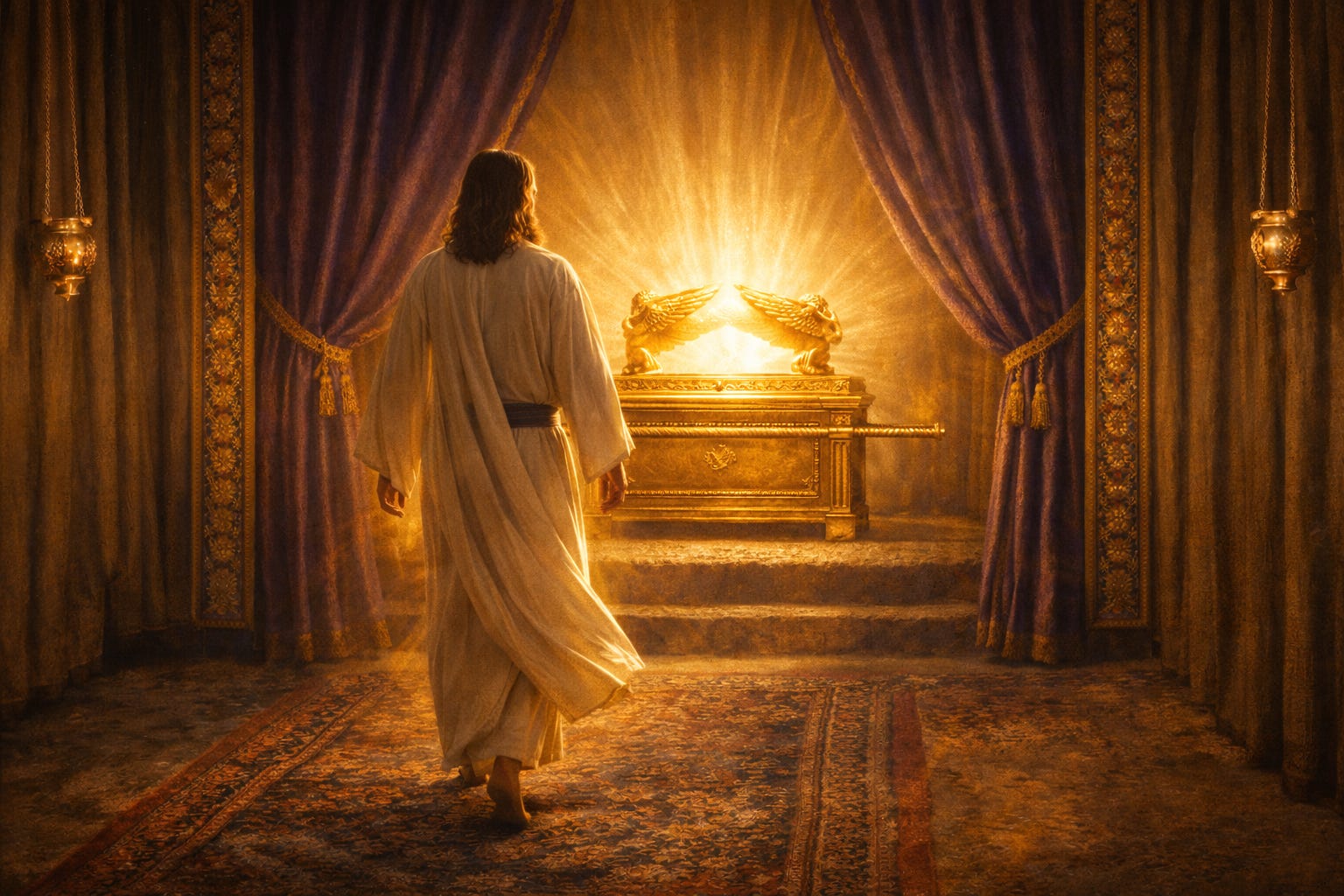
“But when Christ appeared as a high priest of the good things to come, He entered through the greater and more perfect tabernacle, not made with hands, that is to say, not of this creation; and not through the blood of goats and calves, but through His own blood, He entered the holy place once for all, having obtained eternal redemption. For if the blood of goats and bulls and the ashes of a heifer sprinkling those who have been defiled sanctify for the cleansing of the flesh, how much more will the blood of Christ, who through the eternal Spirit offered Himself without blemish to God, cleanse your conscience from dead works to serve the living God?”
Hebrews 9:11-14 NASB1995
As the celebration of Christmas continues (the twelve days actually go until January 6), we have gazed again this time of year upon the innocent Christ child in the manger, marveling that God came down among humans. He appeared as a high priest of “the good things to come”. Those good things that are to come came through His blood, shed on the cross for eternal redemption, once for all and for all time.
A few commentators believe this passage means that Christ carried His blood into heaven. Most, however, acknowledge that this was the blood shed before He died on the cross. There are numerous debates about the word “through” so let’s look at this word in the Blue Letter Bible lexicon in the context of this passage.
Through comes from the Greek preposition διά or diá (Strong’s G1223), with the following Biblical usages:
through
of place
with
in
of time
throughout
during
of means
by
by the means of
through
the ground or reason by which something is or is not done
by reason of
on account of
because of for this reason
therefore
on this account
By means of His blood, redemption is gained once and for all who believe! So why does the Christian faith require His blood? Couldn’t His words or miracles have been enough? Well, we all know that there is no way to bridge the gap between sinful humanity and a holy God, unless something atones for our sin. Hence the sacrificial system was born, first with the life blood of selected animals in the Old Covenant and then with the precious lifeblood of Jesus, the Son of God, in the New and Perfect Covenant.
Here are some excerpts from a great answer to that question from Gotquestions.org:
The blood of Jesus Christ plays a central role in Christian salvation, symbolizing the ultimate sacrifice of our Savior’s life for the atonement of sins, the establishment of a new covenant, and the justification and redemption of humanity.
The blood of Christ was shed through His suffering and death on the cross. He bled as He was flogged and when a crown of thorns was put on His head (John 19:1–2). When soldiers nailed spikes through His hands and feet (Psalm 22:16; John 20:25) and speared His side, the blood of Jesus flowed (John 19:34). This shed blood was the price our Savior paid to cover the debt we owed to God for our sins: “He himself is the sacrifice that atones for our sins—and not only our sins but the sins of all the world” (1 John 2:2, NLT).
The significance of blood in the context of atonement and salvation traces back to the Old Testament. In the sacrificial system instituted by God for the Israelites, the blood of animals played a crucial role in the atonement of sins. Leviticus 17:11 states, “For the life of a creature is in the blood, and I have given it to you to make atonement for yourselves on the altar; it is the blood that makes atonement for one’s life.”
…
In the New Testament, the concept of atonement for sin through the shedding of blood is fulfilled in the person of Jesus Christ. He stepped in, took our punishment upon Himself, and paid the price with His blood—His life for ours—fulfilling God’s demand for perfect justice (Romans 3:25; Ephesians 1:7; Hebrews 10:10). Redeemed believers are “made perfect” and “made holy” by Christ’s one perfect sacrifice (Hebrews 10:14–18). His blood poured out on the cross “cleanses us from all sin” (1 John 1:7, NKJV)
John the Baptist identified Jesus as “the Lamb of God who takes away the sin of the world!” (John 1:29). This metaphor highlights Jesus as the ultimate and perfect sacrificial lamb whose blood was shed for our salvation. When Christ offered Himself on the cross as the atoning sacrifice for our sins (Hebrews 7:27; 9:14), His lifeblood was accepted by God the Father as payment in full for every last sin—past, present, and future—for the whole human race. No earthly treasure, no silver or gold, can compare to the value of “the precious blood of Christ, the sinless, spotless Lamb of God” (1 Peter 1:18–19, NLT).
…
On the cross, Jesus established the New Covenant, replacing the old sacrificial system with His own sacrifice. In the ordinance of communion, believers partake of the bread and the cup, symbols of Christ’s body and blood, in remembrance of His sacrifice. This observance tangibly reminds us of the cost of our salvation and the New Covenant established by Christ.
…
Knowing that the blood of Christ has secured our salvation brings assurance and peace (Colossians 1:19–20; Ephesians 2:13–14; Romans 5:1). The writer of Hebrews expounds, “So Christ has now become the High Priest over all the good things that have come. He has entered that greater, more perfect Tabernacle in heaven. . . . With his own blood—not the blood of goats and calves—he entered the Most Holy Place once for all time and secured our redemption forever. . . . Christ offered himself to God as a perfect sacrifice for our sins . . . so that all who are called can receive the eternal inheritance God has promised them” (Hebrews 9:11–15, NLT). As we reflect on the blood of Christ, may we always be grateful for the costly and precious gift of our salvation.

Do you have assurance in your salvation through the Lamb of God? I think we all struggle with our concerns that we are not sorry enough or do not repent often enough. I thought this commentary from William Smith, who wrote a series of Bible dictionaries, was really good (quoted in Precept Austin):
Have you ever wondered, “When I asked God to forgive me, was I truly sincere? Did I really repent? Did I confess all my sins? Was I specific enough? Comprehensive enough? Sorry enough?”
You may not realize it, but those questions are a sneaky version of works righteousness. That’s how theologians describe any attempt to say to God, “I’ve been good enough for you, and so you should save me.”
Are you surprised that repenting can become a “work”? Most religious activities can. You fall into this trap any time you make gaining God’s mercy contingent on your own efforts—such as asking for forgiveness “the right way” or being remorseful “enough.” Thankfully, God addressed this version of works righteousness thousands of years ago.
In the Old Testament, God foreshadowed what Jesus would do on the cross by telling his people to offer an animal sacrifice as a substitute death on their behalf. The animal would symbolically take the penalty for the human’s sin on itself and would die, rather than the person who had sinned.
Even before God established the tabernacle or the temple, he told his people that they could make an earthen or stone altar on which to offer their sacrifices (see Ex. 20:24–26). But he gave them explicit instructions not to shape or cut the stones (see v. 25). They had to use them as they found them. This didn’t simply distinguish the appearance of their altars from those of their surrounding neighbors. It clarified the role that his people played in atoning for their sin: none at all. They didn’t create or give life to the creatures that they sacrificed, nor did they create the materials that were used to sacrifice them. They couldn’t even set their own stamp on those materials.
The altar pictured the mind-set that the people needed to approach God. It was a mind-set that said, “I have no part in fixing the problem I have created between God and me. All that I bring to this altar is my sin. The only reason I don’t die for my sin, as God’s presence comes near, is that he has offered to accept a substitute for me. If he’s satisfied with the sacrifice, then I live. If he isn’t, then there’s nothing I can do to satisfy him.”
It was never a matter of doing enough, because there was never anything you could do. By asking, “Did I do enough? Well enough?” you’re really asking, “Is God satisfied with what I’ve done?” The question that you need to ask instead is “Is God satisfied with what Christ has done?” [my emphasis]
Since Jesus entered the Most Holy Place—and not an earthly copy of heaven’s throne room, but the real one in which God’s presence dwells (see Heb. 9:24–26)—then the answer throughout Scripture and heaven to “Is God satisfied?” is a resounding “Yes! It is enough.”
Let that answer resound in your heart just as loudly.Reflect: Consider what is the underlying root of your question “Did I repent well enough?” Does that question come from (1) wanting to think well of yourself, (2) hating to be in another’s debt, (3) not wanting to feel vulnerable, (4) wanting to feel in control of your life, or (5) wanting to show God that you really do care? Or does it come from something else entirely?
Act: Here’s the good news: even for this, Jesus’s sacrifice was enough. Ask him to forgive you, and then rejoice in the greatness of his salvation.
Verse 13 of this passage talks about the blood of sacrificial animals and the sprinkling of ashes from a heifer on those seeking atonement. A lot of the commentary that I read had long excursions into stories about red heifers and their use in sacrificial rites (interesting to read but I’m not going to go down that bunny trail). But those sacrifices have been replaced and superseded by the blood of Christ. Verse 14 is repeated below, comparing the shadow to the substance (animal sacrifices to the sacrifice of Jesus):
who through the eternal Spirit offered Himself without blemish to God, cleanse your conscience from dead works to serve the living God?”
There’s that pesky word “conscience” again. I wrote in my last devotional about conscience and how it can try to point us in the right direction. But I read more about it today and perhaps that is too simplistic. Here is what Ray Stedman said about conscience and dead works and serving the Living God from a sermon excerpted in Precept Austin :
We each have a conscience. We may not be able to analyze it, and we certainly cannot control it, but we know we all possess one. Conscience has been defined as “that still, small voice that makes you feel smaller still,” or, as one little boy put it, “It is that which feels bad when everything else feels good.” Conscience is that internal voice that sits in judgment over our will. There is a very common myth abroad that says that conscience is the means by which we tell what is right and what is wrong. But conscience is never that. It is training that tells us what is right or wrong. But when we know what is right or wrong, it is our conscience that insists that we do what we think is right and avoid what we think is wrong. That distinction is very important and needs to be made clear.
Conscience can be very mistaken; it is not a safe guide by itself. It accuses us when we violate whatever moral standard we may have, but that moral standard may be quite wrong when viewed in the light of God’s revelation. But conscience also gives approval whenever we fulfill whatever standard we have, though that standard is right or wrong. And conscience, we have all discovered, acts both before and after the fact -- it can either prod or punish.
In the case of these Hebrews, the problem is not over wrongdoing, it is not a conscience troubled over evil deeds, but “dead works.” We must remember that the readers of this letter are Christians who already know how to handle the problem of sins. When they become aware that they have deliberately disobeyed what they knew to be right, they know the only way they can quiet an avenging conscience is to confess the sin before God, and deal with the problem immediately. That aspect of a troubled conscience can easily be taken care of by Christians as they accept the forgiving grace of God. But the problem here is a conscience plagued with guilt over good left undone -- not sins of commission, but sins of omission.
These people try to put their conscience to rest by religious activity; they are goaded by an uneasy conscience into a high gear program in order to please God. Here are people who are intent on doing what is right, and thus pleasing God, and they have therefore launched upon an intensive program of religious activity which may range all the way from bead-counting and candle-burning to serving on committees, passing out tracts, and teaching Sunday school classes. What perceptible difference in motive is there between a poor, blinded pagan who, in his misconception of truth, crawls endlessly down a road to placate God, and an American Christian who busies himself in a continual round of activity to try to win a sense of acceptance before God? None whatsoever!
A woman said to me recently, “I don’t know what is the matter with me. I do all I can to serve the Lord but I still feel guilty, and then I feel guilty about feeling guilty!” [my emphasis]
Precisely! It is rather discouraging, is it not, to see that all this laudable effort on our part is dismissed here as “dead works.” It is disconcerting to see that such effort is not acceptably serving God. God is not impressed by our feverish effort. What do you do when this is your problem? Certainly not try harder; that is the worst thing you could do.
…
The cross is God’s way of saying there is nothing in us worth saving at all, apart from Christ -- no salvageable content whatsoever. He takes us as we are, men and women apart from Christ, and he says, “There is nothing you can do for me, not one thing.” For when Christ became what we are, when he was “made sin for us” {cf, 2 Cor 5:21}, God passed sentence upon him, and put him to death. This is God’s eloquent way of saying to us, “There is nothing to please me in yourslf; there is not a thing you can do by your own effort that is worth a thing.” All that we can ever be, without Christ, is totally set aside. Death eliminates us, wipes us out.
That is why our activity does not improve our relationship with him in the least degree. It does not make us any more acceptable, even though it is activity for him. See what this does to our human pride. It cuts the ground right out from under us.
…
That is why Verse 14 closes with this wonderful sentence, “the blood of Christ … purifies our conscience to serve the living God.” The gospel is that he has made himself available to us, to do everything in us, as a living God. “Faithful is he who calls you, who also will do it,” {cf, 1 Th 5:24}. The one who calls you to do something is the one who intends to do it, through you. Therefore, let us stop thinking we have to depend on our intellect, our ability, our gifts, our talents, or our anything, and start reckoning on his ability to supply what we lack to do what he asks. We can say with Paul, “I can do all things through Christ, who strengtheneth me,” {cf, Phil 4:13}. Do you understand that? What a relief that is!
By repenting and accepting our Lord’s blood sacrifice, He will purify our conscience, guide us away from sin and “dead works” and into the true ways to serve the Living God! It’s one for all for all time!
I have to admit that studying Hebrews has been very challenging for me, but also so enlightening. There are touches of Paul in the words, that’s for sure!
My next devotional examines Hebrews 9:15-17 - Christ the true mediator.
Heaven on Wheels Daily Prayer:
Dear Lord - I am so in awe of the most earth-shattering event in our history, the incarnation of our Lord Jesus as a man who was also God. His sacrifice, as I have said before, is one for all who believe for all time! Whatever service I provide to You, or Living Lord, is through Your guidance and not through my guilty conscience. Amen!
Credits and Citations:
Scripture quotations taken from the (NASB®) New American Standard Bible®, Copyright © 1960, 1971, 1977, 1995 by The Lockman Foundation. Used by permission. All rights reserved. www.Lockman.org.
Gotquestions.org was accessed on 12/27/2025 to answer the question, What does the blood of Christ have to do with our salvation?. © COPYRIGHT 2002-2025 GOT QUESTIONS MINISTRIES. ALL RIGHTS RESERVED.
Precept Austin was accessed on 12/27/2025 to review commentary for Hebrews 9:11-14.
“G1223 - dia - Strong’s Greek Lexicon (NASB95).” Blue Letter Bible. Web. 27 Dec, 2025. <https://www.blueletterbible.org/lexicon/g1223/nasb95/mgnt/0-1/>.
That’s great insight, thank you for sharing Hebrews today!
The context from the woman who felt guilty about her actions not being or doing enough to please God to possibly make the cut so to speak into Heaven. This was comforting because that woman is not alone in her feelings. This content isn’t explained well within a church service. Thank you for sharing a wonderful story followed by insight straight from the Bible.