


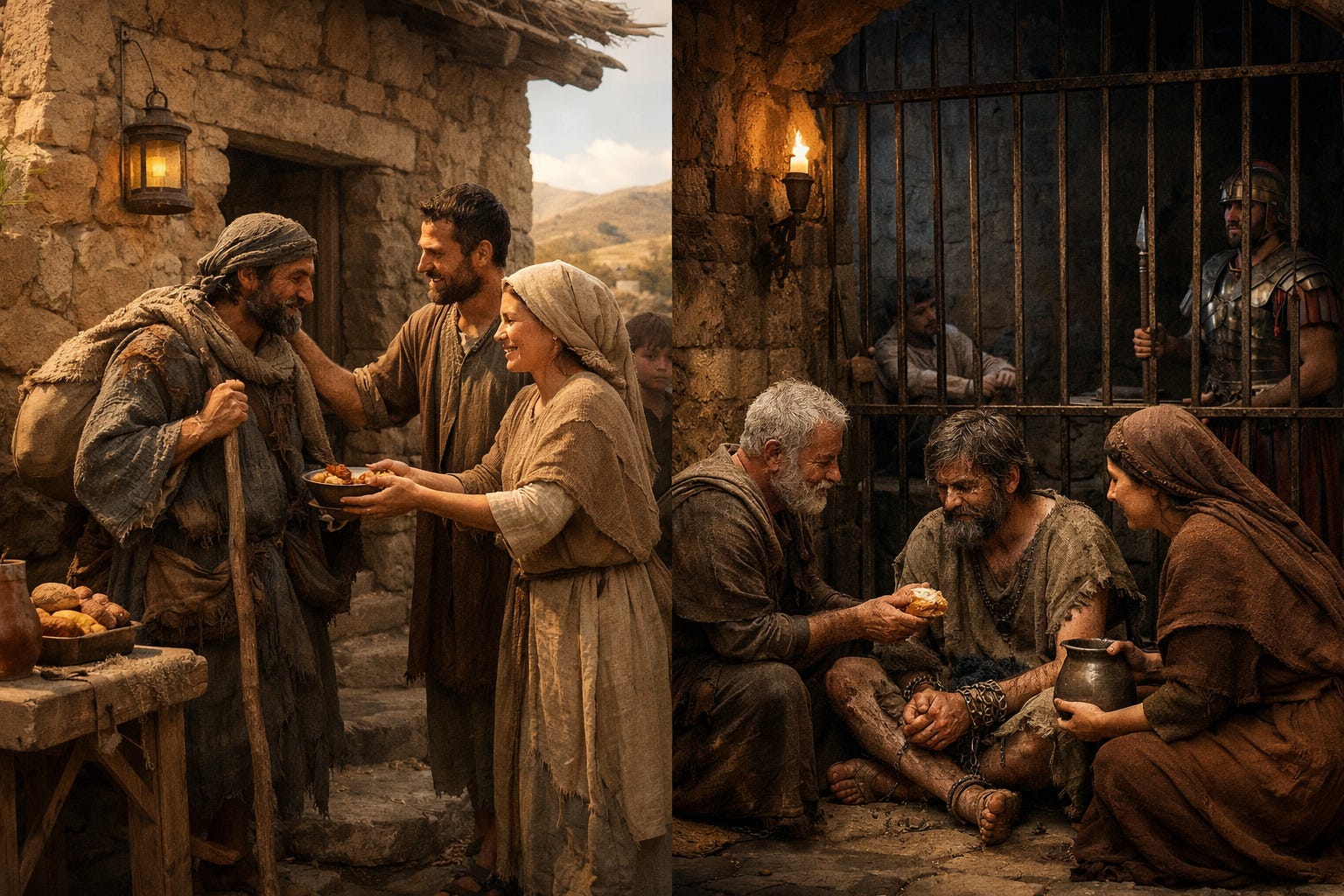
“Let love of the brethren continue. Do not neglect to show hospitality to strangers, for by this some have entertained angels without knowing it. Remember the prisoners, as though in prison with them, and those who are ill-treated, since you yourselves also are in the body.”
Hebrews 13:1-3 NASB1995
The author of Hebrews has pretty much filled the first twelve chapters of this epistle in deep theological studies, pointing to Christ as the fulfillment of God’s new (and final) covenant with His people and warning the believers in as many ways as possible to not retreat from their faith.
Now in the last chapter, the author addresses more mundane behaviors and attitudes that define the Christian believer. Let’s look at the word love in Hebrews 13:1, as defined in the Blue Letter Bible lexicon:
Love of the brethren comes from the Greek noun φιλαδελφία or philadelphía (Strong’s G5360), with the following Biblical usages:
love of brothers or sisters, brotherly love
in the NT the love which Christians cherish for each other as brethren
This is one of four types of words for love that come from the Ancient Greek. Enduring Word describes these four types of love:
a. Let brotherly love continue: The writer to the Hebrews used the ancient Greek word philadelphia here. He assumed there was brotherly love among Christians, and simply asked that it would continue among them.
i. In the ancient Greek language of the New Testament, there were four words at hand that we might translate love.
· Eros was one word for love. It described, as we might guess from the word itself, erotic love, referring to sexual love.
· Storge was a second word for love. It referred to family love, the kind of love there is between a parent and child or between family members in general.
· Agape was another word for love. It is the most powerful word for love in the New Testament, and was often used to describe God’s love towards us. It is a love that loves without changing. It is a self-giving love that gives without demanding or expecting re-payment. It is love so great that it can be given to the unlovable or unappealing. It is love that loves even when it is rejected. Agape love gives and loves because it wants to; it does not demand or expect repayment from the love given – it gives because it loves, it does not love in order to receive. Agape love isn’t about feelings; it is about decisions.
ii. But the word for love used in Hebrews 13:1 is philadelphia, coming from the root philia. This ancient Greek word spoke of brotherly friendship and affection. It is the love of deep friendship and partnership. There should always be plenty of this kind of love among Christians, and it should continue.
The assumption in this first short verse is that brotherly love is already in place and it should continue. William Barclay is quoted in Precept Austin about the risks of this love within the Christian faith:
The very circumstances of the early Church sometimes threatened brotherly love. The very fact that they took their religion as seriously as they did was in one sense a danger. In a Church which is threatened from the outside and desperately in earnest in the inside, there are always two dangers. FIRST, there is the danger of heresy-hunting. The very desire to keep the faith pure tends to make men eager to track down and eliminate the heretic and the man whose faith has gone astray. SECOND, there is the danger of stern and unsympathetic treatment of the man whose nerve and faith have failed. The very necessity of unswerving loyalty in the midst of a heathen and a hostile world tends to add rigorousness to the treatment of the man who in some crisis had not the courage to stand for his faith. It is a great thing to keep the faith clean; but when the desire to do so makes us censorious, harsh and unsympathetic, brotherly love is destroyed and we are left with a situation which may be worse than the one we tried to avoid. Somehow or other we have to combine two things--an earnestness in the faith and a kindness to the man who has strayed from it. (Hebrews 13 Commentary)
If you spend more than five seconds looking at commentary on various Christian social media sites, you will see that “heresy hunting” is more popular than ever! Heresy hunting has probably been responsible for the development of this situation, my favorite spaghetti chart (from Truthforsaints.com):

When we left the legitimately heretical Evangelical Lutheran Church of America, I joined a Facebook group that watches and comments on the rapidly growing apostasy of that particular denomination. When we first came to faith, we thought that a Lutheran tradition would be good, but the ELCA went off the rails in the last decade endorsing every anti-Biblical idea in sight. However, many of the people in the watch group were adamant that if you did NOT in turn join a Lutheran Missouri Synod church, then you were a heretic!! Going to another denomination or even a non-denominational church was frowned upon. No Philadelphia among some of those folks, that’s for sure.
William Barclay is right - there has to be an earnestness in faith combined with a kindness to those who have strayed from that faith. Doctrinal differences are pointless if you believe that:
Christ is the Son of God, equal to God and the Holy Spirit (making the Holy Trinity) and is the Creator of the Universe and our Savior.
Christ became a man, born of the Virgin Mary, and died on the cross for our sins.
His death and resurrection point to an eternity with Him if we repent of our sins and believe in Him (justification).
Scripture is fully inspired by God and is authoritative.
The Holy Spirit guides believers into sanctification through prayer, obedience and service.
The music, the order of the service, the type of baptism ceremony, the lighting, the prayers used, the timing and method of communion, whether or not you have confirmation for young people and the preaching of the word don’t mean anything unless those five elements are at the core of a Christian church and its mission.
Remember the words from “One of the scribes came and heard them arguing, and recognizing that He had answered them well, asked Him, “What commandment is the foremost of all?” Jesus answered, “The foremost is, ‘Hear, O Israel! The Lord our God is one Lord; and you shall love the Lord your God with all your heart, and with all your soul, and with all your mind, and with all your strength.’ The second is this, ‘You shall love your neighbor as yourself.’ There is no other commandment greater than these.” The scribe said to Him, “Right, Teacher; You have truly stated that He is One, and there is no one else besides Him; and to love Him with all the heart and with all the understanding and with all the strength, and to love one’s neighbor as himself, is much more than all burnt offerings and sacrifices.” When Jesus saw that he had answered intelligently, He said to him, “You are not far from the kingdom of God.” After that, no one would venture to ask Him any more questions.”
Mark 12:28-34 NASB1995
All of the laws in the OT were distilled down by Jesus into two precepts: Love God with everything that you have (mind, heart, soul, strength) and love your neighbor as yourself. That neighbor may be the person next door who voted differently than you or it may be a person across the globe who is seeking answers to life’s mysteries or is suffering in some way. I have to share one more story about brotherly love, from an anecdote found on Precept Austin:
It was a quiet December evening on Ward C43, the oncology unit at Georgetown University Hospital. Many of the rooms around the central nurses’ station were dark and empty, but in Room 11 a man lay critically ill. The patient was Jack Swigert, the man who had piloted the Apollo 13 lunar mission in 1970 and was now Congressman-elect from Colorado’s 6th Congressional District. Cancer, the great leveler, now waged its deadly assault on his body. With the dying man was a tall, quiet visitor, sitting in the spot he had occupied almost every night since Swigert had been admitted. Though Bill Armstrong, U.S. Senator from Colorado and chairman of the Senate subcommittee handling Washington’s hottest issue, social security, was one of the busiest and most powerful men in Washington, he was not visiting this room night after night as a powerful politician. He was here as a deeply committed Christian and as Jack Swigert’s friend, fulfilling a responsibility he would not delegate or shirk, much as he dislikes hospitals.
This night Bill leaned over the bed and spoke quietly to his friend “Jack, you’re going to be all right. God loves you. I love you. You are surrounded by friends who are praying for you. You’re going to be all right.” The only response was Jack’s tortured and uneven breathing. Bill pulled his chair closer to the bed and opened his Bible. “Psalm 23,” he began to read in a steady voice. “The Lord is my shepherd, I shall not want....” Time passed. “Psalm 150,” Bill began, then his skin prickled. Jack’s ragged breathing had stopped. He leaned down over the bed, then called for help. As he watched the nurse examining Jack, Bill knew there was nothing more he could do. His friend was dead. Politicians are busy people, especially Senate committee chairmen. Yet, it never occurred to Bill Armstrong that he was too busy to be at the hospital. Nothing dramatic or heroic about his decision -- just a friend doing what he could.
Holiness is obeying God --
loving one another as He loved us.
I knew Senator Armstrong (he actually attended our Lutheran church when I was growing up) and I met Jack Swigert after his mission on Apollo 13 and before he was elected to Congress. Both men were admirable in their own ways; Senator Armstrong was a very devout man, someone that I can’t even fathom being elected now in our rabidly secular state that is nothing like the Colorado I grew up in. Armstrong exhibited true Philadelphia for Jack Swigert.

This leads to the second precept in these three verses: Do not neglect to show hospitality to strangers, for by this some have entertained angels without knowing it. In the early church, this hospitality was between believers, as noted in the commentary from Enduring Word:
b. Do not forget to entertain strangers: This is a simple and practical way that brotherly love should continue among believers. Hospitality is an important virtue and often it is commanded of Christians and leaders (Romans 12:10-13, 1 Timothy 3:2, Titus 1:7-8, 1 Peter 4:9). In the ancient world, where inns did exist, they were notorious for immorality. It was important for traveling Christians to find open homes from other Christians.
i. Because of this command of hospitality, Christians had to watch out for people just masquerading as Christians so they could leech off the generosity of God’s people. As time went on, Christian leaders taught their people how to recognize these deceivers.
ii. The Didache was an early church “ministry manual,” written perhaps somewhere between A.D. 90 and 110. It had this to say about how to tell if a false prophet abused the hospitality of those in the church:
Let every apostle that comes to you be received as the Lord. But he shall not remain except one day; but if there be need, also the next; but if he remains three days, he is a false prophet. And when the apostle goes away, let him take nothing but bread… but if he asks for money, he is a false prophet. And every prophet that speaks in the Spirit you shall neither try nor judge; for every sin shall be forgiven, but this one sin shall not be forgiven. But not everyone that speaks in the Spirit is a prophet; but only if he holds the ways of the Lord. Therefore from their ways shall the false prophet and the true prophet be known. (From The Ante-Nicean Fathers, Volume 7, page 380)
c. Strangers: The point was that they were to do this for other Christians who are strangers to us. If you invite your best friends over for lunch, that is wonderful – but it doesn’t fulfill this command. A wonderful way to fulfill this command is to meet and befriend strangers at church and to entertain them with hospitality.
i. The ancient Greek word for hospitality (used in passages like Romans 12:13) is literally translated, “love for strangers.” Brotherly love means love for all our brothers and sisters in Jesus, not just those who are currently our friends.
d. For by so doing some have unwittingly entertained angels: When we are hospitable to others, we really welcome Jesus (Matthew 25:35), and perhaps angels. Abraham (Genesis 18:1-22) and Lot (Genesis 19:1-3) are examples of those who unwittingly entertained angels.
I think there is some importance to the precautions outlined in the Didache in light of our current immigration situation. Our hospitality to strangers should begin with other believers, but our love for others must also recognize legitimate refugee situations and groups who sincerely need our help and not those who are deceiving us by accepting our hospitality and then coming here to set up criminal networks to defraud citizens and government agencies. We don’t know who the angels are among us but there certainly can be devils; Jesus told His disciples how to behave in their ministries when He sent then out:
““Behold, I send you out as sheep in the midst of wolves; so be shrewd as serpents and innocent as doves.”
Matthew 10:16 NASB1995

Finally, verse 3 reminds us of our obligations to those who are imprisoned: Remember the prisoners, as though in prison with them, and those who are ill-treated, since you yourselves also are in the body. The context of this verse is likely addressing those other believers who have been imprisoned and ill-treated for their beliefs. But prison ministries are among the most needed in our country and in the world. Here’s what Enduring Word says about remembering prisoners:
e. Remember the prisoners as if chained with them: Prisoners here probably has first reference to those imprisoned for the sake of the Gospel. But it can also be extended to all who are in prison. We must serve them with a sympathetic heart (as if chained with them). This is just another way to let brotherly love continue.
i. We do this by doing what we call prison ministry, bringing the truth and love and hope of Jesus to those imprisoned.
ii. We do this by remembering those who are imprisoned for the sake of the gospel, such as the many now imprisoned in the Middle East.
If you practice intercessory prayer, remember others who are imprisoned for their faith around the world. We should also pray for those imprisoned by authoritarian governments and even those who are languishing in places that do not have access to the Bible. A prison doesn’t have to have bars or guards. I highly recommend adding the daily prayers to your list of prayers from these two organizations:
Voice of the Martyrs (supports Christians worldwide who suffer from persecution).
Joshua Project (supports and reaches out to those who have not been reached by the Gospel message).
Chuck Swindoll is quoted in Precept Austin about how we cannot forget the forgotten, whether they are imprisoned or not:
ON THAT ICY JANUARY MORNING, in a twenty-five-cent-a-night flophouse, a shell of a man who looked twice his age staggered to the washbasin and fell. The basin toppled and shattered.
He was found lying in a heap, unclothed and bleeding from a deep gash in his throat. His forehead was badly bruised, and he was semiconscious. A doctor used black sewing thread that somebody had found to suture the wound. All the while the bum begged for a drink. A buddy shared the bottom of a rum bottle to calm his nerves.
He was dumped in a paddy wagon and dropped off at Bellevue Hospital, where he would languish, unable to eat for three days . . . and die. Still unknown.
A friend seeking him was directed to the local morgue. There, among dozens of other colorless, nameless corpses with tags on their toes, he was identified. When they scraped together his belongings, they found a ragged, dirty coat with thirty-eight cents in one pocket and a scrap of paper in the other. Enough coins for another night in the flophouse and five words, “Dear friends and gentle hearts.” Almost like the words of a song. Why would a forgotten drunk carry around a line of lyrics? Maybe that derelict with the body of a bum still had the heart of a genius. For once upon a time, long before his tragic death at age thirty-seven, Stephen Foster had written songs that literally made the whole world sing, such as “Camptown Races” and “Oh! Susanna!”
There are many forgotten lives on the earth. Some are in prison. Some in hospitals. Some in nursing homes. And some silently slip into church on Sunday morning, terribly confused and afraid. Until someone steps in and, in love, rebuilds a life, restores a soul, rekindles a flame that sin snuffed out, and renews a song that once was there. Read carefully God’s penetrating perspective:
Remember those in prison, as if you were there yourself. Remember also those being mistreated, as if you felt their pain in your own bo.
HEBREWS 13:3Can you put yourself into the pain of those who suffer? Can you pause long enough to show the love of Christ to them?
I did not know this tragedy about Stephen Foster. This is such a hard lesson, because many of us are fearful around those who are “down and out”. Can we show love to those who suffer and are forgotten? We’re so blessed, so we should be a blessing to others.
My next devotional tackles Hebrews 13:4 - Marriage is to be held in honor.
Heaven on Wheels Daily Prayer:
Dear Lord - Please help me to show love to other believers, entertain other strangers in our faith or are truly suffering and to remember those who are forgotten. Amen.
Credits and Citations:
Scripture quotations taken from the (NASB®) New American Standard Bible®, Copyright © 1960, 1971, 1977, 1995 by The Lockman Foundation. Used by permission. All rights reserved. www.Lockman.org.
Precept Austin was accessed on 02/23/2026 to review commentary for Hebrews 13:1-3.
Commentary from Enduring Word is used with written permission and without any alteration. ©1996-present The Enduring Word Bible Commentary by David Guzik – enduringword.com.