


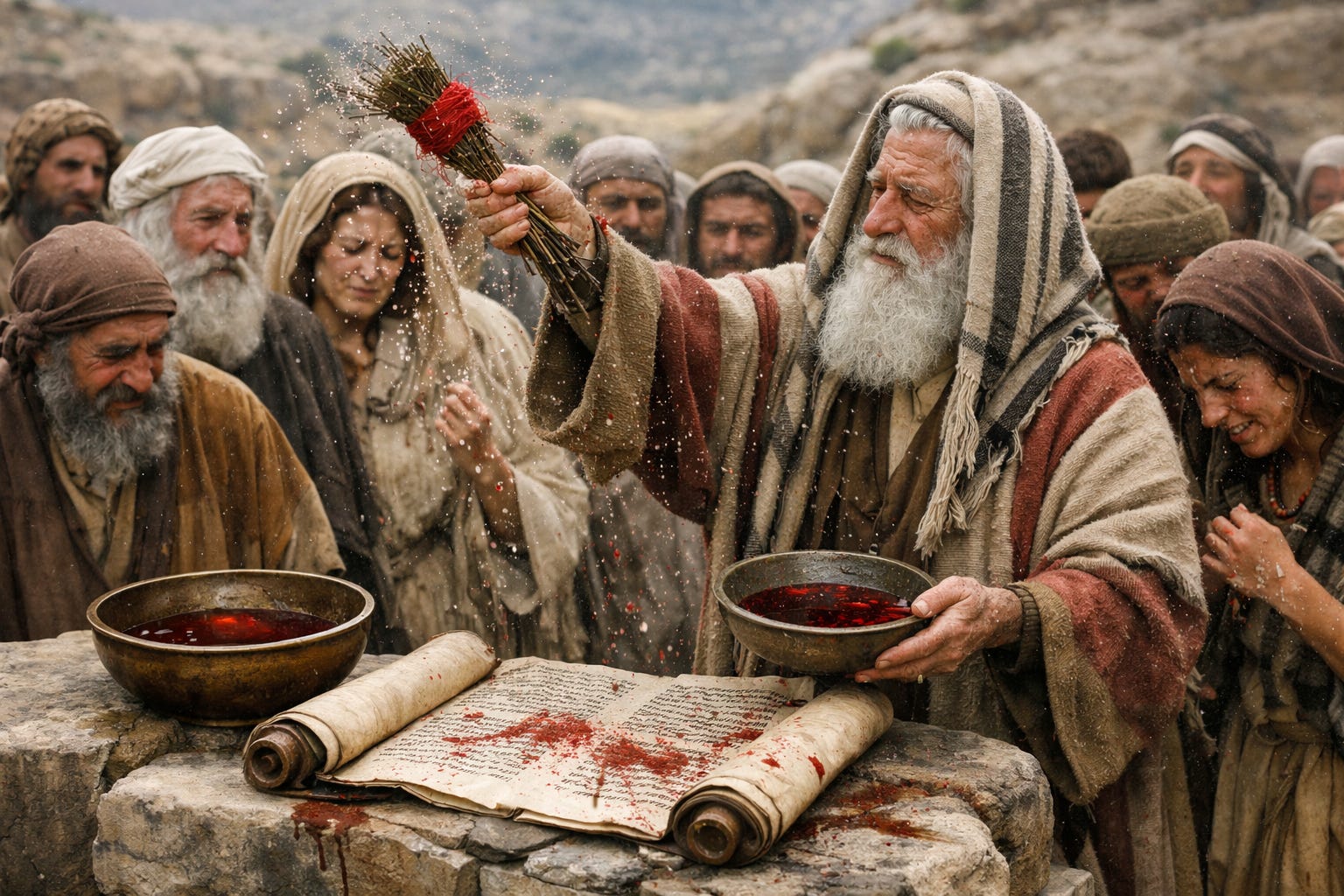
“Therefore even the first covenant was not inaugurated without blood. For when every commandment had been spoken by Moses to all the people according to the Law, he took the blood of the calves and the goats, with water and scarlet wool and hyssop, and sprinkled both the book itself and all the people, saying, “This is the blood of the covenant which God commanded you.” And in the same way he sprinkled both the tabernacle and all the vessels of the ministry with the blood. And according to the Law, one may almost say, all things are cleansed with blood, and without shedding of blood there is no forgiveness.”
Hebrews 9:18-22 NASB1995
As this post will publish on January 1, 2026, let me first wish a blessed and happy New Year to our readers!
This is a bit of a sticky subject continuing through this passage in Hebrews 9 (no pun intended) but it must be emphasized that without the shedding of life blood, there can be no cleansing from sin or forgiveness. The reference to Moses comes from Exodus 24:
“Then Moses came and recounted to the people all the words of the Lord and all the ordinances; and all the people answered with one voice and said, “All the words which the Lord has spoken we will do!” Moses wrote down all the words of the Lord. Then he arose early in the morning, and built an altar at the foot of the mountain with twelve pillars for the twelve tribes of Israel. He sent young men of the sons of Israel, and they offered burnt offerings and sacrificed young bulls as peace offerings to the Lord. Moses took half of the blood and put it in basins, and the other half of the blood he sprinkled on the altar. Then he took the book of the covenant and read it in the hearing of the people; and they said, “All that the Lord has spoken we will do, and we will be obedient!” So Moses took the blood and sprinkled it on the people, and said, “Behold the blood of the covenant, which the Lord has made with you in accordance with all these words.””
Exodus 24:3-8 NASB1995
I had Steve create an AI image to correspond with the words in Hebrews about the Old Covenant. I think the result, at the top, is rather stunning. AI seems to be advancing rather rapidly in terms of image generation (a bit scary in my opinion). The people in the picture are acting just like real people would act if something was being sprinkled on them, especially something rather appalling like the blood of just-slaughtered animals. Steve gave the AI tool the words from Hebrews, but the picture obviously ALSO referenced the passage from Exodus!
I addressed this question a little bit in the last devotional with an excerpt from a sermon by Steven Cole, but the question remains: Why is Christianity so bloody? Well, there’s a good answer from Gotquestions.org:
To understand why Christianity is a “bloody religion,” we must go back to God’s declarations regarding blood in the Old Testament: “the life of the flesh is in the blood” (Leviticus 17:11, 14). Here God tells us that life and blood are essentially one and the same. The blood carries life-sustaining nutrients to all parts of the body. It represents the essence of life. In contrast, the shedding of blood represents the shedding of life, i.e. death.
Blood is also used in the Bible to represent spiritual life. When Adam and Eve sinned in the Garden of Eden by disobeying God and eating fruit of the forbidden tree, they experienced spiritual death immediately, and physical death years later. God’s warning, “You shall not eat of the tree of knowledge of good and evil. For in the day that you eat of it you shall surely die” (Genesis 2:17) was fulfilled. Their blood—their lives—were now tainted by sin. In His gracious plan, however, God provided a “way out” of their dilemma by declaring that sacrifices of blood, first the blood of animals and finally the blood of the Lamb of God (Jesus Christ), would be sufficient to cover the sin of fallen mankind and restore us to spiritual life. He instituted the sacrificial system, beginning with the animals He himself killed to provide the first garments, thereby “covering” the sin of Adam and Eve (Genesis 3:21). All the Old Testament sacrifices which followed from then on were temporary ones, needing to be repeated over and over. These continual sacrifices were a foreshadowing of the one true and final sacrifice, Christ, whose blood shed on the cross would pay the penalty of sin forever. His death made any further bloodshed unnecessary (Hebrews 10:1-10).
As far as Christianity being a bloody religion, it is. But it is uniquely a bloody religion. Contrary to bloodless religions, it takes sin seriously, indicating that God takes sin seriously and gives a death penalty for it. Sin is not a small matter. It is the simple sin of pride that turned Lucifer into a demon. It was the simple sin of jealousy that caused Cain to slay Abel, etc. And in Adam and Eve eating the forbidden fruit, they believed the deceiver over a good and loving God, choosing to rebel against His love and denying the goodness of His character. Christianity is a bloody religion because it views sin as a holy God views it—seriously.
Also, because God is just, sin requires a penalty. God cannot merely forgive in mercy until the demands of justice have been met. Thus the need for a sacrifice before forgiveness is possible. The shedding of the blood of animals, as Hebrews points out, could only "cover" sin for a time (Hebrews 10:4) until the intended and sufficient sacrifice was made in Christ’s atoning death. Thus, Christianity is different from other bloody religions in that it alone provides a sufficient sacrifice to take care of the sin problem.
Last, although Christianity presents a bloody sacrifice in these regards, it is the only religion that is bloodless in the end. The opposite of death is life. In Jesus’ death, He brought life as is shown in so many verses. And in trusting Christ and His atoning sacrifice for one’s sins, one is saved from death and has passed into life (John 5:24; 1 John 3:14). In Him is life. All other paths lead to death (Acts 4:16; John 14:6).
If you encounter a nay-sayer about Christianity and its origins, it might be good to know the answers found in this article (if you go to the link, there are many more articles at Gotquestions.org along the same lines about why blood is required). Sin is SERIOUS stuff and people take it less and less seriously these days. I could cite recent headlines on a variety of issues for us to know that many people consider murder, widespread fraud, cheating, and other sinful behaviors as “acceptable” to achieve some social or political goal.

Enduring Word has a good, succinct commentary on these verses:
b. Therefore not even the first covenant was dedicated without blood: Clearly, death was necessary to the Old Covenant. Virtually every part of the sacrificial system under the Law of Moses was touched by blood in some way or another.
c. Without shedding of blood there is no remission: This is a foundational principle of God’s dealings with men. Modern people think that sin is remitted (forgiven) by time, by our good works, by our decent lives, or by simply death. But there is no forgiveness without the shedding of blood, and there is no perfect forgiveness without a perfect sacrifice.
i. The shedding of Jesus’ blood is God’s answer to man’s problem of sin. In his sermon The Blood-Shedding, Spurgeon began by showing us three fools. The first is a soldier wounded on the field of battle. The medic comes to the soldier, and immediately the solider wants to know everything about the rifle and the soldier that shot him. The second fool is a ship captain, whose ship is about to go under in a terrible storm. The captain is not at the wheel of the ship, trying to guide it through the crashing waves; he is in his room studying charts, trying to determine where the storm came from. The third fool is a man who is sick and dying with sin, about to go under the waves of God’s justice, yet is deeply troubled about the origin of evil. We should look to the solution more than to the problem.
I spent my career looking at problems and failures and advocating ways to find root cause, which would then drive solutions. The summary of the Charles Spurgeon sermon turns that around a bit: Root cause (who wounded the soldier and how) is of no value to the soldier dying on the field, unless the type of ammunition or blade wounds require different surgical mitigations. The ship captain is already in the storm and must sail through it, not sit in his cabin and ponder where and how the storm formed. The dying sinful man must leap to the solution of Christ, rather than pondering how this fallen state for humanity began. By the way, if you want to read that original sermon (The Blood Shedding) here is a link: https://www.spurgeon.org/resource-library/sermons/the-blood-shedding/#flipbook/
Speaking of Spurgeon, he is widely quoted in Precept Austin with other sermons and expositions on these four verses. Here is an excerpt from another sermon that he gave in 1880 (reference https://www.spurgeon.org/resource-library/sermons/the-blood-of-the-testament/#flipbook/
Blood is always a terrible thing. It makes a sensitive mind shudder even to pronounce the word; but, to look upon the thing itself causes a thrill of horror. Although by familiarity men shake this off, for the seeing of the eye and the hearing of the ear can harden the heart, the instinct of a little child may teach you what is natural to us in referrer to blood. How it will worry if its finger bleeds ever so little, shocked as the sight, actually there be no smart. I envy not the man whose pity would not stir to see a sparrow bleed or a lamb wantonly put to pain; and as for the cruel man, I shudder at the thought of his depravity. What exquisite pain it must be caused our first parent - how deeply it must have touched the fine sensibilities of their nature to have had to offer sacrifice! Probably they had never seen death until they brought their first victim to the altar of God. Blood! Ah ! how they must have shuddered as they saw the warm life-fluid flowing forth from the innocent victim. It must have seemed to them to be a very horrible thing, and very properly so, for God intended them to feel their feelings outraged. He meant them to take to heart the anguish of the victim, and learn, with many a shudder, what a destructive and killing thing sin was. He meant them to see before their eyes a commentary upon his threatening, “In the day that thou eatest thereof thou shalt surely die.” He meant Adam and Eve to witness the harrowing appearance, as the sentence upon sin was executed, stabbing at the very heart of life, convulsing all the frame, sealing up the senses, and leaving behind but a wreck of the beautiful creature, and not a relic of happiness for it in the world. How dreadful must have been the spectacle, when the first pair gathered around the corpse of their second son, slain by his find this brother! There were the clots of blood on the murderous club, or the sharp stone, or whatever other instrument Cain may have used in smiting his brother to the grave. How they must have mourned and sighed as they saw the precious crimson of human life wantonly poured out upon the ground, and crying to God against the murderer!
Yes, blood is always a ghastly and a terrible thing. It is so, I suppose, because we recognize in it the destruction of life. Is it not so, also,—though we may not be able to define the emotion,—because we are compelled, in our consciences, to admit the effect of sin, and we are staggered as we see what our sin has done? All through the great school of the Jewish law, blood was constantly used to instruct the Israelite in the guilt of sin, and in the greatness of the atonement necessary for putting it away. I suppose that the outer court of the Jewish temple was something worse than ordinary shambles. If you will read the lists of the multitudes of beasts that were sometimes slain there in a single day, you will see that the priests must have stood in gore, and have presented a crimson appearance,—their snow-white garments all splashed over with blood as they stood there offering sacrifice from morning till night. Every man who went up to the tabernacle or to the temple must have stood aside for a moment, and have said, “What a place this is for the worship of God! Everywhere I see signs of slaughter.” God intended this to be so. It was the great lesson which he meant to be taught to the Jewish people, that sin was a loathsome and a detestable thing, and that it could only be put away by the sacrifice of a great life, such a life as had not then been lived,—the life of the Coming One, the life of the eternal Son of God, who must himself become man, that he might offer his own, immaculate life upon the altar of God to expiate the guilt, and put away the filth and the loathsomeness of human transgression.
Some of you will feel sickened at these reflections, and object to what I have already said, as unworthy of my lips and offensive to your ears. I know who these will be,—the creatures of taste, who have never felt the loathsomeness of sin. Oh, I would that your sins would sicken you ! I would to God that you had some sense of what a horrible thing it is to rebel against the Most High, to pervert the laws of right, to overthrow the rules of virtue, and to run into the ways of transgression and iniquity, for if blood be sickening to you, sin is infinitely more detestable to God; and if you find that being washed in blood seems awful to you, the great bath which was filled from Christ’s veins, in which men are washed and made clean, is a thing of greater and deeper solemnity to God than any tongue shall be ever able to express.
I do not think anyone ever knows the preciousness of the blood of Christ, till he has had a full sight and sense of his sin, his uncleanness, and his ill-desert. Is there, any such thing as truly coming to the cross of Christ until you first of all have seen what your sin really deserves? A little light into that dark cellar, sir; a little light into that hole within the soul, a little light cast into that infernal den of your humanity, and you will soon discern what sin is, and, seeing it, you would discover that there was no hope of being washed from it except by a sacrifice far greater than you could ever render. Then the atonement of Christ would become fair and lustrous in your eyes, and you would rejoice with joy unspeakable in that boundless love which led the Savior to give himself a ransom for us, “the Just for the unjust, that he might bring us to God.” May the Lord teach us, thundering at us, if need be, what sin means. May he teach it to us so that the lesson shall be burned into our souls, and we shall never forget it! I could fain wish that you were all burden-carriers till you grew weary. I could fain wish that you all laboured after eternal life until your strength failed, and that you might then rejoice in him who has finished the work, and who promises to be to you All-in-all when you believe in him, and trust in him with your whole heart.
This is unbelievably profound! Have you heard a sermon that is anything like this in our modern age? I certainly haven’t and many times the word “sin” is muttered or skipped over like a secondary clause in a legal document and blood is rarely, if ever, mentioned (most Protestant churches showcase empty crosses that are beautifully made without reference to the agony that was suffered). People today do not understand what sin is and why it is so repellent to our Creator or why it required this extreme blood atonement of the Son of God, once and for all. This lengthy excerpt is just part of the introduction to this sermon! At the link, you can scroll down and read the entire sermon on Precept Austin or I provided a link to the Spurgeon library.
I found this to be revelatory. The next time you participate in communion, really think about that wine or juice that represents His blood. We all just eat the bread and chug down the wine and listen to a few words, but the typology this represents should be revealed to us every time in those actions; it is no longer the blood of animals, but the life blood of He who made us that saves us:
“When the hour had come, He reclined at the table, and the apostles with Him. And He said to them, “I have earnestly desired to eat this Passover with you before I suffer; for I say to you, I shall never again eat it until it is fulfilled in the kingdom of God.”
And when He had taken a cup and given thanks, He said, “Take this and share it among yourselves; for I say to you, I will not drink of the fruit of the vine from now on until the kingdom of God comes.”
And when He had taken some bread and given thanks, He broke it and gave it to them, saying, “This is My body which is given for you; do this in remembrance of Me.” And in the same way He took the cup after they had eaten, saying, “This cup which is poured out for you is the new covenant in My blood.”
Luke 22:14-20 NASB1995
My next devotional examines Hebrews 9:23-26 - The consummation of the ages.
Heaven on Wheels Daily Prayer:
Dear Lord - Please bring to believers and those who are contemplating repentance more fervent speakers of the word like Charles Spurgeon. We need pastors who are focused on all of the aspects of our faith, not just the “feel good” ones. Amen.
Credits and Citations:
Scripture quotations taken from the (NASB®) New American Standard Bible®, Copyright © 1960, 1971, 1977, 1995 by The Lockman Foundation. Used by permission. All rights reserved. www.Lockman.org.
Commentary from Enduring Word is used with written permission and without any alteration. ©1996-present The Enduring Word Bible Commentary by David Guzik – enduringword.com. Within the Enduring Word commentary:
Spurgeon, Charles Haddon The New Park Street Pulpit, Volumes 1-6and The Metropolitan Tabernacle Pulpit, Volumes 7-63 (Pasadena, Texas: Pilgrim Publications, 1990)
Enduring Word was accessed on 12/31/2025 to review commentary for Hebrews 9:18-22. Links are provided above in the text to the Charles Spurgeon library.
Gotquestions.org was accessed on 12/31/2025 to answer the question, Why is Christianity such a bloody religion? © COPYRIGHT 2002-2025 GOT QUESTIONS MINISTRIES. ALL RIGHTS RESERVED.