



“Make sure that your character is free from the love of money, being content with what you have; for He Himself has said, “I will never desert you, nor will I ever forsake you,” so that we confidently say,
“The Lord is my helper,
I will not be afraid.
What will man do to me?””
Hebrews 13:5-6 NASB1995
The writer of Hebrews admonishes his audience (and us) to keep our character free from the love of money, being content with what we have. Let’s do a word study from the Blue Letter Bible lexicon:
Being content comes from the Greek verb ἀρκέω or arkéō (Strong’s G714), with the following Biblical usages:
to be possessed of unfailing strength
to be strong, to suffice, to be enough
to defend, ward off
to be satisfied, to be contented
We are not just supposed to be content with what we have, but that contentment comes through knowing that He will not forsake us (from Deuteronomy 31.6). The author of Hebrews then quotes Psalm 118. Here is the original verse:
“The Lord is for me; I will not fear;
What can man do to me?”
Psalms 118:6 NASB1995
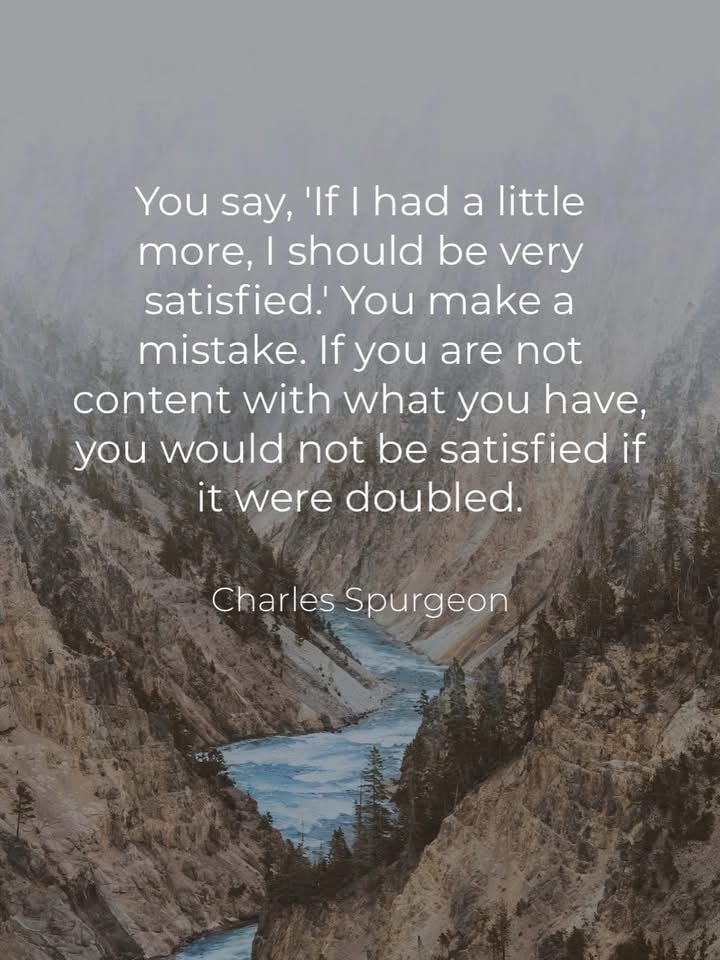
Are you content with what you have? I bet a survey of the average person on the street would determine that hardly anyone is content with where they are and what they have. Not even the most supposedly devout Christian can claim to be content and I must confess that I also fall into that category, although I am more content now with what we have than I was a few years ago. A lack of contentment comes from a lack of faith and too much envy and attention paid to the distractions of the world. Here’s a quote from Charles Spurgeon that I saved from an on-line group dedicated to the writings of that great pastor:
Enduring Word has good commentary on this passage; in the NKJV translation that David Guzik uses, the passage talks about not being covetous:
Let your conduct be without covetousness; be content with such things as you have. For He Himself has said, “I will never leave you nor forsake you.” So we may boldly say:
“The LORD is my helper;
I will not fear.
What can man do to me?”a. Let your conduct be without covetousness; be content: Covetousness is the opposite of contentment. Often covetousness and greed are excused or even admired in today’s culture, and are simply called ambition.
b. Be content with such things as you have: Contentment has much more to do with what you are on the inside rather than what you have. The Apostle Paul had the right idea in Philippians 4:11-13: Not that I speak in regard to need, for I have learned in whatever state I am, to be content: I know how to be abased, and I know how to abound. Everywhere and in all things I have learned both to be full and to be hungry, both to abound and to suffer need. I can do all things through Christ who strengthens me.
i. Someone asked millionaire Bernard Baruch, “How much money does it take for a rich man to be satisfied?” Baruch answered, “Just a million more than he has.”
c. I will never leave you nor forsake you: This promise from God (from Deuteronomy 31:6) is the foundation for contentment. We can’t count on material things, but we can depend on God and His promise.
i. “You that are familiar with the Greek text know that there are five negatives here. We cannot manage five negatives in English, but the Greeks find them not too large a handful. Here the negatives have a fivefold force. It is as though it said, ‘I will not, not leave thee; I will never, no never, forsake thee.’” (Spurgeon)
ii. “Here it is – ‘For he hath said, I will never leave thee, nor forsake thee.’ This is the reason why we must not be covetous. There is no room to be covetous, no excuse for being covetous, for God hath said, ‘I will never leave thee, nor forsake thee.’ We ought to be content. If we are not content, we are acting insanely, seeing the Lord has said, ‘I will never leave thee, nor forsake thee.’” (Spurgeon)
iii. “I cannot under the influence of this grand text find room for doubt or fear. I cannot stand here and be miserable to-night. I am not going to attempt such a thing; but I cannot be despondent with such a text as this, ‘I will never leave thee, nor forsake thee.’ I defy the devil himself to mention circumstances under which I ought to be miserable if this text is true. Child of God, nothing ought to make you unhappy when you can realize this precious text.” (Spurgeon)
d. So we may boldly say: “The LORD is my helper; I will not fear. What can man do to me?”This quotation from Psalm 118:6 points to the truth that real contentment comes only when we trust in God to meet our needs and to be our security. Strangely we are often more likely to put security and find contentment in things that are far less reliable and secure than God Himself is.
When we walk the straight and narrow path with the Lord as our goal in front of us, we don’t have time to look to the right or the left to see what someone else is doing or what they have that we don’t have.
I am a believer in free markets, but it is also true that you can’t go five seconds without an advertisement encouraging you to dream about getting a better car, going on a better vacation, or buying a better house. The next version of the iPhone is coming out! A new cruise ship is debuting, with more specialty restaurants and more bars! That on-line store with all of the cute clothes is having a big sale (a sure way to buy more than you need). Netflix, Prime, and Hulu all have new shows coming out so I need to subscribe to all of them. That new 55” LED Smart TV is already outdated!
I can’t imagine the pressures for “keeping up with others” if you have children. They must play sports of several kinds, take art and dancing classes, and not be embarrassed by clothing and shoes that are a few years old. Also, they “need” the latest video games and devices.

My downfall is traveling. We like to travel, then we like planning more travel, and then we like talking about traveling (we even have a travel blog). This devotional blog was started four years ago probably out of collective guilt that we also own an RV and Steve thought about ways to combine RV’ing and serving others for His kingdom. We lack for nothing and are now in the disposal phase of our lives, getting rid of useless stuff that we have accumulated. Are we greedy? Steven Cole has a great checklist that you can read to see if your lives are more tied up in the world than in His Kingdom (quoted on Precept Austin):
A TEST FOR GREED: Here are five questions to ask yourself:
(1) Do my thoughts more often run after material things than after God Himself? If I am often thinking about that new car or that nicer house or that better computer, and I seldom think about how I can know God better, I am tainted by greed.
(2) Do I ever compromise godly character in the pursuit of material gain? If I sometimes cheat or lie or steal to get ahead financially or to avoid loss, I am being greedy. If I am willing to shred relationships or to take advantage of another person for financial gain, I am being greedy. If I care more about making money than about being a witness for Jesus Christ, I am being greedy.
(3) Do I enjoy material things more than I enjoy knowing God? If my happiness soars when I get a new car, but I am bored by the things of God, I am greedy. If I rejoice when I win a raffle or door prize, but I yawn when I hear about a soul being saved, I am greedy.
(4) How do I respond when I lose material things? When the stock market drops, do I fall apart emotionally? If I get robbed or lose some or all of my things in a fire, does it devastate me? I’m not saying that we must be stoical about such losses. We will always feel some sadness when we lose things. But if it wipes us out, then we’re probably too attached to this world and its goods.
(5) What would I do if I suddenly came into a fortune? I presume that none of you play the lottery, but what if you won the Reader’s Digest Sweepstakes? What if a distant relative died and left you a large inheritance? Would your first thought be, “Now I can get that better house or car or boat”? “Now I can take that trip around the world I’ve always wanted to take.” Or, would you think, “Now I can support dozens of missionaries”? “Thousands of people can hear about Christ because He has given me funds to invest in the spread of His kingdom!”
The complete sermon can be found at this link: https://bible.org/seriespage/lesson-59-how-be-really-rich-luke-1213-21. My attitude towards money and things has changed quite a bit over the years, but like most people, I have a long ways to go be content in any situation.
The Lord will never leave us! The greatest riches we can ever have are from Him and Him alone. Ray Pritchard says it well, as quoted by Precept Austin:
The Lord Jesus says to us, “I will never leave you” (Hebrews 13:5). That’s a promise. It’s true and you can rest your life upon it. If you belong to him, he will never leave you. Because he rose from the dead, he lives today and will be with us forever. Therefore, we are never alone, never forsaken.....Are you excited about your future? If you’re a child of God, you ought to be excited about your future. Jesus Christ has already taken care of your past, your present and your future. He’s taken care of your past by forgiving your sins. He’s taken care of your present when he said, “I will never leave you.” (Hebrews 13:5) He’s taken care of your future when he said, “In my Father’s house are many mansions."....God is always near his people. This promise is repeated many places in scripture. Hebrews 13:5b says, ‘‘Never will I leave you; never will I forsake you.” In Matthew 28:20b Jesus promised, “I am with you always.....In our worship services we sometimes have a prayer called an “invocation,” which means we pray and invite God’s presence in our midst. Now I know what is meant by that. We are praying for God’s manifest or powerful presence in our midst. However, I do think it’s good to remember that we don’t have to ask God to be with us because he is always with us. We don’t have to “invoke” God’s presence. He’s already here!
I’ll end this with a quote that I saw on Precept Austin about contentment that is quite good. It reminds me of the stories that I read or heard about people who were sent to the worst concentration camps during the Third Reich. Those who were fortunate enough to be set aside as slave laborers (rather than being sent to the gas chambers immediately) at first found the soups they received twice a day, along with stale bread, to be quite vile. Within a few days of hard labor, however, that watery, horrid soup (that too often tasted like the worst offal) and that hard bread was worth more than gold to them; soup and bread rations were often traded for things that were far more valuable, like skipping a work shift or some rudimentary medicine.
Here’s the quote:
A Puritan sat down to his meal and found that he had only a little bread and some water. His response was to exclaim, “What? All this and Jesus Christ, too!”
Such an important lesson! My next devotional examines Hebrews 13:7-8 - Imitate faithful believers; Jesus is same yesterday, today and tomorrow.
Heaven on Wheels Daily Prayer:
Dear Lord - Teach me more and more each day to sow into Your kingdom and to leave the distractions of this world and its wealth behind. Amen.
Credits and Citations:
Scripture quotations taken from the (NASB®) New American Standard Bible®, Copyright © 1960, 1971, 1977, 1995 by The Lockman Foundation. Used by permission. All rights reserved. www.Lockman.org.
“G714 - arkeō - Strong’s Greek Lexicon (NASB95).” Blue Letter Bible. Web. 27 Feb, 2026. <https://www.blueletterbible.org/lexicon/g714/nasb95/mgnt/0-1/>.
Precept Austin was accessed on 02/27/2026 to review commentary for Hebrews 13:5-6. Within the Precept Austin commentary, the Steven Cole sermon can be found at the link in the article above and is © Copyright 2004 Steven Cole.
Commentary from Enduring Word is used with written permission and without any alteration. ©1996-present The Enduring Word Bible Commentary by David Guzik – enduringword.com. Within the Enduring Word commentary:
Spurgeon, Charles Haddon The New Park Street Pulpit, Volumes 1-6and The Metropolitan Tabernacle Pulpit, Volumes 7-63 (Pasadena, Texas: Pilgrim Publications, 1990)