


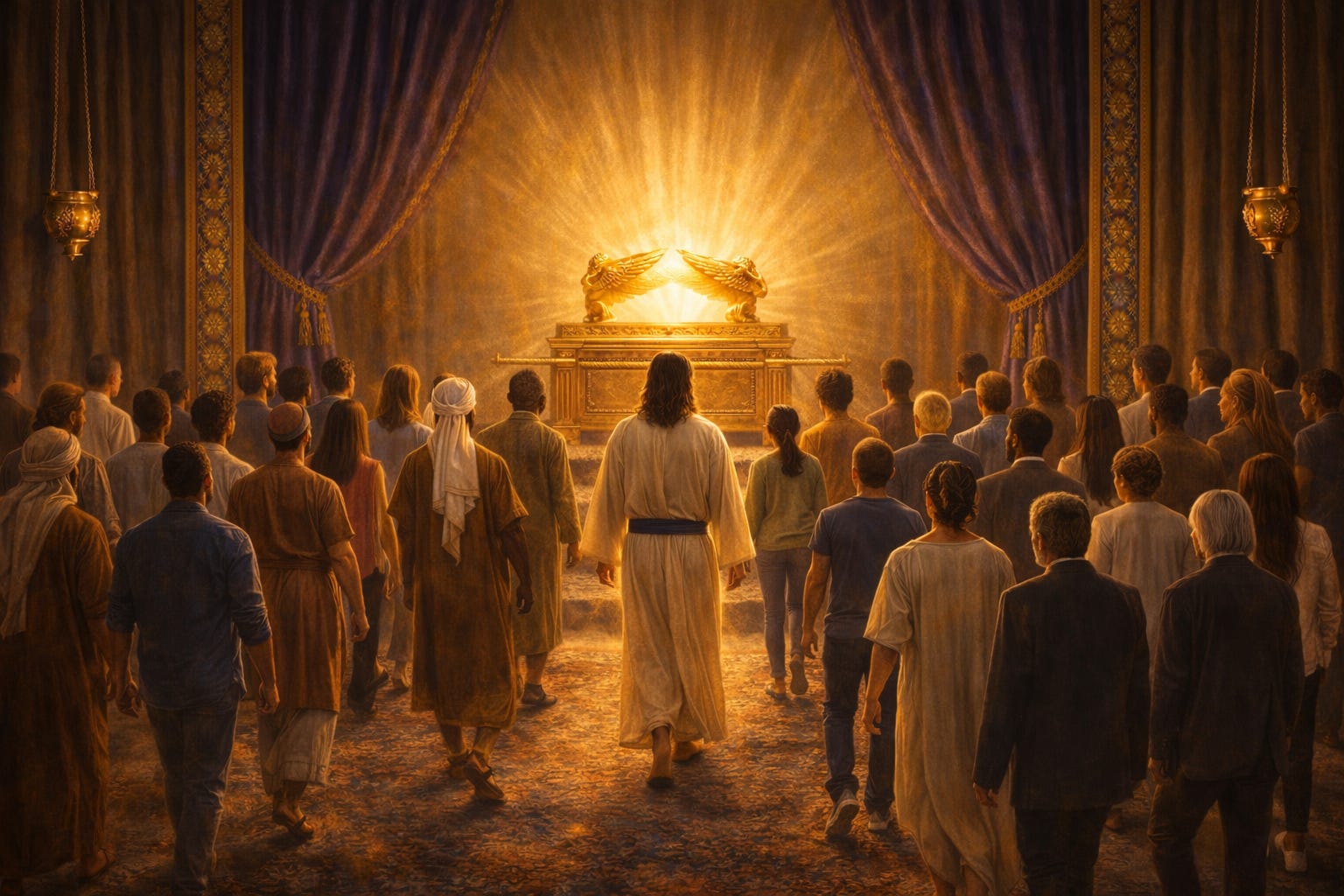
“Therefore, brethren, since we have confidence to enter the holy place by the blood of Jesus, by a new and living way which He inaugurated for us through the veil, that is, His flesh, and since we have a great priest over the house of God, let us draw near with a sincere heart in full assurance of faith, having our hearts sprinkled clean from an evil conscience and our bodies washed with pure water.”
Hebrews 10:19-22 NASB1995
The Holy of Holies in the Tabernacle was behind the veil and was restricted to the High Priest once a year on the Day of Atonement. He would enter it with the blood of the sacrifice with fear and trembling, and the people would wait anxiously for him to emerge. If the elaborate instructions anyplace in the Tabernacle were not followed to the letter for maintaining and keeping the Tabernacle holy, the results were devastating. Let’s look at part of Leviticus 10:
“Now Nadab and Abihu, the sons of Aaron, took their respective firepans, and after putting fire in them, placed incense on it and offered strange fire before the Lord, which He had not commanded them. And fire came out from the presence of the Lord and consumed them, and they died before the Lord. Then Moses said to Aaron, “It is what the Lord spoke, saying,
‘By those who come near Me I will be treated as holy,
And before all the people I will be honored.’ ”
So Aaron, therefore, kept silent.
Moses called also to Mishael and Elzaphan, the sons of Aaron’s uncle Uzziel, and said to them, “Come forward, carry your relatives away from the front of the sanctuary to the outside of the camp.” So they came forward and carried them still in their tunics to the outside of the camp, as Moses had said. Then Moses said to Aaron and to his sons Eleazar and Ithamar, “Do not uncover your heads nor tear your clothes, so that you will not die and that He will not become wrathful against all the congregation. But your kinsmen, the whole house of Israel, shall bewail the burning which the Lord has brought about. You shall not even go out from the doorway of the tent of meeting, or you will die; for the Lord’s anointing oil is upon you.” So they did according to the word of Moses.
The Lord then spoke to Aaron, saying, “Do not drink wine or strong drink, neither you nor your sons with you, when you come into the tent of meeting, so that you will not die—it is a perpetual statute throughout your generations— and so as to make a distinction between the holy and the profane, and between the unclean and the clean, and so as to teach the sons of Israel all the statutes which the Lord has spoken to them through Moses.”
Leviticus 10:1-11 NASB1995
Leviticus is one of the most likely books of the Bible that can derail a half-hearted commitment to a “Bible in One Year” plan faster than any other book (probably even more so than Job or 1 and 2 Chronicles). Since most BIOY casual readers reach this book fairly early in their journey if they go through their readings in standard Biblical order, this means that they are never able to make the connection between the impossible Old Covenant under the Law and the grace-filled New Covenant under Christ.
Full of arcane rules and laws and horrible incidents like this, where the two oldest sons of Aaron made up their own rules on the tabernacle fire process and are instantly obliterated by God’s fire (their immediate family can’t even mourn them), Leviticus is pointed to as an example by non-believers of the questionable character of the God of the Old Testament. When you start looking at the bigger picture, you begin to realize that God has had the same character since the beginning of the Universe. He wants obedience and and He is holy, both of which are impossible for humans who couldn’t be bothered to stay in His company for more than a very short time after they were created because they could not be obedient and did not recognize God’s perfect holiness, but rather chose sin.
Another rule in this section of Leviticus is the one requiring the tribe of Levi (the priests) to not drink wine or strong drink before entering the tent of meeting (Tabernacle) so as to make a distinction between the holy and profane and the unclean and the clean. This order was on penalty of death and was in place throughout the generations of Levitical priests. The requirement to never drink wine was even more strict for those who took a Nazirite vow (see Numbers 6:1-12). Jesus was not a priest or a Nazirite in His earthly life and was of the tribe of Judah. And here is what He said to the Pharisees in Luke:
““To what then shall I compare the men of this generation, and what are they like? They are like children who sit in the market place and call to one another, and they say, ‘We played the flute for you, and you did not dance; we sang a dirge, and you did not weep.’ For John the Baptist has come eating no bread and drinking no wine, and you say, ‘He has a demon!’ The Son of Man has come eating and drinking, and you say, ‘Behold, a gluttonous man and a drunkard, a friend of tax collectors and sinners!’ Yet wisdom is vindicated by all her children.””
Luke 7:31-35 NASB1995
Jesus, of course, was perfect and sinless and was not a drunkard or a glutton; He is noted as being a wine drinker (and a wine maker!) several times in the Gospels including at the Last Supper on Passover (see this Gotquestions.org article). Wine and bread are not sinful in and of themselves, but only when they are abused by sinners. Jesus saw the companionship and opportunities for bringing sinners to Him as more important than abstaining from these activities. He turned the Law upside down as our true High Priest! He approaches us!

He has brought down the veil to the Holy of Holies through His atoning sacrifice on the Cross so that we can confidently approach God. It’s quite interesting that this passage describes the veil as being His body. Here is commentary from Enduring Word on verses 19-21:
a. Having boldness: This is stated as a fact, not an exhortation. We have access for a bold approach to God. The point is simple: we must take advantage of this access, and take it with boldness. On the Day of Atonement, the high priest entered the holiest place of all with fear and trembling, but we can enter the Holiest with boldness.
i. We can have boldness because we enter the Holiest by the blood of Jesus. If we entered as the Old Testament high priest did, with the blood of animals, we wouldn’t have boldness. But with the blood of Jesus providing a new and living way which He consecrated with us, we really can come into the presence of God with boldness.
ii. This boldness is a complete contrast to the way the High Priest entered the Holy Place under the Old Covenant. “He went with fear and trembling, because, if he had neglected the smallest item prescribed by the law, he could expect nothing but death. Genuine believers can come even to the throne of God with confidence, as they carry into the Divine presence the infinitely meritorious blood of the great atonement; and, being justified through that blood, they have a right to all the blessings of the eternal kingdom.” (Clarke)
iii. Having boldness to enter: “Special notice should be taken of the word ‘having,’ which, as elsewhere, always implies a present and conscious experience. It is impossible to exaggerate the ‘present tenses of the blessed life,’ of which this is one.” (Thomas)
b. A new and living way: This means that the sacrifice of Jesus is always fresh in the mind of God. Though it happened centuries ago it is not “stale.” It means that a living Jesus ushers us into the presence of God.
i. Newell on a new and living way: “It is eternally as if just now He had borne our sins in His own body on the Tree, as if just now He had said, ‘It is finished,’ and the soldier had pierced His side and there had come forth blood and water. He is evermore freshly-slain.”
ii. “This is evidently an allusion to the blood of the victim newly shed, uncoagulated, and consequently proper to be use for sprinkling. The blood of the Jewish victims was fit for sacrificial purposes only so long as it was warm and fluid.” (Clarke)
iii. It is a living way. Under the Old Covenant, the High Priest had access because of the blood of a dead animal. Now under the New Covenant we have access because of the perfect sacrifice of the sinless Son of God, and it is as if the living, resurrected Jesus ushers us into the throne room of God.
c. Through the veil: The veil separated the Holiest from the holy place. To enter into the Holiest, you had to pass through the veil. But this veil separating man from God’s intimate presence is forever opened wide, being torn into two from top to bottom. (Matthew 27:51)
i. That is, His flesh: The writer to the Hebrews makes an analogy between the veil that stood between God and man and the body of Jesus. Jesus’ body was “torn,” and so was the veil, each indicating that now we can come to God boldly.
ii. “For believers the veil is not rolled up, but rent. The veil was not unhooked, and carefully folded up, and put away, so that it might be put in its place at some future time. Oh, no! But the divine hand took it and rent it front top to bottom. It can never be hung up again; that is impossible. Between those who are in Christ Jesus and the great God, there will never be another separation.” (Spurgeon)
iii. “What he does seem to suggest is that it was only when the body of Jesus was torn asunder on the Cross that His life-blood became available for its supreme purpose, the salvation of men.” (Robinson)
d. Having a High Priest over the house of God: We have a High Priest who presides over the heavenly courts to make certain the believer has total access.
i. “The combination of the way and the Priest gives us confidence, frees us from fear and all other inhibitions, and makes it possible for us to come, as ourselves, into the presence of God.” (Robinson)
ii. “The ‘house of God’ over which He exercises His high priesthood is, of course, the community of God’s people.” (Bruce)
In the AI rendering at the top of this devotional, the curtain or veil has been pulled aside, a limitation of the artwork. In reality it should be ripped apart. Through Christ, the living way to God, we can now step into the glory of the House of God at His side. Yesterday at church, we had a guest pastor who does an awesome job with his sermons. He used stacked stools to demonstrate how we were first separated from God, but then God pursued us because He loves us! If God had wanted to give up on the humans He created the Bible would have ended with Genesis 3. The Old Covenant gave humans imperfect ways to approach God and the sacrifices had to be repeated over and over following the strict rules in the Tabernacle. Then Jesus came and opened the doors to the Holy of Holies through His once-for-all-time/for-all sacrifice and came next to believers. Now believers ARE the Tabernacle of God through the Holy Spirit indwelling in them and guiding them into obedience to Him.
Let’s look at verse 22 of this passage again: let us draw near with a sincere heart in full assurance of faith, having our hearts sprinkled clean from an evil conscience and our bodies washed with pure water.”
Our hearts are sprinkled clean by the blood of Christ to purge our conscience and our bodies are washed with pure water. One commentator I read said that we can draw near to God through our sincerity, our unwavering belief, without guilt, and with integrity (public confession of faith through baptism). We can walk into the Holy of Holies and be drawn into in His Light, rather than quivering with fear and trepidation with the blood of an animal on our hands. Enduring Word has good commentary on verse 22:
a. Let us draw near: With the perfect cleansing available to us, described in terms of promises of the New Covenant in the Hebrew Scriptures (hearts sprinkled) and the Christian practice of baptism (bodies washed), we can draw near to God in a way never available to someone under the Old Covenant. The work of Jesus makes us able to draw near in a full assurance of faith.
i. “Therefore the appeal to me is not a call to prepare myself, or to make a way for myself to God. It is simply to come, to draw near, to enter in. This I do through my great High Priest, but this I may do through Him without faltering and without fear.” (Morgan)
ii. Bodies washed: “The thing that distinguished Christian baptism from the multiplicity of lustrations that were practiced in the religions of the ancient world was that it was more than an outward rite cleansing the body from ritual defilement. Baptism is the outward sign of an inward cleansing, and it was the latter that was the more important.” (Morris)
iii. Hearts sprinkled… bodies washed: “These participles express not conditions of approach to God which are not yet to be achieved, but conditions already possessed.” (Dods)
b. Let us draw near: We can draw near because several issues are settled. The problem of access to God has been settled. The problem of a perfect High Priest has been settled. The problem of moral and spiritual pollution has been settled.
i. The encouragement to draw near wouldn’t be given unless it was necessary. These discouraged Christians had a problem in drawing near. This was their real problem: they lost their intimate relationship with Jesus, and nothing else is going right.
ii. They may have thought that they had many, many problems – persecution, difficult relationships, hard times with culture or economy. But the real problem was their relationship with God wasn’t on track. They didn’t draw near to God on the basis of what Jesus had done.
iii. When we are in tough times, we should remember that many people have gone through worse times and have had a better attitude, and more joy, than you do now. What is the difference? They knew how to draw near.
iv. Just as importantly, the original readers of this letter are reminded that they will never regain that close relationship with God coming through the institutions of the Old Covenant.
In really tough times, would you know how to draw near to God? If you were being persecuted and even hunted down because of your belief, would you become wobbly like the intended audience for the epistle of Hebrews or use that time to come even closer to God? I always look to the incredible story of Corrie ten Boom and her family, especially her older sister Betsie, who died in Ravensbruck, a German concentration camp for women. The ten Booms had helped many Jews and Dutch resistance members in Holland and were finally caught and imprisoned. They suffered greatly, but here is what Betsie said to Corrie before she died; Corrie often used this quote to inspire audiences around the world.
“No pit is so deep that He is not deeper still; with Jesus even in our darkest moments, the best remains and the very best is yet to be.” - From The Hiding Place. The photo below is of Betsie, from Wikipedia:

Draw near to Him in confidence!
My next devotional examines Hebrews 10:23-25 - Encouraging One Another
Heaven on Wheels Daily Prayer:
Dear Lord - Please guide me through Your Holy Spirit to draw closer to You in confidence and unwavering faith! Amen!
Credits and Citations:
Scripture quotations taken from the (NASB®) New American Standard Bible®, Copyright © 1960, 1971, 1977, 1995 by The Lockman Foundation. Used by permission. All rights reserved. www.Lockman.org.
Precept Austin was accessed on 01/12/2026 to review commentary for Hebrews 19-22 and to review the Charles Spurgeon expositions for Hebrews.
Commentary from Enduring Word is used with written permission and without any alteration. ©1996-present The Enduring Word Bible Commentary by David Guzik – enduringword.com. Within the Enduring Word commentary:
Clarke, Adam The New Testament with A Commentary and Critical Notes, Volume II (New York: Eaton & Mains, 1831)
Newell, William R. Hebrews Verse by Verse (Chicago: Moody Press, 1947)
Spurgeon, Charles Haddon The New Park Street Pulpit, Volumes 1-6and The Metropolitan Tabernacle Pulpit, Volumes 7-63 (Pasadena, Texas: Pilgrim Publications, 1990)
Robinson, Theodore H. The Epistle to the Hebrews (London: Hodder and Stoughton, 1948)
Bruce, F.F. The Epistle to the Hebrews(Grand Rapids, Michigan: Eerdmans Publishing Company, 1964)
Morgan, G. Campbell An Exposition of the Whole Bible (Old Tappan, New Jersey: Revell, 1959)
Morris, Leon “Hebrews” The Expositor’s Bible Commentary Volume 12 (Grand Rapids, Michigan: Zondervan Publishing House, 1981)
Dods, Marcus “The Epistle to the Hebrews” The Expositor’s Greek Testament, Volume IV (London, Hodder and Stoughton Limited: ?)
No reference in the Enduring Word Bibliography for Thomas.