



“See to it that you do not refuse Him who is speaking. For if those did not escape when they refused him who warned them on earth, much less will we escape who turn away from Him who warns from heaven. And His voice shook the earth then, but now He has promised, saying, “Yet once more I will shake not only the earth, but also the heaven.” This expression, “Yet once more,” denotes the removing of those things which can be shaken, as of created things, so that those things which cannot be shaken may remain. Therefore, since we receive a kingdom which cannot be shaken, let us show gratitude, by which we may offer to God an acceptable service with reverence and awe; for our God is a consuming fire.”
Hebrews 12:25-29 NASB1995
Chapter 12 of Hebrews ends with a severe warning. Those who refused the voice of God at Mt. Sinai will have even less chance of escape now if they ignore the warning He speaks now from Heaven with the New Covenant at hand. At Mt. Sinai, His voice shook the earth and the people were terrified. But those same people walked away from Him a short time later and built and worshipped a golden calf. Jesus did many glorious signs and wonders during His ministry, but those were not sufficient to impress the religious leaders and they always wanted more. But we have what we need in God’s promises!
The AI image that Steve requested from ChatGPT at the top was created by that tool just from the words in this passage of Hebrews 12. God has promised in this passage that “yet once more” that those things that can be shaken will be removed (created things, i.e. material belongings) so that those that cannot be shaken will remain. We receive a kingdom that cannot be shaken from a God who is a consuming fire.
Enduring Word has excellent commentary on this passage:
a. See that you do not refuse Him who speaks: As described in the previous verses, God holds the goodness and glory of Mount Zion before us – the perfect and finished work of Jesus and the New Covenant through Him. If we choose to refuse this from God, we can’t ignore the consequences.
b. They did not escape: There were consequences for rebelling at Mount Sinai. There are and should be even greater consequences for resisting God’s greater work at Mount Zion.
c. Whose voice then shook the earth… Yet once more I shake not only the earth, but also heaven: At Mount Sinai God shook the earth with His voice. The New Covenant shakes things up even more (Yet once more I shake not only the earth, but also heaven).
i. It’s easy – and dangerous – to think that God was severe and mean in the Old Testament and somehow became nice in the New Testament. This is so simplistic that it is deceiving – there is more mercy in the Old Testament than many imagine, and there is more judgment in the New Testament than many imagine.
ii. When everything is shaken the only question is, where are you standing? Is it safe and secure?
…
a. Indicates the removal of those things that are being shaken: God promises to shake things again to take away (the removal) reliance on the material – as in material things, materialism.
b. That the things which cannot be shaken may remain: God shakes things to test them, and then to take away the things that can’t take the test.
…
a. Since we are receiving a kingdom which cannot be shaken: In contrast to the instability of the world around us, the kingdom of Jesus cannot be shaken, and we are receiving this kingdom.
i. This is our stability in an unstable world. We don’t yet full have this kingdom; it is yet to come. Yet we are receiving it. Griffith Thomas noted that the ancient grammar and phrasing indicates “We are constantly and perpetually (Greek) receiving a Kingdom that is incapable of being shaken.”
ii. How we have already received the kingdom:
· We have received it in promise; a promise from a trustworthy man is just as sure as having the thing itself.
· We have it in principle, and we see the principles of God’s kingdom at work in the world.
· We have received it in power, and see the life-changing and miraculous power of God at work in the world today.
· We have received some of the provision and protection of the kingdom, because our King provides for and protects us.
· We have received it in community, for our congregational gatherings are kingdom communities.
b. Let us have grace: The kingdom itself will never be shaken. So we must seize God’s unmerited approval in Jesus, helping us to serve God acceptably.
i. “Glory be to God, our kingdom cannot be moved! Not even dynamite can touch our dominion: no power in the world, and no power in hell, can shake the kingdom which the Lord has given to his saints. With Jesus as our monarch we fear no revolution and no anarchy: for the Lord hath established this kingdom upon a rock, and it cannot be moved or removed.” (Spurgeon)
ii. We may serve God acceptably: These words explain just how this may be done.
· Our acceptable service begins with our being receivers (since we are receiving a kingdom).
· Our acceptable service is offered by the work of God’s grace in us (let us have grace).
· Our acceptable service is marked by reverence (with reverence).
· Our acceptable service is marked by the spirit of happy reverence (with godly fear).
· Our acceptable service is marked by a profound sense of the divine holiness (for our God is a consuming fire).
iii. Some wrongly argue that “too much” grace gives license and breeds disrespect towards God. Actually, grace gives us reverence and godly fear. Perhaps those who think grace gives them license to sin aren’t walking in grace at all.
c. Our God is a consuming fire: Since God is in fact a consuming fire, we do best to come to Him on His terms. These are the terms of unmerited approval in Jesus. He will consume all that is outside of that sphere.
i. Elijah knew that God was a consuming fire; He consumed the sacrifice at the altar on Mount Carmel. Solomon knew that God was a consuming fire; He consumed the sacrifice at the altar at the dedication of the temple.
ii. The truth that God is a consuming fire is a comfort to the believer. They realize that the Father poured out His consuming fire of judgment on the Son in our place. When He did, it completely consumed the guilt of sin in all who believe. The penalty of sin was consumed in Jesus at the cross.
It is not our terms that govern our relationship with God, it is His terms. His terms are remarkably simple - repent and believe in Jesus and His atonement on the cross and His resurrection! His kingdom cannot be moved and is impervious to earthly revolutions and anarchy.

Precept Austin has some good illustrations of the power of this passage:
A former park ranger at Yellowstone National Park tells the story of a ranger leading a group of hikers to a fire lookout. The ranger was so intent on telling the hikers about the flowers and animals that he considered the messages on his two-way radio distracting, so he switched it off. Nearing the tower, the ranger was met by a nearly breathless lookout, who asked why he hadn't responded to the messages on his radio. A grizzly bear had been seen stalking the group, and the authorities were trying to warn them of the danger.
Any time we tune out the messages God has sent us, we put at peril not only ourselves, but also those around us. How important it is that we never turn off God's saving communication!…
He Forgot God
He wore his rubbers when it rained.
He brushed his teeth TWICE a day—with a nationally advertised toothpaste. The doctors examined him twice a year.
He slept with the windows open.
He stuck to a diet with plenty of fresh vegetables.
He relinquished his tonsils and traded in several wornout glands.
He golfed—but never more than 18 holes at a time.
He got at least eight hours' sleep every night.
He never smoked, drank or lost his temper.
He did his "daily dozen" daily. He was all set to live to be a hundred.
The funeral will be held Wednesday. He's survived by eight specialists, three health institutions, two gymnasiums and numerous manufacturers of health foods and antiseptics.He forgot God.
…
A Texas thunderstorm rolled in quickly. Lightning flashed, thunder cracked so close it rattled the windows, and the family dog scrambled for safety. One bolt hit so near the house that everyone ran to the hallway. In that moment, fear did what nothing else had done all day—it got their full attention. So it is when God shakes the earth. His shaking isn’t random; it’s purposeful. It gets our attention. It calls us to listen. Hebrews 12:26 reminds us that God is not silent, and His “shaking” is mercy in motion—awakening sleepy souls.
…
A man built his dream home on a scenic hillside. He cut corners on the foundation, thinking the view was more important. When the ground began to shake one night, the house collapsed. Next door, another home stood firm—built on solid rock with deep foundations. Likewise, God’s “shaking” of this world will test what we’ve built our lives upon. Only what is founded on Christ—the unshakable rock—will endure. What parts of your life are built on fleeting things? Are you building for eternity?
…
Live for what lasts, not for what fades. (1Jn 2:17)
Anchor your soul in eternity, not in the shifting sands of time. (Heb 6:19, Col 3:2)
Invest in heaven’s treasures, not earth’s trinkets. (Mt 6:19-21, 1Ti 6:18-19)
Let the eternal rule your priorities, not the urgent. (Mt 6:33, Lk 10:41,42)
Cling to God’s promises, not the world’s illusions. (Heb 10:23)
Focus on the unseen, for it’s more real than what you can see. (Heb 11:1, 2Cor 4:18)
Value what God values—eternity over vanity. (Eccl 1:2, Lk 12:15)
Don’t trade eternal joy for temporary pleasure. (Heb 11:25,26, Mark 8:36)
Earth is a temporary home—live like you’re passing through. (1Pe 2:11, Heb 13:14)
Hold tightly to God’s Word, loosely to this world’s comforts. (Ps 119:11, 1Co 7:31)
Measure your days by eternal impact, not earthly success. (Eph 5:15, 16, 2Ti 4:7,8)
…
On the prairies of the Midwest, a grass fire can be a good thing.
“To ask whether a prairie needs fire is to wonder whether it needs water,” says writer Cindy Schreuder. “Burns stimulate the growth of grasses and forbs, return nutrients to the soil, expose seed beds to the sun and suppress invading trees and shrubs.”
During the 1960s, as people in the prairie restoration movement saw the benefits of a regular prairie fire, the practice of intentionally setting such fires became widespread. Schreuder describes one such fire:
Pushed forward by the wind, the flames raced across the prairie. Thick, dead grass stalks wavered for just a moment before buckling and falling into flames.…
Nineteenth-century settlers spoke of the violence of the burns, their noise, heat, power and attraction. They are reactions modern-day scientists share. “A prairie burning is something like a great thunderstorm—you experience the raw power of nature,” said [Stephen Packard, science director for the Nature Conservancy, Illinois]. “After you’ve burned it off, nothing is left. It’s so pure. Every leaf that emerges is new and shiny and wet. Every flower petal is perfect. It reminds you of being young.”
In the same way, God’s consuming fire brings new life when we willingly let him burn the fields of our hearts.
There are some real nuggets in those excerpts above, especially the list of the ways that we ought to live as believers. The anecdote about prairie fires is also quite good - I remember when Yellowstone National Park had horrendous wildfires in 1988 and how stark the park looked in the years after those fires with dead and burned trees everywhere. When we visited in recent years, however, we noted that the new forest growth (created out of those terrible wildfires) is absolutely splendid and looks better than ever! When you ponder the power and glory and infinite aspects of God, it should make you feel really uncomfortable with mundane worship and half-hearted prayer or prayers that treat God like a vending machine (we had one this week in our intercessory prayers from someone asking God for an iPad, which I found to be really sad).
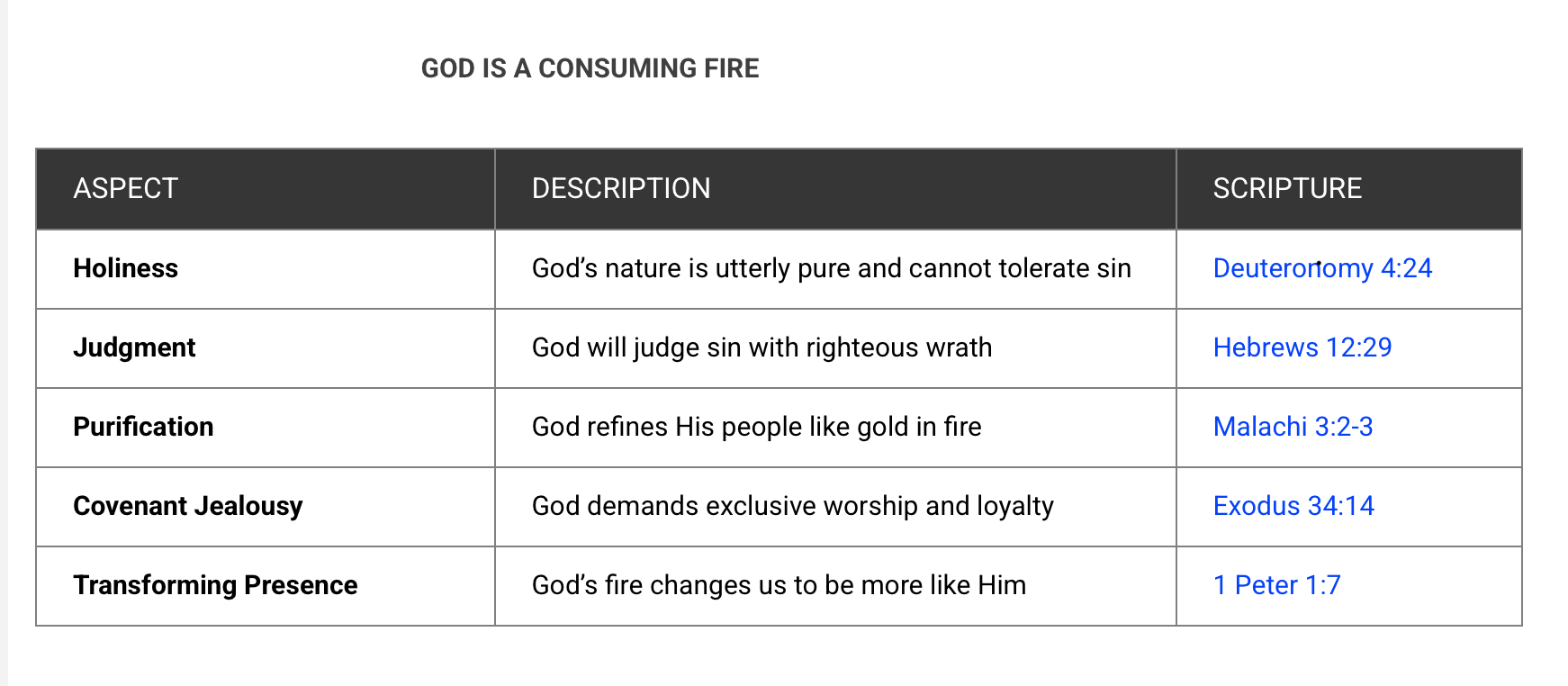
God is a consuming fire! Here’s a summary of the aspects of God’s character and how His fire dominates our spiritual lives and changes us (from Precept Austin):
My next devotional examines Hebrews 13:1-3 - Showing love to others. This is the last chapter of Hebrews. After completing the devotionals for this chapter, I will have a summary of what we learned reviewing this incredibly challenging and rich epistle, then I will start a series on the Paulian Epistle to the Ephesians.
Heaven on Wheels Daily Prayer:
Dear Lord - Please help me to serve You acceptably, with deep reverence and gratitude and an abiding sense of awe for Your power and glory. Amen.
Credits and Citations:
Scripture quotations taken from the (NASB®) New American Standard Bible®, Copyright © 1960, 1971, 1977, 1995 by The Lockman Foundation. Used by permission. All rights reserved. www.Lockman.org.
Precept Austin was accessed on 02/21/2026 to review commentary for Hebrews 12:25-29
Commentary from Enduring Word is used with written permission and without any alteration. ©1996-present The Enduring Word Bible Commentary by David Guzik – enduringword.com. Within the Enduring Word Commentary:
Spurgeon, Charles Haddon The New Park Street Pulpit, Volumes 1-6and The Metropolitan Tabernacle Pulpit, Volumes 7-63 (Pasadena, Texas: Pilgrim Publications, 1990)
Wow! A lot of Bible research went into this.
I just wish people understood. God is not trying to condemn them. He's trying to save them from Satan and hell! People consider God their enemy while he is the best friend they will ever have. But he is a gentleman and will not force them.