


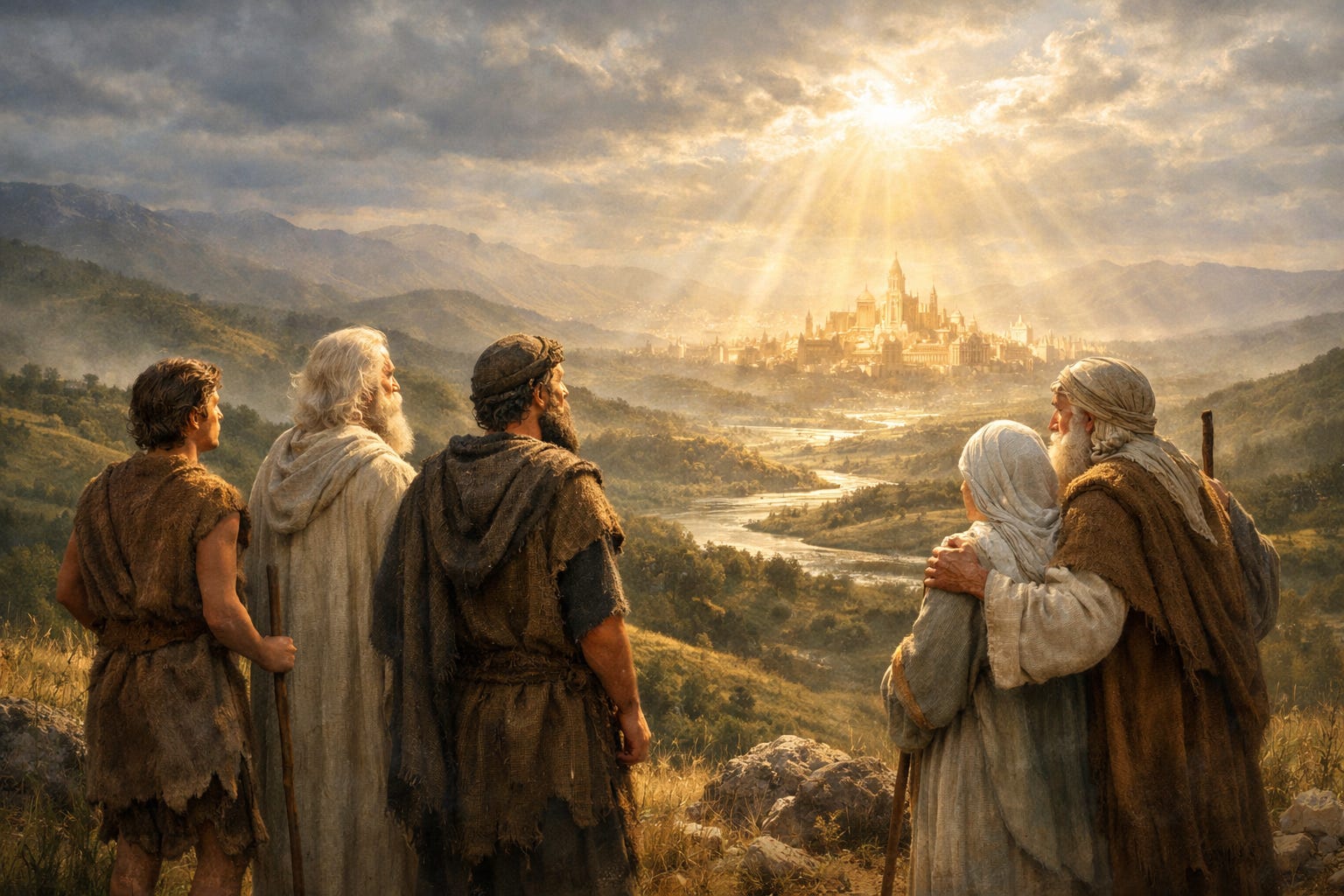
“All these died in faith, without receiving the promises, but having seen them and having welcomed them from a distance, and having confessed that they were strangers and exiles on the earth. For those who say such things make it clear that they are seeking a country of their own. And indeed if they had been thinking of that country from which they went out, they would have had opportunity to return. But as it is, they desire a better country, that is, a heavenly one. Therefore God is not ashamed to be called their God; for He has prepared a city for them.”
Hebrews 11:13-16 NASB1995
In the image at the top, Abel, Enoch, Noah, Sarah and Abraham gaze into the distance at the heavenly citadel that beckons from the promises of God. We know that Enoch did not die in the faith but walked so closely to God that he reached the next life and those promises through God’s actions without having to suffer death. But he was an exception to the rule. In the passages that follow these verses, we will learn about the faith of many more from the Old Testament. The writer of Hebrews takes a little break in these examples of faith to describe what it is they are looking towards, which is the promise of the Messiah and a restored world around God’s New Jerusalem. They died IN faith hopeful in these promises.
As C.S. Lewis said in “Mere Christianity”:

Enduring word has good commentary on this passage:
a. These all died in faith, not having received the promises: The promise of the Messiah was made to Abraham and Sarah, and they believed the promise. Yet they died having never received it, only seeing it in faith.
i. They saw the promises afar off, willing to look at and consider the promise of God, even though the fulfillment seemed so far away.
ii. They were assured of them, carefully considering the promise, assured that the promise was valid because God made the promise.
iii. They embraced them, taking the promise and embracing it in faith. Abraham and Sarah probably thought many times a day about the son God promised them and these many times they embraced the promise. “The saints ‘embraced’ the promises. The Greek word signifies ‘salutes,’ as when we see a friend at a distance.” (Spurgeon)
iv. They confessed that they were strangers and pilgrims: Abraham and Sarah always took the promise with the understanding that this world was not their home. They knew God had a better and more enduring home for them in heaven.
v. If these examples of faith endured through difficulty and discouragement without having received the promises, then we who have received the promises have even more reason for endurance.
vi. These all died in faith:
· They did not need to seek faith on their deathbed. They died in faith.
· Though they did have faith, they did also die. We do not have faith to escape death, but to die in faith.
· They never went beyond faith and “grew beyond” simple dependence on God.
· They never went below faith or lost faith.
b. They seek a homeland… they desire a better, that is, a heavenly country: Living by faith is easier when we remember that this world is not our home. It is easier when we remember that on this side of eternity, not everything is settled and not every wrong is righted. That is why they seek a homeland and a better… heavenly country.
i. Faith is very difficult when we live as “practical atheists.” This describes someone who may have a theoretical belief in God, but the belief doesn’t matter in what they do from day to day. When we remember there is a spiritual reality – a heavenly home that is our real home – faith is much easier.
ii. The great theme of modern times is naturalism, the belief that only what can be found and measured in nature is “real.” Scientists and educators who trust in naturalism may be content to let us believe in God, just as long as we agree that God is a fairy tale – someone not real. But when we believe in the reality of God and of heaven and of His word, it is completely unacceptable to those who live by naturalism.
iii. H.L. Mencken said faith is the “Illogical belief in the occurrence of the impossible.” This would only be true if there is no God or if He does not matter. Since God is and since He does matter, faith is entirely logical.
c. Therefore God is not ashamed to be called their God: For those courageous enough to believe in God, and to believe in Him as real, and heaven and eternal life as real, God is not ashamed to be called their God, for He has prepared a city for them.
i. We often consider the idea that we should not be ashamed of God, but we must also consider that we may make God ashamed of us. When we do not regard God and heaven and eternity as real, there can be a sense in which God is ashamed to be called our God.
A few takeaways from this commentary:
Believing in God’s promises may mean not receiving all of those promises in this lifetime.
We are strangers in this world, looking into the distance at the heavenly realm and the restored Earth. If you don’t think about heaven every single day, then you are looking far too much at the sodden muck of this world (stop the doomscrolling). I compare it to the long travails of the ranger Strider, also known as Aragorn, son of Arathorn in the Lord of the Rings saga. He was the rightful heir to the throne of the kingdom of Gondor and he looked beyond his current difficulties and battles to his triumphant return as the ruler in the beautiful city of Minas Tirith, yet he still fought those battles to reach that life. We believers have a rightful place in heaven so we must fight the battles against the enemy and the travails of this life embracing that promise. The King IS returning.
These patriarchs died IN the faith. They didn’t go beyond faith nor did they lose their faith. Except for Enoch, they still died but with the promises on their hearts.
Ask yourself, do you live as a “practical atheist”, thinking about God for one hour every Sunday (or even less)? Is God ashamed of you because you are secretly (or openly) ashamed of Him?
Christianity is not a fairy tale. The foundations of our faith are real and tangible.

Charles Spurgeon has an excellent devotional about dying in faith, as quoted in Precept Austin:
Behold the epitaph of all those blessed saints who fell asleep before the coming of our Lord! It matters nothing how else they died, whether of old age, or by violent means; this one point, in which they all agree, is the most worthy of record, they all died in faith. In faith they lived - it was their comfort, their guide, their motive and their support; and in the same spiritual grace they died, ending their life-song in the sweet strain in which they had so long continued. They did not die resting in the flesh or upon their own attainments; they made no advance from their first way of acceptance with God, but held to the way of faith to the end. Faith is as precious to die by as to live by.
Dying in faith has distinct reference to the past. They believed the promises which had gone before, and were assured that their sins were blotted out through the mercy of God.
Dying in faith has to do with the present. These saints were confident of their acceptance with God, they enjoyed the beams of his love, and rested in his faithfulness.
Dying in faith looks into the future. They fell asleep, affirming that the Messiah would surely come, and that when He would in the last days appear upon the earth, they would rise from their graves to behold Him. To them the pains of death were but the birth-pangs of a better state.
Take courage, my soul, as thou readest this epitaph (a brief statement commemorating or epitomizing a deceased person or something past).
Thy course, through grace, is one of faith, and sight seldom cheers thee; this has also been the pathway of the brightest and the best.
Faith was the orbit in which these stars of the first magnitude moved all the time of their shining here; and happy art thou that it is thine. Look anew to-night to Jesus, the Author and Finisher of thy faith (He 12:2+), and thank Him for giving thee like precious faith with souls now in glory.
I also LOVE this John Piper devotional on feeding your faith, also found in Precept Austin:
January 7, 1997 | by John Piper | Topic: Faith
Faith feeds on the word of God. Without a steady diet it gets weaker and weaker. If you are dissatisfied with your Christian courage and joy and purity of heart, check the way you are feeding your faith.
Compare the way you eat. Suppose that you start the day with a glass of orange juice. It’s good, and good for you. It takes you maybe five minutes to drink it, if you read the newspaper at the same time. Then you go off to work or school. You don’t eat anything else until the next morning. And you have another glass of juice. And so you go on drinking one glass of juice a day until you drop.
That’s the way a lot of Christians try to survive as believers. They feed their faith with five minutes of food in the morning, or evening, and then don’t eat again until 24 hours later. Some even skip one or two mornings and don’t give their faith anything to eat for days.
Now the effect of starving your faith is that faith starves. Not hard to understand. And when faith is starving, it is weak and not able to do much. It has a hard time trusting God and worshipping and rejoicing and resisting sin. It is gasping and stumbling.
But someone may say, “How do you know faith needs the food of the word to thrive and grow?” Well, there are some biblical clues.
First, Romans 10:17 says, “Faith comes by hearing and hearing by the word of Christ.” If faith comes by the word, it goes by the absence of the word.
Second, Psalm 78:5-7 says that God “appointed a law in Israel, which he commanded our fathers, that they should teach them to their children…that they should put their confidence in God.” In other words, the aim of teaching the word of God to our children is to foster confidence (that is, faith) in God. Thus faith feeds on the word of God.
Third, Proverbs 22:18-19 says, “It will be pleasant if you keep [the words of God] within you, that they may be ready on your lips. So that your trust may be in the Lord, I have taught you today, even you.” This shows that the words of God are “so that you may trust in God.” Faith feeds on the word of God.
Fourth, compare Psalm 1:2-3 and Jeremiah 17:7-8. One says that the one who meditates on the word of God is like a tree that remains strong; and the other says that the man who trusts in the Lord is like a tree that remains strong. Which is it? It’s both. Why? Because the person who meditates on the word of God day and night feeds his faith day and night, so that his trust is strong.
Fifth, it simply stands to reason that faith feeds on the word because the word is what faith trusts. And where trustworthy words are not present, faith has nothing to bite into. That’s the nature of faith. It exists by what it trusts. It has no life but what it gets from the truth it believes. So if we do not feed it with a substantial diet of life-giving truth, it will shrivel.
All this means that we should memorize Scripture day by day so that we can feed our faith hourly throughout the day. Only a few people have the luxury of being able to open a Bible every hour or so. But all of us can consult our memory every hour. In fact we need to.
So, with all my heart, I encourage you to do this. When you have devotions in God’s word, find a phrase or a verse and memorize it. This is like putting faith-food in the pantry of your mind. Then throughout the day you reach in and take a bite from that morsel. It may be as simple as, “I will never leave you or forsake you.” Take that out and chew on it hourly. The nutrition will feed your faith and your faith will grow strong and you will pray for fruit and it will come.
Learning with you how the word abides in us,
Pastor John
Faith feeds on a daily consumption of word of God!! Memorizing His word is an even better path to having it available to you all the time. For some reason, my stubborn brain can remember the lyrics of insipid pop songs from 50-60 years ago, but I have problems memorizing scripture. But I need to be more like the desperate colony of people in the science fiction classic “Fahrenheit 451” by Ray Bradbury. These people, hiding from the government, memorize complete books (including one person who knew every verse of the Bible) and repeat those books over and over again to themselves every day since the government-sanctioned book-burning in this future dystopia destroyed those resources.
I’m going to take this on as a new challenge! Perhaps these verses, suggested by Precept Austin, are a good start to this practice and to give us the long perspective:
“Therefore if you have been raised up with Christ, keep seeking the things above, where Christ is, seated at the right hand of God. Set your mind on the things above, not on the things that are on earth. For you have died and your life is hidden with Christ in God. When Christ, who is our life, is revealed, then you also will be revealed with Him in glory.”
Colossians 3:1-4 NASB1995
“Do this, knowing the time, that it is already the hour for you to awaken from sleep; for now salvation is nearer to us than when we believed. The night is almost gone, and the day is near. Therefore let us lay aside the deeds of darkness and put on the armor of light. Let us behave properly as in the day, not in carousing and drunkenness, not in sexual promiscuity and sensuality, not in strife and jealousy. But put on the Lord Jesus Christ, and make no provision for the flesh in regard to its lusts.”
Romans 13:11-14 NASB1995

One other aspect to this passage is that the author of Hebrews is telling the wobbly Christians that these patriarchs of the faith did not return to their home countries because they desired a better country, not the place they came from. Abraham did not strike the tents and head back to Ur. The sign in the picture above has some wisdom in it. We can be nostalgic for childhood homes and for things of the past and study history, but we should mostly live in the present and be hopeful every waking moment of an even more beautiful future with the Lord. From Philippians:
“For our citizenship is in heaven, from which also we eagerly wait for a Savior, the Lord Jesus Christ; who will transform the body of our humble state into conformity with the body of His glory, by the exertion of the power that He has even to subject all things to Himself.”
Philippians 3:20-21 NASB1995
My next devotional examines Hebrews 11:17-22 - The Faith of Abraham (again), Issac, Jacob and Joseph.
Heaven on Wheels Daily Prayer:
Dear Lord, today I pray the words from this song by Steven Curtis Chapman:
To all the travelers
Pilgrims longing for a home
From one who walks with you
On this journey called life’s road
It is a long and winding road
From one who’s seen the view
And dreamt of staying on the mountains high
And one who’s cried like you
Wanting so much to lay down and die
I offer this, we must remember this
We are not home yet
We are not home yet
Keep on looking ahead
Let you heart not forget
We are not home yet
Not home yet
So close your eyes with me
And hear the Father saying, welcome home
Let us find the strength
In all His promises to carry on
He said, I go prepare a place for you
So let us not forget
Amen
Credits and Citations:
Scripture quotations taken from the (NASB®) New American Standard Bible®, Copyright © 1960, 1971, 1977, 1995 by The Lockman Foundation. Used by permission. All rights reserved. www.Lockman.org.
Precept Austin was accessed on 01/30/2026 to review commentary for Hebrews 11:13-16. Within the Precept Austin commentary: John Piper is founder and teacher of desiringGod.org and chancellor of Bethlehem College and Seminary. For more than thirty years, he served as pastor of Bethlehem Baptist Church, Minneapolis. He is author of more than fifty books, and his sermons, articles, books, and more are available free of charge at desiringGod.org. By John Piper. © Desiring God Foundation. Source: desiringGod.org
Commentary from Enduring Word is used with written permission and without any alteration. ©1996-present The Enduring Word Bible Commentary by David Guzik – enduringword.com. Within the Enduring Word commentary:
Spurgeon, Charles Haddon The New Park Street Pulpit, Volumes 1-6and The Metropolitan Tabernacle Pulpit, Volumes 7-63 (Pasadena, Texas: Pilgrim Publications, 1990)
Note Home Yet: Written by: Steven Curtis Chapman
Album: 8 Great Hits: Steven Curtis Chapman
Released: 2003 Copyright © Steven Curtis Chapman