



Netherlands American Cemetery, Margraten, Netherlands. Photo © 2025, Steven Sande
“Greater love has no one than this: to lay down one’s life for one’s friends.”
John 15:13 NIV
With God, there are no coincidences. As I write this, it is Memorial Day 2026, and my random verse picker chose this very relevant verse to study. On this day we remember those who made the ultimate sacrifice with their lives to secure the treasure of freedom for not just brothers and sisters in arms, but for all of the freedom-loving people of the world.
In April, Barb and I had the opportunity to learn about many American soldiers who laid down their lives so that others might live. We visited the new (2025) National Medal of Honor Museum in Arlington, TX, which honors the approximately 3,500 recipients who “have distinguished themselves at the risk of their own lives above and beyond the call of duty in action against an enemy of the United States.” Most of those medals were received posthumously.
Last year our travels took us to three of the American cemeteries in Europe where many who didn’t necessarily receive medals — yet gave their lives for our freedom — are laid to rest. It is truly a humbling feeling seeing the thousands of gravestones representing lives that were cut short prematurely, never having the chance to know a world at peace.
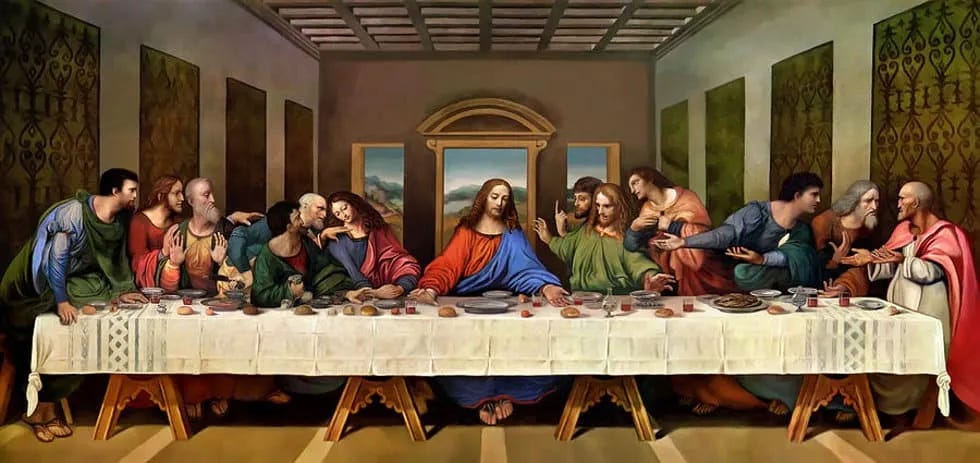
The Last Supper by Leonardo Da Vinci
This chapter of the Gospel of John consists of the words of Jesus at the Last Supper. He is teaching the disciples how to abide in Him and how to handle persecution after He has departed from His human existence.
Jesus is about to give the ultimate sacrifice and lay down His life for not only His friends — the disciples — but for all humankind. Enduring Word uses these words to describe the meaning of this verse:
b. Greater love has no one than this, than to lay down one’s life for his friends: Jesus described the measure and quality of His love for them, to use as a pattern for the way they should love each other. His love is complete and of surpassing greatness, laying down its life.
i. “No man can carry his love for his friend farther than this: for, when he gives up his life, he gives up all that he has. This proof of my love for you I shall give in a few hours; and the doctrine which I recommend to you I am just going to exemplify myself.” (Clarke)
The meaning of this verse may be better understood by doing a reverse inline word study in the original ancient Greek:
Greater — μείζονα (megas) — the most relevant definition is “predicated of rank, as belonging to
persons, eminent for ability, virtue, authority, power
things esteemed highly for their importance: of great moment, of great weight, importance
a thing to be highly esteemed for its excellence: excellent”
Love — ἀγάπην (agapēn) — “affection, good will, love, benevolence, brotherly love”
Has no one than this: — ἔχει οὐδεὶς ταύτης (echei oudeis tautēs) — “to hold one's self to a thing, to lay hold of a thing, to adhere or cling to” “not even one (man, woman or thing)” “this”
To lay down — ἵνα τις θῇ (hina tis thē) — “that” “a certain one” “to lay off or aside, to wear or carry no longer, commit“
One’s life — αὐτοῦ ψυχὴν (autou psychēn) — “himself, herself, themselves” “breath of the, the vital force which animates the body and shows itself in breathing.”
For one’s friends — ὑπὲρ αὐτοῦ φίλων (hyper autou philōn) — “in behalf of, for the sake of, in one’s stead” “himself, herself, themselves” “he who associates familiarly with one, a companion”
The word study brings to light the depth of importance of the words of Jesus in this verse — that this brotherly love of His followers was a thing to be highly esteemed for its excellence, that they should all hold themselves to that love, even to the point of giving up their last breath for the sake of their companions.
Jesus would shortly demonstrate His love for His disciples and all believers at the cross. I’ll end today’s devotional with a lengthy, but enlightening commentary from GotQuestions.org found on Precept Austin.
In John 15:13 Jesus states, “Greater love has no one than this: to lay down one’s life for one’s friends.” The statement upholds sacrificial love as the ultimate expression of love. In saying this, Jesus prepares His disciples for His crucifixion and shows them what He meant when He told them to “love each other as I have loved you” (verse 12).
All true love involves some kind of sacrifice, as the lover seeks to benefit the loved one. It stands to reason, then, that the greatest love of all would involve a total laying down of one’s life for the loved one. God, who is love, revealed His love for mankind through sacrifice (John 3:16; Romans 5:8). Sacrifice is paramount in 1 John 4:10: “This is love: not that we loved God, but that he loved us and sent his Son as an atoning sacrifice for our sins.” The sacrificial love of God, also known as agape love, stands as the “greater love” and is how the Source of Love saved us.
Another reason why laying down one’s life is considered the greatest love is its counterintuitive nature. Humans tend to prefer taking rather than giving, so instances of selflessness leave us amazed. When a father dives into raging water to rescue his child, when a woman asks the doctor to prioritize her child, or when a soldier falls on a grenade to save his brothers-in-arms, we’re humbled and awed. In the modern concept of love, the focus often gravitates toward self-satisfaction, and in many circles the idea of sacrifice is considered unnecessary or even repugnant. In contrast to our diluted version of love, agape shines brightly.
For Christians, the expression of this “greater love” isn’t limited to literally laying down our lives. We don’t have to wait for a grandiose moment of sacrifice to love others as Jesus loves us. Our daily lives should be characterized by selflessness and deference, a denying of ourselves for the good of others. Such displays of love should be common in the body of Christ (John 13:35). We are called to follow Christ, which includes showing love in the way He demonstrated.
Other portions of Scripture also reflect the truth of John 15:13. For instance, Philippians 2:3–4 instructs us to “do nothing out of selfish ambition or vain conceit. Rather, in humility, value others above yourselves, not looking to your own interests but each of you to the interests of the others.” Romans 12:10 urges Christians to “be devoted to one another in love” and to “honor one another above [them]selves.” The Christian lifestyle does not nurture self-aggrandizement but centers on humility and self-denial.
It is worth delving into the word friend in John 15:13. Are we only supposed to love our friends? Wouldn’t this contradict other passages like Matthew 5:46–47? In the context of John 15:13, the friendship Jesus refers to is the relationship He had with the disciples. Yet we know that Jesus did not just die for His “friends” alone. Romans 5:6 says, “Christ died for the ungodly.” So, the principle of laying down one’s life extends further than just benefiting friends. We show love even to enemies.
There is no greater love than laying down one’s life for others. Jesus exemplified this love for us, and we are called to walk in the same selfless love.
Heaven On Wheels Daily Prayer:
Thank You, Lord, for showing the greatest love by sacrificing Yourself for us. Help me to love others in the same way, demonstrating selflessness and compassion in my relationships. In Your holy name I pray, AMEN.