


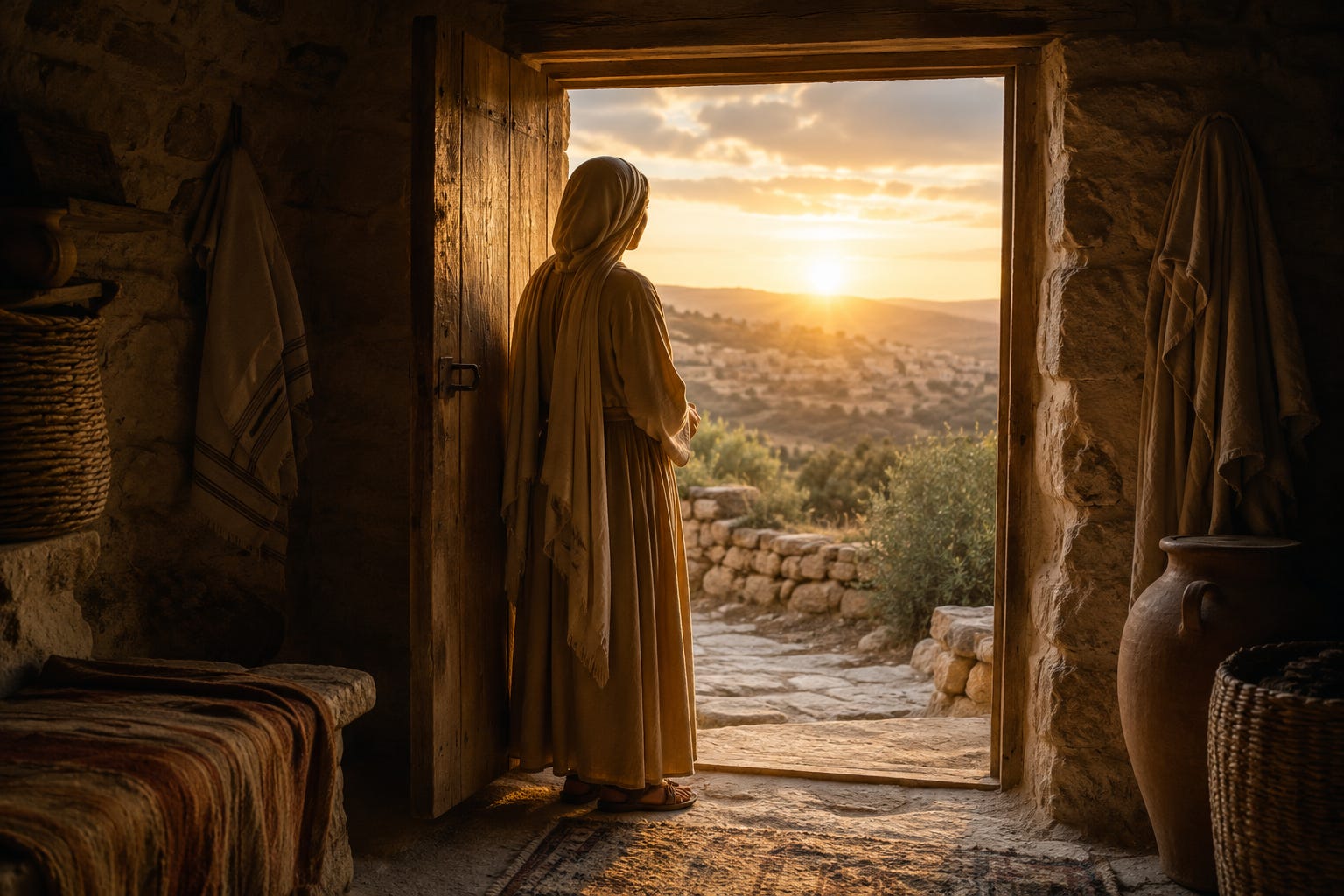
The open door symbolizes the gift already given—not something earned, but something received. The light represents the life found in Christ without becoming overly symbolic or sentimental. Image generated by ChatGPT (OpenAI) using the DALL·E model.
“And this is the testimony: God has given us eternal life, and this life is in his Son.”
1 John 5:11 NIV
The Lord is definitely trying to teach me something, as He has pointed me to six somewhat similar verses in the New Testament — mainly from epistles written by the apostles — in the past two weeks. Today we are looking at the first epistle of John, chapter 5 (the last chapter of this epistle) again, and this short summary verse that is packed with meaning.
In the verses leading up to verse 11, John is telling his readers about the benefits of their faith in Jesus, and like a lawyer giving a summation in court, he’s laying out the testimony of the witnesses to the incarnation — the union of divinity with humanity in Jesus Christ, the Son of God. This list of witnesses in verse 8 varies by scriptural translation, with the 4th century Vulgate translation of Jerome stating it as “The Father, the Word, and The Holy Spirit” and modern translations listing it as “the Spirit, the water, and the blood”.
That’s quite a contrast, so what is the difference, and what does it mean? From Enduring Word:
c. He who came by water and blood: Probably the best explanation (though there are good points to some of the other ideas) is the oldest recorded Christian understanding of this passage (first recorded by the ancient Christian Tertullian). Most likely, John means the water of Jesus’ baptism, and the blood of His crucifixion.
i. When Jesus was baptized, He was not baptized in repentance for His own sin (He had none), but because He wanted to completely identify with sinful humanity. When He came by water, it was His way of saying, “I am one of you.”
ii. When Jesus died on the cross, He did not die because He had to (death could have no power over Him), but He laid down His life to identify with sinful humanity and to save us from our sin. When He came by… blood it was so that He could stand in our place as a guilty sinner, and to take the punishment our sin deserved.
iii. This explanation also connects best with what Jesus said in John 3:5: Most assuredly, I say to you, unless one is born of water and the Spirit, he cannot enter the kingdom of God. The being born of water in this passage speaks of the cleansing waters of baptism.
In both situations we have the Spirit, interpreted to be the Holy Spirit. We have the Father — God. We have the Word — the Word of God. And we have the Son, who came by water (baptism) and laid down his life (crucifixion, “came by blood”). In other words, we have the Holy Trinity, the Father, the Son, and the Holy Spirit — God — as the witness. God is providing the testimony that “God has given us eternal life, and this life is in his Son.”
In biblical times, testimony was a very solemn declaration of truth. God’s testimony provides the authority of the truth and the reliability of the message John is delivering.
In the New Testament, eternal life is at the center of many writings, particularly those of John. Eternal life doesn’t just mean that we exist forever in some sort of holding pattern, it is a quality of life that begins when a person declares their faith in Jesus Christ and continues as a relationship with God forever. How do we know that we have eternal life now? The answer is in the words “has given” — God has already bestowed eternal life on believers.
The final words — “this life is in his Son” — state that Jesus alone is the source of eternal life, underscoring Christian belief that we find salvation and eternal life only through Jesus Christ. Jesus explains this in John 14:6 —
“I am the way and the truth and the life. No one comes to the Father except through me.”
John uses the phrase “in his Son” in today’s verse to illustrate abiding in Christ, which is both a spiritual and real union with Jesus that can be realized through a relationship with Jesus.
There are many amazing commentaries on 1 John 5:11 and the verses that surround it. For illumination, here are a few found on Precept Austin:
John Stott (The Letters of John : an introduction and commentary, 1988, Leicester, England : Inter-Varsity Press ; Grand Rapids, Mich. : Eerdmans):
Three important truths are taught in these verses about eternal life. First, it is not a prize which we have earned or could earn but an undeserved gift. Secondly, it is found in Christ, so that, in order to give us life, God both gave and gives us his Son. Thirdly, this gift of life in Christ is a present possession. True, it is further described as eternal, aiōnios, which means literally ‘belonging to the age’, i.e. the age to come. But since the age to come has broken into this present age, the life of the age to come, namely ‘eternal life’, can be received and enjoyed here and now.
J. Hampton Keathley, III writes on eternal life:
Eternal life is a life with eternal ramifications that are not only future, but is to so encompass our daily existence that it becomes a controlling and directing force… Our need is to take hold of our eternal life and live in the light of its significance and meaning both for time and eternity.
Robert J. Morgan focuses on 1 John 5:11 (from 100 Bible Verses Everyone Should Know By Heart, 2010, Nashville, TN, B&H Publishing Group):
As a college sophomore, I was mentored by an upperclassman who gave me these two verses, 1 John 5:11-12, to memorize. He called them two of the best verses in the Bible about assurance of salvation. As long as I knew these verses, he said, I’d never doubt being saved. I’ve come back to them many times, and I’m thankful for what’s not in them. There is no maybe, if, might, or hope so...
This is the testimony. This is what God Himself has declared as truth. This is the record. These are the facts.
• He has... It’s already done. This has been irrevocably accomplished.
• He has given us... It’s not just a generic promise that He has given eternal life. It includes that personal pronoun us. And us includes you and me.
• He has given us eternal life. While the whole Bible teaches that God is eternal and He bestows everlasting life on His children, it’s John who is the apostle of eternal life. He used the phrase twenty-three times in His writing.
• And this life is in His Son. Jesus not only gives us life; He is the Source and Creator of life. And yet—paradox of the ages—He died to conquer death, and because He lives, we live also.
And what better Bible commentator to end this devotional with than Charles H. Spurgeon:
Many go to heaven with very little comfort on the road. I do not commend them for their want [lack] of comfort; but I do advise you, instead of looking to singular experiences as a ground of confidence, look to the bleeding Saviour, and rest alone in Him, for if you have Him you have eternal life.
Heaven On Wheels Daily Prayer:
Father in Heaven, I thank You for the gift of eternal life that you have given us through Your Son, Jesus Christ. Thank You also for the grace that gives us trust in His sacrifice, and for the assurance that nothing can separate us from Your love. In Jesus’ name I pray, AMEN.
Am Grateful and thankful for your support and may GOD bless you too in the mighty name of Jesus Christ we have prayed and Amen.