


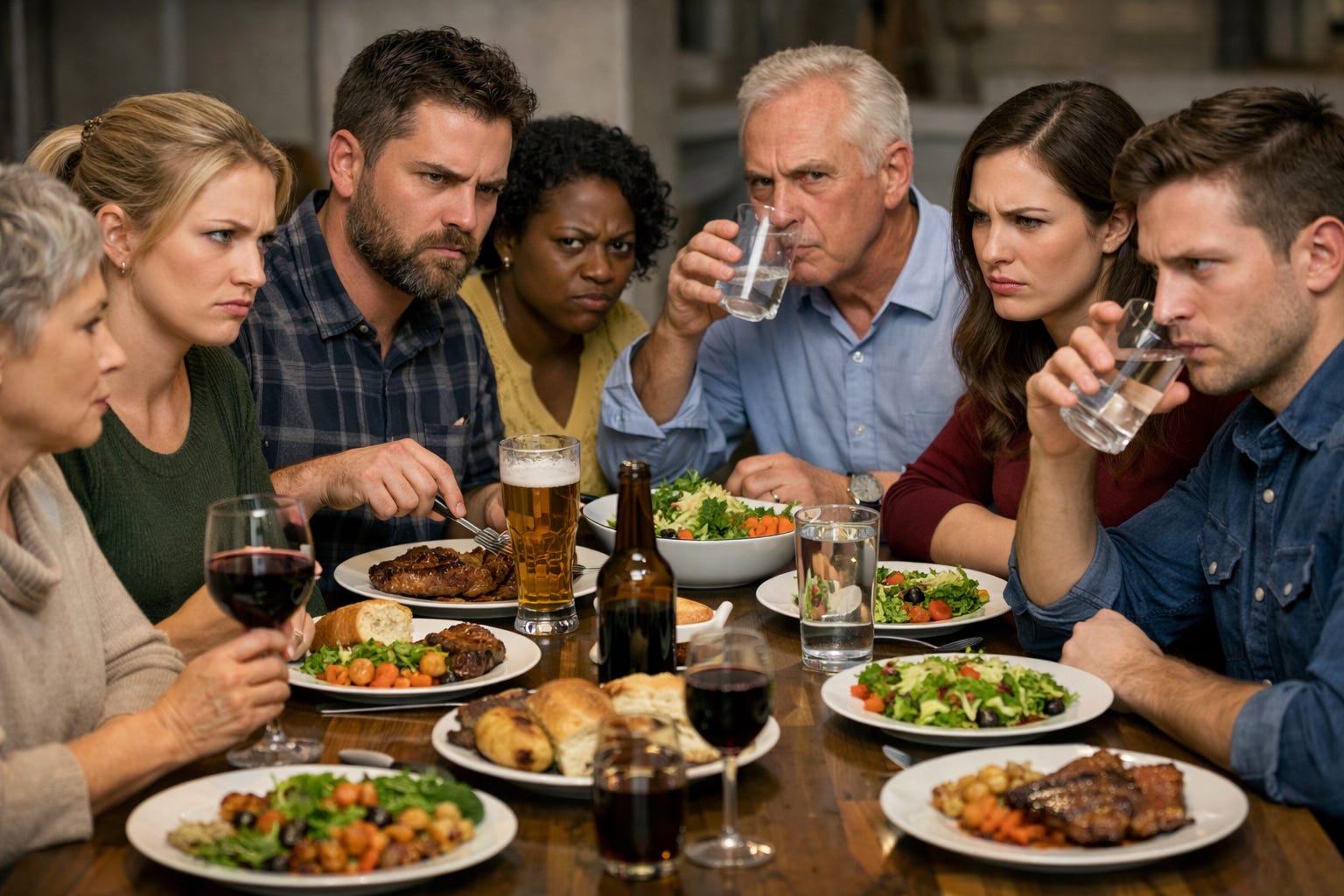
Images generated by ChatGPT (OpenAI) using the DALL·E model.
“One person’s faith allows them to eat anything, but another, whose faith is weak, eats only vegetables. The one who eats everything must not treat with contempt the one who does not, and the one who does not eat everything must not judge the one who does, for God has accepted them.”
Romans 14:2-3 NIV
To the new Christian who might be just getting started in studying scripture, the beginning of Romans chapter 14 can seem a little strange as it appears to be focusing on dietary habits! A closer look at these verses and the context in which they are placed makes it clear that these are more focused on acceptance of those in the faith who might be different from you.
Right off the bat you might think that the author of Romans, Paul, is saying that vegetarians and vegans can’t be good Christians. Well, let’s look at the context. At the time, there were those who were Jewish converts to Christianity and still followed the strict dietary rules of their former religion. They would not eat meat because they thought that it might have been sacrificed to a pagan god, and chose to eat only vegetables instead. Or perhaps they passed on eating the meat because it was non-kosher — i.e., pork or shellfish.
Paul appears to be using a bit of shock talk here, saying that those who continued to have legalistic attitudes — particularly in their attitude towards food — were weaker in their faith. By refusing to eat foods that were offered to them, they were also showing a lack of love towards others of their faith.
Now these “weak” Christians probably didn’t think they were weaker; in fact, they were probably quite proud of their strong adherence to dietary rules. That’s the problem with legalism — it makes us think that we are strong and that anyone who doesn’t follow the rules the way we do is weak.
In the second verse, Paul points out that “the one who eats everything” shouldn’t treat the legalists with contempt, and vice-versa. God has accepted both the Christians who eat meat and those who do not, so judging each other on this basis is just plain wrong.
2,000 years later, there is still way too much judgmental thinking going on in Christianity. Some feel it’s wrong to go to church on Saturday rather than Sunday. Others are totally upset with any use of alcohol, even wine being used in communion as it was at the Last Supper. There are arguments about which translation of the Bible is “best”. I won’t even touch the Catholic / Protestant rift, having been on both sides of that chasm. When these judgmental thoughts interfere with fellowship with others, you get a situation like that seen in the image at the top of this article…
I found this wonderful, albeit lengthy, commentary by Ray Stedman on Precept Austin:
"Those who think it is morally wrong for a Christian to drink wine or beer must not look down on those who feel free to do so. They must not judge them. The word "judge" means "to sit in judgment" on them and it involves several things: It involves, first, no criticizing of such people or censoring of them. We are not to go up to them and tell them, "I do not see how you can be a Christian and do things like that." That has nothing to do with being a Christian. Their Christianity is established on grounds other than those. It means no categorizing of such people, no classifying them as carnal Christians or reproving or rebuking them. In these areas we have no rights to reprove or rebuke. The church has no authority in these areas. It means no legislating against them; no imposing of behavioral standards or codes without the agreement of all those who are affected by them. These are areas in which the Scriptures say we are to make up our own minds and we are to go along only with that with which we agree. Now, there are sometimes good reasons for limitations. But they must be reasons which the individual accepts and makes. They are not to be imposed upon him by others, that is the point. What has happened often in the church is that those who are weak in the faith, i.e., those who do not fully understand the freedom in Christ, are the majority party and they often make artificial standards for Christians and impose them on everybody who comes into the church, with the implication that you really cannot be a Christian unless you do these things or do not do these things. That has given rise to a tremendous distortion of Christianity in the eyes of the world. It has given rise to the idea that Christianity is a "do not do something" idea, a "don't" religion. This distorts the freedom that is the message of the Gospel. It propagates the feeling that Christianity is a set of rules to be obeyed, and the freedom of the sons of God is denied. The world therefore, gets a totally false idea of what the church is all about. This has happened widely in our day and for the most part, I think, the "narrow party" has triumphed in the evangelical churches. This is why many people will not touch the church with a 25-foot pole, even though they are fantastically interested in the Gospel. They see the church as having imposed standards and rules of conduct that have nothing to do with the Scriptures. These are artificial regulations that only the church has brought about."
(From RayStedman.org “On Trying to Change Others”)
The point of these two verses, as well as much of the rest of Romans 14, is that we are not to judge one another because we are not responsible for another person’s conduct. You can look everywhere in Scripture and you will not find one word saying that we are to change each other. We don’t have the authority!
Paul is telling us that we are all the Lord’s servants. The Lord chose us. He is the one responsible to change all of us, if only we’ll let Him. By the way, I think the non-judgmental group at this table is having a lot more fun and fellowship:

Heaven On Wheels Daily Prayer:
Heavenly Father, thank You for these words from Your servant Paul demonstrating that we’re all guilty of religious legalism in one way or another. We judge our brothers and sisters when we should not, and we ask for Your forgiveness for that fault of ours. Help us to stop judging others of our faith and to begin to prepare to answer only for ourselves before Your throne. Let us turn our judgment into prayer for others if we feel they need to have someone interceding on their behalf. Grant us the understanding of Your truth that sets us free, AMEN.