


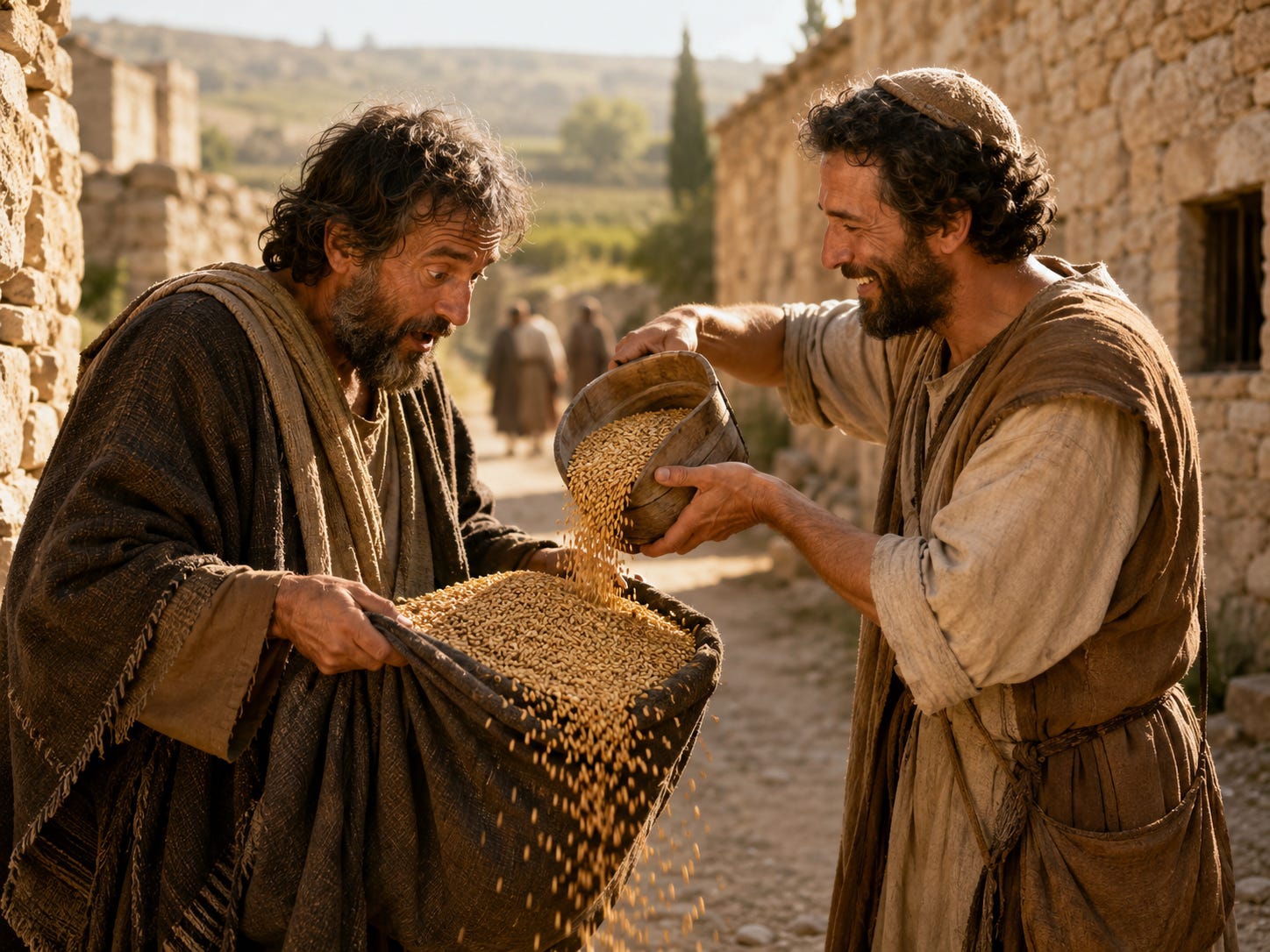
Image generated by ChatGPT (OpenAI) using the DALL·E model.
“Give, and it will be given to you. A good measure, pressed down, shaken together and running over, will be poured into your lap. For with the measure you use, it will be measured to you.””
Luke 6:38 NIV
The Lord seems to be focusing me on giving and generosity these days. It’s not surprising; Barb and I have some artworks that we collected years ago that we’re having auctioned off this weekend, and our first priority is to take the tithe (10%) off of the proceeds and give it to God. Give the first fruits to God!
Today’s teaching is from Jesus, captured in the Gospel of Luke. This verse is part of the “Sermon on the Plain,” just after He preaches the Beatitudes (the “blessed are” verses).
The verse begins with the reminder “Give, and it will be given to you.” Throughout the Old Testament, there are many reminders that generosity is rewarded by God. At the time, giving was both a religious duty (giving one’s tithe to the synagogue or temple) and a social expectation. Unlike today’s online giving that is done in private, neighbors and fellow synagogue-goers could see who was placing coins in the tithe box. I can imagine that those who didn’t give to the synagogue were the targets of a lot of gossip…
God does reward all who are generous with their resources of time, treasure, and talent, and the reward is sometimes material (unexpected windfalls) but always spiritual. I like to reflect on Proverbs 11:25 when thinking about generosity in giving, “A generous person will prosper; whoever refreshes others will be refreshed.”
The next verse probably sounds very odd to our ears — A good measure, pressed down, shaken together and running over, will be poured into your lap. — so a bit of context is in order here. In the marketplaces of the day, a “good measure” meant a full and honest measure from an honest and generous seller of grains or other commodities. To ensure that whatever container was being filled was packed to its maximum capacity, the seller would press it down, shake it (to compact the grains), and sometimes even topped off the measure with a little extra. Jesus was describing the overflowing of blessings that are God’s reward for generosity. Those rewards aren’t just adequate to fill a container, they’re abundant. God’s grace is the same; it’s overflowing and more than we deserve.
What’s Jesus talking about saying that this “will be poured into your lap”? Once again, we need to look at the context of the times. At the time, people wore long robes which had either a fold or a pouch in the front; think of that space as being equivalent to today’s pockets that are used to carry items… but larger. By saying that something was poured into one’s lap meant that you were getting more than you could hold in a container, the excess was spilling into that pouch or fold.
In the image at the top of this devotional, the merchant is pouring a generous amount of grain into a poor man’s pouch; he’s probably too poor to even own a basket or container to carry it. That’s like the personal and direct character of God’s blessings — they are always discernible and obvious in our lives!
The last part of the verse, “For with the measure you use, it will be measured to you,” hearkens back to the Biblical theme that is best described in Galatians 6:7: “A man reaps what he sows.” Our actions always have consequences, and that maxim is most evident in terms of morality and spirituality. As noted on Bible Hub, “the standard one uses in giving will be the standard used in receiving.”
The Bible Says commentary on the verse explains this rather well:
Jesus continues, give, and it will be given to you. We will all be measured and judged according to our own judgment and standard of measure. If we want a lenient measure of mercy, we should be merciful. If we want a strict measure of judgment and condemnation, we should be quick to judge and condemn others. If we desire pardon, we should pardon others. We should be quick to give to others as we wish to receive.
David Guzik of Enduring Word expounds on the same concepts in his commentary:
d. Give, and it will be given to you: good measure, pressed down, shaken together, and running over: Jesus encouraged the freedom to give without fearing that we will become the loser in our giving. He wanted to set us free from the fear of giving too much.
i. This is true and has been tested when it comes to generosity with material resources. Simply said, you can’t out-give God. He will return more to you, in one way or another, more than you give to Him. Yet the most pointed application of this in context is not so much the giving of material resources, but with giving love, blessing, and forgiveness. We are never the loser when we give those things after the pattern of God’s generosity.
Guzik also points out that there is another meaning of the last part of this verse. Not only is Jesus teaching a lesson about generosity, but also about how we judge others!
e. With the measure you use, it will be measured back to you: This is the principle upon which Jesus built the command, “Judge not, that you be not judged.” God will measure unto us according to the same measure we use for others. This is a powerful motivation for us to be generous with love, forgiveness, and goodness to others. If we want more of those things from God, we should give more of them to others.
i. We might say that Jesus did not prohibit the judgment of others. He only requires that our judgment be completely fair, and that we only judge others by a standard we would also like to be judged by.
ii. When our judgment in regard to others is wrong, it is often not because we judge according to a standard but because we are hypocritical in the application of that standard – we ignore the standard in our own life. It is common to judge others by one standard and ourselves by another standard – being far more generous to ourselves than others.
iii. According to the teaching of some rabbis in Jesus’ time, God had two measures that He used to judge people. One was a measure of justice and the other was a measure of mercy. Which ever measure you want God to use with you, you should use that same measure with others.
iv. We should only judge another’s behavior when we are mindful of the fact that we ourselves will be judged, and we should consider how we would want to be judged.
Jesus emphasizes that we should never calculate the minimum that we can give or pay someone, but instead cultivate a heart that gives an abundance of mercy, forgiveness, and generosity.
Heaven On Wheels Daily Prayer:
Knowing Jesus had a perfect prayer for today’s verse, so it is used here with my grateful thanks and a link to this wonderful website:
Heavenly Father, thank You for the simple yet universal principle of ‘giving to others and it will be given to you’. Thank You that You have given to me over and above all that I could ask or think, by sending Jesus to pay the price for my sin, and that He rose again to give me eternal life. Too often, I have not lived as You would have me to live, nor have I always sown the love, mercy, generosity, and kindness that honours You, but I pray that from today You would enable me to reflect the love, generosity, goodness, and grace of Jesus Christ. In His name I pray, AMEN.