


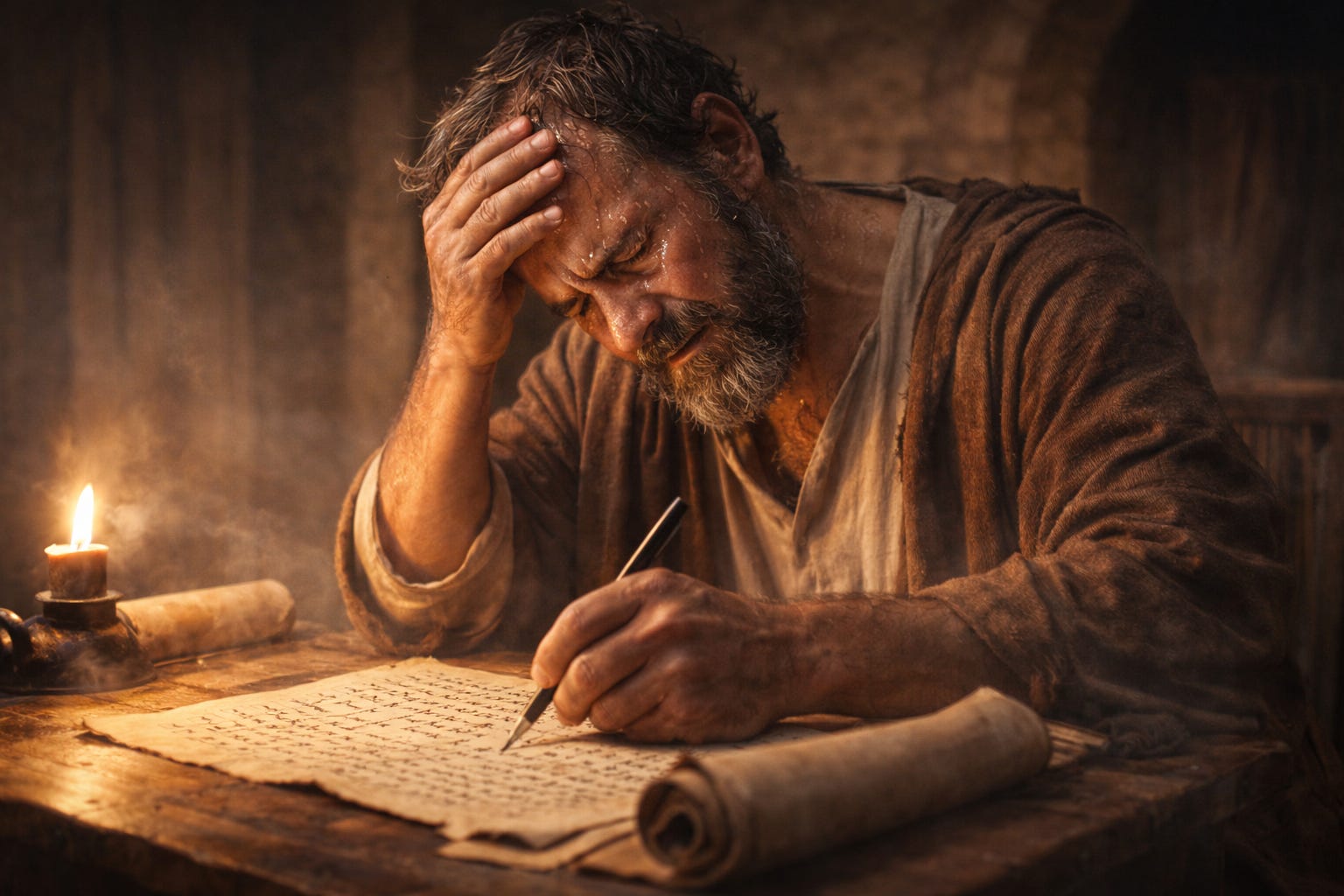
Image generated by ChatGPT (OpenAI) using the DALL·E model.
“That is why, for Christ’s sake, I delight in weaknesses, in insults, in hardships, in persecutions, in difficulties. For when I am weak, then I am strong.”
2 Corinthians 12:10 NIV
This verse in Paul’s second epistle to the Corinthians follows his testimony of being “a man in Christ who fourteen years ago was caught up to the third heaven. Whether it was in the body or out of the body I do not know—God knows” (2 Corinthians 12:2 NIV) and his admission of being “given a thorn in my flesh, a messenger of Satan, to torment me” (2 Corinthians 12:7 NIV) and to keep him from becoming conceited as a result of “these surpassingly great revelations”.
What the “thorn in my flesh” actually was has been fodder for speculation and commentary for two millennia. Enduring Word provides this commentary on possible maladies:
i. Some see it mainly as spiritual harassment. Others think it was persecution. Many suggest that it was a physical or mental ailment. Some say this was Paul’s struggle with lustful and sinful thoughts.ii. Among Christians, Tertullian gives the earliest recorded guess at the exact nature of Paul’s problem. He thought the thorn in the flesh was an earache or a headache.
iii. In more modern times, historian Sir William Ramsay offered the suggestion that Paul’s infirmity was a type of malaria common to the area where he served as a missionary. Sufferers of this type of malaria experience attacks when under stress, and they “feel a contempt and loathing for self, and believe that others feel equal contempt and loathing.” This malarial fever also produces severe headaches, described by sufferers as being “like a red-hot bar thrust through the forehead.”
As with all of God’s Word, He has a reason for telling us — or NOT telling us — certain things. The Enduring Word commentary goes on to say:
iv. Each of these suggestions is possible, but God had a definite purpose in not revealing the exact nature of Paul’s thorn. If we knew exactly what Paul’s thorn was, then everybody who was afflicted — but not in exactly the same way — might doubt that Paul’s experience was relevant for them. God wanted everyone with any kind of thorn in the flesh to be able to put themselves in Paul’s shoes. “I generally find that each expositor has selected that particular thorn which had pierced his own bosom.” (Spurgeon)
When we finally reside in God’s Kingdom, we’ll know what Paul’s thorn actually was. Until then, it’s more important to know that we all have our own thorns — physical or mental issues, or perhaps spiritual struggles with sin and temptation — to contend with.
God tells Paul in the vision or actual physical conversation that “My grace is sufficient for you, for my power is made perfect in weakness.” (2 Corinthians 12:9). He will not remove the literal or figurative thorn from Paul’s life, but will instead keep providing His grace to Paul as it is sufficient to meet every need.
Does Paul complain or fret about not being relieved of the thorn? No, quite the contrary! He says “That is why, for Christ’s sake, I delight in weaknesses, in insults, in hardships, in persecutions, in difficulties.” Why? Paul realized that his dependence on God made him stronger than he would have been if his revelations from God has made him boastful and independent. Once again from Enduring Word:
i. Many of us think that real Christian maturity is when we come to a place where we are somewhat “independent” of God. The idea is that we have our act so together that we don’t need to rely on God so much day to day, moment to moment. This isn’t Christian maturity at all. God deliberately engineered debilitating circumstances into Paul’s life so he would be in constant, total dependence on God’s grace and God’s strength.
Paul’s response to the “weaknesses, insults, hardships, persecutions, difficulties”? He delights in them, “For when I am weak, then I am strong.”
That statement from Paul is the source of many powerful sermons and commentaries. Rather than repeat them all here, I suggest visiting this page on Precept Austin and then spending time reading through the examples of how many famous Christians have been living proof of this paradox. When they are weakened by physical issues and hardship, they become increasingly reliant on God and become stronger as a result!
There are a few examples that I will cite from Precept Austin, as they do such a good job of explaining Paul’s paradoxical statement:
When we are really weak in ourselves and are conscious of that weakness, we are in the state suited to the manifestation of God’s power. When we are emptied of ourselves, we are filled with God. Those who think they can change their own hearts, atone for their own sins, subdue the power of evil in their own souls or in the souls of others, who feel able to sustain themselves under affliction, God leaves to their own resources. But when they feel and acknowledge their weakness, He imparts divine strength to them. (Charles Hodge)
We exult in suffering because it is the path to spiritual maturity and glory. The great saints of God all agree. Ask Abraham and he will direct your attention to the sacrifice on Mount Moriah. Ask Jacob and he will point you to his stone pillow. Ask Joseph and he will tell you about the dungeon. Ask Moses and he will remind you of his trials with Pharaoh. David will tell you his songs came in the night. Peter will speak of his denial, John of Patmos, and Jesus of the cross. Blessings are poured out in bitter cups. (R.K. Hughes, Romans: Righteousness from God, Preaching The Word)
If there is anything that we love to hate more than the arrogance of others, it would have to be an awareness of our own weakness. We detest it so much that we invent ways to cover our personal inadequacy.
Even the apostle Paul needed to be reminded of his own frailty. He was jabbed time and again by a “thorn in the flesh” (2Co 12:7). He didn’t name this thorn, but J. Oswald Sanders reminds us that whatever it was, “it hurt, humiliated, and restricted Paul.” Three times he begged the Lord to take it away, but his request was not granted. Instead, he used his thorn to tap into God’s all-sufficient grace. The Lord promised, “My grace is sufficient for you, for my strength is made perfect in weakness” (2Co 12:9).
Courageously, Paul began to “own” his weakness and put the Lord’s grace to the test, a pathway that Sanders calls “a gradual educative process” in the apostle’s life. Sanders notes that eventually Paul no longer regarded his thorn as a “limiting handicap” but as a “heavenly advantage.” And his advantage was this: When he was weak in himself, he was strong in the Lord.
As we accept our weaknesses, in Christ we can be strong weak people. -- Joanie E. Yoder (Our Daily Bread, Copyright RBC Ministries, Grand Rapids, MI. Reprinted by permission. All rights reserved)
From this treasury of commentaries on Precept Austin comes this advice that I’ll use to wrap up today’s devotional: Remember to thank God for the thorns!
When we count our blessings, we should include the weaknesses, the hardships, the burdens, and the trials we face. If we do, we might find that God has used our difficulties more than the “good” things to help us grow spiritually. Why is that? Because it is in those difficult places that we discover the sufficiency of His grace. In our trials, we turn to God. As we depend on Him, we find that His strength is made perfect in our weakness (2Cor 12:9). Take a moment and think about the way God has led you. When you praise God for your blessings, do you remember to thank Him for the thorns? (Paul Van Gorder, Our Daily Bread, Copyright RBC Ministries, Grand Rapids, MI. Reprinted by permission. All rights reserved)
Heaven On Wheels Daily Prayer:
Father in Heaven, thank You for the truth that is the core of Your Word. Help me to understand and then rejoice in the fact that my worth comes from You alone. Teach me to measure my life by Your standards and not by earthly benchmarks, and to find your strength in my weaknesses. I ask this in Jesus’ name, AMEN.