


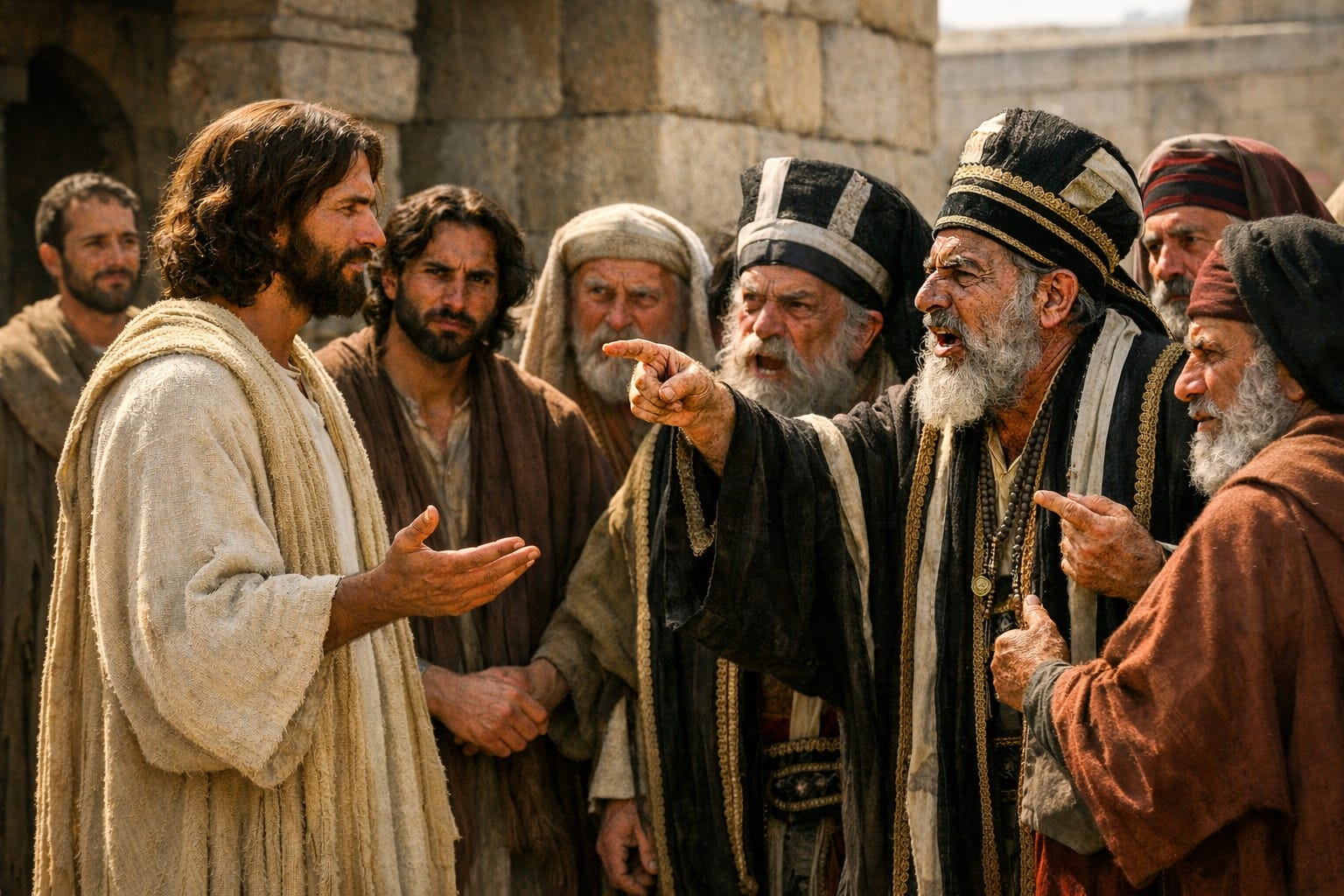
Image generated by ChatGPT (OpenAI) using the DALL·E model.
“But I tell you that everyone will have to give account on the day of judgment for every empty word they have spoken.”
Matthew 12:36 NIV
In this part of Matthew Chapter 12, Jesus is in the midst of answering some criticism from the Pharisees, part of the ruling religious class in Israel at the time — the Sanhedrin. He had just healed a man who was both blind and mute, and the Pharisees attributed the healing not to God’s power, but instead of powers gained through “Beelzebul, the prince of demons” (Matthew 12:22-24).
With the simple words “But I tell you,” Jesus emphasizes His divine authority and demonstrates just how serious His message is to these supposedly learned religious leaders! In many of His teachings, including the Sermon on the Mount (Matthew 5), Jesus uses these or similar words to contrast His teachings with the traditional interpretations of divine truth.
Scripture reminds us repeatedly that individuals are responsible for their own actions and words. When Jesus says that “everyone will have to give account,” He has extended this accountability to God to include the Pharisees. God’s divine judgement doesn’t just target actions, but words as well. What words? Words about God and religious matters, or all words that we speak?
The Greek theologian Spiros Zodhiates (1922-2009) explains what this accounting entails in this commentary from his Exegetical Commentary on Matthew cited on Precept Austin:
Most people think that God is not interested in details, particularly idle chatter, which, they assume, He overlooks. Yet here we learn not only that such useless words exist but they also are being recorded for review on the day of judgment. The Lord wants us to measure our words before we speak. He wants us to speak valuable words that justify His presence in our lives and advance His kingdom.
Jesus is reminding the Pharisees — who should know better — of their responsibility before God to speak and teach the truth.
That accounting won’t come immediately. Jesus provides another reminder to the Pharisees — they’ll “have to give account on the day of judgment”. These Jewish leaders know that God will judge the living and the dead, as this has been repeatedly driven home to them in much of the Old Testament prophetic literature.
The final words of Jesus tell them what they’re going to have to account for — “every empty word they have spoken.” In researching this verse, I came across this lengthy commentary by J.C. Ryle on Precept Austin that should make each of us consider spending more time thinking about what we say… before we actually utter the words:
There are few of our Lord's sayings which are so heart-searching as this. There is nothing, perhaps, to which most men pay less attention than their words. They go through their daily work, speaking and talking without thought or reflection, and seem to imagine that if they do what is right, it matters but little what they say. But is it so? Are our words so utterly trifling and unimportant? We dare not say so, with such a passage of Scripture as this before our eyes. Our words are the evidence of the state of our hearts, as surely as the taste of the water is an evidence of the state of the spring. "Out of the abundance of the heart the mouth speaks." The lips only utter what the mind conceives. Our words will form one subject of inquiry at the day of judgment. We shall have to give account of our sayings, as well as our doings. Truly these are very solemn considerations. If there were no other text in the Bible, this passage ought to convince us, that we are all "guilty before God," and need a righteousness better than our own, even the righteousness of Christ. (Phil. 3:9.) Let us be humble as we read this passage, in the recollection of time past. How many idle, foolish, vain, light, frivolous, sinful, and unprofitable things we have all said! How many words we have used, which, like thistle-down, have flown far and wide, and sown mischief in the hearts of others that will never die! How often when we have met our friends, "our conversation," to use an old saint's expression, "has only made work for repentance." There is deep truth in the remark of Burkitt, "A profane scoff or atheistical jest may stick in the minds of those that hear it, after the tongue that spoke it is dead. A word spoken is physically transient, but morally permanent."
The words we speak reflect the condition of our hearts. That’s why it is so important to align our hearts with God’s will, as our words will follow suit. How do we do this? Pray for God to provide us with the ability to control our tongues; to avoid gossip, slander, and idle talk. Pray for the guidance of the Holy Spirit to speak words that build up and encourage others.
When we fail in our speech as we know we will, we should seek God’s forgiveness, ask for the help of the Holy Spirit to grow in our ability to choose our words more carefully, and become more Christ-like in our communication.
Heaven On Wheels Daily Prayer:
Father in Heaven, I know that I will be held accountable for every careless word that I speak. I pray for your help in being mindful of the words I speak and write, and for your guidance to communicate with love and truth, reflecting Your goodness in all of my words. I ask this in the name of Jesus, AMEN.