


“With good will render service, as to the Lord, and not to men, knowing that whatever good thing each one does, this he will receive back from the Lord, whether slave or free. And masters, do the same things to them, and give up threatening, knowing that both their Master and yours is in heaven, and there is no partiality with Him.”
Ephesians 6:7-9 NASB1995
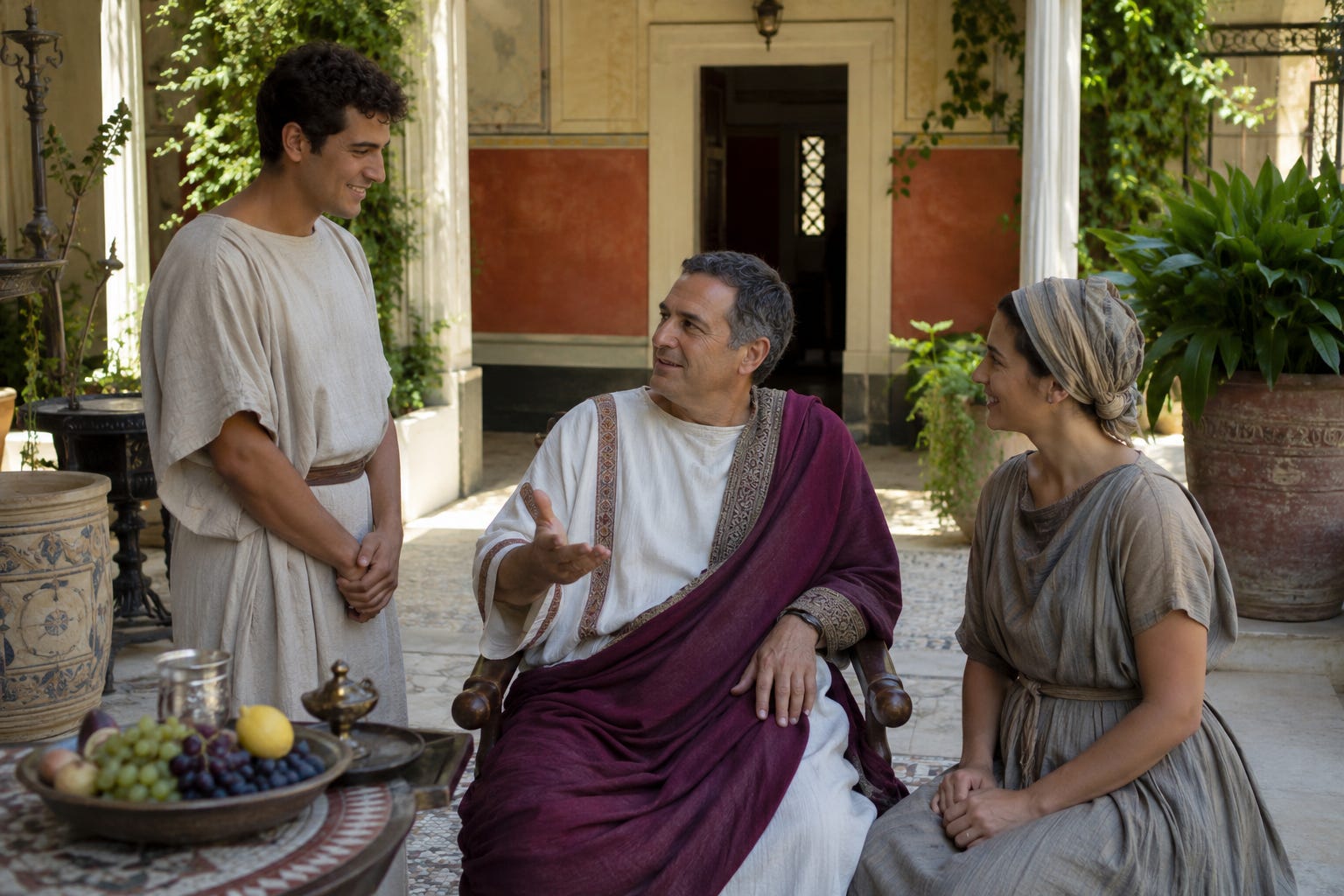
This passage continues the theme of rendering service as to the Lord, and not to men. This admonition is for the servant/slave/employee and master/employer. The masters are also told to not be threatening because there is no partiality in Him. The AI image shows a Roman citizen enjoying the company of people that are in all likelihood his slaves.
This is a fairly simple passage and does not require a lot of deep examination. I’ll share first the short commentary from Enduring Word:
a. You, masters, do the same things to them: Masters are told to do the same things to them (their employees). Even as servants are to work hard and honestly for their masters, so masters are to do the same on behalf of those who work for them.
i. “So the Gospel leaves its message of absolutely equal obligation, in Jesus Christ, upon the slave and upon the slave owner. The principle will do its work. There is no word of Revolution.” (Moule)
b. Giving up threatening: Employers are also to give up threatening and other forms of harsh treatment. They do this knowing that they are employees of their Master in heaven, and He judges without regard to wealth or position.
As far as God is concerned, we are equal and beloved by Him. We do our tasks both for us (and our integrity) and for someone else here in this life and perform them as though we are doing them for the Lord. Those that we work for also are to understand that they are to be honest and non-threatening. He will judge without regard to wealth or position. We have an equal obligation.
Warren Wiersbe has an excellent commentary on these verses and the ones that precede them, as noted on Precept Austin:
This is practicing the lordship of Christ. The wife submits to her own husband “as unto the Lord” (Ep 5:22-note), and the husband loves the wife “as Christ also loved the church” (Ep 5:25-note). Children obey their parents “in the Lord” (Ep 6:1-note), and parents raise their children “in the nurture and admonition of the Lord” (Ep 6:4-note). Servants are obedient “as unto Christ” (Ep 6:5-note), and masters treat their servants as their “Master in heaven” would have them do. Each person, in submission to the Lord, has no problems submitting to those over him. Jesus said the way to be a ruler is first to be a servant (Mt 25:21). The person who is not under authority has no right to exercise authority. (Wiersbe, W: Bible Exposition Commentary. 1989. Victor)
I love that statement, that the person who is not under authority has no right to exercise authority.
This is, I must confess, a very weak devotional (short) because it is really based in common sense for believers and has some repetition, but let’s look at that passage in Matthew to fill this out, which is the parable of the talents:
““For it is just like a man about to go on a journey, who called his own slaves and entrusted his possessions to them. To one he gave five talents, to another, two, and to another, one, each according to his own ability; and he went on his journey. Immediately the one who had received the five talents went and traded with them, and gained five more talents. In the same manner the one who had received the two talents gained two more. But he who received the one talent went away, and dug a hole in the ground and hid his master’s money.
“Now after a long time the master of those slaves *came and *settled accounts with them. The one who had received the five talents came up and brought five more talents, saying, ‘Master, you entrusted five talents to me. See, I have gained five more talents.’ His master said to him, ‘Well done, good and faithful slave. You were faithful with a few things, I will put you in charge of many things; enter into the joy of your master.’
“Also the one who had received the two talents came up and said, ‘Master, you entrusted two talents to me. See, I have gained two more talents.’ His master said to him, ‘Well done, good and faithful slave. You were faithful with a few things, I will put you in charge of many things; enter into the joy of your master.’
“And the one also who had received the one talent came up and said, ‘Master, I knew you to be a hard man, reaping where you did not sow and gathering where you scattered no seed. And I was afraid, and went away and hid your talent in the ground. See, you have what is yours.’
“But his master answered and said to him, ‘You wicked, lazy slave, you knew that I reap where I did not sow and gather where I scattered no seed. Then you ought to have put my money in the bank, and on my arrival I would have received my money back with interest. Therefore take away the talent from him, and give it to the one who has the ten talents.’
“For to everyone who has, more shall be given, and he will have an abundance; but from the one who does not have, even what he does have shall be taken away. Throw out the worthless slave into the outer darkness; in that place there will be weeping and gnashing of teeth.”
Matthew 25:14-30 NASB1995
We are faithful to each other, regardless of position or authority or circumstance. But in the end, the most important thing is that we are faithful to HIM. That’s what matters!
Oh - I can do one more thing: What does partiality mean, from a word study perspective? We can look at the Blue Letter Bible:
Partiality comes from the Greek feminine noun προσωποληψία or prosōpolēpsía (Strong’s G4382), with the following Biblical usages:
respect of persons
partiality
the fault of one who when called on to give judgment has respect of the outward circumstances of man and not to their intrinsic merits, and so prefers, as the more worthy, one who is rich, high born, or powerful, to another who does not have these qualities
God does not look at how we were born, what we have done, or how much we have earned and does not compare one human made in His image to another. How perfect is His judgment!
My next devotional examines Ephesians 6:10-11 - Put on the full armor of God. NOTE: I did a series on the splendid “armor of God” exposition early in our devotional exercises. I am not going to go back and read those and will do this crucial passage in Ephesians 6 just like I’m studying it for the first time. At the end, I might do a comparison!
Heaven On Wheels Daily Prayer:
Dear Lord - Thank you for the lesson again on the hierarchy of submission and for the lessons on working hard in this day and age, when most people are hardly working. I pray to be entered into the joy of the Master. Amen.
Citations and Credits:
Scripture quotations taken from the (NASB®) New American Standard Bible®, Copyright © 1960, 1971, 1977, 1995 by The Lockman Foundation. Used by permission. All rights reserved. www.Lockman.org.
“G4382 - prosōpolēmpsia - Strong’s Greek Lexicon (NASB95).” Blue Letter Bible. Web. 21 Jun, 2026. <https://www.blueletterbible.org/lexicon/g4382/nasb95/mgnt/0-1/>.
Precept Austin was accessed on 06/20/2026 to review commentary for Ephesians 6:7-9.
Commentary from Enduring Word is used with written permission and without any alteration. ©1996-present The Enduring Word Bible Commentary by David Guzik – enduringword.com. Within the Enduring Word commentary:
Moule, Handley C. G. Ephesian Studies (London: Pickering and Inglis, ?)