


“For this you know with certainty, that no immoral or impure person or covetous man, who is an idolater, has an inheritance in the kingdom of Christ and God.”
Ephesians 5:5 NASB1995
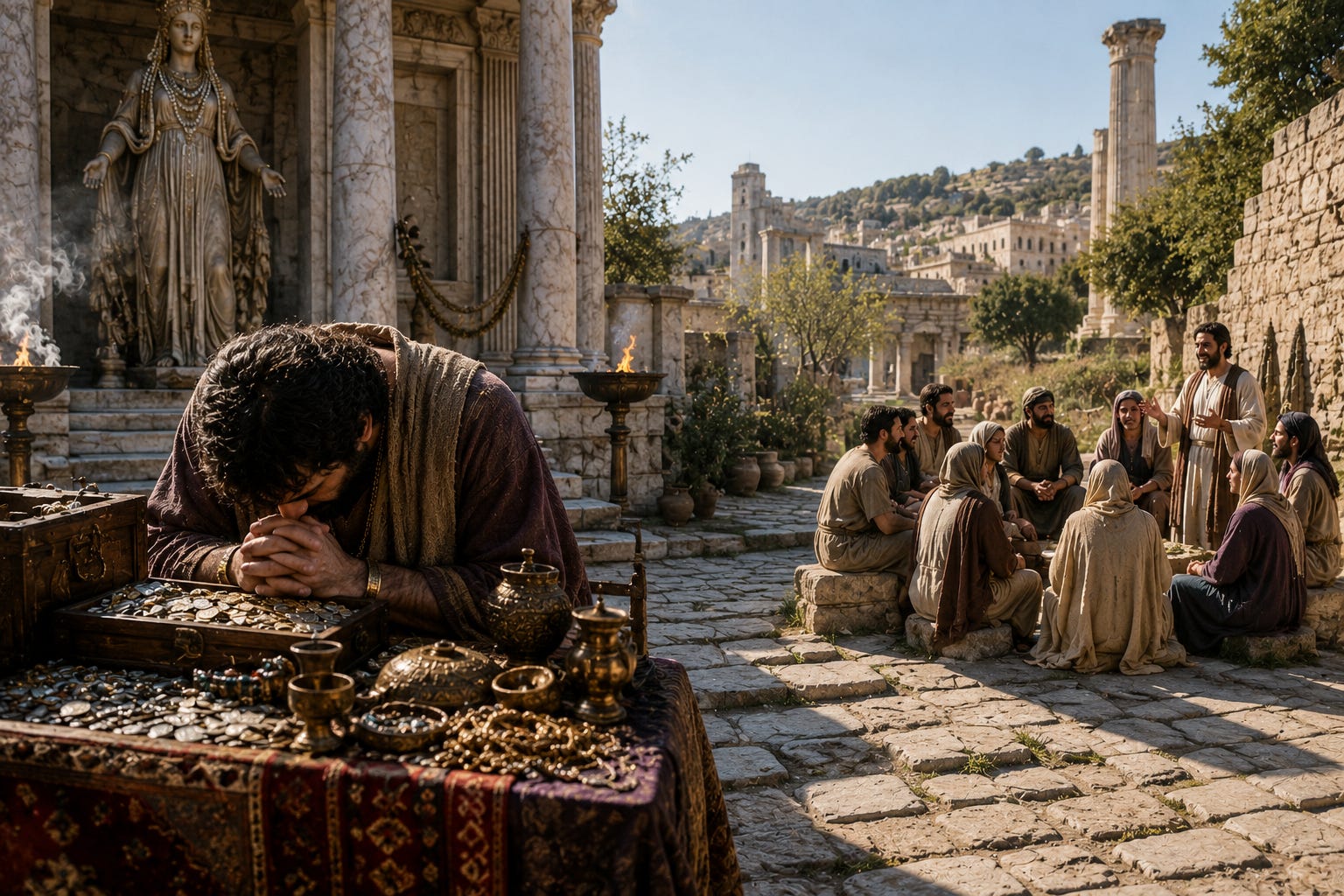
We spent plenty of time investigating immorality and impurity in my last devotional and also touched on covetousness. The saints are to know with certainty (that’s pretty emphatic) that any one of them who still practices these things will not have an inheritance in the kingdom of Christ and God. The AI image for today shows a group on the right in Ephesus talking about the Good News from God. The man on the left is bowing in reverence towards his large repository of coins and jewelry. He is an idolator because he covets and essentially worships the money that he has accumulated. Behind him, a statue of the false goddess Athena looks on the scene. The remains of her elaborate temple in Ephesus today consist of one column.
So if we slip up and sin or become more focused (even temporarily) on an earthly idol (see the definitions below) have we lost our salvation? Some of the scholars I read believe that this admonition is focused on those who claim to be believers who continue to regularly pursue these sinful states. When we do sin, the Holy Spirit convicts us of that sin and we should repent.

I’m going to dig into the idea of idolatry a little bit more. Here are two good commentaries from Precept Austin on what can become a idol:
[Henry] Morris has an interesting note on the meaning of idols writing that they “are either physical images or mental constructs with which men try to explain and control the forces and systems of nature without acknowledging the one true God as Creator and Sustainer of all things. Paganism, with its pantheism and polytheism, worshipping the various forces and systems of nature personified as Mother Earth with all her other personifications as various gods and goddesses, was rife in John’s day and, through various forms of evolutionism, has always been arrayed in opposition to the true God of creation and redemption. This is more true today than ever before, and it is absolutely vital that true Christians should refrain from all forms of idolatry, whether rationalistic humanism, economic materialism, or New Age pantheism--all of which are founded on an evolutionary world view.” (Morris, Henry: Defenders Study Bible. World Publishing)
[M.F.] Unger adds that...
Idolatry may be classified as follows: (1) the worship of inanimate objects, such as stones, trees, rivers, etc.; (2) of animals; (3) of the higher powers of nature, such as the sun, moon, stars; and the forces of nature, as air, fire, etc.; (4) hero-worship or of deceased ancestors; (5) idealism, or the worship of abstractions or mental qualities, such as justice.
Another classification is suggestive: (1) the worship of Jehovah under image or symbol; (2) the worship of other gods under image or symbol; (3) the worship of the image or symbol itself. Each of these forms of idolatry had its peculiar immoral tendency. (Unger, M. F., Harrison, R. K., Vos, H. F., Barber, C. J., & Unger, M. F. The New Unger’s Bible Dictionary. Chicago: Moody Press)
Fascinating! There are many people today who spend their lives and time completely laser-focused on various types of mental abstractions like justice, characterized as environmental justice, social justice, economic justice (“fair share”), and restorative justice (like reparations for slavery), to name a few of the popular types of justice that are floating around. This idealism can never be achieved, so peace will never be obtained, in spite of slogans written on a sign. There will always be someone who can “claim” an injustice, no matter how petty or small and someone else will pay the price. Some mainstream churches have replaced working towards an inheritance in God’s kingdom, which would include serving those who are truly needy and understanding and obeying His word, with working towards “perfect justice” in this world.
This focus on idealism can lead to another idol: outrage. Outrage about everything under the sun seems to be the result of constant doom scrolling through news and opinion. This outrage, usually impotent, creates an anxious state of mind that is unable to receive the “peace that passes all understanding”. People do not want to give up their outrage, making it one of the worst forms of modern idolatry.

It’s also interesting to see that these idolatries include hero worship. Our culture is so focused on hero worship that we have a term for those folks that are inappropriately idolized: Celebrity. According to the search assist AI in my search engine (DuckDuckGo) here are the attributes of a celebrity:
Definition of Celebrity:
A celebrity is a person who is widely recognized and famous, often due to their involvement in various fields such as:
Entertainment
Sports
Politics
This fame is typically driven by media attention and public interest.
Characteristics of Celebrity Status - Key Attributes
Public Recognition: Celebrities are known by a large audience, often through mass media.
Media Coverage: Their lives and activities are frequently reported in news outlets, magazines, and social media.
Cultural Impact: Celebrities can influence trends, opinions, and behaviors in society.
Pathways to Fame - Celebrities often achieve their status through:
Talent: Exceptional skills in acting, music, sports, etc.
Endorsements: Collaborations with brands that enhance their visibility.
Public Persona: Crafting a unique image that resonates with the audience.
Historical Context:
The concept of celebrity has evolved over time. Notable historical figures, such as athletes in Ancient Greece and actors in Ancient Rome, were celebrated similarly to modern celebrities. The rise of mass media in the 18th and 19th centuries further transformed how fame is generated and maintained.
Conclusion:
In summary, a celebrity is not just a famous person but someone whose life and persona are consumed by the public, often leading to significant cultural influence.
We can admire the skills and talent of other people without turning that into hero worship and spending thousands of dollars attending concerts and buying memorabilia and screaming at just the sight of certain celebrities.

As most readers know, I am an amateur scholar of WWII history. The people that I admire a lot are those ordinary people who dug deep into internal wells of courage and fortitude during that awful war and other wars, many of them paying the ultimate price. In April, we visited the new National Medal of Honor museum in Arlington, Texas (it opened in 2025). It was a cool and rainy Sunday, a perfect opportunity for locals to check out this brilliant and very emotionally moving new museum. Sadly, there were very few visitors there (the volunteer docents and staff certainly outnumbered the attendees). As an aside, you can begin to idolize a hobby or learning, too, and I have to back away from my other interests every day and realize that He is the priority.
This museum is in an area surrounded by huge arenas that serve as temples at various times for those who are invested in celebrity athlete worship; those temples are likely full to the brim regardless of the caliber of the teams playing on the field (there’s nothing wrong with enjoying a good game, by the way). The day we visited the museum, there were no games going on in any of the venues, thank goodness. I can’t imagine how this museum’s attendance can suffer during Cowboys season or when the Rangers are in town. By the way, I also admire people who are inventors, engineers, entrepreneurs and explorers, but “American Idol” doesn’t award big money contracts to the next Thomas Edison.
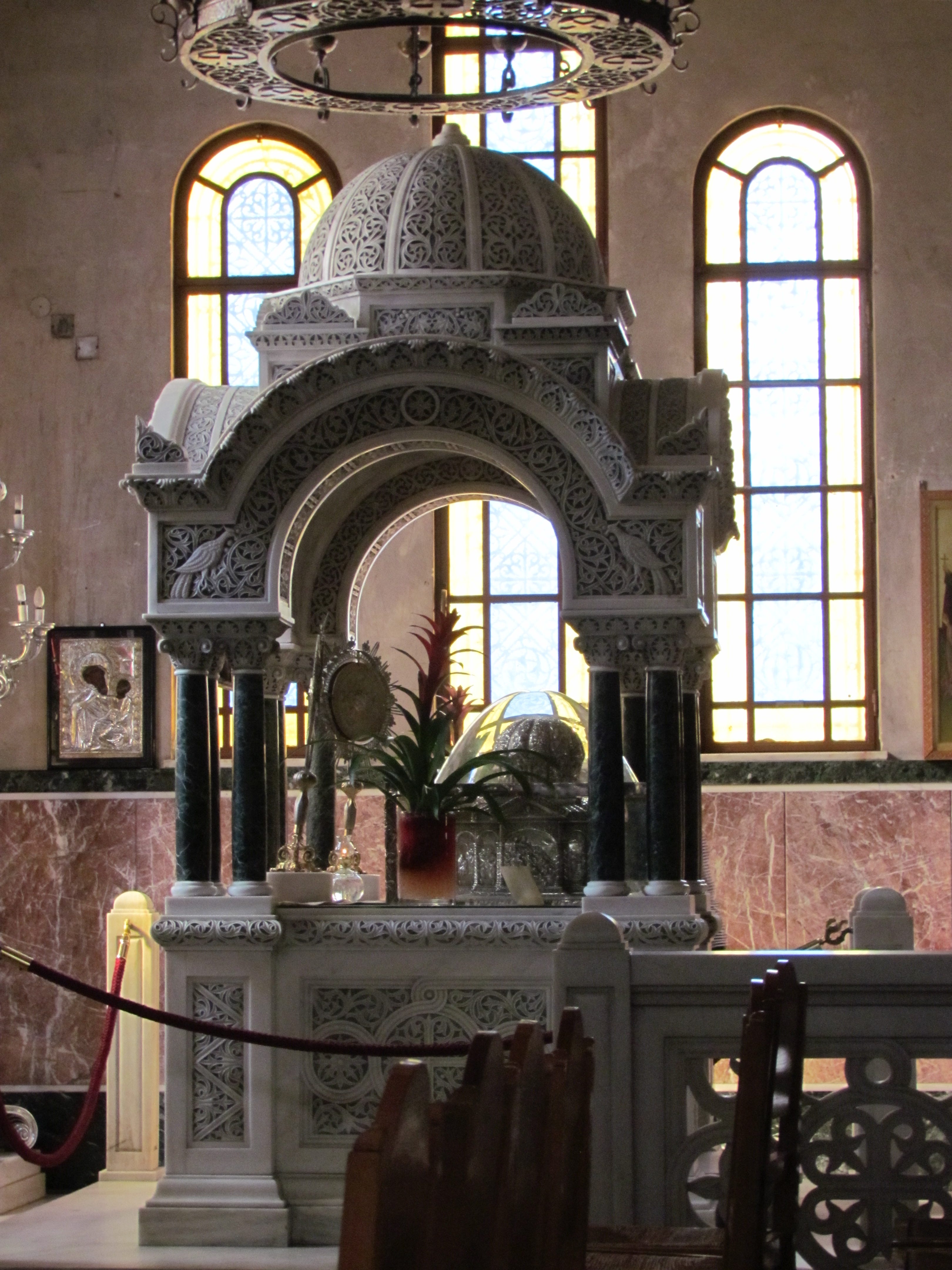
Another interesting definition of idolatry is the worship and focus on religious symbols to the exclusion of worshipping God. This crops up in the focus on relics and symbols in various Christian denominations like Catholicism and Orthodoxy. I’ve talked about some of our encounters with relics on our travels. The photo above shows the elaborate reliquary for a few body parts that allegedly belonged to the Apostle Andrew in Patras, Greece. This reliquary was treated as an object of worship, with people praying over it. This beautiful church, by the way, was also full of icons (you can see one on the wall to the left of the reliquary).
Is the prayer itself important or is the relic or the rosary with rare jewels and beads more important? When we visited the Vatican the first time, we wandered into the gift shop and bought Steve’s Mom a rosary (she was a perfunctory Catholic). There were rosaries in that store that cost about one Euro or less and there were rosaries that were thousands of dollars with rare shells, jewels and gold beads. And who are you praying to when looking at the relic or using that rosary?

Another idol mentioned in the first commentary from Henry Morris is economic materialism. Grokipedia defines economic materialism as:
Economic materialism is a consumer-oriented value system in which individuals prioritize the acquisition, possession, and consumption of material goods and wealth as central measures of personal success, social status, and life satisfaction.[1]This orientation treats worldly possessions not merely as utilities but as primary sources of happiness and identity, often leading to heightened status-seeking behaviors and economic aspirations.[2]
As a person who lives in the United States, I strongly admire the virtues of a true capitalistic and free Republic that we supposedly inhabit. Usually we are not forced by a mandate to buy something, but we tend to buy a product or possession because of a mutual benefit that can be had between buyer and seller. However, this exchange system can devolve into an idolatry, like the one the AI drawing at the top where the man is bowing to his gold, when this consumption becomes the sole source of our “happiness” and identity and life satisfaction. This idolatry is closely linked to pride and envy and usually those who engage in hardcore economic materialism worship those things ahead of God (or don’t worship God at all).

Paul’s warning is that those who persistently engage in these behaviors and sins will not inherit the kingdom of Christ and God. Here’s what Martyn Lloyd-Jones has said about the kingdom, as quoted in Precept Austin:
It means, in its essence, Christ’s rule or the sphere and realm in which He is reigning. It can be considered in three ways as follows. Many times when He was here in the days of His flesh our Lord said that the kingdom of heaven was already present. Wherever He was present and exercising authority, the kingdom of heaven was there. You remember how on one occasion, when they charged Him with casting out devils by the power of Beelzebub, He showed them the utter folly of that, and then went on to say, ‘If I cast out devils by the Spirit of God, then the kingdom of God is come unto you’ (Matt 12:28). Here is the kingdom of God. His authority, His reign was actually in practice. Then there is His phrase when He said to the Pharisees, ‘the kingdom of God is within you, or, ‘the kingdom of God is among you’ (NAS “is in your midst” Luke 17:21). It was as though He were saying,
It is being manifested in your midst. Don’t say “look here” or “look there”. Get rid of this materialistic view. I am here amongst you; I am doing things. It is here.
Wherever the reign of Christ is being manifested, the kingdom of God is there. And when He sent out His disciples to preach, He told them to tell the cities which received them not, ‘Be ye sure of this, that the kingdom of God is come nigh unto you.’ (Luke 10:9, 11, cf Luke 19:11, 21:31)
It means that; but it also means that the kingdom of God is present at this moment in all who are true believers...In writing to the Colossians he gives thanks to the Father ‘who hath delivered us from the power of darkness, and hath translated us into the kingdom of his dear Son’ (Col 1:13-note). The ‘kingdom of his dear Son’ is ‘the kingdom of God, it is ‘the kingdom of heaven’, it is this new kingdom into which we have entered. Or, again, in his letter to the Philippians he says, ‘Our conversation is in heaven,’ or, `Our citizenship is in heaven.’ We are here on earth, we obey the powers that be, we live our lives in this way. Yes; but ‘our citizenship is in heaven; from whence also we wait for a Saviour’ (Php 3:20-note). We who recognize Christ as our Lord, and in whose lives He is reigning and ruling at this moment, are in the kingdom of heaven and the kingdom of heaven is in us. We have been translated into the ‘kingdom of his dear Son’; we have become a ‘kingdom of priests. (cf 1Pe 2:9, 10-note, Rev 1:6 -note; Rev 5:10 -note)
The third and last way of looking at the kingdom is this. There is a sense in which it is yet to come. It has come; it is coming; it is to come. It was here when He was exercising authority; it is here in us now; and yet it is to come. It will come when this rule and reign of Christ will be established over the whole world even in a physical and material sense. The day is coming when the kingdoms of this world will have become ‘the kingdoms of our Lord, and of his Christ, when Jesus shall reign where’er the sun Doth his successive journeys run; His kingdom stretch from shore to shore, Till moons shall wax and wane no more. (Play Isaac Watts precious hymn - Jesus Shall Reign sing it out unto the Lord)
It will then have come, completely and entirely, and everything will be under His dominion and sway. Evil and Satan will be entirely removed; there will be `new heavens and a new earth, wherein dwelleth righteousness’ (2Pe 3:13-note), and then the kingdom of heaven will have come in that material way. The spiritual and the material will become one in a sense, and all things will be subject to His sway, that ‘at the name of Jesus every knee should bow, of things in heaven, and things in earth, and things under the earth; and that every tongue should confess that Jesus Christ is Lord, to the glory of God the Father’ (Php 2:10, 11-note). (Lloyd-Jones, D. M. Studies in the Sermon on the Mount) (Bolding added)
Jesus is the life and the mission as it says (in French) in that photo just above. The treasures and idols will die and rot away, but He endures forever.
My next devotional examines Ephesians 5:6-10 - Walk as children of Light.
Heaven on Wheels Daily Prayer:
Dear Lord - Please help me to continue my journey away from those sins and idols that can keep me from the Kingdom of Heaven. Amen.
Citations and Credits:
Scripture quotations taken from the (NASB®) New American Standard Bible®, Copyright © 1960, 1971, 1977, 1995 by The Lockman Foundation. Used by permission. All rights reserved. www.Lockman.org.
Precept Austin was accessed on 05/30/2026 to commentary for Ephesians 5:5. Links to the source documents are provided where appropriate.
Commentary from Enduring Word is used with written permission and without any alteration. ©1996-present The Enduring Word Bible Commentary by David Guzik – enduringword.com. Commentary from Enduring Word was not used for this devotional.