


“And take the HELMET OF SALVATION, and the sword of the Spirit, which is the word of God.”
Ephesians 6:17 NASB1995
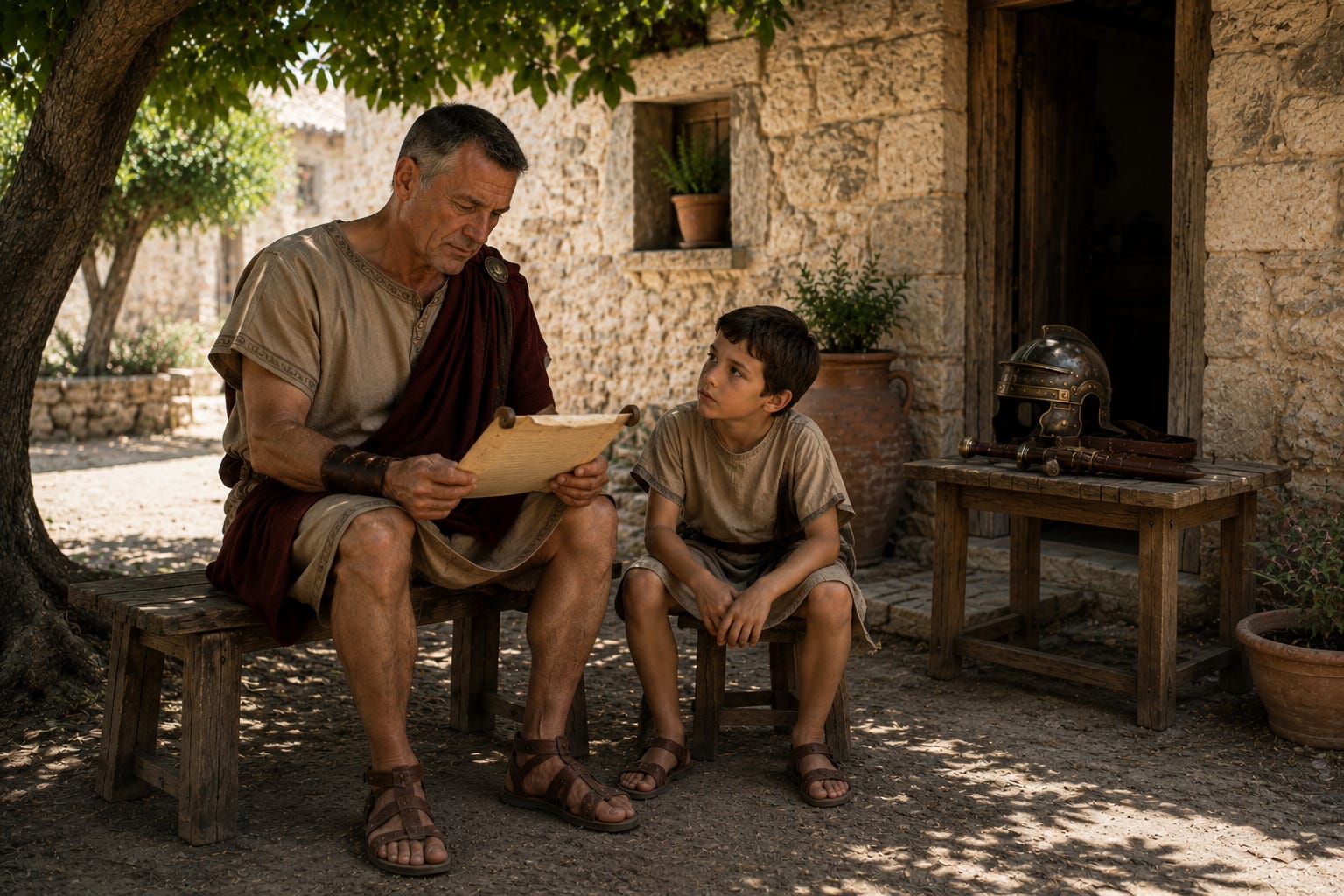
This verse ends the passage in Ephesians 6 about the armor of God. The AI image above is really intriguing. I wasn’t particularly enamored with its explanation, so I’ll do my own. It appears that a Roman soldier, perhaps with his grandson, is reading a scroll. This scroll has the word of God and the soldier is one of many new converts to the new religion of Christianity, along with his family members. Over on the table, his helmet and sword are readily available because he is still a soldier, but the true helmet of salvation invisibly rests on their heads and the word of God they are reading is the sword of the Spirit.
Here’s the commentary from Enduring Word about this verse:
d. And take the helmet of salvation: In the ancient world this usually was a leather cap studded with metal for extra strength. Often some kind of plume or decoration was added, perhaps to identify the solider to his regiment. Salvation is pictured as this kind of helmet, protecting an essential part of the body. A soldier would be foolish to go into battle without his helmet.
i. 1 Thessalonians 5:8 speaks of the helmet of salvation in connection to the hope of salvation. The helmet of salvation protects us against discouragement, against the desire to give up, giving us hope not only in knowing that we are saved, but that we will be saved. It is the assurance that God will triumph.
ii. One of Satan’s most effective weapons against us is discouragement. When we are properly equipped with the helmet of salvation, it’s hard to stay discouraged.
e. The sword of the Spirit, which is the word of God: The idea is that the Spirit provides a sword for you, and that sword is the word of God. To effectively use the sword of the Spirit, we can’t regard the Bible as a book of magic charms or tie one around our neck the way that garlic is said to drive away vampires.
i. To effectively use the sword, we must regard it as the word of God – which is the word of God. If we are not confident in the inspiration of Scripture, that the sword really came from the Spirit, then we will not use it effectively at all.
ii. But we must also take the sword of the Spirit in the sense of depending that He helps us to use it. Not only did the Spirit give us the Scriptures, but also He makes them alive to us (or us alive to them), and He equips us with the right thrust of the sword at the right time.
iii. Think of a soldier or a gladiator in training, practicing sword thrusts and moves and positions. Now, he must practice them ahead of time and if he is a superior fighter and has a great fighting instinct, at the time of battle he will instantly recall which thrust, which position suits the precise moment. He will never be able to use the thrust in the fight if he has not first practiced it; but he still needs to make the move at the moment.
iv. Therefore, effectively using the sword takes practice. The great example of this was Jesus combating the temptation of Satan in the wilderness.
The helmet of salvation protects us from the discouragement and doubt that the enemy aims at our heads. Both discouragement and doubt are mental processes; the enemy loves to use our thinking as a way to turn us away from Jesus. I was too much of a know-it-all earlier in my life and ended up on the path of discouragement and doubt for many years.
Steven Cole has this to say about the helmet of salvation, as quoted in Precept Austin:
The helmet protects your head from the enemy’s attacks. Your head is a very important part of your body, because it contains your brain, which controls everything. Your head determines how you think about all of life. How you think in large part determines how you feel and how you act....
To put on the helmet of salvation requires that you learn to think biblically about the predominant worldviews. You must develop a Christian mind, a saved mind. Your head determines how you function in all of life. If your brain is not working properly, it affects how other parts of your body work. A brain injury can affect motor skills or the ability to speak or think clearly. If a soldier got knocked unconscious by a blow to the head, he was probably doomed. He had to guard his head by having his helmet securely in place.
Spiritually, salvation determines how we live in this sinful world. We live as pilgrims who have been rescued from this present evil kingdom of Satan. We live in subjection to Jesus Christ as Lord and King. We view everything—values, money, entertainment, the arts, or politics—from the perspective of being saved people. Understanding the doctrine of salvation equips us to stand firm against the schemes of the devil.
Salvation is the foundational doctrine to understand cognitively and to know experientially. Putting on the helmet of salvation protects everything in your life. Your head determines how you relate to others. Once you put on the helmet of salvation, you realize that all people are in one of two (and only two) camps: either they are saved and going to heaven; or, they are lost and going to hell....
But because you have put on the helmet of salvation, you relate to people differently than you did before. You now love the people of God, whom you avoided before. You now view lost people with compassion and understanding, yearning that they would come to know God through Jesus Christ.....
So when Paul tells us to take the helmet of salvation, he is saying, “Don’t go into the world with your head unprotected. Mind thy head!” It determines how you think, how you function in all of life, and how you relate to people. As someone said, “Watch your thoughts, they become words; watch your words, they become actions; watch your actions, they become habits; watch your habits, they become character; watch your character, for it becomes your destiny” (Frank Outlaw, in Readers' Digest [date unknown]).
Probably the most important takeaway from this is that we must develop a Christian mind, which is a saved mind. By seeing that there are only two paths for us eternally, this helps the believer focus on what is important, like sharing the word of God with as many as possible and having compassion for the lost and praying for them.
I want to insert a word study here from the Blue Letter Bible:
Word comes from the Greek neuter noun ῥῆμα or rhēma (Strong’s G4487), with the following Biblical usages:
that which is or has been uttered by the living voice, thing spoken, word
any sound produced by the voice and having definite meaning
speech, discourse
what one has said
a series of words joined together into a sentence (a declaration of one’s mind made in words)
an utterance
a saying of any sort as a message, a narrative
concerning some occurrence
subject matter of speech, thing spoken of
so far forth as it is a matter of narration
so far as it is a matter of command
a matter of dispute, case at law
This usage is in contrast to logos, which was used by John to describe “the Word” in the beginning of his Gospel.

Here’s what Ray Stedman has to say about this word, rhema, in Ephesians, as quoted in Precept Austin:
It is important to see that Paul doesn’t mean the complete Bible when he says “the Word of God.” There are two words that are used in the original Greek Scripture for “the Word of God.” There is the familiar Greek word logos, which is used in the opening verse of John’s Gospel, “In the beginning was the Logos [Word], and the Logos was with God, and the Logos was God.”
Then there is another word, used less frequently, rhema, which is somewhat different in meaning than the first. The word logos refers to the total utterance of God, the complete revelation of what God has said. The second word, rhema, means a specific saying of God, a passage or a verse that has special application to an immediate situation. It implies a use of the Word of God that is applied to a specific experience in our lives.
The second word, rhema, is the one used here. The “sword of the Spirit” is the saying of God applied to a specific situation in your life. That is the great weapon placed in the hands of the believer. Perhaps you have had some experience with this. Sometimes, when you are reading a passage of Scripture, the words seem to suddenly come alive, take on flesh and bones, and leap off the page at you. Sometimes they seem to grow eyes that follow you around everywhere you go, or develop a voice that echoes in your ears until you cannot get away from it. Perhaps you have had that experience in some moment of temptation or doubt when you were assailed by what Paul calls here “the flaming arrows of the evil one.” And immediately a passage of Scripture that supplies the answer comes flashing to mind. That passage of Scripture is God’s rhema for you.
Or perhaps you have been asked a question that caught you off guard for a moment and you were about to say, “I don’t know,” when suddenly you had a moment of illumination and a word of Scripture came to mind that provided the answer. Perhaps this experience has happened while sitting in a meeting where some message has come home to your heart with an unusually powerful effect. You were greatly moved, and in that moment you made a significant and lasting decision. That illuminating word of Scripture was God’s rhema for you.
The rhema-word of God in your life is called “the sword of the Spirit” because it not only originated by the Spirit as the author of the Word but it is also recalled to your mind by the Spirit and made powerful by Him in your life. It is His specific, well-chosen answer to the attack of the devil. Like a swordsman with a trusty blade in his hand, the Spirit brings a flashing, sharp-edged, highly polished word to our mind to parry the sword-thrust of the devil
But a sword is useful for both defense and for offense. So it is with the sword of the Spirit, the Word of God. As a sword, the Word is useful for both defensive and offensive purposes. It is, in fact, the only part of the armor of God that can be used for offense. It protects us for attack, in that it can be used to parry and deflect the vicious sword-strokes of the enemy--but it goes further, in that it can also be used to pierce other human hearts with the truth and to hack away and kill the lies of the devil in others besides ourselves. That is its great effect...
A man once came to me for counseling. He was in the grip of a terrible emotional and spiritual depression--one of the most lonely, isolated, miserable people I have ever met--and we met together every week for over a year. His liberation began when he decided to pray a single phrase of Scripture whenever he was in the grip of his depression. It was the one portion of Scripture this man could, in faith, lay hold of. He rejected everything else I tried to point out to him. But one phrase stuck with him, and he prayed it again and again, the words of Jesus in the Garden of Gethsemane: “Not my will but Yours be done.” At last, slowly, like the sun coming up, the light began to dawn, and you could see the change in his life. Today he is living a normal, free life. He was set free by “the sword of the Spirit,” the rhema, the saying of God given specifically for his situation. (Ray Stedman. Spiritual Warfare - Available online and highly recommended!)
This is such a great distinction on the Word and its Greek origins! I have difficulty memorizing scripture, for some reason, although my brain contains huge numbers of neural networks full of useless trivia and facts. However, I know the words that matter and they have come to me at the right times guided by the Spirit! I may not recall where they were exactly in Mark 4 or Matthew 6 or John 3 or Ephesians 2 or Philippians 4 but I can recall the truth of the word and the word itself. I know to be anxious for nothing but in everything through prayer and petition to bring my requests to God and His peace will surpass all understanding. I know that Jesus is the Way, the Truth and the Life and we will not come to the Father without believing in Him. I may not remember the chapter and verse when Paul was in prison with Silas in Acts and they were singing (and I studied Acts, remember), but I KNOW that his example of faith helped convert the jailer and his family and is an example for all of us for any circumstance in our lives. The chapters and verse numbers are a human artifact, but the word stretches across them and then into our minds.
My next devotional examines Ephesians 6:18-20 - Paul asks for prayers on his behalf.
NOTE: I am nearing the end of Ephesians! My plan is to finish the remaining verses, summarize what we learned in this great epistle and then begin a dive into Isaiah (with much trepidation and prayer).
NOTE 2: Prayers are much appreciated today (6/6) as we are losing a very sweet kitty that we have loved for 12 years. Steve will have a devotional on Tuesday about this. Pippin became ill earlier year and we did what we could, but he is at the end and we are so sad. God’s creation is beautiful and so loved!
Heaven on Wheels Daily Prayer:
Dear Lord - I thank you for destroying doubt and discouragement and for creating a way for us to see and use Your word exactly at the right times and places. Amen.
Citations and Credits:
Scripture quotations taken from the (NASB®) New American Standard Bible®, Copyright © 1960, 1971, 1977, 1995 by The Lockman Foundation. Used by permission. All rights reserved. www.Lockman.org.
“G4487 - rhēma - Strong’s Greek Lexicon (NASB95).” Blue Letter Bible. Web. 5 Jul, 2026. <https://www.blueletterbible.org/lexicon/g4487/nasb95/mgnt/ss1/0-1/>.
Precept Austin was accessed on 07/05/2026 to review commentary for Ephesians 6:17.
Commentary from Enduring Word is used with written permission and without any alteration. ©1996-present The Enduring Word Bible Commentary by David Guzik – enduringword.com.
I love it, good work. Those are some of my favorite verses.
https://eliasoftheveil.substack.com/p/principalities-powers-spiritual-wickedness?r=8ghiqg&utm_campaign=post&utm_medium=web&showWelcomeOnShare=true
Thanks alot