



“Therefore, laying aside falsehood, speak truth each one of you with his neighbor, for we are members of one another.”
Ephesians 4:25 NASB1995
Back in my working days, I had an opportunity to go through the screening for a higher security clearance to work on certain programs. This process required me to undergo a polygraph examination. At the end of the process, the person conducting the polygraph told me that I was “too honest”. I passed, but was cautioned to be careful in my “honesty”. In the type of work that I would get involved in, it was imperative, per company AND government requirements, that I never tell an uncleared person (including my spouse or any other family member or close friend) what I was working on. This burden was put in place until the end of my natural life. I wasn’t supposed to “lie”, per se, but I also wasn’t supposed to be honest with them. I had internal difficulty many times with these requirements, but I somehow have managed to never “spill the beans” by just not talking about it. Years later I don’t even remember the details of those programs, quite honestly (and gratefully).
So was I living a lie? This admonition by Paul to the saints at Ephesus opens up many cans of worms, folks!
First let’s do a word study using the Blue Letter Bible lexicon:
Falsehood comes from the Greek neuter noun ψεῦδος or pseûdos (Strong’s G5579), with the following Biblical usages:
a lie
conscious and intentional falsehood
in a broad sense, whatever is not what it seems to be
of perverse, impious, deceitful precepts
Lying is so egregious that it is identified in the Ten Commandments, usually identified as commandment #9 in this verse where the commandments are repeated in Deuteronomy:
“‘You shall not bear false witness against your neighbor.”
Deuteronomy 5:20 NASB1995
Enduring Word has good commentary on the verse and commandment from Deuteronomy:
a. You shall not bear false witness against your neighbor: The primary sense of this command has to do with the legal process. Yet it is common to speak in an informal court, where what we say is taken seriously and truth or error matters for us and for others.
i. In an extended sense, we can break the ninth commandment through slander, tale-bearing, creating false impressions, by silence, by questioning the motives behind someone’s actions, or even by flattery.
ii. “Slander…is a lie invented and spread with intent to do harm. That is the worst form of injury a person can do to another. Compared to one who does this, a gangster is a gentleman, and a murderer is kind, because he ends life in a moment with a stroke and with little pain. But the man guilty of slander ruins a reputation which may never be regained, and causes lifelong suffering.” (Redpath)
iii. “Talebearing…is repeating a report about a person without careful investigation. Many, many times I have known what it is to suffer with that. To repeat a story which brings discredit and dishonor to another person without making sure of the facts, is breaking this commandment.… How many people, especially Christian people, revel in this, and delight in working havoc by telling tales about others. To excuse the action by saying they believed the report to be true, or that there was no intention to malign, is no justification.” (Redpath)
iv. Inappropriate silence may also break this command. “When someone utters a falsity about another and a third person is present who knows that statement to be untrue but, for reasons of fear or being disliked, remains quiet, that third person is as guilty of breaking this law as if he had told a lie.” (Redpath)
v. “If one has evidence of a public charge against anyone and withholds that evidence, ‘he will be held responsible’ (Lev 5:1). Upholding the truth was important in Israel.” (Kalland)
b. You shall not bear false witness against your neighbor: The New Testament puts it simply. Do not lie to one another, since you have put off the old man with his deeds (Colossians 3:9). Lying and false representations belong to the old man, not to the new life believers have in Jesus Christ.
i. “How very strange that we have ever come to think that Christian maturity is shown by the ability to speak our minds, whereas it is really expressed in controlling our tongues.” (Redpath)
ii. “What a startling revelation it would be if a tape recording could be played of all that every church member has said about his fellow members in one week!” (Redpath)
iii. Satan always has an interest in encouraging lies (John 8:44; Acts 5:3), and Jesus Himself was the victim of false witness (Mark 14:57). In some ways, we might say this was the sin that sent Jesus to the cross.
So there are lots of ways to engender a false witness, falsehoods and lies: Slander, tale-bearing (gossip!), creating false impressions about yourself or someone/something, silence in the face of falsities, questioning someone else’s motives, and flattery (to name a few). Being a Christian is not the ability to speak our minds but to control our tongues. What’s really frightening is that half or more of what you read these days is probably a falsehood or created to make a false impression, especially with amoral AI entering the mix. Slander is rampant and gossip and lies travel seven times around the world before the truth can even react (to paraphrase a great quote).
So is it ever, ever appropriate to lie? You might answer this question with a universal negative statement and it is true that God hates lying. But this answer, from Gotquestions.org does touch on a couple of Biblical examples and other dilemmas about lying:
There are at least two instances in the Bible where lying produced a favorable result. For example, the lie the Hebrew midwives tell Pharaoh seems to result in the Lord’s blessing on them (Exodus 1:15-21), and it probably saved the lives of many Hebrew babies. Another example is Rahab’s lie to protect the Israelite spies in Joshua 2:5. It is important to note, however, that God never condones these lies. Despite the positive outcome of these lies, the Bible nowhere praises the lies themselves. The Bible nowhere states that there are instances where lying is the right thing to do. At the same time, the Bible does not declare that there is no possible instance in which lying is an acceptable option.
The question then remains: is there ever a time when lying is the right thing to do? The most common illustration of this dilemma comes from the life of Corrie ten Boom in Nazi-occupied Holland. Essentially, the story is this: Corrie ten Boom is hiding Jews in her home to protect them from the Nazis. Nazi soldiers come to her home and ask her if she knows where any Jews are hiding. What is she to do? Should she tell the truth and allow the Nazis to capture the Jews she was trying to protect? Or, should she lie and deny that she knows anything about them?
In an instance such as this, where lying may be the only possible way to prevent a horrible evil, perhaps lying would be the best of the available options. Such an instance would be somewhat similar to the lies of the Hebrew midwives and Rahab. In an evil world, and in a desperate situation, it may be the right thing to commit a lesser evil, lying, in order to prevent a much greater evil. However, it must be noted that such instances are extremely rare. And, even in those situations, lying would still be a sin, because it would still be violating the character of the God of truth (Hebrews 6:18). The vast majority of lies are due to people seeking to protect themselves, promote themselves, or harm someone else. That is why the Bible so clearly, strongly, and consistently condemns lying as a sin.
Corrie ten Boom was certainly not the only “righteous among nations” and devout Christian who lied to keep innocent people from being sent to their deaths just because of their ethnicity. I have to confess - had I lived in that time I might have also practiced subterfuge or lied to save Jews and others from a certain death. Roddie Edmonds, an American POW in Germany during the war, lied to the camp authorities with a gun to his head when they asked about Jewish prisoners by saying that all of them were Jewish. Edmonds posthumously received the Medal of Honor this year for saving over 300 Jewish POWS. People that worked in resistance movements and underground groups during WWII became quite good at hiding their activities, through silence or lying (and it would still be a sin regardless of the nobility of the cause), but they also saved many lives. What a horrible dilemma!

Those circumstances are rare exceptions to the precept against lying. People usually lie for selfish or harmful reasons or “rationalizations” that are almost engrained in our DNA. Here’s an excerpt from a sermon by Steven Cole quoted on Precept Austin:
One of the greatest moral issues that we all struggle with is that of telling the truth, the whole truth, and nothing but the truth. The book, The Day that America Told the Truth, states (p. 45) that 91 percent of us lie regularly (cited by Alistair Begg, “Cedarville Torch, Fall, 1994, p. 15). “Of the people interviewed, 92 percent said the main reason for their lying was to save face, and 98 percent said the reason they told lies was so as not to offend people” (ibid.).
Another survey of 20,000 middle- and high-schoolers indicated that 92 percent admitted to lying to their parents in the previous year, and 73 percent said that they told lies weekly. Despite these admissions, 91 percent of all respondents said they were “satisfied with my own ethics and character” (Reader’s Digest [Nov., 1999], pp. 81-82). Their consciences were insensitive to their sin! (cp Ro 1:32+)
Lest you think, “Well, these surveys were probably taken among pagans,” pollster George Gallup indicts us when he says, “church attendance makes little difference in people’s ethical views and behavior with respect to lying, cheating, pilferage, and not re-porting theft” (cited by Vernon Grounds, “Focal Point” [Summer, 1995], p. 8).
We bend the truth in many ways. There is the half-truth. You sort of tell the truth, but not the whole truth. You tell your employer, “I wasn’t feeling well,” which was sort of true. But, in reality, you were not so ill as to miss work. You just wanted to do something else. Or, there is the white lie, a supposedly “innocent” lie that doesn’t hurt anyone. “Yes, your new hairdo is beautiful!” “Thank you, I just love fruitcake!”
There are the lies that cover for someone or for ourselves: The boss is in the next room, but you say, “He’s not here right now to take your call.” Often, the rationalization for cover-up lies is that the truth would hurt too many people. This was the excuse behind the Watergate scandal that brought down the Nixon administration. It would “hurt the country” if the truth were known!
Or, lies often go undercover as exaggeration. You stretch the story a bit to make yourself look better or to evoke sympathy. One of the easiest lies to fall into is the silent lie. This is where someone assumes something about you, which you know to be untrue. But, their mistaken view makes you look good, so you just let it go by and don’t say anything to correct it. In a similar way, we use evasive lies. We change the subject or don’t directly answer the question.
We also bend the truth by cheating on our income taxes, always with the justification that the government wastes so much money or that the tax system is unfair to the little guy (that’s me!). We cheat on tests with the excuse, “everyone else does it.” Or, we pilfer from our employer with the rationalization that they don’t pay me enough. Or, if the clerk at the store makes a mistake to our advantage, we don’t say anything to make it right. We figure, “They over-charge for everything, anyway!” (To Tell the Truth Ephesians 4:25).
Holy Cannoli! Anyone who claims complete honesty in their lives is a liar! I cringed at some of these examples of lying, including white lies, half-truths, exaggerations, and lies by omission or silence. I knew many people who padded their travel expense reports (including a couple of co-workers who got fired for fraud). I have run back to the store because of a missing item or an overcharge, but I know I brushed off an undercharge or two over the years. I told white lies to keep my sensitive mother happy when she was alive. I have lied about my job to protect security concerns. I have exaggerated my accomplishments just a wee bit, especially when writing a resume.
We live in an extremely low-trust society. No one trusts their neighbor, their church congregation, the media, the person walking behind them on a dark street, the opposite political party or most authority figures. Lately the news has been full of stories about an expedition cruise ship that has had several people become ill or die from a rare person-to-person transmissible form of hantavirus (the “Andes” strain). This is a deadly disease with about a 38% fatality rate, about the same as the cases that come from direct exposure to the source (rodent droppings and urine). Hantavirus is familiar to anyone who lives in the western US. I recall sweating bullets for about eight weeks many years ago when we were cleaning out a storage locker that my parents owned and I picked up a fishing net that had a dead deer mouse in it!
Unfortunately, the perceived overreaction to COVID-19 six years ago and the concerns around side effects from the vaccines that were developed have made many people extremely skeptical of this story (go read the comments on the news sources; some people even believe there are no such things as “viruses” and are calling this mini-epidemic a ploy to steal the 2026 midterm elections). A low-trust society quickly devolves into total anarchy if nothing can be believed. That same low-trust society will have massive fatality rates if a truly deadly virus became a pandemic because people will not trust and obey health authorities. Low-trust societies are also full of gossip, falsehoods, conspiracy addicts and outright slander. Social media is a powerful tool for the enemy to destroy human bonds and compassion.
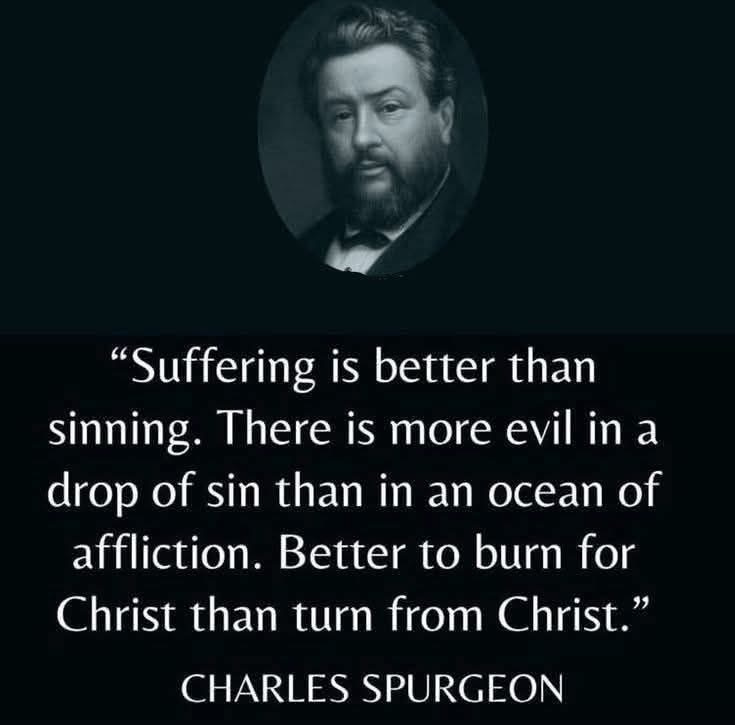
God hates lying, period. Peter found this out the hard way, but the good news is that he was forgiven and given another chance by Jesus. We must transform into the new human through Him, but rest assured there IS forgiveness there (over and over again) if we confess our sins (including lies that we never thought about before). We will never be perfect in this lifetime and the sin of lying, in all of its manifestations, is probably the one that is hardest to discard. Just keep in mind that lying about your faith to “save face” with unbelievers is one of the worst sins you can commit; many Christian martyrs have accepted death rather than lie and pretend they no longer believe. Stay strong in the faith! I found this quote from Charles Spurgeon on-line today on that very subject:
My next devotional examines Ephesians 4: 26 - Be angry, but don’t sin in your anger.
Heaven on Wheels Daily Prayer:
Dear Lord - Please forgive me for the times I’ve embellished the truth, told white lies to spare someone’s feelings, kept quiet or redirected a conversation to keep from telling the truth, and also kept quiet when someone praised me for something that was not my doing or was an effort done by a group. Please help me grow in my faith and my honesty and integrity. Amen.
Citations and Credits:
Scripture quotations taken from the (NASB®) New American Standard Bible®, Copyright © 1960, 1971, 1977, 1995 by The Lockman Foundation. Used by permission. All rights reserved. www.Lockman.org.
“G5579 - pseudos - Strong’s Greek Lexicon (NASB95).” Blue Letter Bible. Web. 12 May, 2026. <https://www.blueletterbible.org/lexicon/g5579/nasb95/mgnt/0-1/>.
Gotquestions.org was accessed on 05/11/2026 to answer the question, Is it ever right to lie? © COPYRIGHT 2002-2026 GOT QUESTIONS MINISTRIES. ALL RIGHTS RESERVED.
Precept Austin was accessed on 05/11/2026 and 5/12/2026 to review commentary for Ephesians 4:20-24. Within that commentary was an excerpt from a Steven Cole Sermon. That sermon may be found at this resource: https://bible.org/seriespage/lesson-32-tell-truth-ephesians-425 and is Copyright, Steven J. Cole, 2008, All Rights Reserved. Unless otherwise noted, all Scripture Quotations are from the New American Standard Bible, Updated Edition © The Lockman Foundation
Commentary from Enduring Word is used with written permission and without any alteration. ©1996-present The Enduring Word Bible Commentary by David Guzik – enduringword.com. Within the Enduring Word commentary are the following references for Deuteronomy:
Kalland, Earl S. “Deuteronomy” The Expositor’s Bible Commentary Volume 3 (Grand Rapids, Michigan: Zondervan, 1990)
Redpath, Alan Law and Liberty: The Ten Commandments for Today (Grand Rapids, Michigan: Revell 1993)
Am grateful.
What else is scary is that. om Revelation, it says liars and murderers are not in the Book of life. And, in the scattered lists of sins in the NT, lying is always next to or near murder.