


“In Him, you also, after listening to the message of truth, the gospel of your salvation—having also believed, you were sealed in Him with the Holy Spirit of promise, who is given as a pledge of our inheritance, with a view to the redemption of God’s own possession, to the praise of His glory.”
Ephesians 1:13-14 NASB1995
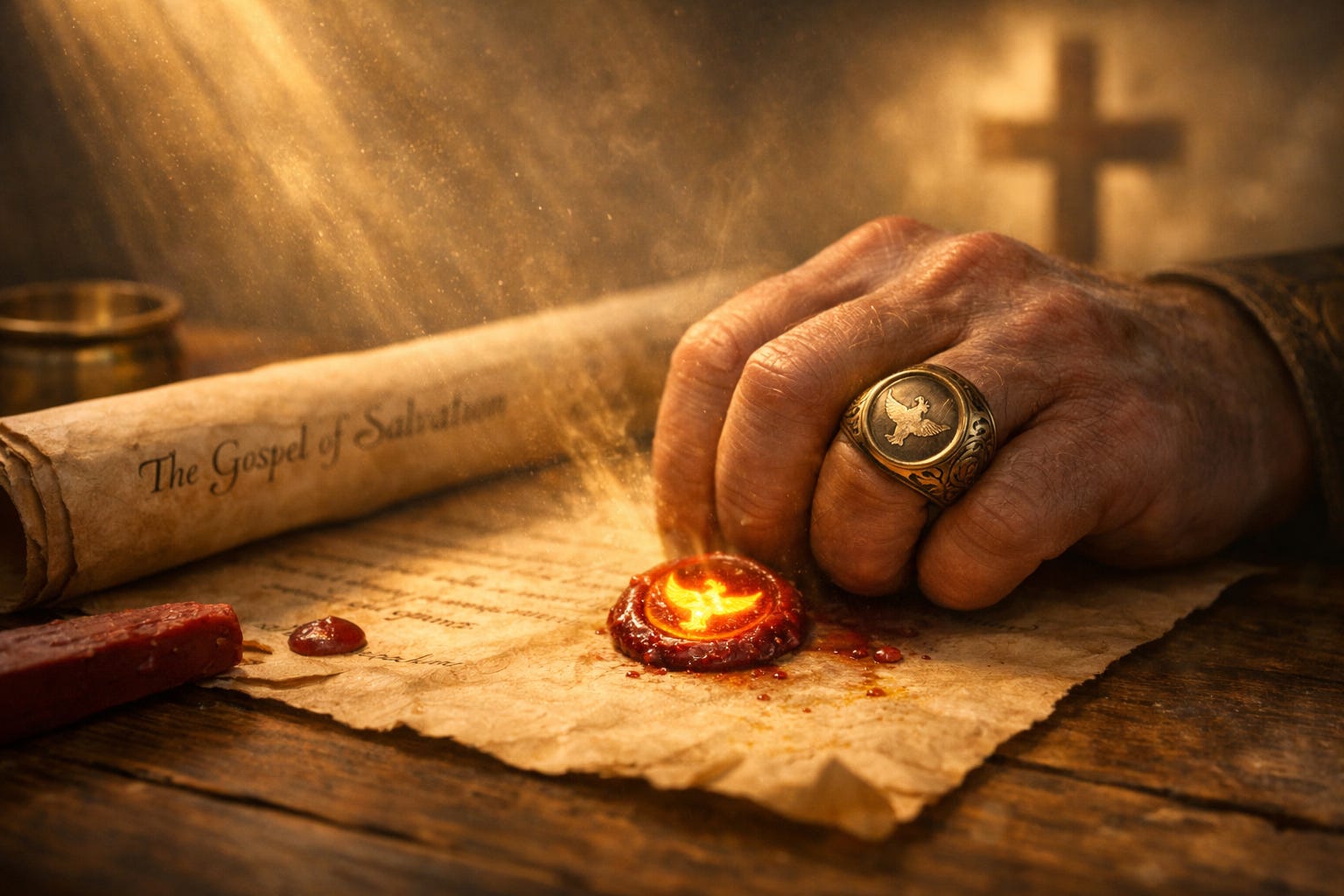
We finally reached a clean verse break in this lengthy passage at the beginning of Ephesians 1. Once again, Steve fed the identified verses to ChatGPT and it produced the AI image at the top. The ring seal apparently represents the Holy Spirit, with the image of the dove. It has been stamped onto the Gospel of Salvation, sealing believers in His promises. There are a number of symbols for the Holy Spirit and Gotquestions.org identifies those symbols:
The Bible presents various symbols of the Holy Spirit, each depicting different attributes of His nature or aspects of His work.
The dove is perhaps the most recognized symbol of the Holy Spirit in Scripture: “As soon as Jesus was baptized, he went up out of the water. At that moment heaven was opened, and he saw the Spirit of God descending like a dove and alighting on him. And a voice from heaven said, ‘This is my Son, whom I love; with him I am well pleased’” (Matthew 3:16–17; see also Mark 1:10; Luke 3:22; John 1:32). The dove is associated with God’s blessing and pleasure and expresses the Holy Spirit’s gentleness, innocence, purity, and patience (Matthew 10:16; Psalm 68:13).
The Holy Spirit is represented as a seal or pledge expressing God’s ownership of the believer: “And you also were included in Christ when you heard the message of truth, the gospel of your salvation. When you believed, you were marked in him with a seal, the promised Holy Spirit, who is a deposit guaranteeing our inheritance until the redemption of those who are God’s possession—to the praise of his glory” (Ephesians 1:13–14; see also 2 Corinthians 1:22). The Holy Spirit as a seal or pledge is the believer’s security in Christ, proof that he or she belongs to God forever (John 6:37; Ephesians 4:30).
Oil is a sign of the Holy Spirit’s approval, anointing, and power: “The Spirit of the Lord is on me, because he has anointed me to proclaim good news to the poor. He has sent me to proclaim freedom for the prisoners and recovery of sight for the blind, to set the oppressed free” (Luke 4:18; see also Acts 10:38; 1 Samuel 16:13; Isaiah 61:1). Biblical scenes of Israel’s kings and priests being anointed with oil are pictures of God’s choice and blessing. The New Testament uses the anointing with oil as a picture of the blessing of the Holy Spirit on all believers: “You have an anointing from the Holy One, and all of you know the truth” (1 John 2:20).
Emphasizing purification, fire is a symbol of the Holy Spirit’s power and presence: “I baptize you with water for repentance. But after me comes one who is more powerful than I, whose sandals I am not worthy to carry. He will baptize you with the Holy Spirit and fire” (Matthew 3:11; see also Exodus 3:2; Isaiah 4:4; Luke 3:16–17; 1 Thessalonians 5:19). On the day of Pentecost, as the disciples saw “what seemed to be tongues of fire” resting on them, and they were filled with the Holy Spirit (Acts 2:3–4).
The invisible, everywhere-present power and life-giving influences of the Holy Spirit are expressed as wind or breath in the Bible: “The wind blows wherever it pleases. You hear its sound, but you cannot tell where it comes from or where it is going. So it is with everyone born of the Spirit” (John 3:8; cf. 20:22). The meaning of the Greek and Hebrew words for “spirit” are synonymous with “breath” or “wind.” The powerful outpouring of the Holy Spirit was accompanied by the sound of a mighty, rushing wind on the day of Pentecost (Acts 2:2).
Water symbolizes the cleansing nature of the Holy Spirit’s new birth: “Jesus answered, ‘Very truly I tell you, no one can enter the kingdom of God unless they are born of water and the Spirit’” (John 3:5; see also Ezekiel 36:25–27). Water also expresses the thirst-quenching, soul-satisfying, life-giving character of the Holy Spirit (John 4:14; see also Isaiah 12:3; 44:3).
Similar to water, rain is a symbol of the Holy Spirit’s refreshing: “Let us acknowledge the LORD; let us press on to acknowledge him. As surely as the sun rises, he will appear; he will come to us like the winter rains, like the spring rains that water the earth” (Hosea 6:3). Likewise, rivers in the Bible typify the abundance and prosperity that flow forth from the Holy Spirit: “On the last and greatest day of the festival, Jesus stood and said in a loud voice, ‘Let anyone who is thirsty come to me and drink. Whoever believes in me, as Scripture has said, rivers of living water will flow from within them’” (John 7:37–38; see also Psalm 1:3). Also, the symbol of dew illustrates the Holy Spirit’s refreshment, abundance, and fertility (Genesis 27:28; Isaiah 18:4).
In the Bible, wine is sometimes a symbol of the joy-giving quality of the indwelling presence of the Holy Spirit. Some of the more cynical onlookers who observed the outpouring of the Spirit on the Day of Pentecost thought the disciples were drunk on wine. But the apostle Peter explained, “These people are not drunk, as you suppose. It’s only nine in the morning! No, this is what was spoken by the prophet Joel: ‘In the last days, God says, I will pour out my Spirit on all people. Your sons and daughters will prophesy, your young men will see visions, your old men will dream dreams’” (Acts 2:15–17).
Clothing is also a symbol of the Holy Spirit. After His resurrection, Jesus told the disciples to wait in Jerusalem “until you have been clothed with power from on high” (Luke 24:49). The passive voice of the verb indicates that the individual does not dress himself. The apostles were to remain in Jerusalem until they were “clothed” by God with the Holy Spirit’s power.

If you look at the KJV (King James) version of these verses, this is what they say:
“In whom ye also trusted, after that ye heard the word of truth, the gospel of your salvation: in whom also after that ye believed, ye were sealed with that holy Spirit of promise, which is the earnest of our inheritance until the redemption of the purchased possession, unto the praise of his glory.”
Ephesians 1:13-14 KJV
This has been interpreted by some, including Lloyd-Jones and Spurgeon as implying that there is a time delay from the moment of belief to the sealing of the Holy Spirit (or it may not ever happen in the believer). Here is what Steven Cole, quoted in Precept Austin says about this misinterpretation:
…"many teach that there is a time lapse between believing in Christ and receiving the Holy Spirit and that only some experience the sealing of the Spirit. This view was fostered by the old King James translation, which stated, “in whom also after that ye believed, ye were sealed with the Holy Spirit of promise.” The word after implies a time lapse. Even Charles Spurgeon and Martyn Lloyd-Jones, whom I greatly respect, err in arguing that the sealing of the Spirit is an experience that only some believers receive subsequent to salvation. But that undermines Paul’s entire point here, which is to assure all believers that God has sealed them with the Spirit at the moment of faith in Christ. (Secure in Him - Ephesians 1:13-14). (Bold italics added for emphasis by Precept Austin).
The link goes to a great sermon by Steven Cole on the Holy Spirit and how people misinterpret the third Being of the Trinity. I am in agreement that the moment of faith opens us to the gift of the Holy Spirit, not some arbitrary point in time later in our faith lives (or never). If you look at other translations, the NKJV has removed this uncertainty in their translation of the original Greek (as has the NASB, my preferred translation):
“In Him you also trusted, after you heard the word of truth, the gospel of your salvation; in whom also, having believed, you were sealed with the Holy Spirit of promise, who is the guarantee of our inheritance until the redemption of the purchased possession, to the praise of His glory.”
Ephesians 1:13-14 NKJV
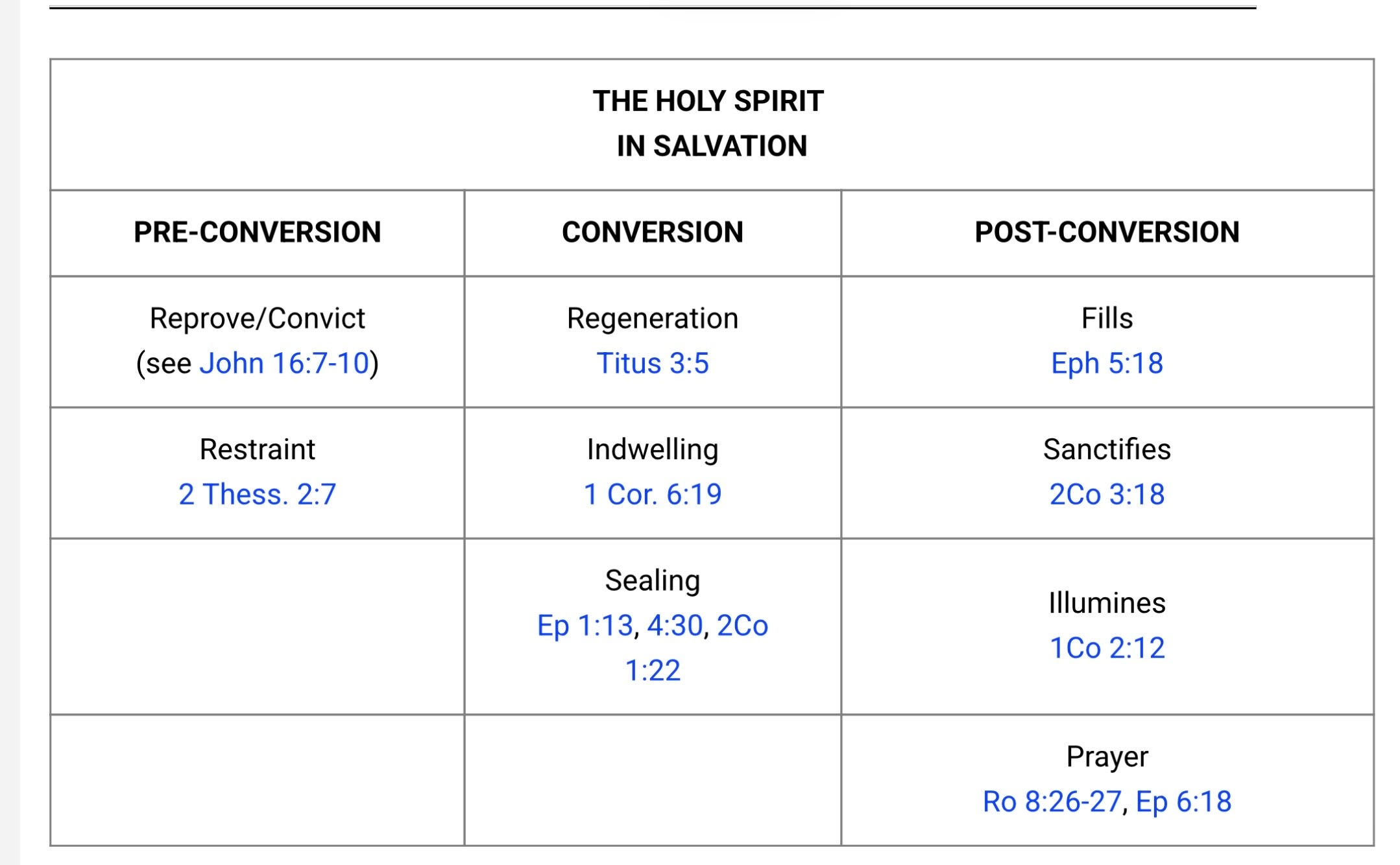
We believe and we are sealed in that promise! Enduring Word has a handy table of how the Holy Spirit works in our salvation, with scripture references:
Charles Spurgeon does have an excellent commentary, quoted in Precept Austin, as to why death bed conversions are most likely false and why we shouldn’t wait until the last moment to make this faith decision:
As for peace in the hour of death, he who is not pardoned while living is not likely to be pardoned when dying. Nine out of ten, perhaps nine hundred and ninety-nine out of every thousand of professed death-bed salvations are a delusion. We have good facts to prove that. A certain physician collected notes of several hundred cases of people who professed conversion when they thought they were dying. These people did not die as they had expected to, but continued to live. In the case of all but one they lived just as they had lived before, though when they were thought to be dying they appeared as if they were truly converted. Do not look forward to a death-bed salvation, it is a mere snare of Satan.
I’ll share one more commentary on this passage, from Enduring Word:
a. In Him you also trusted, after you heard the word of truth: God’s sovereign choice works, but it does not exclude human cooperation. These ones who were so sovereignly chosen were also the ones who trusted, heard the word of truth, and believed.
b. You were sealed with the Holy Spirit of promise: Also essential in God’s work is the sealing work of the Holy Spirit. His presence in our lives acts as a seal which indicates ownership, and which is a guarantee of our inheritance.
i. “The seal is therefore the Holy Spirit Himself, and His presence in the believer denotes ownership and security. The sealing with the Spirit is not an emotional feeling or some mysterious inward experience.” (Gaebelein)
ii. The word guarantee (“down payment”) is used only in the New Testament of the Holy Spirit. He is our only down payment of coming glory; nothing else is provided – or needed.
c. Having believed, you were sealed: The sealing does not come before we believe, and those who demand some assurance from God before they will believe treat God as if His word could not be trusted.
i. “For sealing there are needed the softened wax; the imprint of the beloved face; the steady pressure. Would that the Spirit might impress the face of our dear Lord on our softened hearts, that they may keep it for evermore!” (Meyer)
d. Until the redemption of the purchased possession: We have this guarantee until we are “completely purchased” by God through resurrection and glorification – again, all to the praise of His glory.
I have never had that “aha” moment that tells me that Holy Spirit is indwelling within me. Instead, I see changes happening over longer periods of time that point to His guidance and illumination. It is not an emotional experience, but it is a sense of unbelievable security.
My next devotional examines Ephesians 1:15-16 - Paul gives thanks to the saints.
Heaven on Wheels Daily Prayer:
Dear Lord - I thank you for the sanctification that comes with the indwelling of the Holy Spirit. Amen.
Citations and Credits:
Scripture quotations taken from the (NASB®) New American Standard Bible®, Copyright © 1960, 1971, 1977, 1995 by The Lockman Foundation. Used by permission. All rights reserved. www.Lockman.org.
Precept Austin was accessed on 03/25/2025 to review commentary for Ephesians 1:13-14. Within the Precept Austin commentary was a link to Gotquestions.org: Gotquestions.org was accessed to answer this question: What are some of the symbols of the Holy Spirit in the Bible?Gotquestions.org Copyright © 2026 all rights reserved.
Commentary from Enduring Word is used with written permission and without any alteration. ©1996-present The Enduring Word Bible Commentary by David Guzik – enduringword.com. Within the Enduring Word commentary:
Gaebelein, Arno C. God’s Masterpiece (Glasgow: Pickering and Inglis, 1913)
Meyer, F.B. Our Daily Homily (Westwood, New Jersey: Revell, 1966)
NKJV: Copyright © 1982 by Thomas Nelson, Inc. All Rights Reserved. Used through the Bible App with permission.