


“Therefore I, the prisoner of the Lord, implore you to walk in a manner worthy of the calling with which you have been called, with all humility and gentleness, with patience, showing tolerance for one another in love, being diligent to preserve the unity of the Spirit in the bond of peace.”
Ephesians 4:1-3 NASB1995
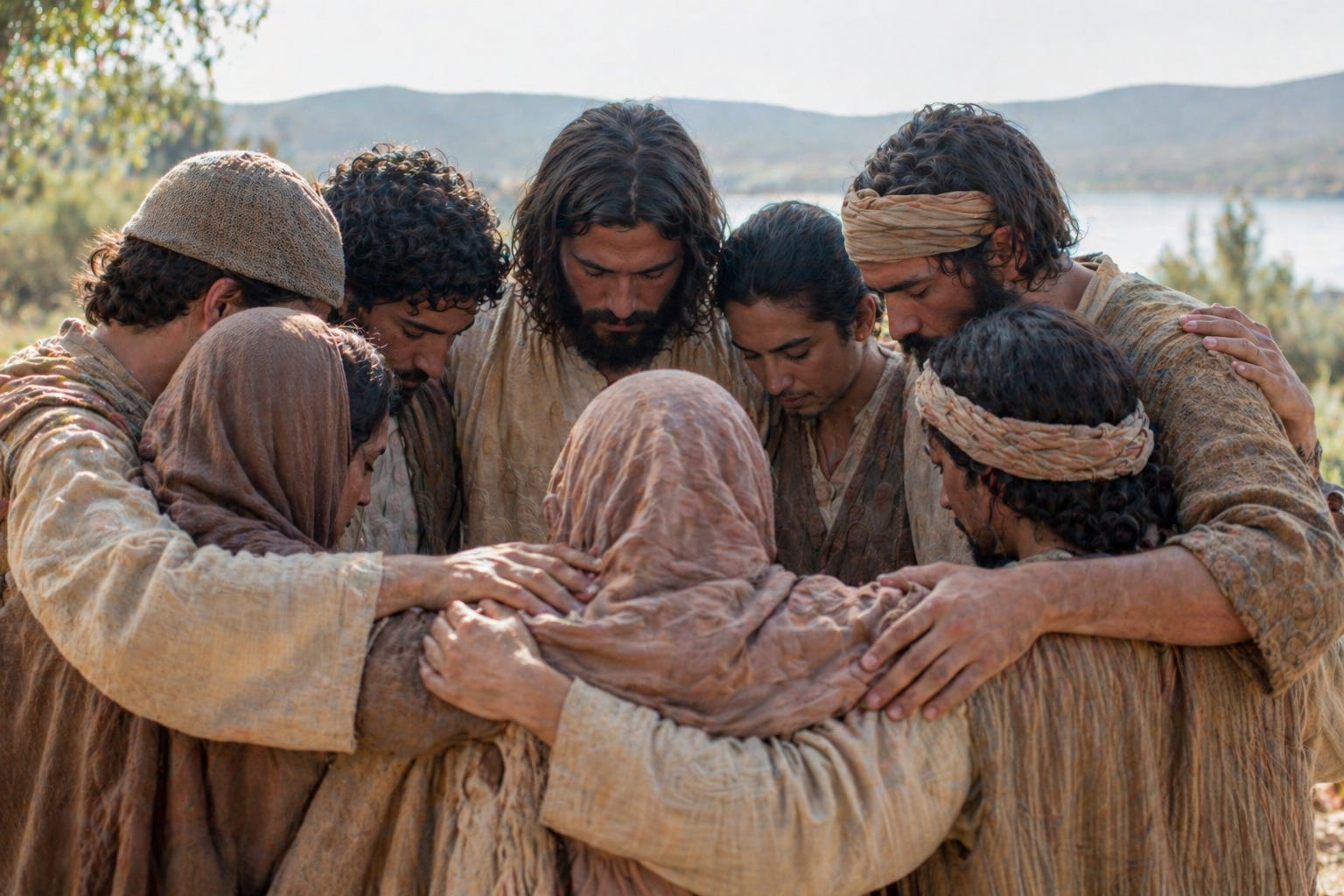
Paul spent the first three chapters of Ephesians telling us what God has done for us. The last three chapters of the book are focused on how we, as believers, can put this into practice and demonstrate our virtues as Christians. Paul, as a grateful prisoner of the Lord (he doesn’t care about his physical imprisonment), implores us to walk in a manner worthy of the calling for which we have been called. The ChatGPT image at the top shows early believers practicing this unity of the Spirit.
Let’s do a word study from the Blue Letter Bible lexicon:
Implore comes from the Greek verb παρακαλέω or parakaléō (Strong’s G3870), with the following Biblical usages:
to call to one’s side, call for, summon
to address, speak to, (call to, call upon), which may be done in the way of exhortation, entreaty, comfort, instruction, etc.
to admonish, exhort
to beg, entreat, beseech
to strive to appease by entreaty
to console, to encourage and strengthen by consolation, to comfort
to receive consolation, be comforted
to encourage, strengthen
exhorting and comforting and encouraging
to instruct, teach
Paul is begging, beseeching, encouraging, comforting, and instructing the saints at Ephesus to walk in a worthy manner. This worthy manner includes humility, gentleness, patience, showing tolerance for one another out of love, and being diligent to preserve the unity of the Spirit in the bond of peace.
When I see how many people who claim to be believers treat other people in comments on social media, I realize that this walk (with all of the attributes suggested by Paul and coming from the Holy Spirit) is extremely difficult when you have the relative anonymity of the internet. I, too, struggle with seeing other opinions sometimes and not reacting, especially viewing comments that cheer on another assassination attempt on the President (or immediately say that it was staged for his advantage, contrary to all evidence). I struggle to not react when I see others laugh at and mock Christians. The best practice is to be diligent in your soul and move past the latest outrages and turn that “doomscrolling” into a prayer of gratitude for what is right in your life, thanks to the Lord. The internet is a powerful tool, but the enemy uses it to its great advantage.
What Paul is doing beginning in Chapter 4 is introducing the doctrine of sanctification. This commentary by Martyn Lloyd-Jones, found on Precept Austin explains this quite well:
"The first section [of Ephesians] consisting of the first three chapters, has been entirely doctrinal. The Apostle has been unfolding and displaying in his own marvelous manner the great essential doctrines of the Christian faith, everything that is central and vital to an understanding of the way of salvation. There is no greater display of the doctrines of the Christian faith than that found in the first three chapters of this Epistle.
But having done that, the Apostle now moves on to the practical application of his doctrine; he goes on to show how it is related to daily life and living. So we are really at a most important point in this Epistle, a point that marks a very real division....The Apostle Paul, when he used the word ‘therefore’, makes the connection between faith and practice quite clear. He has laid down the doctrine; it has now got to be applied....Here, then, in chapter 4, the Apostle proceeds to make a great appeal to the Ephesian believers to put into operation the things he has been teaching them. He reminds them of the things that inevitably follow as a natural consequence from an understanding of the great doctrines of the Christian faith....There is always the danger—and it affects some people more than others—of forgetting that Christianity is, after all, a way of life and a way of living. [My emphasis].
Of course there are certain people who emphasize that alone, and who know nothing about doctrine and are not interested in doctrine. Such people regard Christianity as a system of morality or of ethics. But I am dealing, rather, with people who are evangelically minded, and whose danger is to stop at doctrine only....If we really do know these things, then more is expected of us. From the man who has, much is expected; to whom much has been given, much is also expected. So if we really have been grasping the great doctrines of the first three chapters of this Epistle let us remember this word therefore. We are not to call a halt; we are to go on to the practical life and living, to the ordinary day-to-day application of basic Christian doctrine.
It is a glorious experience to be on top of that mountain; but we must go down to the valleys, to all the problems of daily life and living. Around us is this godless world which cannot know about Christ unless you and I tell them about Christ, either by preaching or by mixing with them in our work and employment and the ordinary avocations in life. We must show what we know, and what we have, and above all show Him in whom we have believed....Doctrine must always come first; and we must never reverse this order. It is, I repeat, the invariable practice in the New Testament itself to speak of doctrine before the application of doctrine. We must not act until we are clear about our doctrine. This is, beyond all question, the most vital principle of all in connection with the New Testament doctrine of sanctification. So we are entitled to say that this word therefore introduces us to the doctrine of sanctification.
The first three chapters of our Epistle with all their astonishing teaching have not considered the doctrine of sanctification as such...The doctrine of the sealing of the Spirit, and the experience of it, is not sanctification. To know the love of Christ is not sanctification. To be filled with all the fulness of God is not sanctification. What then is the relationship between these things? It is that those are things that promote sanctification, that encourage sanctification, and give us motives for sanctification; but they are not sanctification itself....It (Sanctification) is the outworking, the outliving, by the power that God gives us and that is already in us, of the doctrine we have believed and the experiences we have enjoyed from His gracious hands (Precept Austin Editorial remark: cp Jesus' prayer for us in Jn 17:17 which shows us the "modus operandi", the role of Truth, the Word, in growing us in Christ-likeness! Are you daily in the Word of Truth? If not, you are short cutting your sanctification process. It's that simple! In the Word-Grow. Not in the Word-No Growth!). ((Ephesians 4:1-16Mp3's - click to listen to the sermon "Worthy of our Calling") [Note from me - that link doesn’t work].
A few takeaways:
The “therefore” that Paul uses at the beginning of this passage indicates a transition from doctrine to practical application through the Holy Spirit.
Believers often get caught up in a trap of concentrating on doctrine only OR on application only. We need both!
Sanctification is the outworking and the outliving by the power that God gives us. Others cannot help but know us by the fruit of the Spirit.

Enduring Word has had excellent commentary for Ephesians so far, IMHO:
a. Therefore: Paul spent three chapters spelling out in glorious detail all that God did for us, freely by His grace. Now he brings a call to live rightly, but only after explaining what God did for us.
b. Walk worthy of the calling with which you were called: When we really understand how much God did for us, we will naturally want to serve and obey Him out of gratitude.
i. Understanding who we are is the foundation of this worthy walk. “Luther counsels men to answer all temptations of Satan with this only, Christianus sum, I am a Christian.” (Trapp)
ii. The idea is clear. We don’t walk worthy so that God will love us, but because He does love us. It is motivated out of gratitude, not out of a desire to earn merit.
iii. “Every believer is God’s first-born; and so higher than the kings of the earth, Psalm 89:27. He must therefore carry himself accordingly, and not stain his high blood.” (Trapp)
…
a. With all lowliness and gentleness: A worthy walk before God will be marked by lowliness and gentleness, not a pushy desire to defend our own rights and advance our own agenda.
i. Before Christianity, the word lowliness always had a bad association to it. In the minds of many it still does; but it is a glorious Christian virtue (Philippians 2:1-10). It means that we can be happy and content when we are not in control or steering things our way.
b. Longsuffering, bearing with one another: We need this so that the inevitable wrongs that occur between people in God’s family will not work against God’s purpose of bringing all things together in Jesus – illustrated through His current work in the church.
i. Chrysostom defined longsuffering as the spirit that has the power to take revenge, but never does. It is characteristic of a forgiving, generous heart.
c. Endeavoring to keep the unity of the Spirit in the bond of peace: This humble, forgiving attitude towards each other naturally fulfills this gift of the unity of the Spirit.
i. We must endeavor to keep this unity – we do not create it. God never commands us to create unity among believers. He has created it by His Spirit; our duty is to recognize it and keep it.
ii. This is a spiritual unity, not necessarily a structural or denominational unity. It is evident in the quick fellowship possible among Christians of different races, nationalities, languages, and economic classes.
iii. We can understand this unity of the Spirit by understanding what it is not. In a sermon on this text, Charles Spurgeon pointed out some of the things that the text does not say.
· It does not say, “To endeavor to maintain the unity of evil, the unity of superstition, or the unity of spiritual tyranny.”
· It does not say, “Endeavoring to keep up your ecclesiastical arrangements for centralization.”
· It does not say, “Endeavoring to keep the uniformity of the Spirit.”
iv. Structural unity can even work against true unity of the Spirit. We can perhaps see a purpose God has in preventing a structural unity of the church right now, to keep misdirected efforts of the church (such as ambitions for political power) from fulfillment. “It is not a desirable thing that all Churches should melt into one another and become one; for the complete fusion of all Churches into one ecclesiastical corporation would inevitably produce another form of Popery, since history teaches us that large ecclesiastical bodies grow more or less corrupt as a matter of course. Huge spiritual corporations are, as a whole, the strongholds of tyranny and the refuges of abuse; and it is only a matter of time when they shall break to pieces.” (Spurgeon)
v. “For the church fellowship in which the Gentile and Jewish believers were united was no mere enrollment on a register of membership; it involved their union with Christ by faith and therefore their union with each other as fellow-members of his body.” (Bruce)
vi. We are confident that this unity is found in Jesus Christ, by the Spirit of God. “We want unity in the truth of God through the Spirit of God. This let us seek after; let us live near to Christ, for this is the best way of promoting unity. Divisions in Churches never begin with those full of love to the Savior.” (Spurgeon)
WOW! That Spurgeon sermon content is so good. This is unity of the Spirit, not uniformity. I have shared a spaghetti chart several times in my devotionals that shows all of the branches of Christian denominations that came out of that single early church. Unity of the Spirit does not mean structural unity of all churches. Any organization that grows large enough is ripe for inappropriate ambitions, abuse, corruption, and tyranny. The union of believers is found in Christ, not with a person or preacher or pope. We don’t create this unity, but we must recognize it and keep it.
My next devotional examines Ephesians 4:4-6 - One body and one Spirit.
Heaven on Wheels Daily Prayer:
Dear Lord: Please guide me into walking in a manner worthy of my calling, by being eternally grateful for what You have given me! Amen.
Citations and Credits:
Scripture quotations taken from the (NASB®) New American Standard Bible®, Copyright © 1960, 1971, 1977, 1995 by The Lockman Foundation. Used by permission. All rights reserved. www.Lockman.org.
“G3870 - parakaleō - Strong’s Greek Lexicon (NASB95).” Blue Letter Bible. Web. 28 Apr, 2026. <https://www.blueletterbible.org/lexicon/g3870/nasb95/mgnt/0-1/>.
Precept Austin was accessed on 04/28/2026 to review commentary for Ephesians 4:1-3.
Commentary from Enduring Word is used with written permission and without any alteration. ©1996-present The Enduring Word Bible Commentary by David Guzik – enduringword.com. Within that commentary are the following references:
Bruce, Frederick Fyvie The Epistles to the Colossians, to Philemon, and to the Ephesians (Grand Rapids, Michigan: Eerdmans, 1984)
Spurgeon, Charles Haddon The New Park Street Pulpit, Volumes 1-6 and The Metropolitan Tabernacle Pulpit, Volumes 7-63 (Pasadena, Texas: Pilgrim Publications, 1990)
Trapp, John A Commentary on the Old and New Testaments, Volume Five (Eureka, California: Tanski Publications, 1997)
I think, when we convert someone, we do not sit down with them and talk to them more about their life about to change. They tend to think it will change because God will protect them more, answer their prayer more, etc. A couple of months ago I began spending more time ASKING THEM what they expect to change. They usually give the above vague responses
Now I am saying things like, "Are you ready to put Jesus first in your life?" They say yes, but it is a vague yes. So now I am spending more time exploring that. "In what way will you put Jesus first in your life? What if your friends come to your house just before worship time. What will you tell them? or, "Is there some good work you would like to spend more time doing?" Sometimes they say yes and explain it. Then I ask, "Would you be willing to give up going to Friday night races so you could accomplish that?"
I realize deep down we don't ask those questions because we're afraid they will back down. But, if you do not do so before, and they drift from the church within weeks, discourage the church and etc.
What do the rest of you think?