


“There is one body and one Spirit, just as also you were called in one hope of your calling; one Lord, one faith, one baptism, one God and Father of all who is over all and through all and in all.”
Ephesians 4:4-6 NASB1995
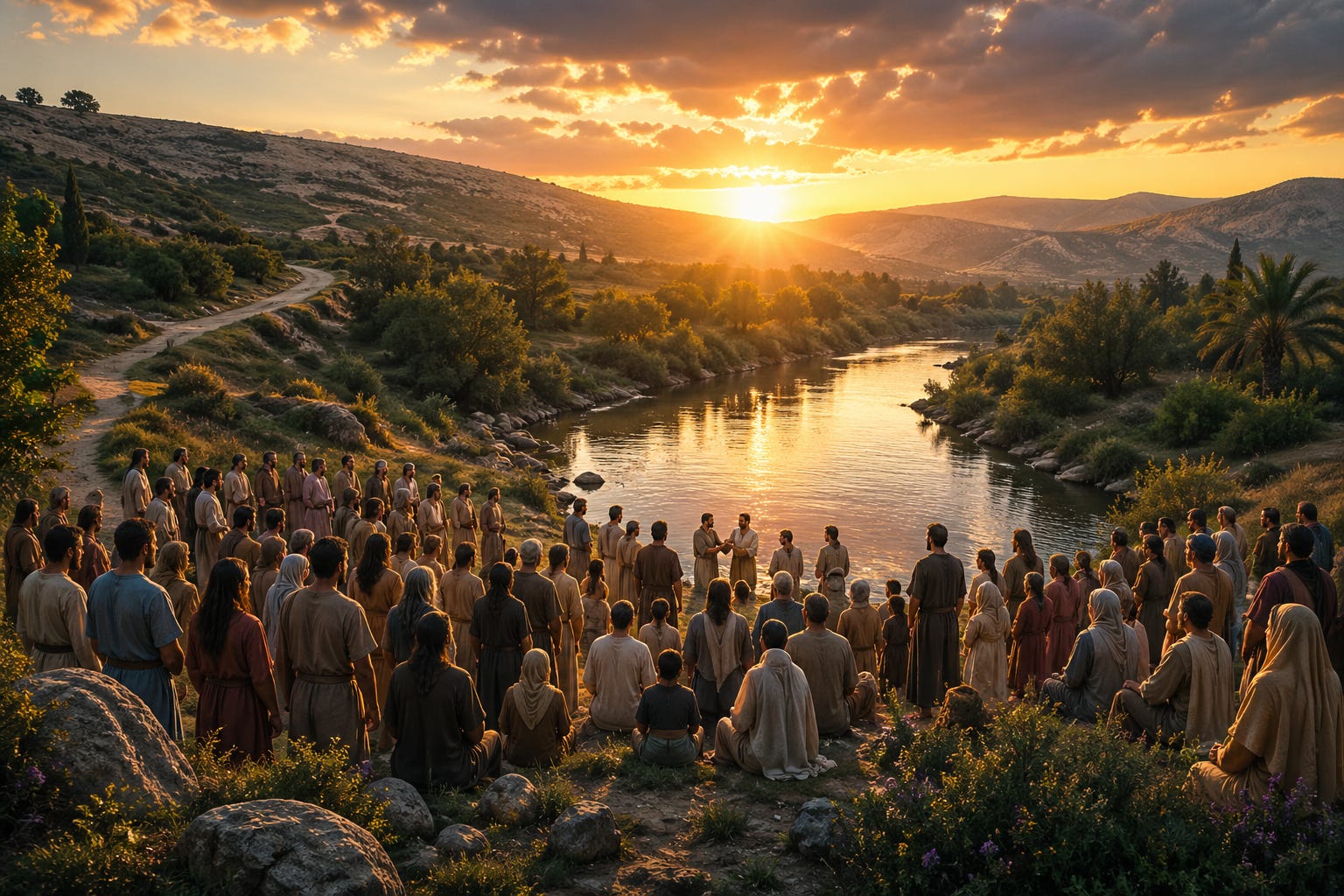
The emphasis in this next passage is on the “oneness” of body, spirit, hope of our calling, Lord, faith, and baptism. This is under one God and Father who is overall and through all and in all. The ChatGPT image shows a group supporting a baptism, but that baptism is a conundrum in this passage, as we will see.
These verses seemed so simple when I first read them again to prepare for writing. I’ll admit it tonight - we had a long day of driving compounded by a mechanical concern for our RV vehicle (this has just been resolved, fairly easily I might add), so I jumped into this expecting a simple evaluation and a short devotional. That’s what happens when you are distracted by the cares and concerns of this world and take your mind off of the Lord! He brings you back to a position of attention!
Let’s do a sampling of commentary to help out on this.
Here is what Charles Spurgeon says, as quoted in Precept Austin:
“If there were two lords, you might be divided into two parties; if there were two faiths, you might split up into two sections; if there were two baptisms, you might be right in having two denominations; if there were two fathers, there might be two families; if there were two indwelling spirits, there would be, and there must be, two sorts of people; but, in the true Church of Jesus Christ, there is “one God and Father of all, who is above all, and through all, and in you all.”
That seems pretty succinct! We need to know that in the true Church of Jesus Christ, there is one God and Father of all.
Ray Stedman says this about the one Spirit, as noted in Precept Austin:
That brings us to the next element, one Spirit. Here is the great, eternal, invisible Person who is the power behind the Christian church. The strength of the church never comes from its numbers. This is the mistaken concept that many Christians have today. They think we only influence society and bear impact upon the world as we can gather together enough Christians and thus swing enough votes to sway our legislatures. That is not where the power of the church lies, and it never has.
The prophet Zechariah was once confronted with a great mountain which God said would become a plain. When Zechariah began to look around to see how this could happen, where the power would come from, what instruments would be provided to level that mountain and make it into a plain, the word of the Lord came to him, saying, "Not by might, nor by power, but by my Spirit, says the Lord of hosts," (Zechariah 4:6b RSV). It is the Spirit that is the true power of the church, and there is only one Spirit. He is the same everywhere no matter where the church exists -- in every place and in every age. That is why the truth remains unchangeable, the passing of time does not change it. That is why the church is not dependent on many or few, or on the wisdom of its membership. It depends on one thing, the one Spirit. (The Cry for Unity - Ephesians 4-1-6)
So important to remember that the Spirit is the true power of the church! he is the same everywhere.
Albert Barnes describes the hope of our calling, quoted in Precept Austin:
Christians have the same hope, and they should therefore be one. They are looking forward to the same heaven; they hope for the same happiness beyond the grave. It is not as on earth among the people of the world, where there is a variety of hopes--where one hopes for pleasure, and another for honour, and another for gain; but there is the prospect of the same inexhaustible joy. This hope is fitted to promote union. There is no rivalry--for there is enough for all. Hope on earth does not always produce union and harmony. Two men hope to obtain the same office; two students hope to obtain the same honour in college; two rivals hope to obtain the same hand in marriage--and the consequence is jealousy, contention, and strife. The reason is, that but one can obtain the object. Not so with the crown of life--with the rewards of heaven. All may obtain that crown; all may share those rewards. How can Christians contend in an angry manner with each other, when the hope of dwelling in the same heaven swells their bosoms and animates their hearts? (Albert Barnes. Barnes NT Commentary)
The crown of life and the rewards of heaven remove any contention between believers; it is the same source of joy for of all of us!

The attributes of one body, one spirit, one faith and one Lord are fairly easy to understand. Where commentary bogs down is in the statement that Paul makes about having “one baptism”. Is this the act of baptism by water or is it baptism by the Spirit? Or both? Here are two commentaries from Martyn Lloyd-Jones and Ray Stedman, as quoted in Precept Austin:
Lloyd-Jones - We must not say that baptism in any shape or form is vital and essential to salvation, and that a man cannot be saved unless he is baptized. This, for the good and sufficient reason that there have undoubtedly been excellent Christians among the Quakers, the early Quakers in particular, and members of the Salvation Army today, and others. Take the case of the thief dying on the cross by the side of our Lord. Surely no-one doubts his salvation, his conversion, his regeneration; yet he was not baptized. There have been others who have come to see the truth on their death-beds and have never been baptized. Baptism is not essential to salvation; so the Apostle cannot have been emphasizing the rite in and of itself...Baptism and the Communion of the Lord’s Supper should be observed; they are the two, and the only two, sacraments which we recognize, because they are the only two which are taught in the Scriptures. But it is more important that we should realize that these are simply outward representations of an inner and unseen spiritual grace. The meaning is the vital element. I am prepared to argue, therefore, that the only conceivable meaning which this term can carry must be in the realm of this spiritual representation which is signified by the outward rite of baptism, whatever form or manner or mode you may choose to employ. It is not the mode of baptism that matters, it is the thing signified that matters. This is so because this interpretation alone is consistent with the principle of unity about which the Apostle is writing, and is concerned to emphasize.... The act of baptism does not achieve anything in and of itself; but it does represent and signify something, and it is this which brings out the element of unity... This is a picture of that which is true of all who are in Christ. Baptism therefore represents and signifies our being put into the realm and into the sphere and into the influence of the Lord Jesus Christ. (Lloyd-Jones, D. M. Exposition of Ephesians in 8 Vol. Baker Book) (Bolding added by Precept Austin)
Ray Stedman writes that regarding one baptism “there is much apparent disunity. The Baptists say, “Ah, this is water baptism, baptism by immersion only.” (The latest sign to appear in Baptist churches now says, “Put a tither in your tank!”) The Presbyterians say, “No, you’re all wet, sprinkling is the only way.” There are other groups that say babies ought to be baptized, while others say, “No, it is only for adults.” There seems to be such disunity on this question of baptism. But the amazing thing is, despite this difference over the symbol (and, after all, water baptism, in whatever form, is recognizably and demonstrably a symbol for something else), there is one baptism everywhere agreed upon by the church. It is the baptism of the Spirit, the real baptism of which water baptism is always a symbol. That baptism is linked here to Jesus Christ because it is baptism into his body. As we read in First Corinthians 12, “For by one Spirit we were all baptized into one body” {1 Cor 12:13}, the body of Christ. Or, as Romans 6 puts it, we were “baptized into his death,” {Ro 6:3}. We have been made one with him, united with him in all the value of his death and his resurrection. Now that is the one baptism of the church and it is everywhere confessed. (Ephesians 4:1-6: Cry For Unity).
I think these two scholars both agree that the real baptism is the baptism of the Spirit, which puts us in the realm and influence of Jesus. The outward symbolism of the rituals we perform are valid, but the inward transformation makes us one with Him.
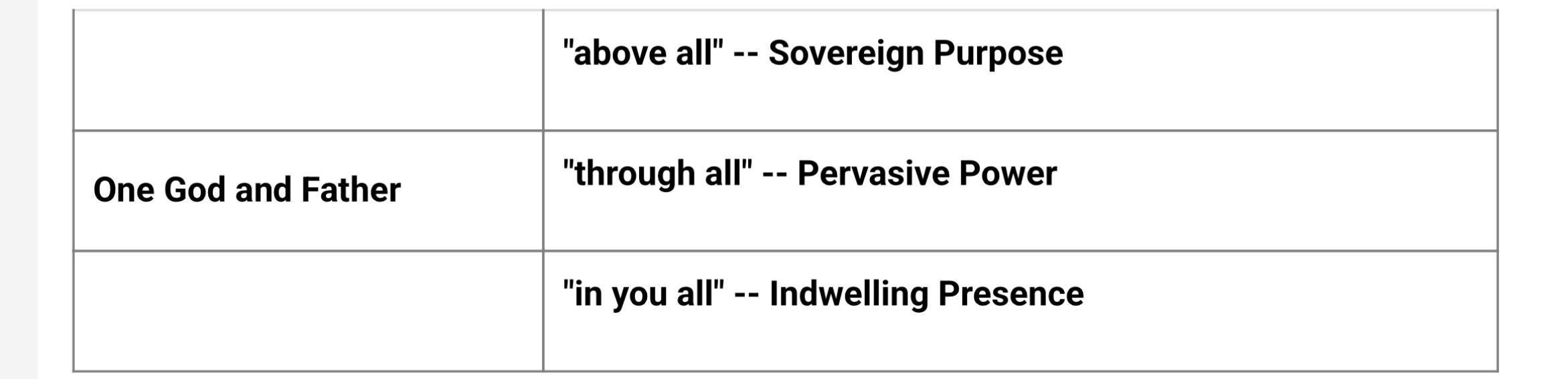
Finally, in this passage, God the Father is over (above) all, through all, and in (you) all. I liked this table from Precept Austin that explains this:
Sometimes the esoteric nature of Scripture is especially challenging, when one is tired and struggling to understand it, so I ask readers to forgive me for the superficial content today. But we can know that what we believe is part of being ONE in the Lord!
My next devotional examines Ephesians 4:7-8 - Grace was given.
Heaven on Wheels Daily Prayer:
Dear Lord - Thank You for your guiding hand today when we had some concerns driving and for helping us to have an easy solution. Thank You for always being there for us as we ponder Your immutable ways! Amen.
Citations and Credits:
Scripture quotations taken from the (NASB®) New American Standard Bible®, Copyright © 1960, 1971, 1977, 1995 by The Lockman Foundation. Used by permission. All rights reserved. www.Lockman.org.
Precept Austin was accessed on 04/30/2026 to review commentary for Ephesians 4:4-6. Within that commentary were links to sermons by Martyn Lloyd-Jones and Ray Stedman; please refer to those links for further information.
Commentary from Enduring Word is used with written permission and without any alteration. ©1996-present The Enduring Word Bible Commentary by David Guzik – enduringword.com. Enduring Word commentary was not used for this devotional.