


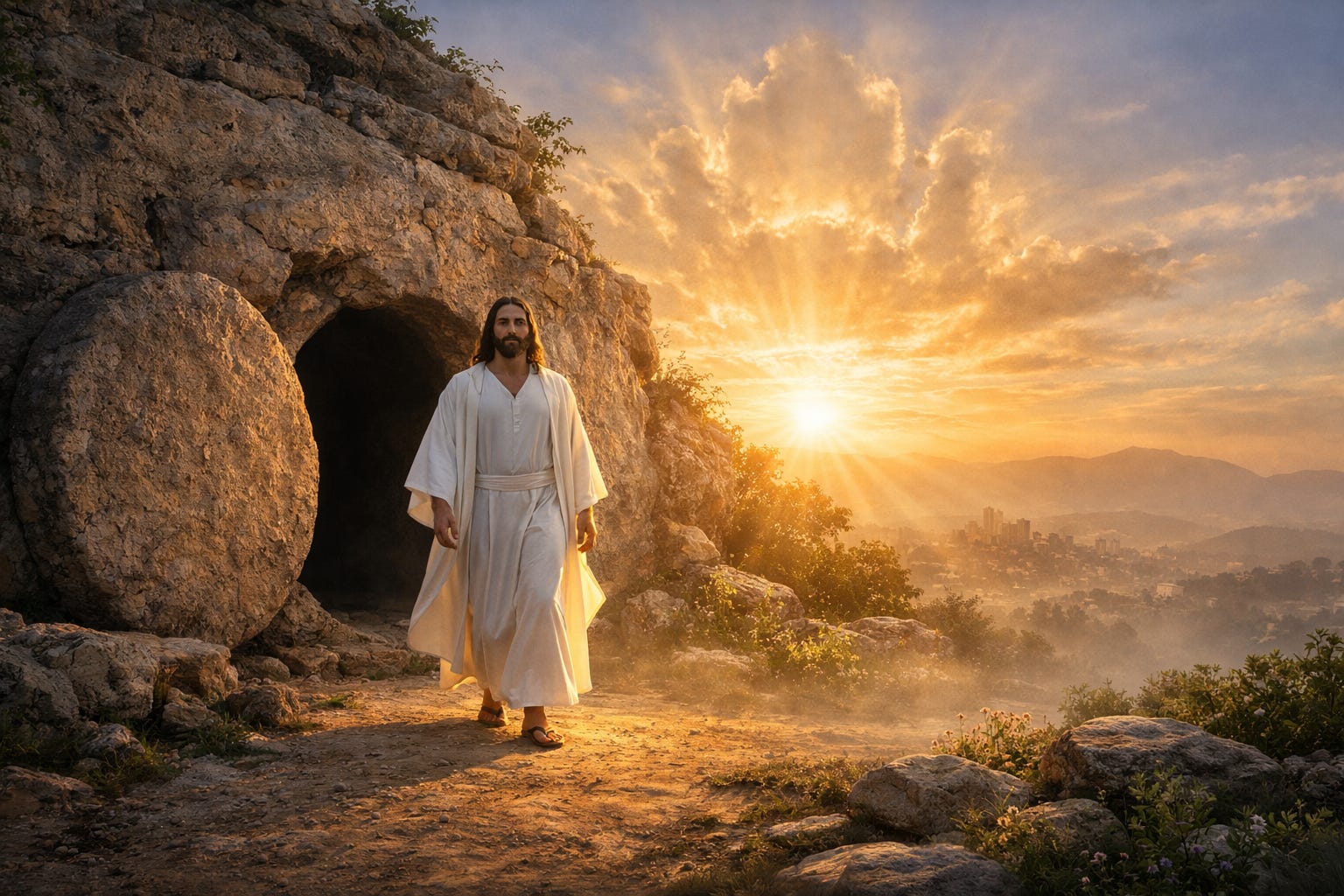
“..which He brought about in Christ, when He raised Him from the dead and seated Him at His right hand in the heavenly places, far above all rule and authority and power and dominion, and every name that is named, not only in this age but also in the one to come. And He put all things in subjection under His feet, and gave Him as head over all things to the church, which is His body, the fullness of Him who fills all in all.”
Ephesians 1:20-23 NASB1995
The strength of God’s might is brought about in Christ, who was raised from the dead and then ascended to be seated at God’s right hand in the heavenly places. Christ is far above all rule and authority and power and dominion and every name that is named, now and in the age to come. The image that Steve had ChatGPT create for us at the top of this post shows our Lord leaving the tomb on Easter morning! The idea of Jesus sitting at the right hand of God was explored in-depth in my study of Hebrews (here’s a link to one of those passages).
Paul explores this idea here in Ephesians and his language sounds very much like what was recorded in Hebrews (not that I’m saying that Paul wrote that, as the jury is still out on the author of Hebrews). Here’s what Enduring Word says about the first part of this passage at the end of Ephesians:
a. According to the working of His mighty power: The power that works in us is the mighty power that raised Jesus from the dead. With this mighty power available to us, there never needs to be a “power shortage” in the Christian life.
i. “If the death of Christ is the supreme demonstration of the love of God… the resurrection of Christ is the supreme demonstration of his power.” (Bruce)
b. And seated Him at His right hand: It is the mighty power that raised Jesus to heaven after His resurrection, raising Him above all demonic foes and every potential enemy of all time – this same power is at work in Christians.
i. “The right hand is the place of friendship, honour, confidence, and authority.” (Clarke)
c. Far above all principality and power and might and dominion: From other passages in Ephesians (Ephesians 3:10 and 6:12) we know that this refers to angelic beings, both loyal and lethal. We don’t completely understand the ranks of the angelic realm, but we do know that Jesus is raised above them. “We know that the king is above all, though we cannot name all the officers of his court. So we know that Christ is above all, though we are not able to name all His subjects.” (Alford)
i. “Think of the paradox. The Apostle is speaking of a Personage of history, of recent, almost contemporary, history… He had worked with His hands, He had walked from place to place like other men, and man could no doubt accurately describe His look and manner when He talked… He is now ‘seated at the right hand of’ Almighty God, on His very throne.” (Moule)
That same incredible power that brought Christ out of the tomb, not like Lazarus who would eventually die again, but as an indestructible being who rules above it all, is available to us as believers! The mystery of how the heavenly realms are organized beneath Him is still not clear, but He reigns above it all!

Jesus is the head of all things for the church. This means the church is the Body of Christ. Here is a great list of ways that we are the Body of Christ in the church, from Gotquestions.org; I added the bold emphasis:
The Church may be called the Body of Christ because of these facts:
1) Members of the Body of Christ are joined to Christ in salvation (Ephesians 4:15-16).
2) Members of the Body of Christ follow Christ as their Head (Ephesians 1:22-23).
3) Members of the Body of Christ are the physical representation of Christ in this world. The Church is the organism through which Christ manifests His life to the world today.
4) Members of the Body of Christ are indwelt by the Holy Spirit of Christ (Romans 8:9).
5) Members of the Body of Christ possess a diversity of gifts suited to particular functions (1 Corinthians 12:4-31). “The body is a unit, though it is made up of many parts; and though all its parts are many, they form one body. So it is with Christ” (verse 12).
6) Members of the Body of Christ share a common bond with all other Christians, regardless of background, race, or ministry. “There should be no division in the body, but . . . its parts should have equal concern for each other” (1 Corinthians 12:25).
7) Members of the Body of Christ are secure in their salvation (John 10:28-30). For a Christian to lose his salvation, God would have to perform an “amputation” on the Body of Christ!
8) Members of the Body of Christ partake of Christ’s death and resurrection (Colossians 2:12).
9) Members of the Body of Christ share Christ’s inheritance (Romans 8:17).
10) Members of the Body of Christ receive the gift of Christ’s righteousness (Romans 5:17).
What more could you ask for? Those are remarkable and eternal gifts!
I also like this commentary from Enduring Word:
a. He put all things under His feet: This great resurrection power placed Jesus above all things. Now all things are under His feet. It set Jesus as the head over all things, including the church.
i. “He says that Christ in his exaltation over the universe is God’s gift to the church.” (Wood)
b. The church, which is His body: If Jesus is the head, then the community of Christians make up His body. The idea of the fullness of Him here is probably connected to the manner in which Jesus fills His church with His presence and blessings.
i. “Yes, this is here given as the final glory of the infinitely exalted Christ. Angels and archangels are subject to Him. But believing men are joined to Him, with a union such that He and they, by this same messenger of His, are called elsewhere (1 Corinthians 12:12) one ‘Christ.’” (Moule)
Believing men and women are joined to Him, whereas the angels are subject to Him. What a privilege for the believer!
My next commentary jumps into Ephesians 2:1-2 - We were dead in our trespasses and sin.
Heaven on Wheels Daily Prayer:
Dear Lord - Today I pray the beautiful words of the hymn “Jesus Shall Reign” written by Isaac Watts (1674 - 1748):
Jesus shall reign where’er the sun
does its successive journeys run,
his kingdom stretch from shore to shore,
till moons shall wax and wane no more.
To him shall endless prayer be made,
and praises throng to crown his head.
His name like sweet perfume shall rise
with every morning sacrifice.
People and realms of every tongue
dwell on his love with sweetest song,
and infant voices shall proclaim
their early blessings on his name.
Blessings abound where’er he reigns:
the prisoners leap to lose their chains,
the weary find eternal rest,
and all who suffer want are blest.
Let every creature rise and bring
the highest honors to our King,
angels descend with songs again,
and earth repeat the loud amen.
Citations and Credits:
Scripture quotations taken from the (NASB®) New American Standard Bible®, Copyright © 1960, 1971, 1977, 1995 by The Lockman Foundation. Used by permission. All rights reserved. www.Lockman.org.
Precept Austin was accessed on 03/31/2025 to review commentary for Ephesians 1:20-23. Within the Precept Austin commentary was a link to Gotquestions.org to answer the question, How is the church the Body of Christ? © COPYRIGHT 2002-2026 GOT QUESTIONS MINISTRIES. ALL RIGHTS RESERVED
Commentary from Enduring Word is used with written permission and without any alteration. ©1996-present The Enduring Word Bible Commentary by David Guzik – enduringword.com. The Enduring Word format has just been updated so I have gone to the Blue Letter Bible commentary to find the references:
Bruce, F. F. “The Epistles to the Colossians, to Philemon, and to the Ephesians” (Grand Rapids, Michigan: Eerdmans, 1984)
Clarke, Adam “Clarke’s Commentary: The Holy Bible Containing the Old and New Testaments with a Commentary and Critical Notes” Volume 6 (Romans-Revelation) (New York: Eaton and Mains, 1832)
Alford, Henry “The Epistles of St. Paul - The Epistle to the Ephesians: The New Testament for English Readers, Volume 2, Part 1” (London: Rivingtons, 1869)
Moule, Handley C.G. “Ephesian Studies” (London: Hodder and Stoughton, 1902)
Wood, A. Skevington “Ephesians: The Expositor’s Bible Commentary” Volume 11 (Ephesians-Philemon) (Grand Rapids, Michigan: Zondervan, 1978)