


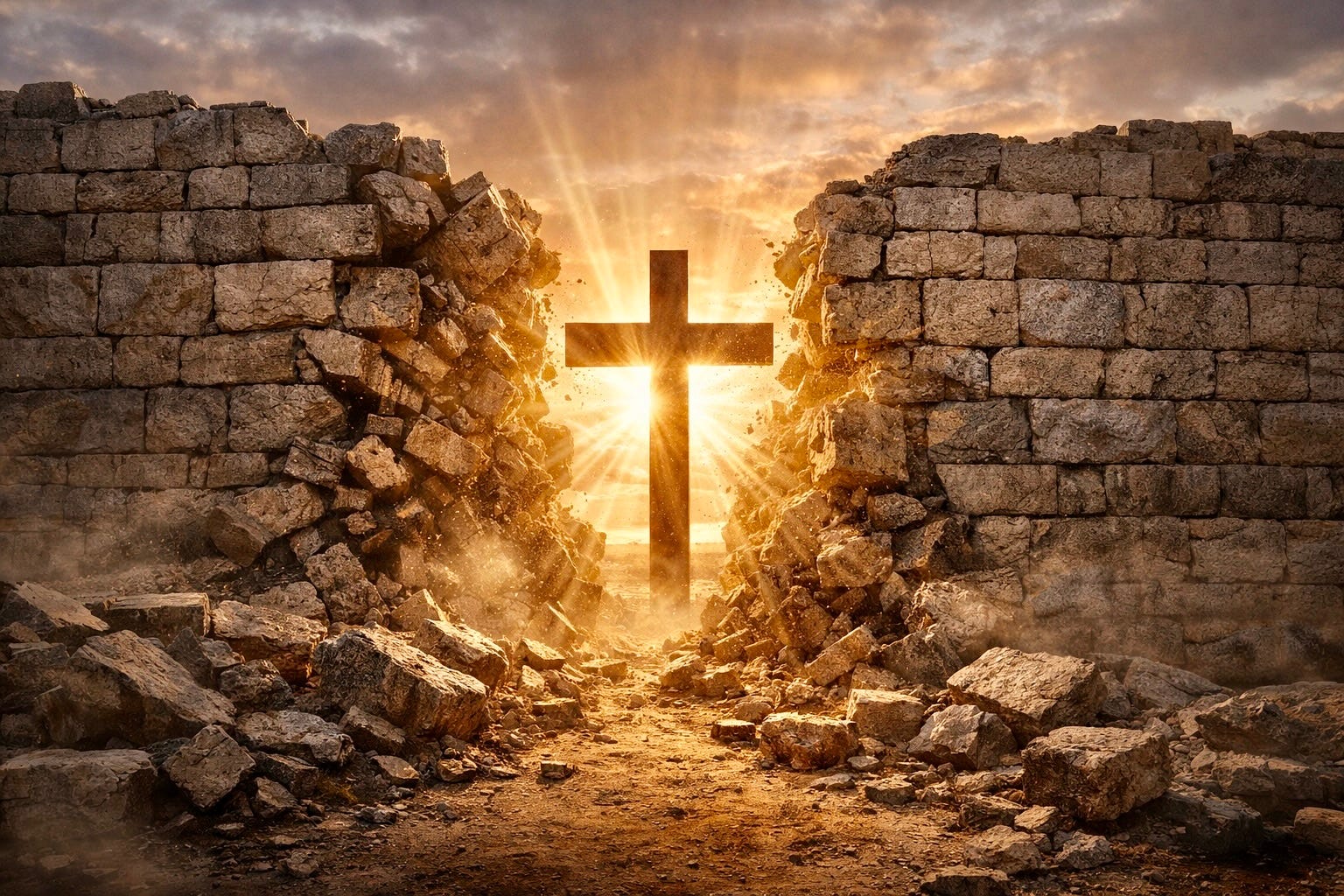
“For He Himself is our peace, who made both groups into one and broke down the barrier of the dividing wall, by abolishing in His flesh the enmity, which is the Law of commandments contained in ordinances, so that in Himself He might make the two into one new man, thus establishing peace, and might reconcile them both in one body to God through the cross, by it having put to death the enmity.”
Ephesians 2:14-16 NASB1995
The dividing wall between believing Gentiles and Jews has been broken down by Jesus. He Himself is our peace! He has made both groups into one by abolishing in His flesh the enmity that stood between them.
A quick aside - This will be one of the weakest and lowest devotionals I’ve written in a long while. The enemy knows how to distract us, that’s for sure. We are on an RV trip and had a LONG drive today, just now settling into a state park for one night. It’s a beautiful place and we snarfed down a couple of sandwiches for dinner catching glimpses of a lake that is right by our campsite; we are also distracted by the imminent return of the Artemis II crew from their amazing lunar fly-by mission. I’ll do what I can with a tired mind and will pray for forgiveness as I also pray for the safe return of this crew.
I will defer to David Guzik and his commentary on this passage as a way to try and untangle Paul’s challenging words:
a. For He Himself is our peace: Jesus Himself is our peace; He hasn’t simply made peace between God and man and Jew and Gentile; He is our peace.
b. Who has made both one, and has broken down the middle wall of separation: The work of Jesus on the cross is the common ground of salvation for both Jew and Gentile. Therefore, there is no longer any dividing wall between Jew and Gentile. Jesus broke that wall down.
i. In the temple, in between the court of the Gentiles and the court of the women, there was a physical barrier, an actual wall of separation between Jew and Gentile.
ii. Paul was, at the time of this writing, under house arrest in Rome, awaiting trial because he was falsely accused by the Jews of taking a Gentile into the temple past the literal wall of separation dividing Jew and Gentile. Paul made it clear that in Jesus, the wall is gone.
iii. The wall of separation is gone because the common Lordship is greater than any previous division. If the Lordship of Jesus Christ is not greater than any difference you have with others – be it political, racial, economic, language, geography or whatever, then you have not fully understood what it means to be under the Lordship of Jesus.
c. Having abolished in His flesh the enmity, that is, the law of commandments contained in ordinances: The source of contention between Jew and Gentile was the fact that the Gentiles did not keep the law. But since Jesus fulfilled the law on our behalf, and since He bore the penalty for our failure to keep the law, we are reconciled through His work on the cross – putting to death the source of contention.
i. “The enmity of which the apostle speaks was reciprocal among the Jews and Gentiles. The former detested the Gentiles, and could hardly allow them the denomination of men; the latter had the Jews in the most sovereign contempt, because of the peculiarity of their religious rites and ceremonies, which were different from those of all the other nations of the earth.” (Clarke)
ii. “And the separation was intensified and emphasized by those institutions which were, in part, designed to isolate Israel from the world, until the fit time for the wider blessing. And He ‘annulled’ them by fulfilling them, in His sacrificial work; thus at once reconciling man to God and man to man.” (Moule)
iii. The law as a source of righteousness is no longer an issue. That source of enmity between Jew and Gentile is dead.
d. That He might reconcile them both to God in one body through the cross: Gentiles and Jews are brought together into one body, the Church, where our unity in Jesus is far greater than our previous differences.
i. So as to create in Himself one new man from the two: Early Christians called themselves a “third race” or a “new race.” Early Christians recognized that they were not Jews, not Gentiles, but one new man embracing all who are in Jesus.
ii. “As Chrysostom explained, it is not that Christ has brought one up to the level of the other, but that he has produced a greater: ‘as if one should melt down one statue of silver and another of lead, and the two together should come out gold.’ ” (Wood)
e. Through the cross: We see the emphasis Paul places on the work of Jesus on the cross. He repeats the idea several times: made near by the blood… having abolished in His flesh the enmity… in one body through the cross. This unity didn’t just happen, it was the hard-fought accomplishment of Jesus.
i. This means that Jesus’ prayer in John 17 (that they all may be one) wasn’t “just” a prayer. It was a prayer Jesus prayed knowing that His work of the cross would accomplish the answer, and a prayer He was willing to pray knowing that His agony would be used to answer.
ii. This bringing together of Jew and Gentile in Jesus is a partial fulfillment of God’s eternal purpose as stated in Ephesians 1:10: that… He might gather together in one all things in Christ. God uses the bringing together Jew and Gentile into the Church as a preview of His ultimate work of summing up all things into Jesus Christ. Since He can do this, He can also do that.
A few takeaways:
The physical barriers are removed between believing Jews and Gentiles.
They are now one new man created from two who lived in separation and enmity.
The law as a source of righteousness is no longer an issue.
The whole question of God’s plan for the Jews and the Gentile believers is a topic for another time (the theory of dispensationalism, my preferred viewpoint, versus replacement theology). I believe that God is not done with the people that He chose and established His first covenants with; He keeps His promises.
Here’s one more gem from the late John MacArthur, quoted in Precept Austin, on the ceremonial laws as the underlying reason for separation of Jews and Gentiles:
"The greatest barrier between Jew and Gentile was the ceremonial law, the Law of commandments contained in ordinances. The feasts, sacrifices, offerings, laws of cleanliness and purification, and all other such distinctive outward commandments for the unique separation of Israel from the nations were abolished. That God’s moral law was not abolished is clear from the phrase contained in ceremonies. His moral law reflects His own holy nature and therefore can never change (cf. Matt. 5:17, 18, 19)… All the ceremonial laws which distinguished and separated Jews from Gentiles were obliterated. Before Christ those groups could not eat together because of restricted foods, required washings, and ceremonial contamination. Now they could eat anything with anyone. Before Christ they could not worship together. A Gentile could not fully worship in the Jewish Temple, and a Jew would not worship in a pagan temple. In Christ they now worshiped together and needed no temple or other sacred place to sanctify it. All ceremonial distinctions and requirements were removed (cf. Acts 10:9-16; 11:17, 18; Col. 2:16, 17), (See Ephesians MacArthur New Testament Commentary)
Oh, and as I wrote this, the crew of Artemis II (Integrity) splashed down successfully after their 10-day mission. Thank you, Lord, for keeping us safe on the roads today and for keeping the crew safe and returning them to their families.
My next devotional examines Ephesians 2: 17-18 - He brings peace from near and far.
Heaven on Wheels Daily Prayer:
Dear Lord - First, please forgive me for being distracted. Second, thank you for your wonderful blessings! Third, thank you for reconciling Your believers. Amen.
Citations and Credits:
Scripture quotations taken from the (NASB®) New American Standard Bible®, Copyright © 1960, 1971, 1977, 1995 by The Lockman Foundation. Used by permission. All rights reserved. www.Lockman.org.
Precept Austin was accessed on 04/10/26 to review commentary for Ephesians 2:14-16.
Commentary from Enduring Word is used with written permission and without any alteration. ©1996-present The Enduring Word Bible Commentary by David Guzik – enduringword.com. Within Enduring Word commentary:
Clarke, Adam The New Testament with A Commentary and Critical Notes, Volume II (New York: Eaton & Mains, 1831)
Moule, Handley C. G. Ephesian Studies (London: Pickering and Inglis, ?)
Wood, A. Skevington Ephesians, The Expositor’s Bible Commentary, Volume 11 (Grand Rapids, Michigan: Zondervan, 1978)