


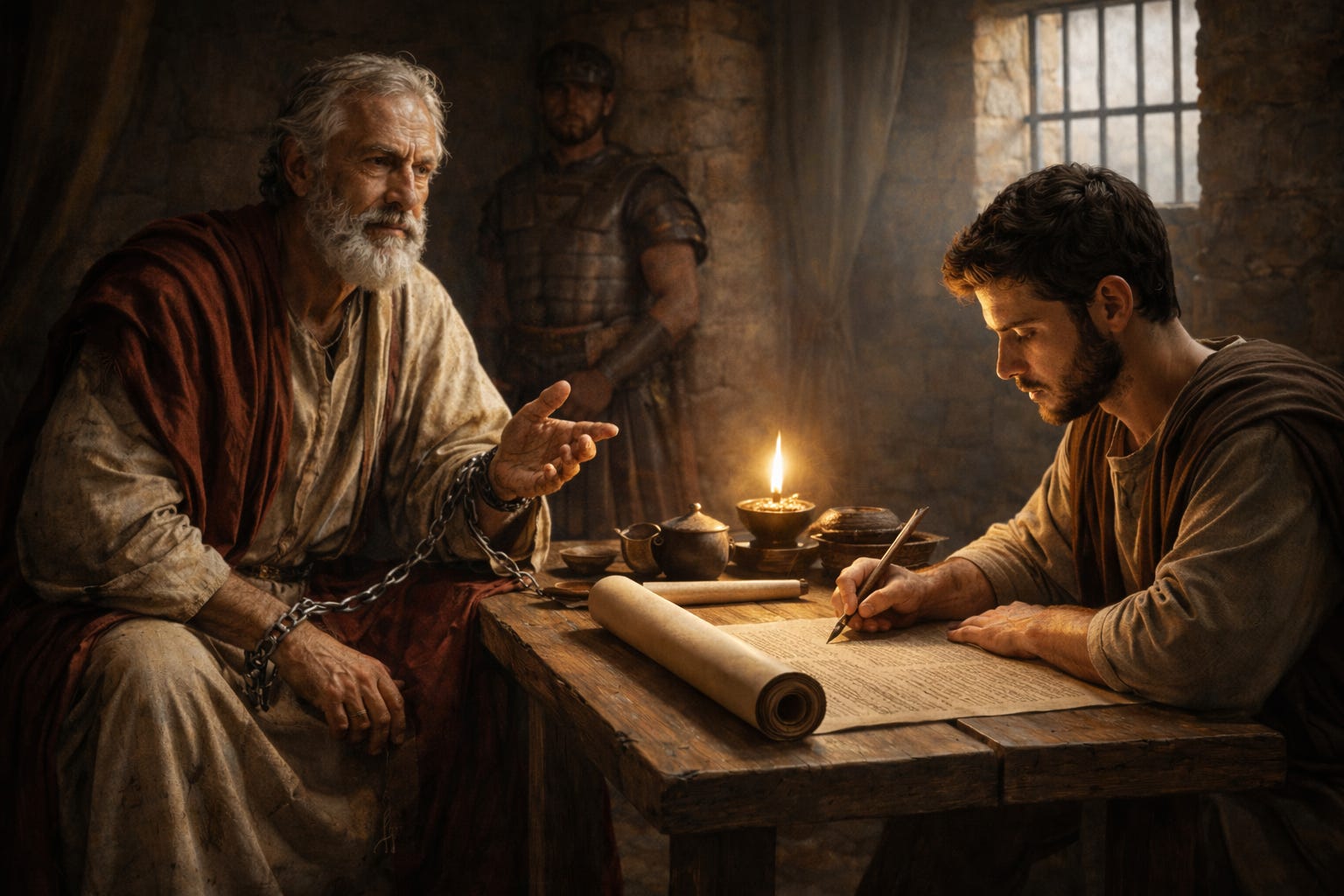
“Paul, an apostle of Christ Jesus by the will of God, To the saints who are at Ephesus and who are faithful in Christ Jesus: Grace to you and peace from God our Father and the Lord Jesus Christ.”
Ephesians 1:1-2 NASB1995
Paul begins his letter to the Ephesians with a fairly simple greeting, much simpler than his greetings in other epistles; perhaps this simplicity was due to the fact that he spent over three years in Ephesus and knows them well.
He identifies himself as an apostle of Christ Jesus. We know from the history of Paul (search for my previous devotionals on Acts, Galatians, and Philippians) that he had a dramatic supernatural and personal encounter with Jesus on the road to Damascus, as documented in Acts 9. His zealous intent before this encounter was the persecution of Christians; this turned 180 degrees in an few moments and his zealous intent after his encounter was to spread the Gospel far and wide, to Jew and Gentile alike. We don’t know if Paul witnessed the crucifixion of Christ, but he was an apostle in every way, the same as the original twelve disciples because of his dramatic conversion and encounter and through the will of God.
He continues his greeting to the saints at Ephesus who are faithful in Christ Jesus. If you are faithful to the Lord, you are a saint! It’s not a special category reserved for only a few who are selected by a human committee, but is a name for any believer in the saving grace of Jesus. I discussed this previously in my devotional series on the Epistle to the Philippians.
Paul sends his blessing to the saints for grace and peace from God the Father and our Lord Jesus Christ. Do you, as a believer, find yourself worthy of this blessing? Dr. Martyn Lloyd-Jones, a Welsh Evangelical Preacher who lived from 1899-1981) wrote eight books on Ephesians, including one book for Ephesians 1 alone. These two excerpts from his study of Ephesians were found in Precept Austin and tell us what it means to be worthy of this greeting:
Much of the trouble in the church today is due to the fact that we are so subjective, so interested in ourselves, so egocentric... Having forgotten God, and having become so interested in ourselves, we become miserable and wretched, and spend our time in ‘shallows and in miseries.’ The message of the Bible from beginning to end is designed to bring us back to God, to humble us before God, and to enable us to see our true relationship to him... And that is the great theme of this epistle.....Luther says of the Epistle to the Romans that it is ‘the most important document in the New Testament, the gospel in its purest expression’, and in many ways I agree that there is no purer, plainer statement of the gospel than in the Epistle to the Romans. Accepting that as true I would venture to add that if the Epistle to the Romans is the purest expression of the gospel, the Epistle to the Ephesians is the sublimest and the most majestic expression of it.
Here the standpoint is a wider one, a larger one. There are statements and passages in this Epistle which really baffle description. The great Apostle piles epithet upon epithet, adjective upon adjective, and still he cannot express himself adequately. There are passages in this first chapter, and others in the third chapter, especially towards its end, where the Apostle is carried out above and beyond himself, and loses and abandons himself in a great outburst of worship and praise and thanksgiving. I repeat, therefore, that there is nothing more sublime in the whole range of Scripture than this Epistle to the Ephesians.....God, the eternal and everlasting God, self-sufficient in Himself, from eternity to eternity, needing the aid of no-one, living, dwelling in His own everlasting, absolute and eternal glory, is the great theme of this Epistle.
We must not start by examining ourselves and our needs microscopically; we must start with God, and forget ourselves. In this Epistle we are taken as it were by the hand by the Apostle and are told that we are going to be given a view of the glory and the majesty of God. As we approach this study I seem to hear the voice that came of old to Moses from the burning bush saying, ‘Take off thy shoes from off thy feet for the ground whereon thou standest is holy ground.’ We are in the presence of God and His glory; so we must tread carefully and humbly (Exposition of Ephesians 1:1).
…
We find ourselves confronted here, then, by what the New Testament teaches is the basic irreducible minimum of what constitutes a Christian. I am emphasizing this because it seems to me that it is the primary need of the Christian Church at the present time to realize exactly what it means to be a Christian. How was it that the early Christians, who were but a handful of people, had such a profound impact on the pagan world in which they lived? It was because they were what they were. It was not their organization, it was the quality of their life, it was the power they possessed because they were truly Christian. That is how Christianity conquered the ancient world, and I am more and more convinced that it is the only way in which Christianity can truly influence the modern world.
The lack of influence of the Christian Church in the world at large today is in my opinion due to one thing only, namely, (God forgive us!) that we are so unlike the description of the Christians that we find in the New Testament....The first thing to say of the Christian is that he is a saint. I fear that may sound rather strange to some of us. We tend to say, ‘Well, I am a Christian, but I am far from being a saint.’ We are afraid of making such a claim; somehow we are afraid of this particular designation; and yet in the New Testament we are addressed as ‘saints.’ The first thing it means is that we are people who are set apart. Primarily it means separated, set apart. A good illustration of this meaning is found in the nineteenth chapter of the Acts of the Apostles where we read that when certain difficulties and oppositions arose the Apostle separated the disciples and then began to meet with them in the school of Tyrannus (Acts 19:9+) and then taught and built them up in the faith; he separated them. That is the essential meaning of this word ‘saint’, and the Church is a collection of saints.
The Church is not an institution, she is primarily a gathering, a meeting of saints....So the Christian is a man primarily who is segregated from the world.....The Christian today, like the children of Israel of old, while he is in the world is not of the world (cf Jn 17:14-18); he is a man like other men, and yet he is very different. This is primary, basic truth. The Christian is not like anybody else, he is separate, he is apart, he is unique. He stands out, he has been called out by God, he has been separated from the world, separated to God. Is this obvious about us Christians today? (Sermon Ephesians 1:1 Saints ... and Faithful in Christ Jesus).
Let’s unpack this excellent commentary. Here are few key takeaways:
We have forgotten God because of our interests in ourselves.
The message of the entire Bible is to bring us humbly back to God.
Dr. Lloyd-Jones believes that Ephesians is the most majestic expression of the Gospel message.
We don’t start by examining our own needs, we start with God and forget ourselves.
What constitutes a Christian? In the time of Paul, it was their quality of life and the power they possessed. They were faithful. Their neighbors could not help but notice that they were different.
Christians, as saints, are set apart. We are unique, we stand out, we are called out by God. We are not of the world!
It’s amazing how much can be gleaned from two introductory verses!
My next devotional examines Ephesians 1:3-4 - Blessed be God, the Father.
Heaven on Wheels Daily Prayer:
Dear Lord - Please guide my hands and heart as I begin this journey through Ephesians. Please also help my vision to see Your words as clearly as possible. Amen.
Credits and Citations:
Scripture quotations taken from the (NASB®) New American Standard Bible®, Copyright © 1960, 1971, 1977, 1995 by The Lockman Foundation. Used by permission. All rights reserved. www.Lockman.org.
Precept Austin was accessed on 03/15/2026 to review commentary for Ephesians 1:1-2. Within the Precept Austin commentary, here is the information for the Martyn Lloyd-Jones Trust, the repository of his sermons:
https://www.mljtrust.org/sermons/book-of-ephesians/saints-and-faithful-in-christ-jesus/
Copyright © 2026 MLJ Trust.
Thank you, Saint Barb for your message
Pleasure reading it looking out over the ocean❤️🙏
I think the early Christians were more specific about what the "quality" of their life was. I think, for them, it was that they loved their enemies and were willing to die rather than recant their faith in Jesus.
I looked up every verse in the Bible (that's how I study) once for the word "Mystery" in chapter 3. The result was dynamic in its simplicity.