



“Be kind to one another, tender-hearted, forgiving each other, just as God in Christ also has forgiven you.”
Ephesians 4:32 NASB1995
Our two men in the previous devotional image who were full of wrath and bitterness are now reconciled in the AI image above. Ephesians 4 ends with a verse describing how believers should behave, after Paul spend several verses telling them how they should NOT behave.
Let’s do some word studies from the Blue Letter Bible lexicon to aid in understanding Paul’s intent:
Kind comes from the Greek adjective χρηστός or chrēstós (Strong’s G5543), with the following Biblical usages:
fit, fit for use, useful
virtuous, good
manageable
mild, pleasant (as opp. to harsh, hard sharp, bitter)
of things: more pleasant, of people, kind, benevolent
Fascinating! This word, used in this context for kind, means fit for use or useful or even mild and pleasant. William Barclay (Church of Scotland minister, 1907-1978) is quoted in Precept Austin with a decent explanation of this word versus another Greek word for good that can be used in a similar context:
Barclay writes that chrestos was defined by the Greeks...
as the disposition of mind which thinks as much of its neighbour’s affairs as it does of its own. Kindness has learned the secret of looking outwards all the time, and not inwards. He tells us to forgive others as God forgave us. So, in one sentence, Paul lays down the law of personal relationships—that we should treat others as Jesus Christ has treated us. (Daily Study Bible)
There are two words for good in Greek; there is agathos and there is chrestos. The difference between them is this. The goodness of a man who is agathos may well issue in rebuke and discipline and punishment; but the goodness of a man who is chrestos is always essentially kind. Jesus was agathos when he drove the moneychangers and the sellers of doves from the Temple in the white heat of his anger. He was chrestos when he treated with loving gentleness the sinning woman who anointed his feet and the woman taken in adultery. (Daily Study Bible)
Christ’s yoke is called chrestos (Mt 11:30), that is, it does not chafe. The whole idea of the word (chrestos) is a goodness which is kind. (Commentary)
He says, “My yoke is easy.” The word “easy” is in Greek chrestos which can mean well-fitting. In Palestine ox-yokes were made of wood; the ox was brought, and the measurements were taken. The yoke was then roughed out, and the ox wigs brought back to have the yoke tried on. The yoke was carefully adjusted, so that it would fit well, and not gall the neck of the patient beast. The yoke was tailor-made to fit the ox. (Daily Study Bible)
Precept Austin also has a good example of this type of kindness; the source for this story is unknown, but President Lincoln was known for his kindness and I can believe this anecdote. Later, I will excerpt another letter of his when discussing being tender-hearted:
Kindness of a Great President - Despite his busy schedule during the Civil War, Abraham Lincoln often visited the hospitals to cheer the wounded. On one occasion he saw a young fellow who was near death. “Is there anything I can do for you?” asked the compassionate President. “Please write a letter to my mother,” came the reply. Unrecognized by the soldier, the Chief Executive sat down and wrote as the youth told him what to say. The letter read, “My Dearest Mother, I was badly hurt while doing my duty, and I won’t recover. Don’t sorrow too much for me. May God bless you and Father. Kiss Mary and John for me.” The young man was too weak to go on, so Lincoln signed the letter for him and then added this postscript: “Written for your son by Abraham Lincoln.” Asking to see the note, the soldier was astonished to discover who had shown him such kindness. “Are you really our President?” he asked. “Yes,” was the quiet answer. “Now, is there anything else I can do?” The lad feebly replied, “Will you please hold my hand? I think it would help to see me through to the end.” The tall, gaunt man granted his request, offering warm words of encouragement until death stole in with the dawn.

Tender-hearted comes from the Greek adjective εὔσπλαγχνος or eúsplanchnos (Strong’s G2155) with the following Biblical usages:
having strong bowels
compassionate, tender hearted
Having strong bowels??? What in the wide, wide world of sports does this mean (to paraphrase a favorite saying that I don’t get to use very often when writing a devotional)? Well, here is a great explanation of that meaning, again from Precept Austin:
The root word splagchnon was used by the Greeks to refer to the upper abdominal viscera, the heart, lungs, liver and upper bowels, which the ancients regarded as the seat of affections and emotions, such as anger and love. The phrase "I feel it in the pit of my stomach" is a modern parallel. And we all know how that feels! So splagchnon refers to that deep, internal caring comparable to the modern expressions of deep feeling such as “broken-hearted” or “gut-wrenching”. Splagchnon is the strongest Greek word for expressing compassionate love or tender mercy and involves one’s entire being. It describes the compassion which moves a man to the deepest depths of his being [Barb’s emphasis]. In the gospels, apart from its use in some of the parables, it is used only of Jesus.
The second letter I was referring to from President Lincoln is known as the Bixby letter. There are some controversies surrounding this letter concerning authorship and the circumstances of Mrs. Bixby and her familial losses (it is likely only two sons actually died), but most scholars agree that the letter is from President Lincoln because of the similarities in language to other writings of his. It is an appropriate letter to share today, as this devotional is being published on Memorial Day, a day that every American should feel tender-hearted to the depths of their soul towards those who gave their all for our freedom. It doesn’t matter if you suffered a loss personally in the wars that we have fought in this nation; it DOES matter that you understand about the ultimate sacrifice that thousands and thousands of service members have made.
Executive Mansion,
Washington, Nov. 21, 1864.Dear Madam,
I have been shown in the files of the War Department a statement of the Adjutant General of Massachusetts, that you are the mother of five sons who have died gloriously on the field of battle.
I feel how weak and fruitless must be any words of mine which should attempt to beguile you from the grief of a loss so overwhelming. But I cannot refrain from tendering to you the consolation that may be found in the thanks of the Republic they died to save.
I pray that our Heavenly Father may assuage the anguish of your bereavement, and leave you only the cherished memory of the loved and lost, and the solemn pride that must be yours, to have laid so costly a sacrifice upon the altar of Freedom.
Yours, very sincerely and respectfully,
A. LINCOLN.Mrs. Bixby.
This letter was used to great effect in “Saving Private Ryan” to justify the mission to save Private Ryan after three of his brothers are killed in action.

I have to share this story from our trip that we took last September with the National World War II Museum that followed the “Band of Brothers” (Easy Company) from the 101st Airborne/506h Regiment from England to the Eagle’s Nest. This trip was one of the most incredible experiences of my life. We visited three of the many overseas cemeteries that are administered by the American Battle Monuments Commission (one in Normandy, France; one in the Netherlands; one in Luxembourg). We had ceremonies as a group to honor the dead in those American cemeteries. particularly some of those soldiers who died as members of Easy Company. We also stopped and viewed a German cemetery in Belgium.
On the last night of the trip at our farewell dinner, we happened to sit with an another couple, probably about ten years older than us, who had been on the trip (but on the other bus). The first thing the man said to us as we talked about the tour was “Why in the world did we have to go to all of those cemeteries?” His wife agreed with him. I was so stunned I couldn’t reply at first, but I said that the cemetery visits were among the most moving and important features of our tour. He shrugged and said that he thought it was boring and a waste of time. We wondered why they were on the tour to begin with (a tour focused exclusively on WWII and very costly). We had an awkward dinner; we quickly ate and bid them farewell and told them to have a safe journey home (we didn’t argue with them or pursue the matter further). Fortunately, I know that the excellent tour directors from the National WWII Museum would never think of changing the itineraries, even if they received a formal complaint about “too many cemeteries”.
I was moved to deep compassion within my splagchnon (and shed many tears) by seeing so many grave markers on that trip (almost 20,000 in the three cemeteries, plus huge walls with names of the missing) and by the solemn ceremonies. These were mostly young men (just teenagers in many cases) who died in action, sometimes in horrible ways. Some of the grave markers we saw were for unknown soldiers (the remains could not be identified). I had to find it within my heart to forgive that couple for their hard-heartedness and indifference; indifference can be another very terrible sin, by the way. Not everyone can be tender-hearted, but believing in Jesus certainly helps! In retrospect, I think we might have missed a witness opportunity with them.

Forgiving comes from the Greek verb χαρίζομαι or charízomai (Strong’s G5483), with the following Biblical usages:
to do something pleasant or agreeable (to one), to do a favour to, gratify
to show one’s self gracious, kind, benevolent
to grant forgiveness, to pardon
to give graciously, give freely, bestow
to forgive
graciously to restore one to another
to preserve for one a person in peril
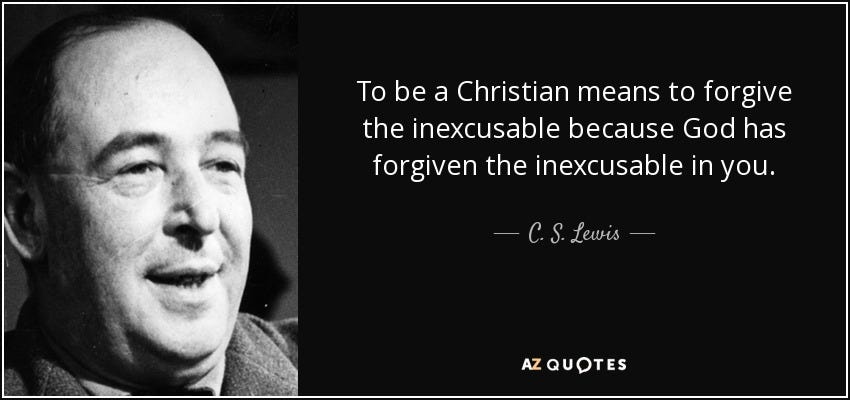
The build-up of bitterness and anger and slander and malice (and hard-heartedness) in the human heart can be attributed to the inability to forgive another person for what they have done. C.S. Lewis had this famous quote about forgiveness:
Forgiving others, being kind and being tender-hearted all come from our attitude (and promptings of the Holy Spirit) in our lives. Chuck Swindoll is quoted in Precept Austin about our attitude:
The longer I live, the more I realize the impact of attitude on life. Attitude to me is more important than facts, it’s more important that the past, it’s more important than education, it’s more important than money, circumstances, failures, successes. It’s more important than what other people think or say or do. It’s more importance than appearance, giftedness, or skill. It will make or break a company, a church, or a home. The remarkable thing is that we have a choice every day regarding the attitude we will embrace. We cannot change our past. We cannot change the fact that people will act in a certain way. We cannot change the inevitable. The only thing we can do is play on the one string that we have, and that is our attitude. I’m convinced that life is ten percent of what happens to me and ninety percent of how I react to it.
And here is a great commentary from Enduring Word on how God forgives us:
h. Just as God in Christ forgave you: Our forgiveness to others is patterned after the forgiveness of Jesus towards us. When we think of the amazing way God forgives us, it is shameful for us to withhold forgiveness from those who have wronged us.
· God holds back His anger a long time until He forgives. He bears with us for a long time though we sorely provoke Him.
· God reaches out to bad people to woo them to Himself, and attempts reconciliation with bad people.
· God always makes the first move in forgiveness, trying to reconcile even though the guilty party is uninterested in forgiveness.
· God forgives our sin knowing that we will sin again, often in exactly the same way.
· God’s forgiveness is so complete and glorious that He grants adoption to those former offenders.
· God, in His forgiveness, bore all of the penalty for the wrong we did against Him. He was innocent yet He bore the guilt.
· God keeps reaching out to man for reconciliation even when man rejects Him again and again.
· God requires no probationary period to receive His forgiveness.
· God’s forgiveness offers complete restoration and honor. He loves, adopts, honors, and associates with those who once wronged Him.
· God puts His trust in us and invites us to work with Him as co-laborers when He forgives us.
i. The older King James Version puts it like this: even as God for Christ’s sake hath forgiven you. This gives us an assurance of forgiveness – that it is for Christ’s sake. “God for Christ’s sake hath forgiven thee. Get hold of that grand truth, and hold it, though all the devils in hell roar at thee. Grasp it as with a hand of steel; grip it as for life: ‘God for Christ’s sake hath forgiven me,’ – may each one of us be able to say that. We shall not feel the divine sweetness and force of the text unless we can make a personal matter of it by the Holy Ghost.” (Spurgeon)
ii. “If anyone here who is a Christian finds a difficulty in forgiveness, I am going to give him three words which will help him wonderfully. I would put them into the good man’s mouth. I gave them to you just now, and prayed you to get the sweetness of them; here they are again! ‘For Christ’s sake.’ Cannot you forgive an offender on that ground?” (Spurgeon)
iii. It isn’t that we must forgive because Jesus will forgive us. We forgive because He has forgiven us. “It is the historical fact of Christ once for all putting away sin by the sacrifice of Himself, which is alluded to.” (Moule)
God certainly did infinitely more for us than we often do for others who have wronged us. When you hear someone say that they can never forgive someone else for what they did, I think it’s worth repeating the story from Corrie Ten Boom to understand how we CAN forgive (I shared this before), as quoted in Precept Austin:
WHEN FORGIVENESS SEEMS IMPOSSIBLE - Corrie ten Boom, author of The Hiding Place, was taken captive and spent time in Nazi concentration camps during World War II. While in prison, Corrie saw incredible abuse, so inhumane that it drove the prisoners to incredible depths, including intentionally allowing lice to breed on their bodies because the more lice they had, the less likely it would be that the guards would molest them! And Corrie even witnessed the death of her own dear sister.
After the war, God sent Corrie ten Boom on a mission of mercy through the war-torn cities to encourage residents to choose forgiveness over bitterness. She would motivate her audiences by sharing some of the atrocities she had experienced, implying that if she could forgive such horrors, so could her listeners. One night speaking, she immediately recognized the man who came walking down the aisle as a particularly cruel guards in one of the concentration camps. The man did not recognize her however. As he approached Corrie he said...
Fraulein, you don’t know me, but I was a guard in one of those camps. After the war, God saved me. I wish I could go back and undo those years. I can’t, but I’ve just been prompted by God to come tonight and ask you, would you please forgive me?
Then he extended his hand to her. Can you imagine the horrible thoughts and memories that raced through Corrie’s mind as she recognized his face and then even worse, heard his incredible plea for forgiveness? How could she? Corrie said her arms froze at her side and she was literally unable to move. The flashbacks in her mind replaying the atrocities, the death of her sister, the abuse. And then God’s Spirit said to her,
Corrie, what have you been telling everyone else to do? As an act of your will, will you choose to forgive?
Corrie went on to explain what happened next...
I reached out my hand, and I put it in his, and I said, ‘You’re forgiven.
She later reported that at that moment...
It was like a dam broke loose—all the bitterness and resentment—and God set me free.
My next devotional examines Ephesians 5:1-2 - Be imitators of God.
Heaven on Wheels Daily Prayer:
Dear Lord - Please help me select my attitude towards others to be kind, tender-hearted and forgiving, as You have forgiven me. Forgive us for not witnessing about Your salvation to the couple from our trip who seemed indifferent to the travails of others. Amen.
Citations and Credits:
Scripture quotations taken from the (NASB®) New American Standard Bible®, Copyright © 1960, 1971, 1977, 1995 by The Lockman Foundation. Used by permission. All rights reserved. www.Lockman.org.
“G5543 - chrēstos - Strong’s Greek Lexicon (NASB95).” Blue Letter Bible. Web. 24 May, 2026. <https://www.blueletterbible.org/lexicon/g5543/nasb95/mgnt/0-1/>.
“G2155 - eusplagchnos - Strong’s Greek Lexicon (NASB95).” Blue Letter Bible. Web. 24 May, 2026. <https://www.blueletterbible.org/lexicon/g2155/nasb95/mgnt/0-1/>.
“G5483 - charizomai - Strong’s Greek Lexicon (NASB95).” Blue Letter Bible. Web. 24 May, 2026. <https://www.blueletterbible.org/lexicon/g5483/nasb95/mgnt/0-1/>.
Precept Austin was accessed on 05/24/2026to review commentary for Ephesians 4:32, Links to the source documents are provided where appropriate.
Commentary from Enduring Word is used with written permission and without any alteration. ©1996-present The Enduring Word Bible Commentary by David Guzik – enduringword.com. Within the Enduring Word commentary:
Moule, Handley C. G. Ephesian Studies (London: Pickering and Inglis, ?)
Spurgeon, Charles Haddon The New Park Street Pulpit, Volumes 1-6 and The Metropolitan Tabernacle Pulpit, Volumes 7-63 (Pasadena, Texas: Pilgrim Publications, 1990)
Very thorough srtudy.